

As an Amazon Associate and eBay Partner, toptenpick.com earns from qualifying purchases. Prices and availability are subject to change.
A Gibson ES-335’s semi-hollow humbuckers land in a genre-crossing sweet spot — warm enough for blues and jazz, punchy enough for classic rock — and the amp matters more than usual, since a semi-hollow’s natural resonance and feedback tendencies react differently to amp voicing than a solid-body would. These are the amps that pair well with it across price points, from bedroom practice to stage volume.
| # | Product | Price | Where to buy |
|---|---|---|---|
| 1 | Fender Deluxe Reverb (reissue) | $1,300-$1,600 | Amazon · eBay |
| 2 | Vox AC30 | $1,400-$1,700 | Amazon · eBay |
| 3 | Vox AC15 | $900-$1,100 | Amazon · eBay |
| 4 | Fender Blues Junior IV | $550-$700 | Amazon · eBay |
| 5 | Fender Princeton Reverb | $1,100-$1,400 | Amazon · eBay |
| 6 | Fender ’65 Twin Reverb (reissue) | $1,600-$1,900 | Amazon · eBay |
| 7 | Orange Rocker 32 | $900-$1,100 | Amazon · eBay |
| 8 | Marshall DSL40CR | $700-$900 | Amazon · eBay |
| 9 | Boss Katana-50 Gen 3 | $250-$330 | Amazon · eBay |
| 10 | Yamaha THR30II Wireless | $400-$500 | Amazon · eBay |
The picks, in detail

Fender Deluxe Reverb (reissue)
Widely cited as one of the best clean/breakup amps for a semi-hollow with PAF-style humbuckers — the archetypal blues/rock combo for a 335.
- 22W tube combo
- Spring reverb and tremolo
- Single 12″ speaker
- Classic warm breakup that suits a 335’s natural resonance
- Extremely well documented pairing across blues and roots-rock players
- Single-channel, so tone shaping is mostly at the guitar and pedal level

Vox AC30
British chime and rich natural overdrive that suits a 335 for rock, indie, and jangle-leaning styles.
- 30W Class A tube combo
- Top Boost circuit
- Twin 12″ speakers
- Chimey top end complements a 335’s brighter neck-pickup voicing
- Natural overdrive at volume without needing a gain pedal
- Loud to reach its best breakup tone — not ideal for apartment volume

Vox AC15
A lower-wattage version of the AC30’s chime, reaching usable breakup at more manageable volume for smaller venues or home use.
- 15W Class A tube combo
- Top Boost circuit
- Single 12″ speaker
- Same British chime as the AC30 at a volume you can actually push at home
- Lighter and more portable than the AC30
- Less headroom before breakup than the AC30 for louder clean playing

Fender Blues Junior IV
A compact tube combo that gives a lot of the Deluxe Reverb’s blues-friendly character at a fraction of the size and price.
- 15W tube combo
- Spring reverb
- Single 12″ speaker
- Fat switch for extra gain
- Genuinely gig-capable despite the small footprint
- Much more affordable entry point into Fender blackface-style tone
- Reverb and tone controls are simpler than the full-size Deluxe Reverb

Fender Princeton Reverb
A smaller blackface-style combo, popular for players who want Fender clean/breakup character at true bedroom-to-small-stage volume.
- 12W tube combo
- Spring reverb and tremolo
- Single 10″ speaker
- Breaks up at a genuinely usable practice/recording volume
- Same blackface tonal family as the Deluxe Reverb, smaller and cheaper
- Less headroom and low-end than the Deluxe Reverb for bigger stages

Fender ’65 Twin Reverb (reissue)
The high-headroom option for a 335 player who wants pristine clean at real stage volume, with reverb and tremolo built in.
- 85W tube combo
- Spring reverb and tremolo
- Dual 12″ speakers
- Massive clean headroom before any breakup — ideal for players who want the amp clean and let the guitar/pedals do the work
- Dual speakers project well in larger rooms
- Loud and heavy — overkill for home practice or small clubs
Orange Rocker 32
A British-voiced alternative to the Fender combos, adding tremolo and a bit more midrange push that suits a 335’s rock and blues-rock side.
- 30W stereo tube combo
- Clean/Dirty channels
- Built-in tremolo
- Different tonal color from the Fender-family amps on this list
- Genuine clean channel plus an easy path into overdrive
- Warmer/darker voicing than a Fender-style amp, which suits some genres better than others

Marshall DSL40CR
The pick if the 335 is being used more for classic-rock crunch than clean blues — a genuine two-channel Marshall for pushing the amp into real gain.
- 40W tube combo
- Two footswitchable channels
- Onboard digital reverb
- Real Marshall crunch/lead channel for rock players who want more gain than the Fender/Vox combos offer
- Two channels cover clean-to-lead without pedals
- Semi-hollow feedback becomes more of a factor at the higher gain this amp is built for

Boss Katana-50 Gen 3
The current generation of Boss’s modelling combo, and the cheapest way to get several of the amp voicings above in one low-maintenance box.
- 50W modelling combo
- Multiple amp voicings
- Built-in effects
- Gen 3 is the current model; the MkII is the previous generation
- Far cheaper than owning several tube amps to cover different voicings
- No tube maintenance, and usable at bedroom volume via built-in power reduction
- Gen 3 adds new voicings and effects over the MkII it replaces
- Does not fully replicate the feel and dynamics of the tube amps it models
- Plenty of discounted MkII stock is still around – check which generation a listing is selling
Yamaha THR30II Wireless
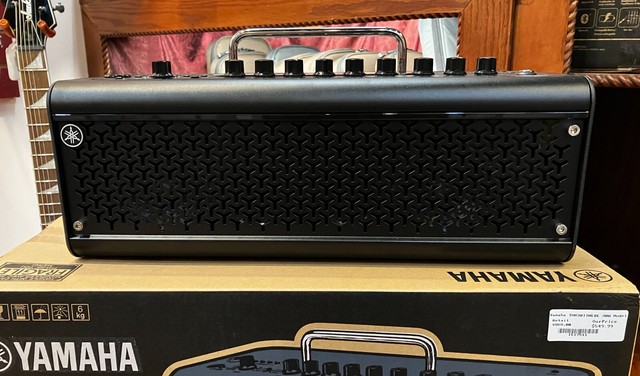
A desktop modeling amp with genuinely good amp models and a wireless guitar receiver built in — the pick for apartment practice or silent recording with a 335.
- Desktop modeling amp
- Built-in wireless guitar receiver
- USB audio interface
- Battery-capable
- Realistic amp modeling at true bedroom/apartment volume
- Doubles as a USB interface for recording directly
- Not a stage amp — strictly a practice/recording tool
Buying tips
- A semi-hollow like the ES-335 feeds back more readily than a solid-body at high gain and volume — amps with cleaner headroom (Twin Reverb, AC30, Deluxe Reverb) are more forgiving than a high-gain Marshall-style channel.
- For home practice, prioritize an amp that sounds good at low volume (Blues Junior, Princeton Reverb, THR30II, Katana) over one built for stage headroom — a 335 rarely needs to be pushed to Twin Reverb volume at home.
- British-voiced amps (Vox, Orange) push more midrange, which suits a 335 for rock and blues-rock; Fender blackface amps stay scooped and cleaner, which suits jazz and traditional blues.
- If budget is tight, a modeling amp (Katana, THR30II) genuinely covers a wider tonal range for less money than any single tube amp on this list — the tradeoff is authenticity of feel, not sound quality.
- Match speaker size to venue expectations: a single 10″-12″ combo (Princeton, Blues Junior, AC15) is fine for small rooms; dual-12″ amps (Twin Reverb, AC30) project further for bigger stages.
As an Amazon Associate and eBay Partner, toptenpick.com earns from qualifying purchases. Prices and availability are subject to change.