

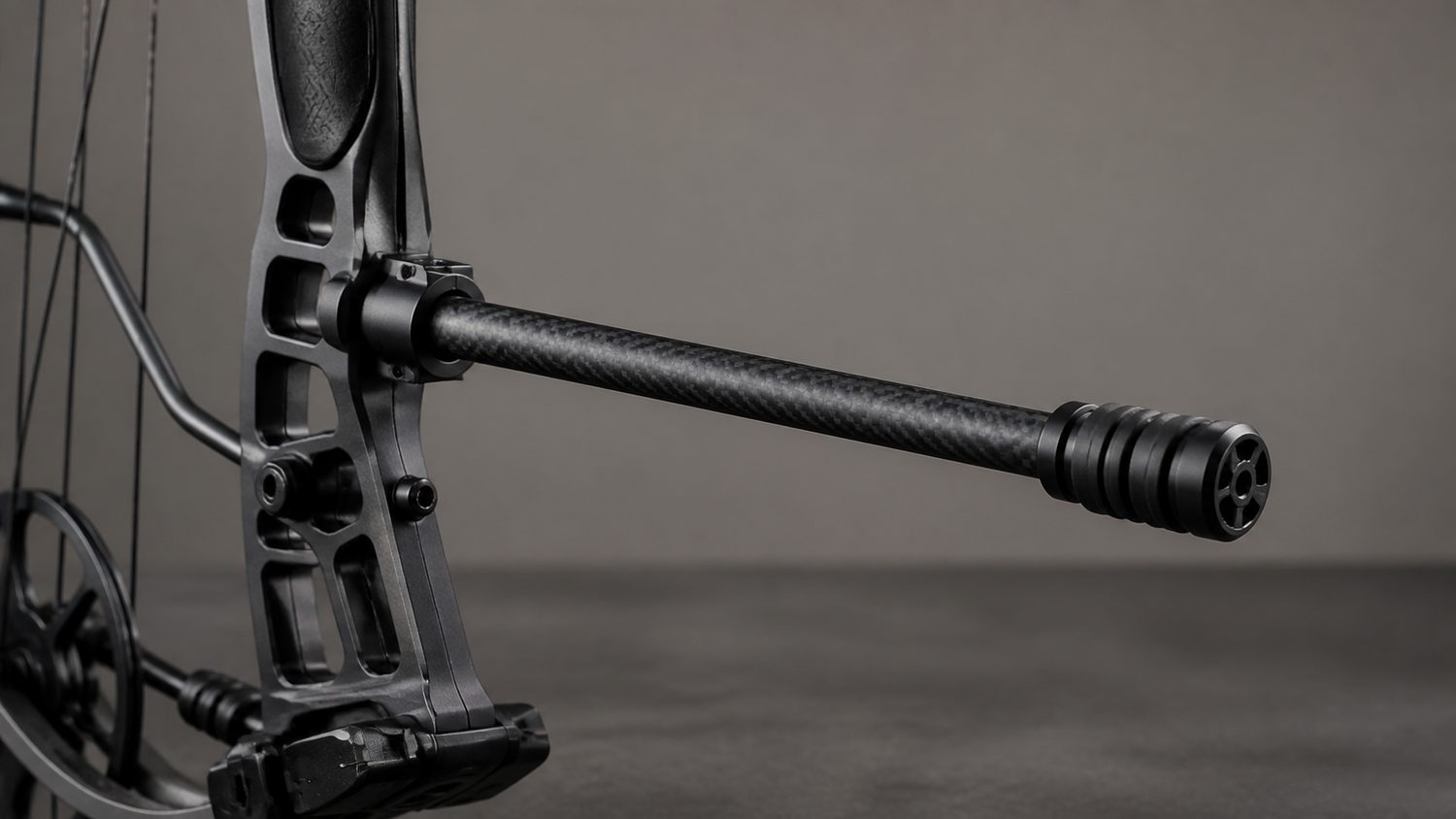
Why a stabilizer needs a fit check
A bow stabilizer is an archery accessory, so this page is informational only: it does not recommend products or provide purchase links. The Mathews Heli-M is a compound bow from an earlier generation, and a stabilizer choice begins with the bow’s actual front mounting point, not with a claim that an accessory is “for Mathews.” The Heli-M’s riser, sight, rest, sling and quiver arrangement all affect clearance. A later riser-integrated system, including a Bridge-Lock design intended for newer bows, is not evidence of compatibility with a Heli-M.
Inspect the front stabilizer bushing on the riser before doing anything else. Many archery stabilizers and quick-disconnect systems use a 5/16–24 thread, but thread size alone does not prove that a specific assembly will clear the bow or that every included screw is suitable. Some accessories add a quick disconnect, offset, V-bar or side rod, changing both the attachment length and the forces applied to the riser. Confirm the exact hardware with the accessory documentation and a qualified archery technician before fitting it.
What balance means on a Heli-M
A stabilizer adds mass forward of the grip to change the bow’s balance and its reaction after a shot. It is not a universal accuracy upgrade, a vibration cure or a substitute for correct draw length, cam timing, arrow spine, rest setup or shooting form. A Heli-M can feel different with a sight, quiver and arrows installed than it does bare. The meaningful comparison is the complete bow in the configuration actually used at the range, not the stabilizer by itself.
Longer, heavier or more offset configurations tend to create more leverage at the front mounting point. That may change how the bow aims and settles, but it can also affect clearance when moving through a doorway, carrying the bow, using a ground blind or fitting it in a case. A configuration that feels acceptable while stationary can snag a sling, rail or vegetation. Keep every movement controlled and ensure the bow is unloaded when evaluating carry clearance.
Mounting hardware and the riser
Do not force a threaded stud into the Heli-M’s stabilizer bushing. Cross-threading can damage the riser interface, and a fastener that bottoms out before the stabilizer is secure can leave the accessory loose. Conversely, overtightening can damage threads or deform a component. Use only the hardware and torque process specified by the manufacturer of the fitted equipment. A shop should resolve any uncertainty about thread pitch, shoulder length, washer stack or whether a quick disconnect needs a flush-mounted barrel nut.
Do not drill the riser, tap a new hole, alter the stabilizer bushing or add a makeshift spacer in an attempt to make parts meet. A bow riser carries significant load and is not a casual modification project. If the assembly requires an adapter, have a technician confirm that it is purpose-built for the two interfaces and that it does not create contact with the cables, limbs, sight or quiver. An adapter can solve one clearance issue while adding another, so inspect the full system rather than the mount alone.
Clearance checks before any shot
With no arrow nocked, examine the bow from the front, side and rear. The stabilizer, any added weights and any side-rod hardware must clear the limbs, cams, string path, cables, cable guard, sight, rest, quiver and sling. Check both the static position and the route the bow takes when it is placed in a case or carried. Do not assume a visible gap is enough if the component can rotate or a quick disconnect can loosen.
A second person or a shop can inspect the bow while it is carefully drawn only under normal range safety conditions. No person should stand in front of the bow or in the line of fire. If any accessory may contact moving components, stop. Never shoot “just to see” whether a stabilizer clears a cable or limb. Contact can damage the bow or create an unpredictable shot. Have the setup corrected and inspected first.
Vibration, noise and loose components
Every added component brings another fastener and another possible source of movement. A stabilizer can change the vibration felt in the hand, but it cannot promise a quieter bow or eliminate all vibration. Rattles can originate in the stabilizer, its weights, the quiver, sight, rest, limb dampers or unrelated hardware. After a new noise, unload the bow and inspect every attached component rather than guessing from the sound alone.
Before each range session, check for cracks, bent studs, loose weights, worn rubber elements, missing retaining screws, corrosion and movement at the riser connection. Follow the maker’s stated service procedure for any removable weights. Do not combine hardware from unrelated systems simply because the diameter looks similar. If a part has been dropped, struck against a hard surface or involved in a dry fire, it should be evaluated by a qualified bow technician before normal use resumes.
Setup changes and tuning
Changing forward mass can alter the way a shooter holds and executes a shot. It does not change the bow’s basic draw setting, but a different complete setup may justify a professional check of sight alignment, rest position and arrow flight. Make one approved change at a time, record it, and test only on a safe range with an appropriate backstop. Avoid adjusting sight, rest and stabilizer variables all at once because it becomes impossible to identify the reason for a change in impact.
Use the same arrow configuration, quiver load and sling arrangement when assessing a change. A bow that is balanced with no quiver may behave differently with several arrows on the side of the riser. Do not claim a setup is “neutral” or “vibration-free” based on another person’s result; grip pressure, draw length, draw weight, arrows and attachments differ.
Range, transport and legal considerations
Transport the Heli-M in a case that does not put pressure on the stabilizer, cams, cables or sight. Remove or secure equipment only in the manner approved by its maker, and keep arrows separate or safely retained during transport. At the range, keep the bow pointed downrange, never nock an arrow until the shooting lane is clear, and follow the facility’s rules for drawing, shooting and retrieving arrows. Local laws and range rules can govern where and how archery equipment is transported and used.
For a used Heli-M, an unfamiliar accessory, a damaged thread or any question about clearance, take the bow to an authorised Mathews retailer or competent archery technician. They can identify the riser interface, inspect the bow and confirm the complete setup without treating an unverified accessory claim as a fitment guarantee.