

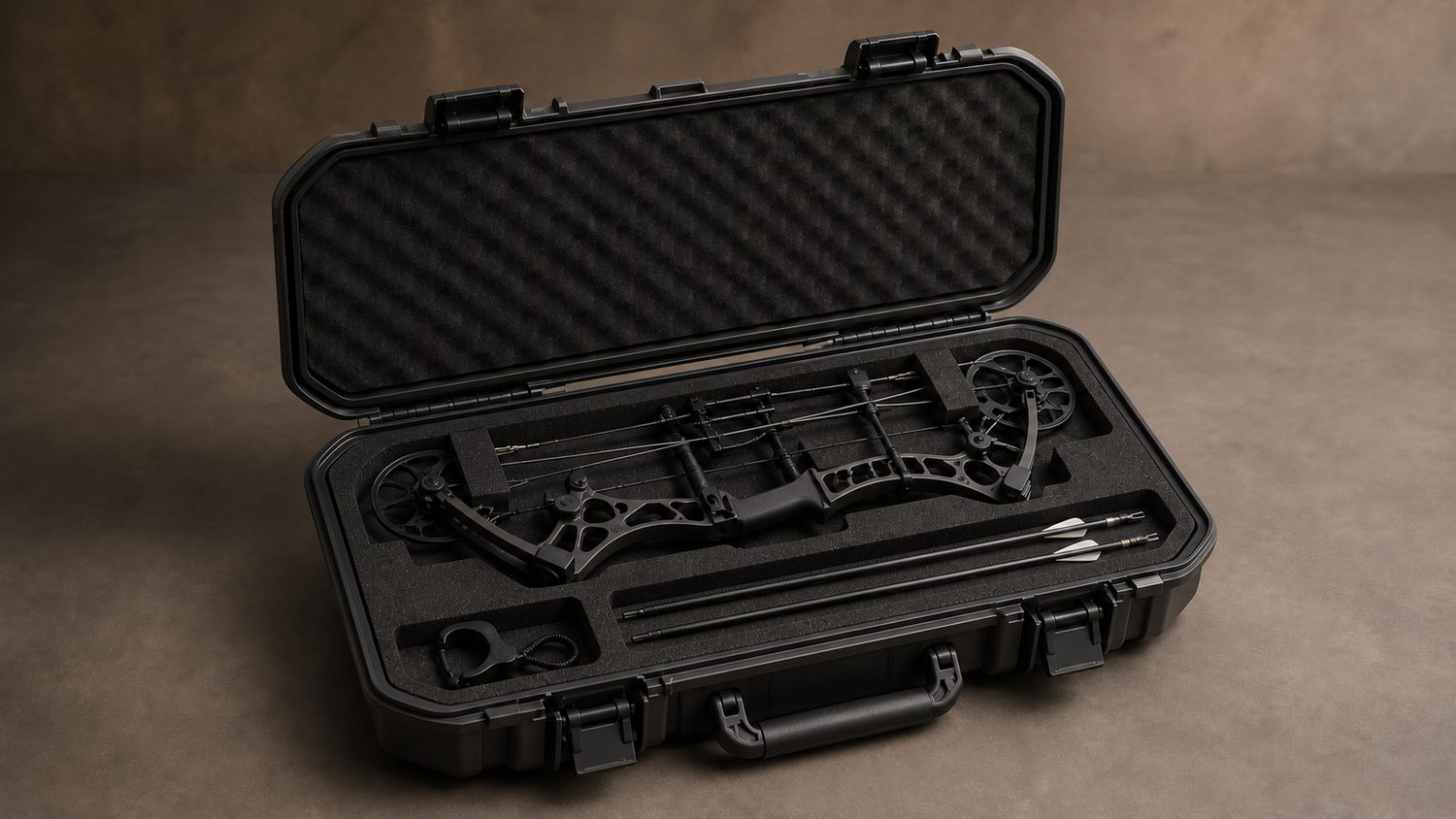
Start with the bow, not the case
The Mathews Creed XS is a compound bow, so its case is firearms-and-archery-accessory adjacent. This page is an informational fit and transport guide rather than a product recommendation or buying list. A case that looks large enough in a shop can still put pressure on a cam, cable guard, sight, stabilizer or rest when the lid closes. Measure the actual bow in its present configuration before comparing any interior dimensions. Do not rely on an advertised axle-to-axle figure alone: that figure describes the bow between axle centers, not the complete packed shape.
Lay the unstrung dimensions out on paper first. Measure overall length from the highest point of the top cam to the lowest point of the bottom cam, the widest point across any installed accessories, and the deepest point from the string plane to the farthest projection. A mounted quiver, long stabilizer, broad sight housing or bulky rest can change all three measurements. Record the dimensions with the bow in the orientation in which it will travel. The useful internal clearance needs to exceed those measurements, with room for padding that does not press hard on moving or aligned parts.
Hard-shell and soft-shell protection solve different problems
A hard-shell case uses a rigid outer structure to resist crushing and impacts. It is the better format where the bow will be stacked beneath other equipment, transported in a vehicle with loose cargo, or handled by someone other than its owner. The trade-off is size and weight. A rigid shell can protect the bow only if the interior is deep enough for the installed accessories; forcing the lid shut defeats the point of the shell. Check hinges, latches and the rim for even closure rather than assuming a locked case has packed safely.
A soft case is lighter and easier to carry, but it protects primarily from scratches, dust and minor knocks. It is not a substitute for a rigid container when luggage, tools or other heavy cargo can rest on top of it. The most useful soft-case details are a structured panel around the limb and cam area, secure handles, a shoulder strap that does not twist, and a zip path that does not rub strings or cables. A soft case should still be sized from the real bow and its accessories, not from a generic label such as “fits compound bows.”
Protect the cams, strings and cables
Compound-bow cams, strings and cables need clear space. The bow should not rest with a cam edge against a hard wall, and a divider should not bend a cable sideways when the case is closed. Padding is helpful when it supports the riser or holds the bow from shifting; padding becomes a problem when it is so thick that it loads the cams, strings, sight or rest. Close the empty case slowly around the packed bow the first time. If the lid requires force, reopen it and find the contact point. A latch is not evidence of proper clearance.
Keep dirt and moisture out of the string and cable area. Before packing, remove mud, grit and standing water from the exterior of the bow. If equipment has been exposed to rain, let it dry in a ventilated place before long-term storage. A sealed case can trap moisture. Avoid storing a compound bow for long periods next to damp clothing, wet boots, chemical cleaners, fuel containers or loose metal tools. These storage choices can create corrosion, odor and abrasion risks that the case itself cannot solve.
Account for accessories separately
Accessories are the common source of an unexpected fit failure. A sight can increase width and depth; a stabilizer can add length; a quiver can obstruct the lid; and arrows require a separate protected channel. Decide which accessories remain on the bow for each trip. If an accessory is routinely removed, use a dedicated pouch or compartment so that it cannot move against the riser, limbs or string. Do not place loose tools, release aids, broadheads or other hard items directly beside the bow. They should be immobilized in a separate compartment designed for them.
Check the rest after every transport cycle. A rest can be bumped out of position even when the bow appears undamaged. Also inspect the sight, stabilizer fasteners, limb pockets, cam area, string, cables and nocking point before shooting. A visual check does not replace professional inspection when there is a suspected impact, cracked component, bent accessory or unexplained change in arrow behavior. Do not shoot equipment that appears damaged or misaligned.
Vehicle transport and handling
Inside a vehicle, position the case where it cannot slide, tip, or have other cargo piled on it. Avoid the dashboard, an open truck bed, and a location exposed to prolonged heat. Secure the case so that sudden braking does not send it into passengers or equipment. When carrying it by hand, use the built-in handle or strap and keep the case closed. Do not carry a compound bow openly through public spaces where local rules, venue policies, or land-manager requirements may apply.
Air and public transport add another layer of planning. Rules can vary by carrier, country, airport, season and the nature of the trip. Check the current carrier policy before leaving home, allow extra time, and use a container that meets the applicable requirements. Do not assume that a locking latch, an archery label or a case sold for travel automatically satisfies every rule. Keep documentation, identification and any required event or destination information available separately from the packed equipment.
A repeatable packing check
- Confirm the bow is unloaded of arrows and that no loose sharp item is in the main bow compartment.
- Measure the configured bow, including the accessories that will remain attached.
- Place the riser on its intended support points and make sure cams, strings and cables have free space.
- Secure removable accessories in separate pockets so they cannot strike the bow.
- Close the lid without force and inspect the perimeter for even closure.
- After arrival, inspect the setup before shooting and seek qualified help after a significant impact.
Fit is more important than a brand label
The right case is the one that accommodates the actual Mathews Creed XS configuration without compression, movement or improvised packing. A correctly sized soft case can be practical for careful local transport; a correctly sized rigid case offers more protection where crushing forces are credible. Neither format makes a poor fit safe. Treat internal length, width, depth, accessory clearance, padding layout and the intended transport environment as one decision. That approach protects the bow better than choosing by appearance, price, or a broad statement that a case is “for compound bows.”