

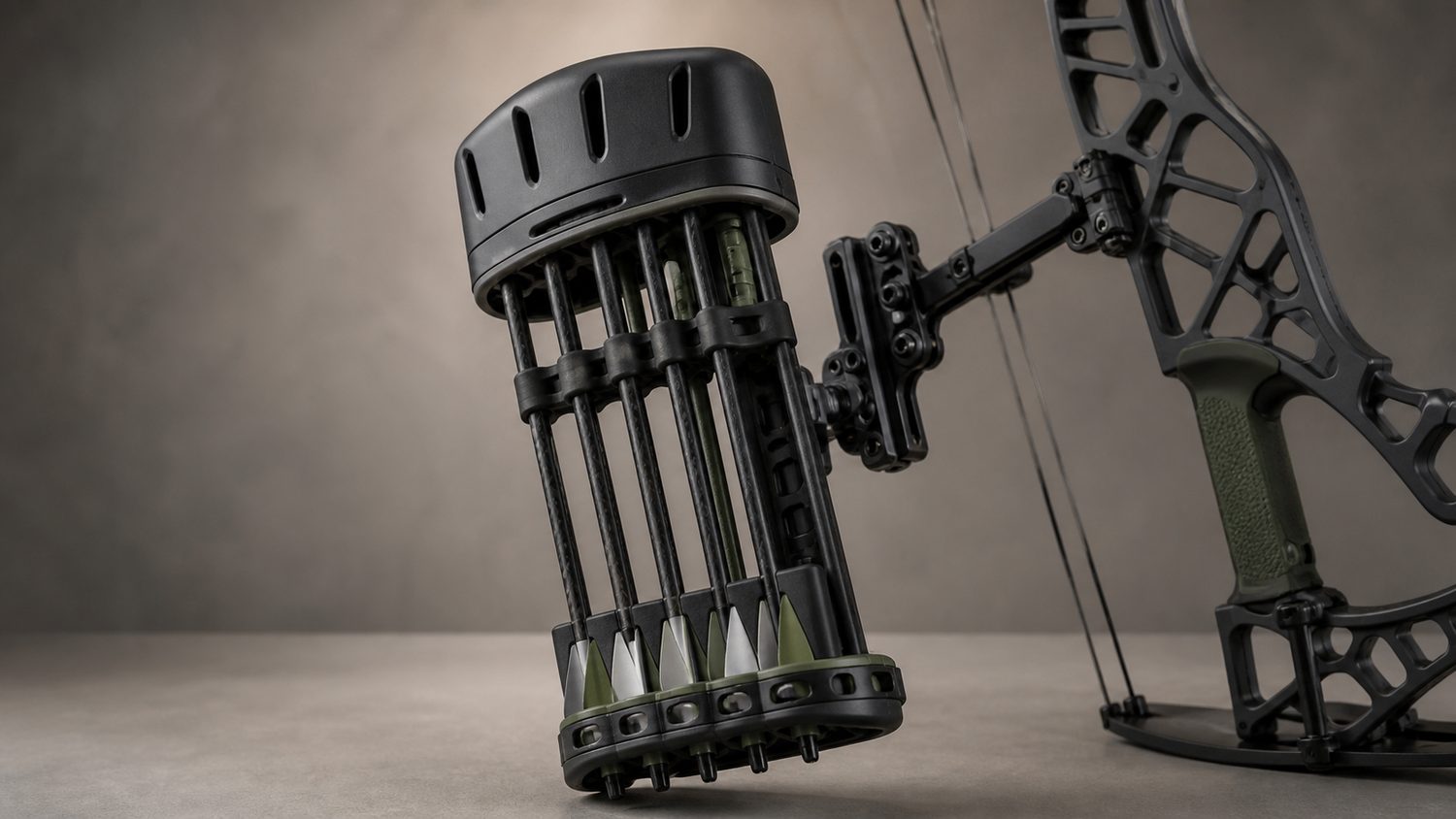
Why this is a fitment question, not a shopping list
A quiver is an archery-bow accessory, so this guide does not recommend products or link to them. On a Mathews Triax, the useful first question is not which quiver is “best”; it is whether the bracket, riser interface, arrow clearance and loaded balance work together on the individual bow. The Triax is an older Mathews compound-bow platform, and it predates later mounting systems such as Bridge-Lock. Parts described as direct-riser or Bridge-Lock accessories for newer bows should not be assumed to attach to a Triax.
Start by identifying what is already on the bow. Look at the riser rather than a listing title: note the existing quiver bracket or mounting holes, the number and position of fasteners, and whether a removable mount is present. A mounting pattern can be proprietary, and two components that appear to have similar screw spacing can still place the quiver at the wrong height, offset or angle. Do not force a screw into a riser or substitute a longer fastener because it seems to start threading. The correct thread engagement and fastener length are safety-critical details for the manufacturer or a qualified archery technician to confirm.
Riser mounting and generation compatibility
Modern Mathews accessories include systems that integrate directly into a compatible riser. Those designs describe their own compatibility and should not be treated as backward-compatible by appearance alone. The current LowPro fixed quiver, for example, is described by Mathews as placing arrows close to the riser for balance and vibration control, but that statement is about its intended platform and mount. It does not establish fit on a Triax. Likewise, a front stabilizer’s 5/16–24 bushing is not a quiver mount; those are separate attachment points serving different loads and geometry.
Before fitting anything, photograph both sides of the bare riser and record the bow’s serial number from the back of the riser. Mathews directs owners needing setup assistance to authorised retailers. A shop can identify the Triax-era quiver interface, compare it with the accessory’s supplied hardware and inspect the threads. This is preferable to trial-fitting multiple brackets because repeated loose fastening can damage a threaded insert or leave an accessory that shifts under movement.
Clearance is more than whether the quiver “fits”
A quiver that bolts on can still be unsuitable. With the bow unloaded and pointed in a safe direction, check clearance among the quiver body, arrows, arrow rest, sight, cables, strings, limb pockets and cam path. Arrow fletching must not brush the rest, sight housing, cable guard or quiver when the bow is at rest or when an arrow is being removed. The broadhead hood or point cover must retain sharp points securely and keep them away from hands, clothing and the bowstring. A clearance check should be repeated with the same arrows and point style that will actually be carried.
Pay particular attention to sight clearance. A low-profile quiver can occupy the same space as a large sight housing, a long sight bar or a side-mounted accessory. An apparent fix such as a spacer or a longer screw changes the load path and should be assessed by a technician rather than improvised. Also inspect the bow in the carried orientation: a quiver may clear indoors but contact a sling, pack strap or tree-stand rail when the bow is moved.
Arrow retention and the loaded setup
Retention is a separate test from mounting. With the bow unstrung only where the manufacturer’s procedures permit, or otherwise handled under shop supervision, insert each arrow one at a time. The gripper should hold the shaft consistently without crushing it, and the hood should secure each point. Different shaft diameters, fletching heights and broadhead shapes can change both retention and clearance. A holder adjusted around one arrow does not automatically suit another.
Do not test retention by shaking a loaded bow near people, pets, vehicles or equipment. Instead, use a controlled bench inspection and follow the quiver maker’s instructions. Confirm that every arrow is fully seated, the nock end is not under sideways pressure, and the quiver cannot release from its bracket unexpectedly. If a component rattles, moves under hand pressure, has a cracked hood, loose gripper or worn latch, stop using it until it is inspected and repaired with approved parts.
Balance, vibration and repeatable shooting
Adding several arrows moves mass to one side of the Triax. That can alter how the bow feels in the hand, how it settles after the shot and how it carries. It does not by itself make a bow more accurate or quieter. Balance is personal and changes with arrow count, point weight, sight configuration, stabilizer mass and draw setup. The relevant question is whether the bow remains controllable and whether the accessories stay fixed during normal handling.
After any approved installation, have the bow checked and paper-tuned or otherwise evaluated by a qualified technician if the setup has changed materially. Keep the inspection conservative: do not draw or shoot if arrows, the rest, cables or any accessory touch. A new rattle after a shot may be a loose fastener, an accessory contacting the riser, or an unrelated component; diagnosing it by repeatedly shooting is not the safe approach. First unload the bow, inspect it and seek professional service.
Routine inspection and transport
Inspect the quiver bracket, latch, hood, arrow gripper, fasteners and riser contact area before each outing. Look for metal fatigue, cracked polymer, stripped threads, corrosion and missing hardware. Check that mounting screws are tightened only to the torque specified by the relevant manufacturer; overtightening can damage the accessory or the bow. Never apply thread locker, drill the riser or modify a mount unless the bow and accessory manufacturers explicitly authorise the process.
When to ask a technician
Use an authorised Mathews retailer or an experienced archery technician when the mounting style is uncertain, a used bow has an unfamiliar bracket, an accessory needs an adapter, or any part contacts the cables, string, rest or sight. Ask them to identify the exact riser interface, verify hardware, test clearance with your arrows, and inspect the bow after fitting. That measured approach is more valuable than treating a later Mathews accessory name as proof of Triax compatibility.