

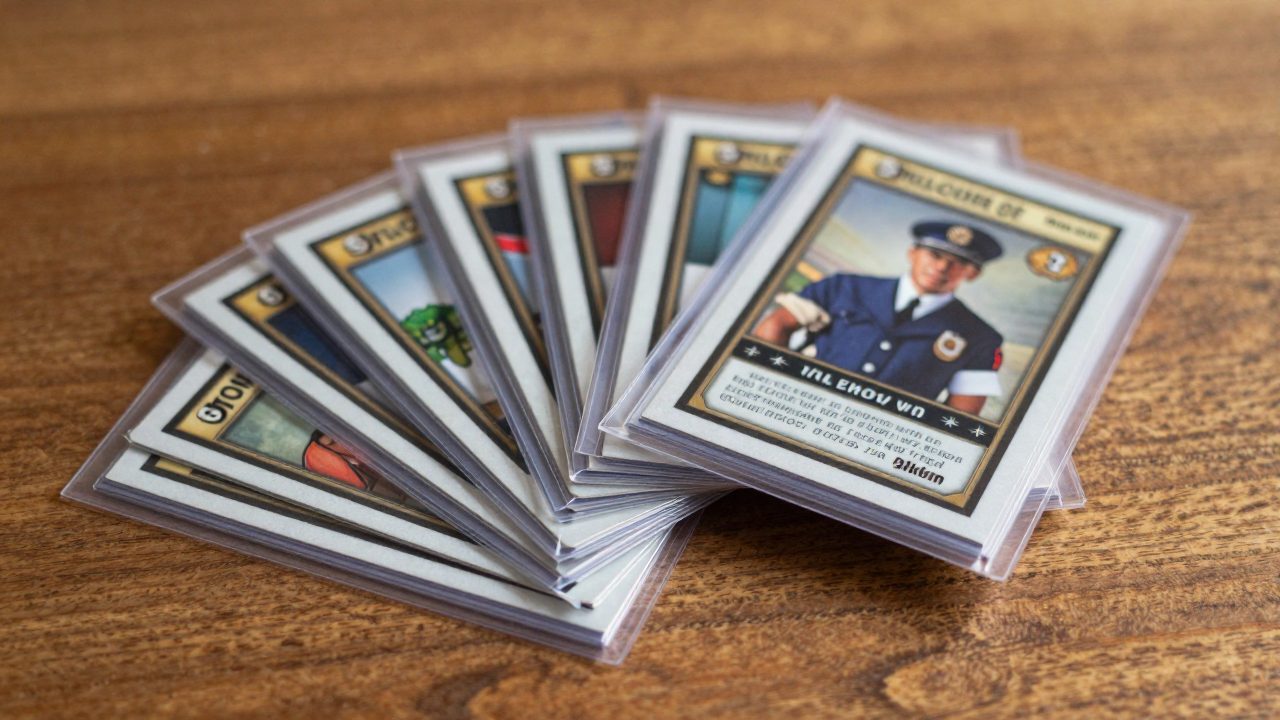
The best Un-cards for a Cube are the ones that match the Cube’s agreed rule set. “Un-card” can mean two different things: older silver-bordered cards and newer Unfinity cards marked with an acorn, both intended for Un-games; or Unfinity’s Eternal cards, which follow normal Magic rules and are legal in Commander, Legacy, and Vintage. Decide which experience your group wants before evaluating a card. A Cube that accepts Un-game logistics can use jokes, physical components, and table talk. A normal-rules Cube should begin with Unfinity’s Eternal cards.
Wizards introduced the acorn symbol in Unfinity to replace silver borders as the marker for cards that are not legal in most Constructed tournaments. Cards without the acorn are Eternal legal. That visual check is more reliable than a card’s black border: Unfinity includes both categories in black border. For a Cube, legality is ultimately a house-rule decision, but the symbol tells drafters what kind of game support a card expects.
Best normal-rules inclusion: Saw in Half
Saw in Half is the clearest starting point for a Cube that otherwise follows normal Magic rules. Wizards identifies it as an Eternal card and gives its rules text: for {2}{B}, it destroys target creature; if that creature dies this way, its controller makes two copies with base power and toughness each rounded up from half the original. That creates an unusual decision for both players. It can remove an opposing creature while leaving its controller with two smaller copies, or it can target a creature you control when splitting it advances your board or triggers death value.
Its limit is complexity. A Cube group should be comfortable tracking copied characteristics and the base power-and-toughness exception. It is a good fit where black has sacrifice, death triggers, or token payoffs. It is not a reason to add the entire Unfinity package, and it does not need stickers, Attractions, or a separate deck of components.
Best conditional creature: Sanguine Sipper
Sanguine Sipper is an Eternal white Vampire Guest for {1}{W} with 3/1 and conditional lifelink: it has lifelink while you control a stickered permanent. It belongs only in a Cube that intentionally supports stickers. The card is legal under ordinary rules, but its power depends on a physical game element. In a Cube with no sticker sheets or sticker-producing cards, it is simply a fragile creature with no lifelink.
That makes Sanguine Sipper an excellent test of Cube design discipline. Include it if the Cube supplies a defined sticker package and players know how it works. Leave it out if you want a normal white aggressive card with guaranteed performance. Eternal legality means it can be used; it does not mean it is automatically self-contained.
Best for a dice theme: The Space Family Goblinson
The Space Family Goblinson is another Unfinity Eternal card highlighted by Wizards as a normal-rules design that uses die rolling. It is a legendary creature and can fit a Cube where randomization is already a supported red-blue theme. The value here is not that every Cube needs dice. It is that the card’s mechanic is recognized by the Comprehensive Rules, unlike a joke that asks players to use outside knowledge or manipulate the physical card.
Use it only when your group enjoys variance and the Cube has a consistent way to represent dice. A single dice card in an otherwise deterministic Cube can feel disconnected. A small cluster of cards that reward or trigger on rolls gives drafters a reason to build around the mechanic rather than treating it as a novelty.
Best acorn choices for a dedicated Un-Cube
A dedicated Un-Cube can make acorn cards its main attraction, provided the group agrees in advance. Astroquarium is an acorn artifact that can place an art sticker on itself and can turn a creature into a blue Shark, or a larger blue Octopus if the cracks in its printed art are fully covered. It is not appropriate for a conventional Cube because its outcome depends on a physical-art condition. It is exactly the kind of table-specific problem an Un-Cube can enjoy.
Surprise Party is another acorn example that requires players to hide printed Clown Robot tokens before casting it. It rewards a group that wants the game to include real-world observation and playful setup. A Cube curator should supply the necessary tokens and explain the rule before the draft. Do not add it to a mixed Cube and expect drafters to discover the required components during a match.
Nearby Planet is a useful warning rather than a default include. Wizards explains that it is acorn because its powerful all-basic-land-types mana fixing raised Legacy and Vintage concerns. It can be fun in a permissive Un-Cube, but a curator should evaluate it as a fixing card first, not assume that a funny origin makes it balanced. Acorn status is a format signal, not a power-level guarantee.
Build the environment before selecting cards
- Choose a rules baseline. State whether acorn and older silver-bordered cards are allowed, and whether Eternal cards are treated as ordinary Cube cards.
- Provide components. Stickers, Attractions, dice, and tokens must be present and explained before drafting.
- Keep mechanics in packages. Sanguine Sipper needs sticker support; dice cards benefit from other dice cards; Attractions need cards and rules that make them relevant.
- Use Oracle and release notes. Wizards says the official card database is the source for disputes and current text.
- Review player tolerance. Some groups enjoy hidden objects and physical-card jokes; others want only normal game actions.
For a conventional Cube, start with Saw in Half and consider other Eternal cards one mechanic at a time. For a true Un-Cube, let Astroquarium and Surprise Party define a deliberately playful package, while treating Nearby Planet with the same power-level care you would give any fixing land. The best Un-cards are not a universal list: they are the ones your Cube’s rules, components, and players are ready to support.