

As an Amazon Associate and eBay Partner, toptenpick.com earns from qualifying purchases. Prices and availability are subject to change.
A polythene tarp is the obvious thing to put under a pool and it is the wrong material for the job, for a reason you will not see until the liner fails. A tarp is a waterproof sheet. Under a pool that is precisely backwards: groundwater and condensation still arrive from below, and a waterproof layer traps them between the tarp and the liner instead of letting them drain away. What sits there is a permanently damp, dark, airless layer — which grows mould and algae, rots the grass into slime, and on a liner that is in contact with it for a whole season, stains and degrades the vinyl.
The second problem is wrinkles, and it is the one that actually punctures liners. A tarp is slippery and it does not lie flat under load; it creases, and every crease becomes a hard ridge with thousands of kilograms of water pressing the liner down onto it. Those ridges are wear points, and a liner that fails after two seasons frequently fails along a line that traces a fold in the sheet beneath it. The grommets are worse — a brass ring under a vinyl liner under five thousand litres of water is a punch.
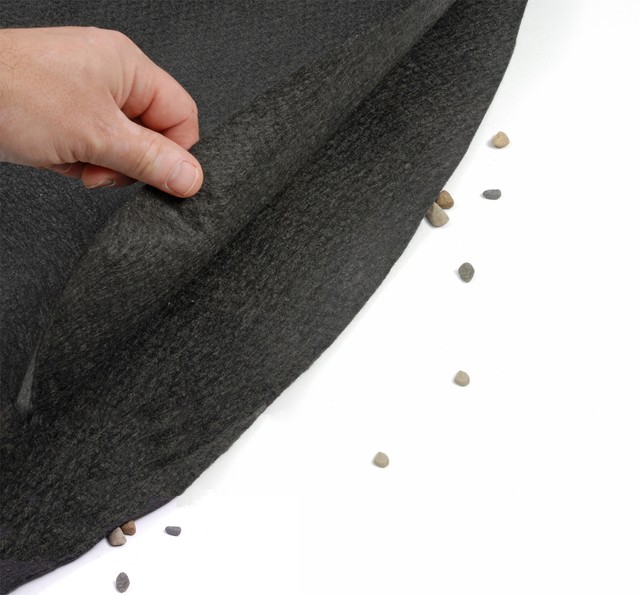
What you actually want is a purpose-made pool pad, and the material difference is the point. These are non-woven geotextile: a felt-like fabric that is permeable, so moisture passes through and drains away rather than pooling, while still stopping stones, roots and grit from reaching the liner. It is thick enough to cushion, it does not crease into ridges, and it has no hardware in it. Gorilla Pad and Armor Shield are the common names; a landscape geotextile from a builders’ merchant is the same class of material at a lower price.
Do the groundwork properly first, because no underlay rescues a bad base. Remove stones and roots, level the ground — an above-ground pool that is more than an inch or two out of level puts uneven load on the wall and is a genuine structural risk, not a cosmetic one — and deal with anything sharp. A pad protects against what you missed, not against what you could not be bothered to remove.
One honest exception. If what you actually want is something under the pool to keep the grass alive or to move the pool later in the season, that is a different problem and a tarp is still the wrong answer — grass under any pool dies within days. Plan to reseed.
| # | Product | Price | Where to buy |
|---|---|---|---|
| 1 | Gorilla Pad Pool Liner Pad | $70–$180 | Amazon · eBay |
| 2 | Armor Shield Liner Guard | $70–$170 | Amazon · eBay |
| 3 | Non-Woven Landscape Geotextile Fabric | $40–$100 | Amazon · eBay |
| 4 | Interlocking Foam Floor Tiles | $50–$130 | Amazon · eBay |
| 5 | Builder’s Sand (a proper base layer) | $60–$150 | Amazon |
| 6 | Heavy-Duty Poly Tarp (what most people buy) | $20–$60 | Amazon · eBay |
| 7 | Ground Levelling Rake and Tamper | $40–$100 | Amazon · eBay |
| 8 | Liner Patch Repair Kit | $15–$30 | Amazon · eBay |
| 9 | Duct Tape or Seam Tape for Joining Pads | $10–$25 | Amazon |
| 10 | Woven Weed Membrane (not this either) | $20–$45 | Amazon · eBay |
The picks, in detail

Gorilla Pad Pool Liner Pad
The purpose-made product and the reason it exists: a thick non-woven geotextile cut to standard pool sizes, permeable so moisture drains rather than pooling, and heavy enough to stop stones and roots reaching the liner. It has no grommets, no seams under load and no tendency to crease into ridges. It costs more than a tarp and it is the correct material.
- Non-woven permeable geotextile
- Cut to standard round and oval pool sizes
- No grommets or hardware
- Resists punctures from stones and roots
- Permeable, so moisture drains instead of being trapped
- Does not crease into ridges under load
- Sized to the pool, so no cutting and taping
- Several times the price of a tarp
- Sizes are pool-specific — measure carefully
- Bulky to store between seasons
Armor Shield Liner Guard
The other established name in this category, and functionally the same idea: a permeable synthetic underlay sized for above-ground pools. Worth comparing on thickness and on whether it is sold as a single piece for your pool size or as panels to be taped together — a single piece removes the seams, which is one fewer place for grit to work through.
- Permeable synthetic underlay
- Single-piece and panel versions
- Standard above-ground pool sizes
- Resists rot and mildew
- Purpose-made for the job
- Single-piece versions have no seams under load
- Does not trap moisture against the liner
- Panel versions need taping, adding seams
- Premium pricing
- Size availability varies by retailer

Non-Woven Landscape Geotextile Fabric
The same class of material sold by the roll for drainage and groundworks, at a considerably lower price per square metre. Look for non-woven rather than woven — non-woven is the felt-like permeable fabric you want, while woven weed membrane is a different product that behaves more like a tarp. Buy a roll wide enough to need few overlaps, and overlap generously where you must.
- Non-woven permeable geotextile by the roll
- Sold by weight in grams per square metre
- Several metres wide on builders’ merchant rolls
- Cuts easily with a knife
- Much cheaper per square metre than a branded pool pad
- Same material class as the purpose-made products
- Roll widths mean few joins
- Must be non-woven — woven membrane is the wrong product
- Needs cutting and laying out yourself
- Heavier weights are awkward to handle alone

Interlocking Foam Floor Tiles
The cushioning answer, popular for pools on patios and decking where the surface is hard and unforgiving rather than stony. EVA foam tiles interlock into a continuous surface, give genuine padding underfoot inside the pool, and are quick to lay. They are not permeable, so on grass or soil they share the tarp’s moisture-trapping problem — this is a hard-surface solution.
- Interlocking EVA foam tiles
- Substantial cushioning thickness
- Quick to lay and lift
- Sold by the pack in square metres
- Real underfoot comfort on a hard base
- Fast to lay and to take up
- Reusable across seasons
- Not permeable — traps moisture on grass or soil
- Tiles separate under a shifting load
- Cheap foam compresses permanently
Builder’s Sand (a proper base layer)
The traditional base for an above-ground pool and genuinely the right answer for a permanent installation on soil. A levelled layer of sand, raked and tamped, conforms perfectly to the liner with no creases at all and fills every small hollow. It is hard work, it wants a border to stop it washing out, and combined with a geotextile pad above it, it is what pool installers actually do.
- Fine builder’s or play sand
- Levelled and tamped to a smooth bed
- Conforms with no wrinkles
- Usually paired with a pad on top
- No creases or ridges at all
- Fills hollows a pad cannot
- What professional installers use
- Heavy work and needs delivering in bulk
- Washes out without an edge or a pad above it
- Ants and burrowing insects disturb it over a season
Heavy-Duty Poly Tarp (what most people buy)
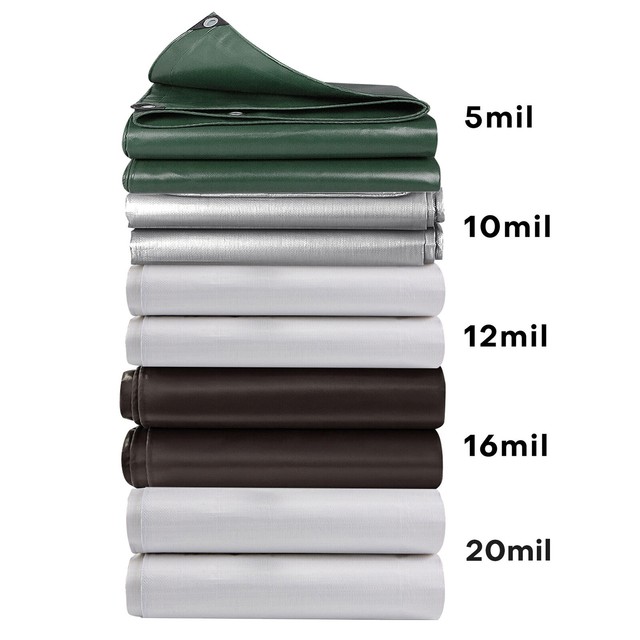
Included honestly because it is the product this page is named for, and it does have a use — just above the pool rather than below it. As a winter cover, a groundsheet for the pump area, or a temporary cover while you work, a heavy poly tarp is genuinely useful. Under a liner it traps moisture, creases into ridges and puts brass grommets under thousands of kilograms of load.
- Woven polyethylene with a waterproof laminate
- Reinforced hems with brass grommets
- Several weights, measured in GSM
- Very cheap per square metre
- Cheap and available everywhere
- Genuinely useful as a cover, above the pool
- Waterproof, which is the right property for a cover
- Traps groundwater and condensation against the liner
- Creases into hard ridges that become liner wear points
- Grommets are a punch point under full water load
Ground Levelling Rake and Tamper
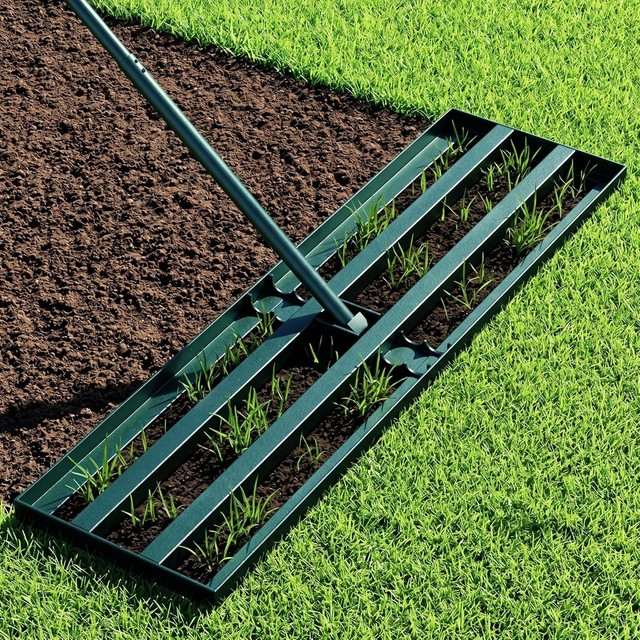
The tools that do the part no underlay can substitute for. An above-ground pool more than an inch or two out of level puts uneven load on the wall, and that is a structural risk rather than an aesthetic one — walls have failed from it. A landscape rake to grade and a hand tamper to consolidate, checked with a long level on a straight board, is the work that actually protects the liner.
- Wide landscape or levelling rake
- Hand tamper or plate compactor hire
- Long spirit level used on a straight board
- String line for larger areas
- Addresses the failure no pad can prevent
- Levelling is a genuine safety matter on above-ground pools
- Tools are reusable for other garden work
- Hard physical work
- Larger pools really want a hired plate compactor
- Needs rechecking after the first fill

Liner Patch Repair Kit
Worth owning before you need it, because the whole point of an underlay is preventing the thing this fixes. Underwater vinyl patch kits work without draining the pool, which matters when the alternative is losing a full refill. Keep one with the pool kit and find the leak with a dye test rather than guessing — a slow leak is usually a pinhole, not a tear.
- Vinyl patch material and underwater adhesive
- Applies without draining
- Clear patches are less visible
- Small kit, long shelf life
- Repairs without losing a tank of water
- Cheap relative to a replacement liner
- Long shelf life sitting in the shed
- Finding the leak is the hard part
- Adhesive degrades once opened
- Not a fix for a long tear or a seam failure
Duct Tape or Seam Tape for Joining Pads
Needed if you are laying geotextile from a roll, and worth doing properly. Overlap generously and tape the joins on the upper face so grit cannot migrate up through a seam into contact with the liner. Ordinary duct tape fails in damp ground within a season; a proper outdoor seam tape holds. Tape the seam, do not rely on the overlap alone.
- Outdoor-rated seam or duct tape
- Wide rolls for geotextile joins
- Water resistant adhesive
- Cheap
- Stops grit migrating through seams
- Keeps a multi-piece pad from shifting
- Very cheap
- Ordinary duct tape fails in damp ground
- Adds a slight ridge at the join
- Needs a dry surface to stick to

Woven Weed Membrane (not this either)
Named because it is the thing people reach for when told to use geotextile, and it is the wrong half of that category. Woven membrane is a thin plastic weave designed to suppress weeds while letting some water through; it is slippery, it offers almost no cushioning, and it frays at cut edges into stiff plastic threads. Non-woven geotextile — the thick felt-like fabric — is what you want.
- Thin woven polypropylene weave
- Designed for weed suppression
- Some permeability
- Very cheap by the roll
- Cheap
- Correct for its actual job, under bark or gravel
- Almost no cushioning against stones
- Slippery and prone to creasing like a tarp
- Frays into stiff threads at cut edges
Buying tips
- Do not use a waterproof tarp under a liner. Groundwater and condensation still arrive from below, and a waterproof sheet traps them in a permanently damp layer that grows mould and degrades vinyl.
- Buy non-woven geotextile, not woven weed membrane. Non-woven is the thick felt-like permeable fabric that cushions; woven membrane is thin, slippery and frays at cut edges.
- Watch for creases above everything else. A fold under thousands of kilograms of water becomes a hard ridge, and liners frequently fail along a line that traces a crease in the sheet beneath.
- Never put anything with grommets or hardware under a liner. A brass ring under vinyl under a full pool is a punch.
- Level the ground properly first. An above-ground pool more than an inch or two out of level loads the wall unevenly, and that is a structural risk rather than a cosmetic one.
- Consider sand under the pad for a permanent installation. A levelled, tamped sand bed conforms with no wrinkles at all and fills hollows a pad cannot.
- Overlap and tape geotextile seams on the upper face. That stops grit migrating up through a join into contact with the liner.
- Accept that the grass underneath will die whatever you lay. Grass under any pool is gone within days, so plan to reseed rather than trying to protect it.
As an Amazon Associate and eBay Partner, toptenpick.com earns from qualifying purchases. Prices and availability are subject to change.