

As an Amazon Associate and eBay Partner, toptenpick.com earns from qualifying purchases. Prices and availability are subject to change.
The mistake most beginners make when buying a nib for Spencerian script is optimizing for flexibility. Online starter guides tend to lump Spencerian in with Copperplate, and Copperplate’s own advice — buy the softest, most responsive nib you can afford — gets repeated for Spencerian without adjustment. Spencerian is actually written with a much lighter touch than Copperplate: its shading is subtler, and the hand depends on the nib staying mostly closed except through a handful of stressed strokes. Hand a beginner a very flexible nib and the tines open under ordinary practice pressure, shading shows up in the wrong places, and the point catches on the upstroke instead of gliding through it. A stiffer nib is the better place to start. It physically resists over-shading no matter how heavy the hand still is, which teaches control before it rewards pressure — the opposite order most flexible-nib starter kits put you in.
The ten nibs below are ordered roughly from stiffest to most flexible for that reason. Nikko G, Zebra G and Tachikawa G — all currently made in Japan, all inexpensive — sit at the learning end and are what most working Spencerian teachers hand a first-time student. Hunt 56 is a step up in size and durability without much more flex, good for writing larger practice letters. Past that comes the genuinely flexible tier: the Gillott 303 and 404, Hunt 22 and Hunt 101, the Leonardt Principal EF, and the Brause EF66. These reward a controlled, light hand with real hairline-to-swell contrast — and punish a heavy one with the same catching and blobbing a beginner would get from any soft nib.
One thing worth knowing before buying a Gillott nib specifically: Joseph Gillott’s steel-pen factory stopped production decades ago, so every Gillott 303 or 404 on sale today is new old stock — unused nibs that have simply sat in a warehouse or a drawer since sometime in the twentieth century. Established calligraphy suppliers store and grade that stock, and it shows in what arrives. A cheap lot from a general auction site is a different bet: tarnish, corrosion and inconsistent hand-grinding all turn up in unvetted deadstock, and that risk is exactly what the price gap between a specialty supplier and an anonymous auction listing is paying for.
Whichever nib you start with, expect a short prep step before it writes cleanly. New nibs, current manufacture or vintage deadstock alike, carry a thin factory oil film that beads ink instead of holding it. A wipe with a little dish soap and water, or a few seconds pressed into a raw potato, clears it before the first real practice page.
| # | Product | Price | Where to buy |
|---|---|---|---|
| 1 | Nikko G Nib | $2–$4 (single nib) | Amazon · eBay |
| 2 | Zebra G Nib | $2–$4 (single nib) | Amazon · eBay |
| 3 | Tachikawa G Nib | $2–$4 (single nib) | Amazon · eBay |
| 4 | Hunt 56 Nib | $2–$4 (single nib) | Amazon · eBay |
| 5 | Gillott 303 Nib | $3–$6 (single nib) | Amazon · eBay |
| 6 | Gillott 404 Nib | $3–$6 (single nib) | Amazon · eBay |
| 7 | Hunt 22 (22B) Nib | $2–$4 (single nib) | Amazon · eBay |
| 8 | Hunt 101 (Imperial) Nib | $2–$4 (single nib) | Amazon · eBay |
| 9 | Leonardt Principal EF Nib | $3–$5 (single nib) | Amazon |
| 10 | Brause EF66 Nib | $3–$5 (single nib) | Amazon · eBay |
The picks, in detail

Nikko G Nib
A hand-cut, chrome-plated Japanese nib with lower flex than most pointed-pen nibs, which is exactly why penmanship teachers hand it to first-time Spencerian students. It resists over-shading under an inexperienced hand and holds its point through long drill sessions, at the cost of the dramatic swells more flexible nibs produce.
- Chrome-plated steel, hand-cut point
- Medium-low flex — stiffer than Zebra G, Tachikawa G and every nib further down this list
- Fits standard straight and oblique holders
- Made in Japan
- Forgiving as a first pointed-pen nib
- Holds its point through many pages of drill practice
- Smooth, consistent ink flow
- Too stiff to produce the dramatic shading some later scripts call for
- New nibs need the factory oil film cleaned off before ink will flow
Zebra G Nib
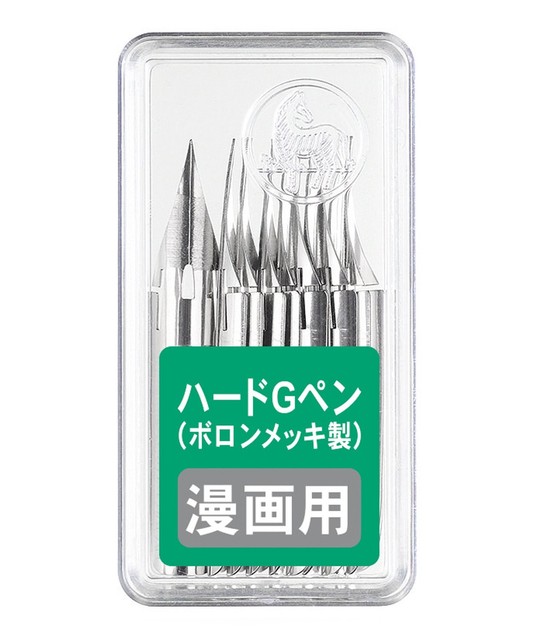
Similar to the Nikko G but a touch more flexible and sharper, producing a finer hairline. It’s the nib several master penmen use for their own Spencerian work once a student has the light touch down, making it a natural second nib after Nikko G rather than a beginner’s first.
- Chrome-plated steel point, made by Zebra (Japan)
- Firmer than the Gillott and Hunt nibs on this list, softer than Nikko G
- Sharp, fine point for crisp hairlines
- Standard nib-holder fit
- Sharper hairlines than Nikko G without much added flex
- Widely stocked and cheap to replace
- Works reasonably for both Spencerian and Copperplate
- Slightly more prone to catching on toothy paper than Nikko G
- Still needs pressure control most true beginners haven’t built yet

Tachikawa G Nib
Sits between Nikko G and Zebra G in sharpness and flex, and holds noticeably more ink than either, which means fewer interruptions to re-dip during a long practice session. A practical, unglamorous choice for someone drilling the same page of ovals and pushes for an hour at a time.
- Chrome-plated point made by Tachikawa, Japan
- Higher ink capacity than Nikko G or Zebra G
- Moderate flex, moderate sharpness
- Fits standard holders
- Fewer re-dips during long drill sessions
- Smooth downstrokes with minimal catching
- Consistently well-made point
- Less line contrast than the fully flexible nibs on this list
- Less widely stocked outside specialty calligraphy shops

Hunt 56 Nib
A stiff, durable point similar in feel to the Gillott 404 but tougher, sized for writing larger letters on smooth or lightly textured paper. It tolerates a heavier hand than the finer nibs on this list, which makes it a reasonable choice for oversized practice sheets rather than fine, small-hand Spencerian.
- 31mm x 6mm steel nib, Hunt/Speedball manufacture
- Stiff flex, comparable stiffness to the Gillott 404
- Durable point that resists wear
- Best suited to larger-scale writing
- Tough enough to survive a heavier beginner hand
- Cheap and easy to replace
- Good for larger practice letters and worksheets
- Limited shading range compared to softer nibs
- Not the nib to move to once fine shading control is the goal
Gillott 303 Nib
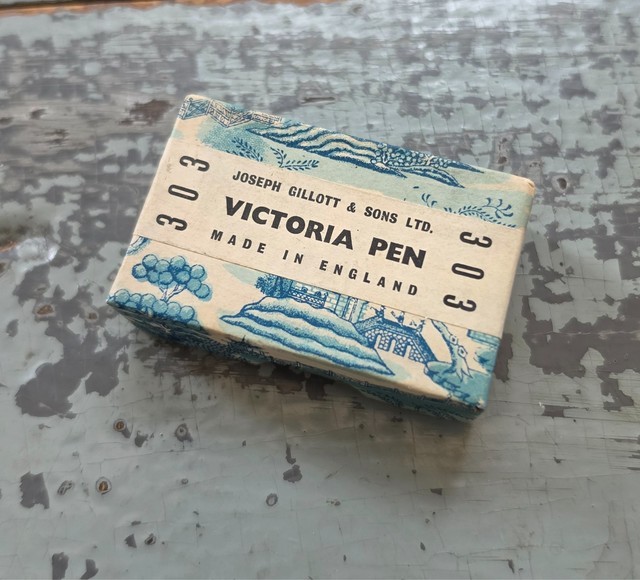
The classic pointed-pen nib for both Spencerian and Copperplate — not too stiff, not too rubbery — but it performs best under a genuinely light hand, which is why suppliers steer true beginners away from it. Because Gillott stopped manufacturing decades ago, every 303 sold today is unused deadstock, so buy from a supplier that grades condition rather than a blind lot.
- Bronze-finish steel nib, original Birmingham (Gillott) manufacture
- Medium-fine flex, sharp point
- Sold as new old stock, not current production
- Fits standard straight and oblique holders
- Excellent line contrast once pressure control is there
- Long-standing reputation among Spencerian and Copperplate writers
- Sharp enough for fine hairlines
- Only as good as the deadstock batch — tarnished or corroded nibs do turn up
- Not a nib to learn pressure control on
- Increasingly scarce, so prices drift upward over time

Gillott 404 Nib
A softer, more flexible sibling to the 303 that gives smoother transitions from hairline to bold swell, favored once a writer wants more expressive Spencerian capitals. The same new-old-stock caveat applies — condition depends heavily on where the nib was stored for the past several decades.
- Bronze-finish steel nib, original Gillott manufacture
- Softer flex than the 303, broader shading range
- Sold as new old stock
- Standard holder fit
- Smooth hairline-to-swell transitions
- Good for larger, more expressive Spencerian capitals
- Long-standing favorite among pointed-pen teachers
- Same deadstock condition risk as the 303
- Too soft for a first nib
- Harder to find in bulk than current-production nibs
Hunt 22 (22B) Nib
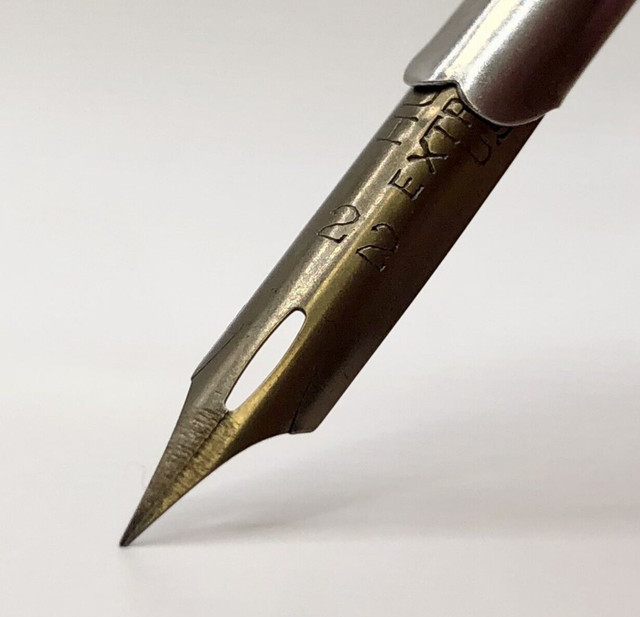
Very close in role to the Gillott 303 — excellent flexibility and thin hairlines — but slightly stiffer and noticeably less prone to catching on textured paper such as Arches hot press. Being currently manufactured rather than deadstock, it’s a more dependable buy for someone who wants 303-like performance without hunting for old Gillott stock.
- Steel nib, current Hunt/Speedball manufacture
- Slightly stiffer than the Gillott 303, still in production
- Sharp point, fine hairlines
- Handles textured paper better than most fine nibs
- Currently manufactured, so supply is far more reliable than Gillott
- Good hairline-to-swell range for intermediate writers
- Tolerates textured paper well
- Needs more pressure than the 303 for the same swell
- Still too flexible for a true beginner

Hunt 101 (Imperial) Nib
One of the most flexible nibs sold for pointed-pen work, capable of dramatic hairline-to-swell contrast — but that same softness makes it a poor first nib for Spencerian specifically. It suits writers who already have pressure control and want more drama in their shading, or who are moving toward Copperplate’s heavier contrast.
- Steel nib, Hunt manufacture
- Very high flex, sharp point
- Best suited to advanced pointed-pen writers
- Standard holder fit
- Dramatic thick-thin contrast
- Responsive to small changes in pressure
- Genuinely versatile once control is established
- Opens too easily for Spencerian’s lighter touch, especially for beginners
- Can catch on the upstroke in inexperienced hands
- Not the nib most Spencerian teachers hand a first-timer
Leonardt Principal EF Nib
A current-production nib designed to reproduce the qualities of the rare, long-discontinued Gillott Principality No. 1 — flexible and fine, but smoother and less prone to catching than most extra-fine nibs. Recommended by penmanship teachers for heavily shaded Spencerian work once a writer is well past the beginner stage.
- Bronze-finish steel nib, current Leonardt (Germany) manufacture
- Flexible, extra-fine point
- Designed to replicate the vintage Gillott Principality No. 1
- Standard holder fit
- Currently manufactured, unlike the vintage nib it’s modeled on
- Smoother and less catch-prone than most extra-fine flexible nibs
- Well suited to heavily shaded, expressive Spencerian capitals
- Too flexible and too fine a point for a first nib
- Costs more than the basic G nibs
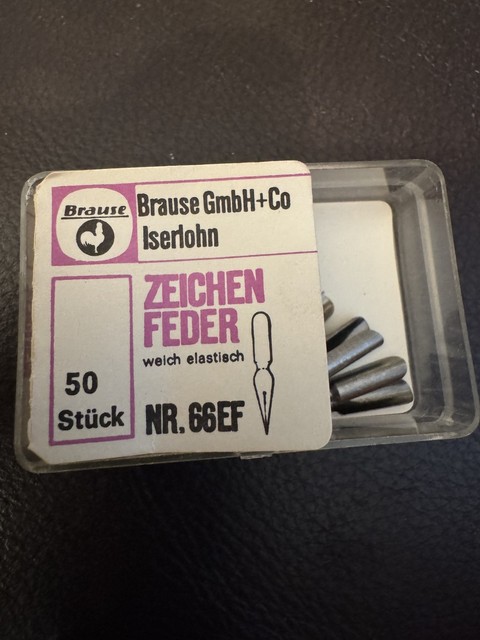
Brause EF66 Nib
A super-flexible German-made nib nicknamed “the Arrow” for its shape, combining strong ink capacity with tines that resist snagging even on textured paper. A favorite among advanced Spencerian and Copperplate writers who want real flex without the catching that plagues most extra-fine nibs — but its small size limits which holders it fits.
- 27.5mm x 4mm steel nib, made by Brause (Germany)
- Very flexible, extra-fine point
- Compact size needs a universal or small nib holder
- High ink capacity for its size
- Handles textured paper better than most flexible extra-fine nibs
- Strong, even ink flow
- Durable tines that resist splitting
- Small size only fits certain nib holders — check compatibility before buying
- Too flexible for a first Spencerian nib
Buying tips
- Start on a stiffer nib — Nikko G, Zebra G or Tachikawa G — before moving to a fully flexible one; Spencerian’s light touch is easier to learn on a nib that physically resists over-shading.
- Wipe a new nib with a little dish soap and water, or press it into a raw potato, before the first use — the factory oil film beads ink instead of holding it.
- Buy Gillott nibs only from calligraphy suppliers who state condition and grind quality, not blind lots on general auction sites — the nibs stopped being made decades ago and deadstock quality varies enormously.
- Pair a Spencerian nib with an oblique holder to match the script’s slant, and check the nib seats snugly before writing a full practice page.
- Retire a nib once the tines split or the point dulls and starts dragging — dip nibs are cheap enough that fighting a worn point wastes more practice time than it saves money.
- Keep two holders loaded at once — one stiffer nib for control drills, one flexible nib for shading drills — so you’re not swapping nibs mid-session.
- Test a new nib’s flex on scratch paper before starting real practice; one that separates at the lightest pressure is going to over-shade Spencerian’s minims.
- Dry nibs off after every session — ink left sitting on the tines corrodes the metal and stiffens the flex within weeks.
As an Amazon Associate and eBay Partner, toptenpick.com earns from qualifying purchases. Prices and availability are subject to change.