

As an Amazon Associate and eBay Partner, toptenpick.com earns from qualifying purchases. Prices and availability are subject to change.
A real PAR meter uses a calibrated quantum sensor to report photon flux density in µmol m⁻² s⁻¹; a lux meter reports light weighted for human vision and a phone app is only as credible as its calibrated external sensor. That difference matters especially under LEDs, whose spectrum may include deep red, blue, or far-red output. The first tier below is for a handheld map of a canopy; the second is for a fixed sensor, computer, Bluetooth logger, or greenhouse system that can record PPFD and DLI over time. Traditional PAR covers 400-700 nm, while ePAR instruments extend to 750 nm to capture far-red used by some newer fixtures.
| # | Product | Price | Where to buy |
|---|---|---|---|
| 1 | Apogee MQ-610 ePAR Meter | $600-$650 | Amazon · eBay |
| 2 | Apogee DLI-600 ePAR, Daily Light Integral and Photoperiod Meter | $500-$550 | Amazon · eBay |
| 3 | Apogee MQ-500 Full-Spectrum Quantum Meter | $525-$575 | Amazon |
| 4 | Apogee SQ-500-SS Full-Spectrum Quantum Sensor | $400-$430 | Amazon · eBay |
| 5 | Apogee SQ-610-SS 400-750 nm ePAR Sensor | $440-$480 | Amazon |
| 6 | Apogee SQ-616 USB Smart ePAR Sensor | $480-$530 | Amazon |
| 7 | Apogee PQ-610 microCache and ePAR Sensor Package | $725-$800 | Amazon |
| 8 | LI-COR LI-250Q PAR Package | $1,400-$1,600 | Amazon |
| 9 | LI-COR LI-1500 Daily Light Integral Package | $3,000-$3,600 | Amazon |
| 10 | LI-COR LI-190R Quantum Sensor with HOBO RX3000 Integration | $470-$1,300+ | Amazon |
| 11 | PHOTOBIO Advanced Quantum PAR Meter (LGBQM2) | $200-$250 | Amazon · eBay |
The picks, in detail

Apogee MQ-610 ePAR Meter
A standalone handheld ePAR meter for growers who need a direct spot reading under LED fixtures that emit far-red. Its detector is designed for 400-750 nm ePAR, so it measures the traditional PAR band plus 700-750 nm photons that a 400-700 nm PAR meter deliberately excludes.
- handheld meter with separate sensor
- 400-750 nm ePAR range
- 0-4,000 µmol m⁻² s⁻¹ measurement range
- Published specifically for LEDs, HPS, MH, sunlight, and far-red photons
- Directional cosine response is specified at ±5% at 75° zenith angle
- Costs substantially more than a basic 400-700 nm PAR meter
- ePAR readings are not directly interchangeable with a traditional PAR-only target without knowing which metric a crop guide uses
Apogee DLI-600 ePAR, Daily Light Integral and Photoperiod Meter
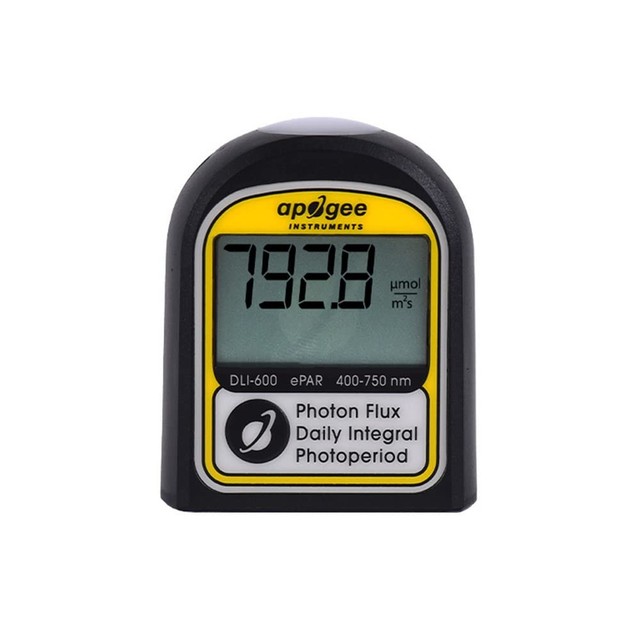
A compact, self-contained ePAR meter for growers who need more than a one-time PPFD spot check. It measures 400-750 nm ePAR, calculates DLI and photoperiod, logs 30-minute PPFD/ePPFD averages, and transfers CSV data over USB-C.
- 400-750 nm ePAR sensor
- DLI and photoperiod calculation
- USB-C CSV export
- Published storage covers 99 days of DLI/photoperiod and 10 days of half-hour PPFD/ePPFD averages
- IP65 enclosure and six-month approximate battery life suit a fixed indoor grow survey
- Three-minute measurement frequency is for light management, not a fast handheld grid map
- Not published as submersible
Apogee MQ-500 Full-Spectrum Quantum Meter
A research-grade handheld traditional-PAR meter with a separate full-spectrum sensor, designed to measure PPFD from LED grow lights as well as sunlight and conventional horticultural sources. Choose it when your target is standard 400-700 nm PPFD rather than far-red-inclusive ePAR.
- handheld meter with separate sensor
- 389-692 nm half-maximum spectral range
- CSV export with optional communication cable
- Published ±5% calibration uncertainty and less than 0.5% repeatability
- Cosine response is specified at ±5% at 75° zenith angle
- Does not count 700-750 nm far-red photons
- Meter body is not described as a permanent remote logger

Apogee SQ-500-SS Full-Spectrum Quantum Sensor
A self-powered analog sensor for a grower who already has a compatible meter, controller, or data-acquisition system. It outputs 0-40 mV for PPFD, covers the traditional full-spectrum PAR band, and is built for fixed canopy, greenhouse, chamber, or aquatic measurement rather than handheld use by itself.
- 0-40 mV self-powered analog output
- 0-4,000 µmol m⁻² s⁻¹ PPFD range
- IP68 sensor housing
- Published as submersible to 30 m, which is useful only where the sensor — not a separate reader — needs wet measurement
- Cosine response is specified at ±5% at 75° zenith angle
- Requires a compatible mV-reading instrument or logger; it is not a complete handheld meter
- Traditional 400-700 nm PAR system does not measure far-red ePAR
Apogee SQ-610-SS 400-750 nm ePAR Sensor
An analog ePAR sensor for permanent or custom logger installations where far-red is part of the LED recipe. It is a sensor rather than a reader, measuring the 400-750 nm range and sending its signal to compatible measurement hardware.
- 400-750 nm ePAR sensing
- self-powered analog sensor format
- four-year Apogee warranty
- Captures the far-red band some next-generation LED fixtures emit
- Lets a grow-room automation or research logger use a dedicated calibrated sensor instead of converting lux
- Needs a compatible reader or data logger
- More setup work than a complete handheld MQ meter
Apogee SQ-616 USB Smart ePAR Sensor
A USB ePAR sensor that connects directly to Windows or macOS for spot readings, graphs, and real-time data logging. It also stores up to 10,000 periodic readings when powered from a standard 5V USB source, making it a practical bridge between a handheld check and a fixed logger.
- 400-750 nm ePAR range
- direct USB connection
- 10,000-reading internal memory
- Included software supports real-time PPFD graphing and data logging
- Published rugged aluminum sensor housing is fully submersible
- Requires a computer or USB-power logging setup instead of offering an integrated screen
- Far-red-inclusive ePAR must be interpreted separately from PAR-only crop charts
Apogee PQ-610 microCache and ePAR Sensor Package
A self-contained Bluetooth logging system that pairs an SQ-610 ePAR sensor with Apogee’s microCache logger, sensor platform, spare battery, and protective case. It is designed for monitoring total photon flux over time rather than walking a grow tent with a display meter.
- SQ-610 400-750 nm ePAR sensor
- microCache Bluetooth micro-logger
- sensor platform and protective case included
- Complete sensor-and-logger bundle avoids sourcing a compatible analog reader separately
- Useful for a fixed point where time-series intensity is more important than quick spot checks
- No integrated handheld display for immediate canopy mapping
- Short 30 cm sensor cable is less flexible than a long remote lead
LI-COR LI-250Q PAR Package
A professional spot-measurement package containing LI-COR’s LI-250A light meter, LI-190R quantum sensor, and 2003S mounting and leveling fixture. The LI-190R measures traditional 400-700 nm PAR and LI-COR publishes it for sunlight, artificial light, and mixed light in greenhouses and growth chambers.
- LI-250A handheld light meter
- LI-190R 400-700 nm quantum sensor
- 2003S mounting and leveling fixture
- Complete professional system with a proper leveling fixture rather than an improvised sensor position
- LI-COR states the LI-190R works with emerging LED systems without correction factors
- Quote-level professional pricing is far above consumer meters
- Traditional PAR sensor does not quantify the 700-750 nm far-red ePAR band
LI-COR LI-1500 Daily Light Integral Package
A long-term monitoring system pairing the LI-190R quantum sensor with an LI-1500 light-sensor data logger and a leveling fixture. It continuously measures PAR and automatically calculates DLI, so it suits a research or commercial grow where a single instantaneous PPFD value is not enough.
- LI-190R quantum sensor
- LI-1500 logger connects up to three sensors
- automatic DLI calculation
- Captures the time component that a handheld PPFD snapshot misses
- LI-COR publishes factory calibration with a recommended two-year recalibration interval for LI-190R sensors
- Professional system is not economical for occasional home-garden spot checks
- Requires planned sensor placement and a logger workflow
LI-COR LI-190R Quantum Sensor with HOBO RX3000 Integration
A remote-monitoring route for a fixed grow environment: the LI-190R measures 400-700 nm PAR, while a HOBO analog module or wireless Analog Mote connects it to an RX3000 station. This is a sensor system, not a handheld meter, and it requires the published amplifier, mounting fixture, and logger components.
- LI-190R 400-700 nm PAR sensor
- wired or wireless HOBOnet integration
- weatherproof anodized-aluminum sensor body
- Supports continuous remote monitoring rather than manual readings
- LI-COR calibration data can be retrieved by serial number and factory recalibration is available
- Sensor price excludes the required amplifier, leveling fixture, and RX3000/HOBOnet hardware
- System complexity makes it a poor fit for a one-time LED-height adjustment

PHOTOBIO Advanced Quantum PAR Meter (LGBQM2)
A lower-cost dedicated handheld PAR instrument with a remote sensor for indoor horticulture. PHOTOBIO describes its LGBQM2 as measuring 400-700 nm PAR from LED, HPS, and other grow lights, with storage for up to 99 readings for comparing fixture height and dimmer settings.
- remote quantum sensor with handheld reader
- 400-700 nm PAR measurement
- stores up to 99 readings
- Remote sensor and long cable make it easier to place the sensor flat at canopy level
- Observed retail listing identifies the current LGBQM2 model at a substantially lower price than research-grade systems
- Published material here does not establish an ePAR/far-red measurement range
- No published waterproof or calibration-service claim was found, so do not treat it as an underwater or long-term unattended logger
Buying tips
- Map PPFD at several points across the actual canopy plane, with the sensor level, before changing fixture height or dimmer output. A center reading alone cannot reveal edge falloff.
- Use the metric the crop plan specifies. Standard PPFD/PAR is 400-700 nm; ePPFD/ePAR extends to 750 nm, so far-red fixtures can produce intentionally different readings.
- Do not convert a phone-camera or lux-meter reading into PAR as if it were a calibrated quantum-sensor measurement. If you need repeatable decisions, use a calibrated sensor and follow its stated recalibration route.
As an Amazon Associate and eBay Partner, toptenpick.com earns from qualifying purchases. Prices and availability are subject to change.