

As an Amazon Associate and eBay Partner, toptenpick.com earns from qualifying purchases. Prices and availability are subject to change.
Orchid grow lights are sold on the wrong number. Listings lead with wattage, sometimes with lumens, occasionally with a made-up “equivalent” figure. None of those tell you what a plant experiences. The measurement that matters is PPFD — photosynthetic photon flux density, the count of usable photons landing on the leaf, quoted at a stated distance. A panel advertised at 100 watts might deliver 400 µmol/m²/s at 12 inches and 90 at 24. Without the distance, the number is meaningless.
This matters more for orchids than for almost any other houseplant, because most popular orchids want far less light than the panels aimed at them deliver. Phalaenopsis — the supermarket orchid, and the one most people are buying a light for — is a low-light epiphyte that grows under a canopy. The American Orchid Society’s guidance is around 1,000 foot-candles, with roughly 1,500 as an upper limit. In PPFD terms the optimum sits around 100 to 500 µmol/m²/s, and commercial growers target a daily light integral of about 4 to 6 mol/m²/day for reliable blooming. Those are modest numbers. A high-output panel designed for fruiting vegetables will comfortably exceed them and bleach the leaves.
So the failure mode in this hobby is rarely too little light. It is a bright panel too close, running for too few hours. Duration is the lever most people do not pull. A gentler light for 12 to 14 hours accumulates the same daily total as a harsh one for 6, and it does so without scorching. Daily light integral is intensity multiplied by time, and orchids are far more tolerant of the time axis than the intensity axis.
One more thing worth knowing before you shop: light is not what triggers a Phalaenopsis to spike. A night-time temperature drop of roughly 10 °F for a few weeks in autumn is the usual trigger. A grow light that also warms the room can work against you there. The picks below cover lights from a single-plant clip lamp to a proper shelf setup, plus the meter that turns all of this from guesswork into a reading.
| # | Product | Price | Where to buy |
|---|---|---|---|
| 1 | Full-Spectrum White LED Clip Lamp | $20-$45 | Amazon · eBay |
| 2 | LED Grow Light Bar (2 ft or 4 ft) | $30-$80 | Amazon · eBay |
| 3 | Quantum Board LED Panel, 60-100 W | $60-$150 | Amazon · eBay |
| 4 | T5 Fluorescent Grow Light Fixture | $50-$120 | Amazon · eBay |
| 5 | Adjustable Plant Shelf with Integrated Lighting | $90-$250 | Amazon · eBay |
| 6 | PAR / PPFD Light Meter | $30-$250 | Amazon · eBay |
| 7 | Digital Timer or Smart Plug | $10-$30 | Amazon · eBay |
| 8 | Adjustable Hanging Kit with Ratchet Hangers | $10-$25 | Amazon · eBay |
| 9 | Digital Thermometer and Hygrometer | $10-$30 | Amazon · eBay |
| 10 | Humidity Tray or Small Room Humidifier | $15-$60 | Amazon |
The picks, in detail

Full-Spectrum White LED Clip Lamp
The right starting point for one or two orchids on a desk or a sill. A gooseneck clip lamp with a full-spectrum white LED head lets you set the distance precisely, which is the variable that actually controls intensity — and being able to move it back six inches is more useful than any spec on the box. Choose white rather than blurple: you can see the plant’s real colour, spot a problem early, and live with the light in a room. For a single Phalaenopsis this is usually all that is needed.
- Full-spectrum white LEDs
- Flexible gooseneck for precise positioning
- Clamp base for shelves, sills and headboards
- Built-in timer on most models
- Distance is easy to adjust, which is the real control
- White light shows true leaf colour
- Cheap enough to buy two for a pair of plants
- Covers only one or two plants
- Cheap clamps lose their grip over time
LED Grow Light Bar (2 ft or 4 ft)
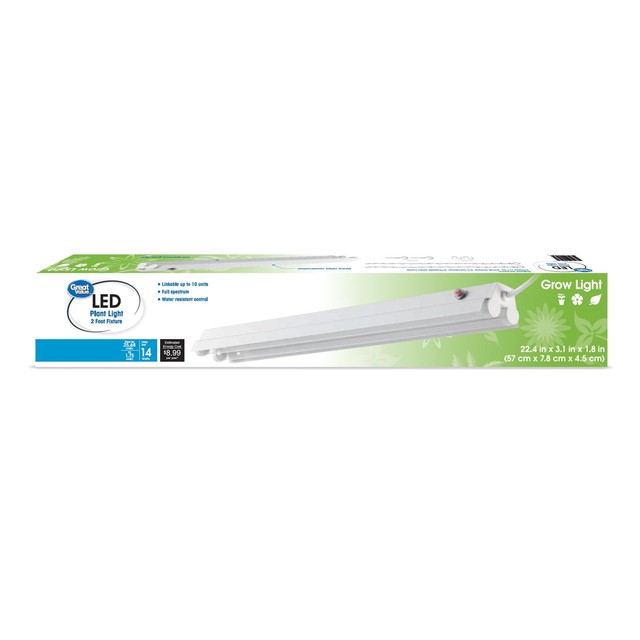
A linear bar is the most sensible format for orchids, because orchids are grown in rows on shelves rather than in a dense canopy. A 2 ft or 4 ft bar spreads a moderate intensity evenly across a whole shelf instead of concentrating it under one hot spot, which suits the low-to-medium light levels Phalaenopsis and Paphiopedilum want. Most bars are linkable, so one power supply can drive several. Look for the PPFD quoted at 12 and 18 inches; a bar delivering 100 to 300 at 12 inches is in the right territory.
- Linear format matching a shelf
- Linkable — several bars on one supply
- Even spread with no central hot spot
- Slim enough to mount under a shelf above
- Even coverage suits orchid growing better than a panel
- Scales one shelf at a time
- Low profile and unobtrusive
- Needs mounting hardware or chains
- Cheaper bars publish no PPFD figures at all

Quantum Board LED Panel, 60-100 W
The format everyone recognises, and the one most likely to be too much light for an orchid if used as instructed. A quantum board spreads its diodes across a flat surface rather than clustering them, which gives good uniformity — but the output is aimed at plants that fruit, not epiphytes that live under a canopy. Bought for orchids it should be hung high, dimmed if it has a dimmer, and measured. Worth buying if you are growing a mixed collection including higher-light Cattleyas and Vandas, where the headroom is genuinely useful.
- Flat board with distributed diodes
- 60-100 W typical, often dimmable
- Wide, uniform coverage area
- Passive cooling, no fan noise
- Enough output for high-light genera like Cattleya and Vanda
- Excellent uniformity across a large area
- Silent, with no moving parts
- Easy to over-light a Phalaenopsis with one
- Needs real hanging height, so not a windowsill solution
T5 Fluorescent Grow Light Fixture
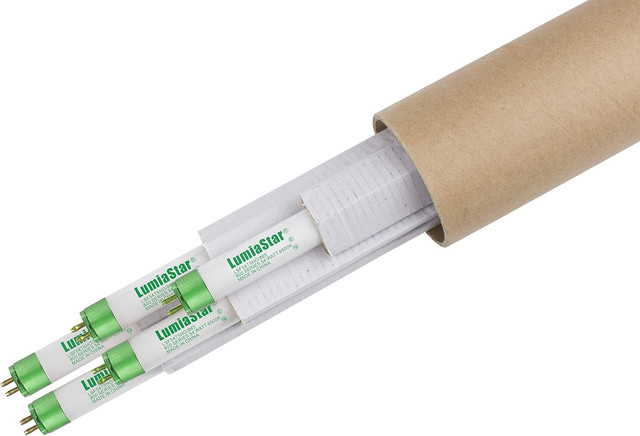
The format orchid growers used for decades before LEDs, and still a very good answer. T5 tubes produce a broad, diffuse, low-intensity light that is close to ideal for low-light orchids — hard to scorch anything with, and cheap to replace. They run warm, which is a mild negative in summer and useful in a cold conservatory. The real drawbacks are running cost and tube replacement every year or two as output fades. For a large shelf of Phalaenopsis, a four-tube T5 is still hard to beat on evenness.
- Two or four T5 high-output tubes
- Very even, diffuse coverage
- Replaceable tubes in a range of colour temperatures
- Reflector housing included
- Gentle intensity, very hard to burn leaves with
- Excellent uniformity over a wide shelf
- Low purchase price
- Uses noticeably more electricity than LED for the same output
- Tubes fade and need replacing every year or two
Adjustable Plant Shelf with Integrated Lighting
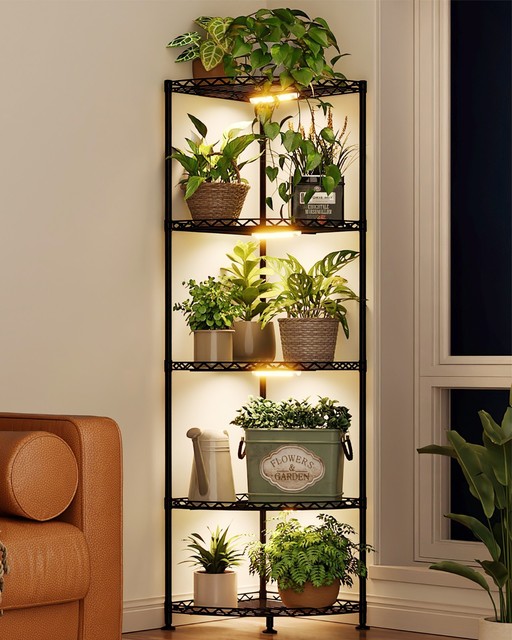
For a collection rather than a plant. A multi-tier shelf with lights fitted under each level uses vertical space efficiently and gives every shelf its own controllable light, which matters because different genera want different intensities — Phalaenopsis low, Cattleya high — and a single overhead source cannot provide both. Look for adjustable shelf heights, since raising or lowering a shelf is the easiest way to change the distance to the light above it, and distance is your main intensity control.
- Three or four tiers with lights on each
- Height-adjustable shelves
- Often includes a multi-outlet timer
- Water-resistant trays on better models
- Different light levels for different genera
- Efficient use of floor space
- Adjusting shelf height adjusts intensity directly
- Integrated lights are often mediocre and hard to replace
- Assembly is a project rather than a task
PAR / PPFD Light Meter
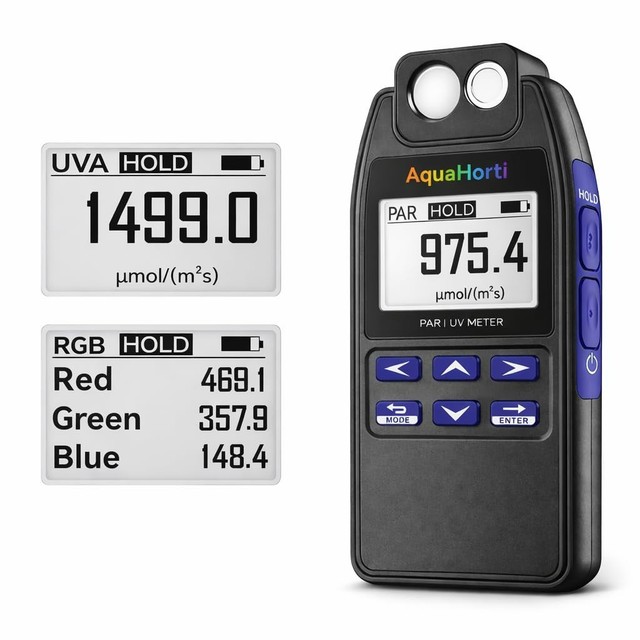
The item that turns this whole article from theory into numbers. A PAR meter reads the photon flux actually reaching your leaves, so you can move a light until you are in the 100 to 500 µmol/m²/s band rather than guessing from a marketing figure. Dedicated meters are expensive; smartphone-based sensors and calibrated apps have got good enough for hobby use and cost a fraction. If you have ever wondered whether your plants are under-lit or scorching, this is the single purchase that answers it.
- Reads PPFD in µmol/m²/s
- Handheld or smartphone-attached sensor
- Some models calculate daily light integral
- Works under any light source
- Replaces guesswork with a measurement
- Lets you position any light correctly
- Reveals how little light a shaded windowsill really gets
- Accurate dedicated meters are expensive
- Cheap sensors are calibrated for specific spectra and drift on others

Digital Timer or Smart Plug
Duration is the lever most orchid growers never pull, and a timer is how you pull it. Twelve to fourteen hours a day, every day, year-round, gives a low-light orchid the daily total it needs without ever approaching the intensity that burns leaves. Doing that by hand fails within a week. A basic mechanical timer works; a smart plug adds scheduling, seasonal changes and a record of whether the light actually came on. Either costs less than a single orchid.
- Daily repeating schedule
- Mechanical, digital or Wi-Fi smart versions
- Multiple on/off periods on digital models
- Manual override
- Makes a long, gentle photoperiod effortless
- Cheaper and more effective than a brighter light
- Smart versions log that the schedule actually ran
- Mechanical timers lose their setting after a power cut
- Smart plugs need a working Wi-Fi network

Adjustable Hanging Kit with Ratchet Hangers
Unglamorous and genuinely important, because distance is your intensity control and you will want to change it. Ratchet hangers let you raise or lower a fixture by an inch at a time with one hand, which means you can respond to a plant that is reddening or stretching without unbolting anything. Buy a pair rated well above the weight of your fixture — the failure mode is a light landing on a collection of orchids, and the price difference between adequate and generous is a couple of dollars.
- Pair of ratchet hangers with carabiners
- Typically rated to 75 lb or more per pair
- One-handed height adjustment
- Fits any fixture with hanging points
- Makes intensity adjustment a two-second job
- Far more precise than chain links
- Cheap and reusable across fixtures
- Needs a solid anchor point above
- Cheap ratchets can slip under load
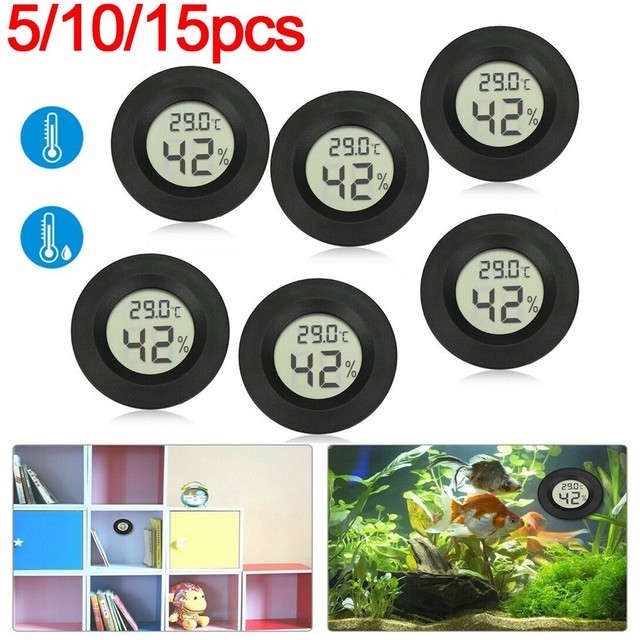
Digital Thermometer and Hygrometer
Directly relevant to lighting, for a reason people miss: a Phalaenopsis is triggered to spike by a night-time temperature drop of roughly 10 °F sustained for a few weeks in autumn, not by more light. A grow light adds heat, and a light left on late can flatten exactly the drop you are trying to create. A cheap min/max thermometer tells you what your night temperature is actually doing. Humidity matters too — most orchids want considerably more than a heated room provides in winter.
- Min/max temperature recording
- Relative humidity reading
- Remote probe on some models
- Wireless models log to a phone
- Reveals whether the night-time drop is really happening
- Diagnoses the humidity problem behind many orchid failures
- Very cheap
- Cheap hygrometers can read several points out
- Needs checking in the plant’s position, not across the room
Humidity Tray or Small Room Humidifier
Grow lights dry the air around a plant, and orchids are mostly epiphytes that expect considerably more humidity than a centrally heated room delivers in winter. A pebble tray under the pots helps a little; a small ultrasonic humidifier helps a great deal and is the difference between a collection that grows and one that merely survives. Pair it with the hygrometer above rather than running it blind — over-humidifying a closed room with poor air movement invites rot, which is a worse problem than dry air.
- Pebble trays or ultrasonic humidifiers
- Adjustable output on better humidifiers
- Some models take a humidistat
- Quiet enough for a living room
- Directly offsets the drying effect of lights and heating
- Visible improvement in root and leaf condition
- Humidifiers are cheap and widely available
- Needs air movement alongside it or rot becomes a risk
- Ultrasonic units leave mineral dust unless filled with distilled water
Buying tips
- Shop on PPFD at a stated distance, not watts or lumens. Watts describe electricity consumed, lumens describe brightness to a human eye, and neither describes what a leaf receives. PPFD in µmol/m²/s at a quoted height is the only number that transfers between products. A seller who will not publish it is usually hiding a disappointing figure.
- Phalaenopsis want far less light than most panels deliver. The American Orchid Society’s guidance is around 1,000 foot-candles with roughly 1,500 as a ceiling — about 100 to 500 µmol/m²/s in PPFD terms. A high-output panel exceeds that easily. If you only grow supermarket orchids, buy a gentle light, or hang a strong one high and dim it.
- Use duration rather than intensity to increase the daily total. Daily light integral is intensity multiplied by hours, and orchids tolerate the hours axis far better than the intensity axis. Twelve to fourteen hours of moderate light beats six hours of harsh light for the same total, and it cannot scorch a leaf. A timer costs less than a brighter fixture and works better.
- Read the leaves — they report the light level before you do. Healthy Phalaenopsis foliage is a medium grass green. Dark, floppy, deep green leaves mean too little light. Yellowish, reddish-tinged or bleached patches mean too much, and red tinging is the early warning that appears before actual scorching. Adjust the height a few inches at a time and give it two weeks.
- Light is not what makes a Phalaenopsis spike. The usual trigger is a night-time temperature drop of about 10 °F sustained for several weeks in autumn. Piling on more light in the hope of flowers does nothing except risk burning the plant. Check your night temperature with a min/max thermometer before changing anything about the lighting.
- Choose white light over blurple unless you have a reason not to. Full-spectrum white LEDs grow orchids perfectly well, and they let you see the plant’s actual colour — which is how you catch the leaf-colour warnings above. Red-and-blue fixtures make everything look magenta and hide exactly the symptoms you need to notice. They are also unpleasant to live with.
- Distance is your intensity dial, so make it easy to change. Light falls off sharply with distance, which means moving a fixture a few inches changes the PPFD a great deal. Ratchet hangers or an adjustable shelf turn that into a two-second adjustment. A light bolted at a fixed height gives you no way to respond to what the plant tells you.
- Give the plants air movement, especially under lights. Lights add heat, heat plus still air plus added humidity is how crown rot and fungal spotting start, and orchids in nature sit in constant moving air. A small clip fan on the far side of the shelf, running gently, solves it. This is the one addition most indoor growers skip and most later wish they had made.
As an Amazon Associate and eBay Partner, toptenpick.com earns from qualifying purchases. Prices and availability are subject to change.