

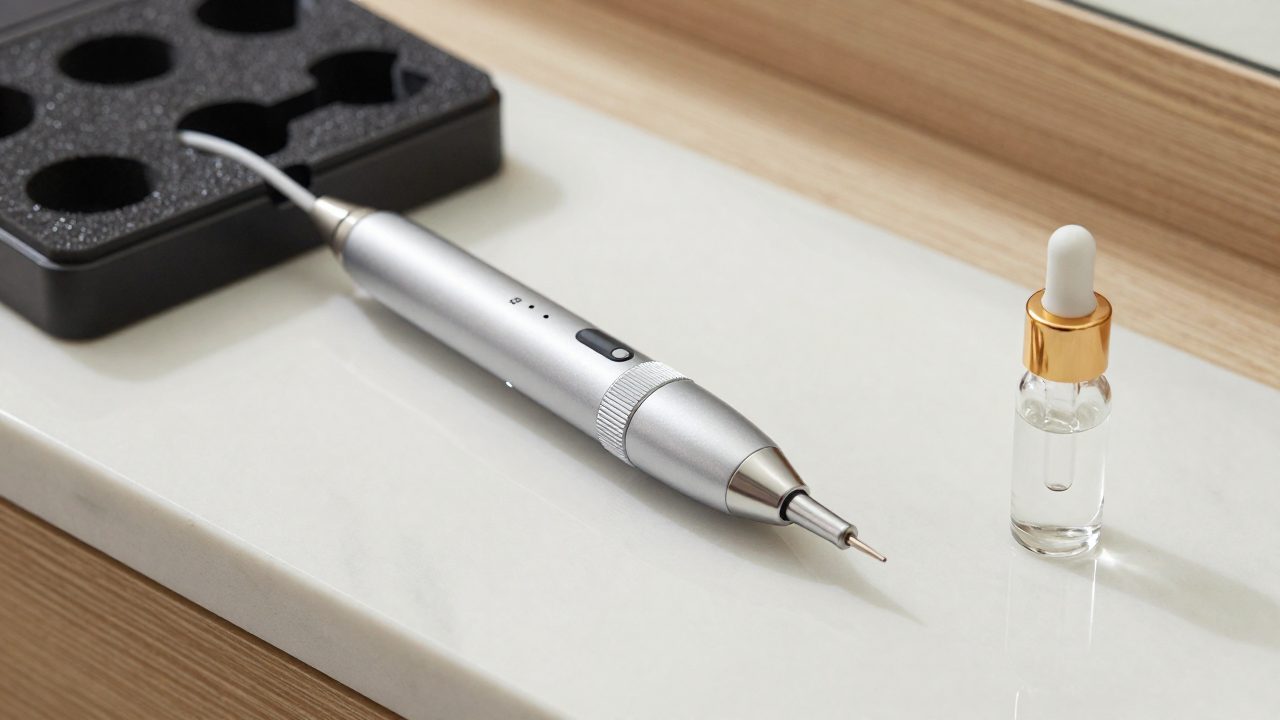
If you have landed here looking for the best hyaluronic acid filler to load into a hyaluron pen, this guide is going to disappoint you in a specific and deliberate way: we are not going to recommend one. Not because we could not find products — they are sold openly online — but because the US Food and Drug Administration has issued a direct safety communication telling both consumers and health professionals not to use these devices at all. That is not a nuance to be worked around with a better brand of gel. It is the whole answer to the question.
What a hyaluron pen actually is
A hyaluron pen is a spring- or pressure-loaded device that fires a fine jet of hyaluronic acid gel through the skin without a needle. It was originally a delivery concept borrowed from needle-free injection systems, and it has been marketed for lip volume, fine lines and cheek filling as a cheaper, less intimidating alternative to conventional dermal filler injections.
The marketing pitch is that no needle means less risk. The regulatory reality is the opposite.
The FDA position
In October 2021 the FDA issued a safety communication advising consumers and health care providers not to use needle-free devices such as hyaluron pens for the injection of hyaluronic acid or any other lip and facial filler. The agency’s stated reasons are worth reading plainly:
- The FDA has received reports of serious injuries, and in some cases permanent harm, to skin, lips and eyes from needle-free filler devices.
- Documented harms include bleeding, bruising, infection, scarring, skin discolouration, lumps under the skin, allergic reactions, eye injury, and blocked blood vessels that can lead to tissue death, blindness or stroke.
- The FDA has not evaluated the safety or effectiveness of any needle-free device for injecting any dermal filler.
- None of the hyaluronic pens on the market appear to correspond to an FDA premarket notification, and their manufacturers do not appear to have applied for one.
The agency’s advice to consumers is equally direct: do not undergo a filler procedure performed with a needle-free device, do not buy lip or facial fillers sold directly to the public, and do not inject yourself or anyone else with them.
Why “which gel is best” is the wrong question
Two separate problems stack here, and improving one does nothing about the other.
The device is uncontrolled
A needle placed by a trained injector goes to a known depth in a known plane. A pressurised jet does not — the depth it reaches depends on skin thickness, the angle of the device and how the pressure happens to release. That variability is the mechanism behind the lumps, the scarring and, at worst, gel entering a blood vessel. The most serious filler complication, vascular occlusion, is a medical emergency that can end in tissue loss or permanent vision damage, and it is treated with an enzyme (hyaluronidase) that a home user will not have to hand and would not know when to use.
The gel is unregulated
FDA-approved dermal fillers are prescription medical devices, sold to licensed practitioners, manufactured sterile, and traceable by lot. Hyaluronic acid gel sold direct-to-consumer for pen use sits outside that system entirely: there is no meaningful assurance of sterility, cross-linking chemistry, particle size or what else is in the syringe. Picking the “best” one is choosing between products none of which have been assessed for this use by anyone.
What to do instead
If you want filler results
See a licensed medical practitioner who injects FDA-approved hyaluronic acid fillers with a needle or cannula. The established product families — Juvéderm, Restylane, Belotero and RHA among them — are approved devices with published safety data, and a qualified injector carries hyaluronidase to dissolve the filler if something goes wrong. That last point is the real difference: not that complications never happen in a clinic, but that a clinic can reverse them. Ask about the injector’s licence and training, and about what happens if you are unhappy with the result.
It is also worth knowing that in many US states and in numerous other countries, injecting dermal filler is a restricted medical act. A non-licensed person offering hyaluron pen treatments — including at a salon or from home — may be practising medicine without a licence regardless of the device used.
If you want hyaluronic acid for your skin
Topical hyaluronic acid is a completely different product and carries none of this risk. It is a humectant: it holds water at the skin surface, which makes skin look plumper and smoother while it is hydrated. It does not add volume the way filler does, and it does not last — but it is cosmetic, widely available, and there is no injection involved. Look for serums that pair hyaluronic acid with an occlusive moisturiser on top, since HA on its own can dry out further in low humidity. Apply to damp skin, then seal it.
If you want lip volume without injections
Lip plumping products that use mild irritants such as cinnamon or capsaicin cause temporary swelling, and makeup techniques using liner and light-reflecting gloss are genuinely effective at the level of appearance. Neither is dramatic, both are reversible, and neither can cause vascular occlusion.
If you have already used one
Watch for warning signs in the hours and days afterwards: blanching or whitening of the skin, pain out of proportion to the procedure, mottled or dusky discolouration, any change in vision, or spreading swelling and redness. Any of these warrants urgent medical attention rather than waiting to see whether it settles. Take the product packaging with you if you have it — knowing what was injected helps.
The bottom line
There is no best hyaluronic acid for a hyaluron pen, because the regulator that assesses these products has assessed the delivery method and told people not to use it. If the appeal was the lower price, the honest comparison is not filler-in-a-clinic versus filler-from-a-pen — it is a clinic visit versus the cost and consequences of a vascular complication treated in an emergency room. That is the trade the FDA warning is describing.