

As an Amazon Associate and eBay Partner, toptenpick.com earns from qualifying purchases. Prices and availability are subject to change.
Start with the awkward question, because it decides whether you should buy anything at all: powered speakers already contain their own amplifiers, crossovers and limiters. A lot of what a loudspeaker management processor exists to do — split the signal, protect the drivers, keep the amp inside its limits — is already happening inside the box. What a processor still buys you on a powered rig is room EQ, feedback suppression, delay alignment between mains and subs, and one place to store settings for each room you play. dbx currently sells three DriveRack models and only one of them is built for this job; below are all three plus the genuine alternatives across the price range, from a $225 miniDSP to a $5,700 Lake. Read the buying tips first — for a fair number of powered setups the honest answer is a mixer preset and no rack box at all.
| # | Product | Price | Where to buy |
|---|---|---|---|
| 1 | dbx DriveRack PX | $350-$450 | Amazon · eBay |
| 2 | dbx DriveRack PA2 | $600-$700 | Amazon · eBay |
| 3 | dbx DriveRack VENU360 | About $1,290 street (list around $1,612) | Amazon · eBay |
| 4 | Behringer DCX2496 Ultradrive Pro | $250-$450 used | Amazon · eBay |
| 5 | miniDSP 2×4 HD | About $225 | Amazon · eBay |
| 6 | miniDSP Flex | $400-$600 depending on variant | Amazon · eBay |
| 7 | Ashly AQM408 | About $999 (list around $1,249) | Amazon · eBay |
| 8 | Ashly AQM1208 | About $1,499 (list around $1,874) | Amazon · eBay |
| 9 | Xilica XP Series (XP-2040, XP-3060, XP-4080) | $800-$1,400 depending on I/O | Amazon |
| 10 | Peavey VSX 26E | $400-$600 | Amazon · eBay |
| 11 | Lab.gruppen Lake LMX 44 / LMX 88 | $4,099-$5,700 | Amazon · eBay |
The picks, in detail

dbx DriveRack PX
The one dbx actually built for this. The PX is named the Powered Speaker Optimizer and is configured around the assumption that the amps are already in the cabinets — 2 in, 4 out, with speaker tunings and setup wizards aimed at a mains-and-subs powered rig.
- 2 inputs, 4 outputs
- Auto-EQ and setup wizard
- AFS advanced feedback suppression
- Speaker tunings for common powered cabinets
- Sub/mains crossover and alignment delay
- Compressor and limiter
- Purpose-built for powered speakers rather than adapted from an amp-rack processor — the setup wizard asks the right questions
- The cheapest DriveRack, and the one whose feature set you will actually use on a self-powered system
- AFS is the single most useful feature here for a live vocal rig
- 2-in/4-out is a hard ceiling — no good if you need more than mains plus a sub pair
- Fewer routing options than the PA2 or VENU360 if your needs grow
- Duplicates limiting your powered boxes are already doing
dbx DriveRack PA2
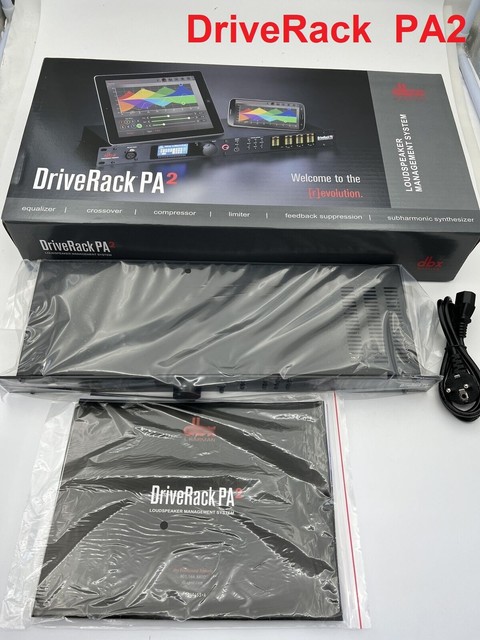
The one most people mean by DriveRack. 2 in, 6 out, with the AutoEQ wizard and RTA microphone workflow that made the line famous, plus Wi-Fi setup from a phone or tablet at the mix position.
- 2 inputs, 6 outputs
- AutoEQ with supplied RTA microphone
- AFS feedback suppression
- Wi-Fi control from iOS, Android, Mac and PC
- Setup wizard with a library of speaker tunings
- Subharmonic synth, compressor, limiter, delay
- Wi-Fi control means you tune from where the audience sits, not from behind the rack — a real workflow difference
- The largest speaker-tuning library of anything at this price
- Six outputs leave headroom for adding fills or a second sub zone later
- Roughly double the PX for capability a two-way powered rig will not use
- The AutoEQ result is a starting point, not a finished tuning — treat it as such
- Wi-Fi module is fiddly in RF-dense venues
dbx DriveRack VENU360
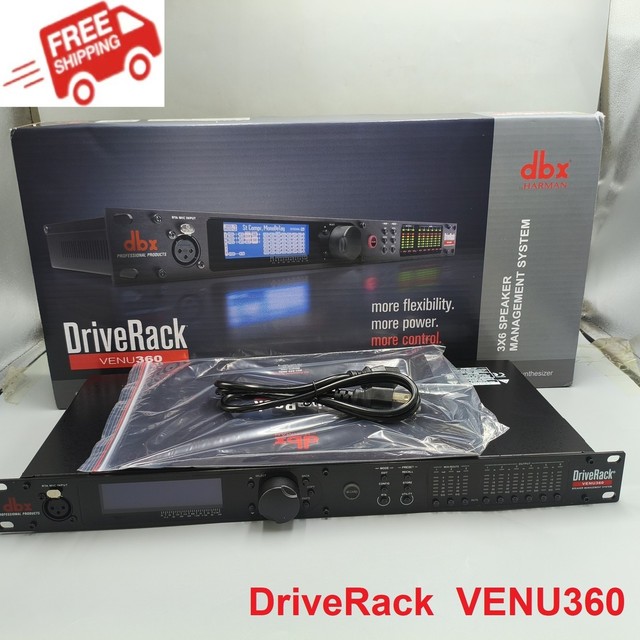
The top of the line and the one that turns up on real touring racks: 3 in, 6 out, with the same wizard workflow but far deeper routing, and a reputation among users for sounding better than processors costing several times more.
- 3 inputs, 6 outputs
- AutoEQ, AFS and full setup wizard
- Front-panel and remote control over Ethernet
- Extensive crossover, PEQ, delay and limiting per output
- Speaker tuning library
- Security lockout for installed systems
- Third input matters more than it sounds — a separate feed for delay fills, monitors or a zone
- Widely regarded as sounding better than several considerably more expensive processors
- Rugged enough for install and touring duty, with lockout for fixed systems
- List is around $1,612 and street around $1,290, which is a lot of processor in front of self-powered boxes
- The routing depth is wasted on a simple mains-and-sub rig
- Steeper learning curve than the PX or PA2

Behringer DCX2496 Ultradrive Pro
The long-running value benchmark. 24-bit/96 kHz processing, AES/EBU digital input and flexible routing, at a fraction of what comparable processing cost when it launched — and still the reference people compare cheap processors against.
- 24-bit / 96 kHz processing
- 3 in, 6 out
- AES/EBU digital input with external sample-rate lock
- Extensive parametric EQ per input and output
- Crossover, delay, limiter per output
- Full front-panel editing
- Hard-to-beat value — the price-to-capability ratio is still the best here
- The AES/EBU input and external clock lock are rare at any price near this
- Deep enough for a fixed install or a permanently configured rig
- Discontinued — you are buying used or old stock, so check condition and firmware before committing
- No wizard, no RTA mic, no auto-EQ; you configure everything by hand
- Fan noise and build quality are the usual complaints
miniDSP 2×4 HD
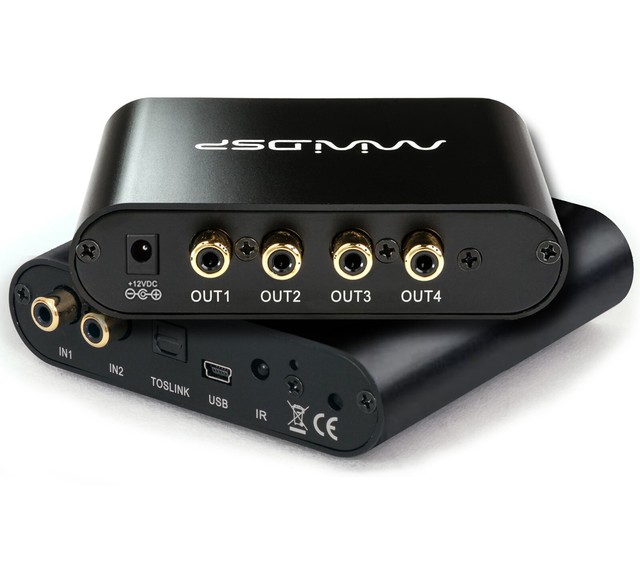
The cheapest genuinely capable option, and the right answer for a small powered rig, a studio or a home setup. All configuration happens on a computer rather than a front panel, which is why it costs a fraction of a rack unit.
- 2 in, 4 out
- 24-bit / 96 kHz processing
- USB audio input as well as analogue
- Crossovers, PEQ, delay and gain per output
- Configured entirely from miniDSP’s plugin software
- Very compact, non-rack form factor
- Around $225 buys real DSP — nothing else here comes close on price
- USB input makes it genuinely useful in a studio or desktop context, not just live
- Small enough to mount inside a cabinet or under a desk
- No front-panel control at all — you need a laptop to change anything
- No feedback suppression, no auto-EQ, no RTA mic
- Not built for the abuse of a gigging rack
miniDSP Flex
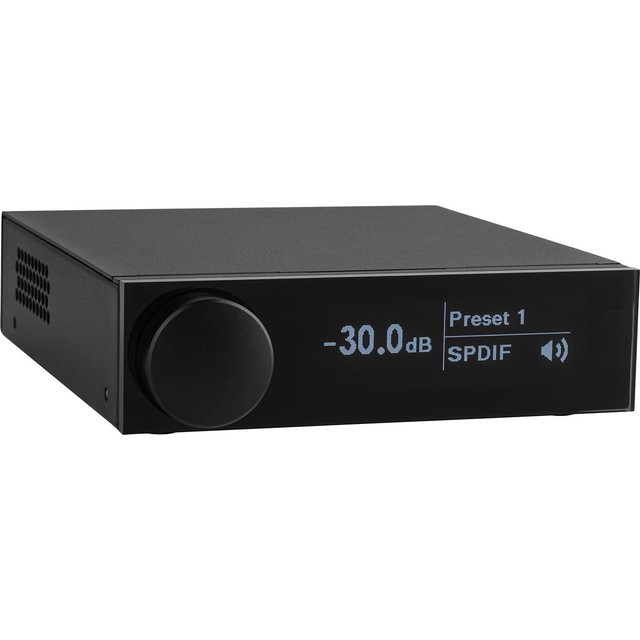
The step up from the 2×4 HD, with a proper display and more input options. It sits in the gap between a hobbyist DSP box and a full rack processor.
- Front-panel display and encoder
- Analogue, USB and (on some variants) digital and Dirac-enabled inputs
- Crossovers, PEQ, delay and limiting
- Multiple configuration presets
- Compact desktop chassis
- Front-panel control fixes the 2×4 HD’s main limitation
- Dirac Live room correction is available on the appropriate variant — genuinely powerful room EQ
- Better converters than the cheaper miniDSP boxes
- Several variants with confusingly similar names — check exactly which inputs and licences you are buying
- Still not a rack-mount live-sound tool
- Costs enough that a used DriveRack becomes a fair comparison

Ashly AQM408
An install-grade 4×8 digital matrix speaker and zone processor. Where the DriveRack thinks in terms of one system, the AQM thinks in terms of zones — the right shape for a venue, a house of worship or a multi-room bar.
- 4 inputs, 8 outputs
- Matrix routing with independent zone processing
- Full crossover, PEQ, delay, dynamics per output
- Network control and configuration software
- Install-oriented security and lockout
- True matrix routing — any input to any output at any level, which no DriveRack does
- Ashly’s install reputation and support are a step above the consumer-facing brands
- Around $999 against a $1,249 list makes it competitive with the VENU360 while doing more
- Aimed at fixed installation; overkill and over-complex for a band’s powered mains
- No auto-EQ wizard or bundled RTA microphone
- Configuration assumes you know what you are doing

Ashly AQM1208
The larger AQM — twelve inputs to eight outputs — for installations where the input count is the constraint rather than the output count.
- 12 inputs, 8 outputs
- Full matrix routing and zone processing
- Crossover, PEQ, delay and dynamics per output
- Network configuration and control
- Rack-mount install chassis
- Twelve inputs covers a venue with multiple sources without an outboard mixer in front
- Same processing quality and software as the AQM408
- Around $1,499 against a $1,874 list is reasonable for this input count
- Comfortably the wrong tool for a portable powered PA
- Price only makes sense if you genuinely need the input count
- Install-oriented, so expect a configuration session rather than a wizard
Xilica XP Series (XP-2040, XP-3060, XP-4080)
The specifier’s choice, now under the same ownership as Ashly. A 96 kHz, 40-bit floating-point DSP engine with configurations from 2×4 up to 8×8, controlled through XConsole software or the front panel.
- 96 kHz, 40-bit floating-point DSP engine
- 24-bit converters
- I/O options from 2×4 through 3×6, 4×8 and 8×8
- Up to 650 ms delay, IIR filters, GEQ and PEQ
- Ethernet, USB and RS232 control
- Front-panel or XConsole configuration
- 40-bit floating-point processing is a genuinely higher spec than most of this list
- The I/O ladder means you buy exactly the channel count you need
- RS232 and Ethernet control make it easy to integrate into a wider control system
- Sold through AV specialists rather than music retailers, so pricing and support are less transparent
- No auto-EQ or feedback suppression — this is a tool, not a wizard
- Model naming across the XP range is easy to get wrong; confirm the I/O count before ordering

Peavey VSX 26E
A 2-in/6-out processor from a brand with deep live-sound roots and an easy return path. It covers the same ground as a PA2 without the wizard, usually for less money.
- 2 inputs, 6 outputs
- Crossover, PEQ, delay, compressor and limiter per output
- Front-panel editing plus computer software
- Preset storage and recall
- Standard 1U rack chassis
- Straightforward, well-supported and easy to buy and return through normal music retail
- Covers the DriveRack PA2’s core routing at a lower price
- Peavey’s parts and service network is genuinely useful for a working rig
- No auto-EQ, no RTA microphone, no feedback suppression
- Front-panel workflow is dated next to Wi-Fi control
- Availability is patchier than the dbx units

Lab.gruppen Lake LMX 44 / LMX 88
The top of the market, listed here so you can see where the ceiling is. Lake processing is the touring-rider standard — and users comparing it directly with the VENU360 do not all conclude it wins by the margin the price implies.
- Lake processing platform with Mesa EQ and Raised Cosine crossovers
- Dante networking
- LMX 44 and LMX 88 I/O configurations
- Lake Controller software
- Touring-grade build
- The reference standard on professional riders — sometimes you need it because the rider says so
- Mesa EQ and Raised Cosine filters are genuinely distinctive processing, not just more of the same
- Dante integration for networked systems
- $4,099 for the LMX 48 and $5,700 for the LMX 88 — between three and sixteen times the rest of this list
- Nothing about a powered-speaker rig justifies this spend
- Requires the Lake Controller ecosystem to configure
Buying tips
- Ask first whether you need one at all. Powered speakers already contain their crossover, amplifier and driver protection. If your rig is a pair of powered tops on sticks with a powered sub, and your mixer has parametric EQ and a delay on the sub bus, a processor may add nothing you cannot already do. The honest reasons to buy one are room EQ, feedback suppression, sub alignment, and storing a tuning per venue.
- The DriveRack PX is the only dbx model designed around powered speakers. The PA2 and VENU360 are excellent processors, but much of their feature set assumes separate amplifiers. Buying the more expensive model is not an upgrade for this use case unless you need the extra outputs.
- Do not double up on limiting. Your powered cabinets already limit to protect their own drivers. Setting a second, tighter limiter in the processor means the processor clamps first and you lose headroom you paid for. Set processor limiters as a safety net above the speaker’s own threshold, not below it.
- Auto-EQ is a starting point, not a tuning. Every wizard here — dbx’s AutoEQ especially — measures one microphone position and applies correction. Move the mic three feet and the answer changes. Use it to get in the ballpark, then trust your ears and a second listening position.
- Delay between subs and tops is usually worth more than EQ. If your subs are on the floor and your tops are on poles, they are not time-aligned, and a few milliseconds of delay on the tops will tighten the low end more than any amount of EQ. Every processor here can do it; most people never set it.
- Feedback suppression is the feature that pays for itself on a vocal rig. dbx’s AFS is the strongest argument for the PX or PA2 over the cheaper computer-configured boxes, none of which offer it. If you run wedges or lively rooms, weigh that heavily.
- Check the input and output count against the rig you will have in two years, not the one you have now. The jump from 4 outputs to 6 is the difference between mains-plus-sub and mains-plus-sub-plus-fills. It is the most common reason people replace a processor.
- A discontinued unit is fine if you know it is discontinued. The Behringer DCX2496 is out of production and still a sensible buy at used prices — but check firmware, fan condition and that the seller has actually powered it up. That is a different transaction from buying new, and should be priced like one.
- Install processors and live processors solve different problems. The Ashly AQM and Xilica XP boxes do matrix routing and zone control that no DriveRack offers, and offer no wizard or feedback suppression in exchange. Pick by whether your problem is one system in many rooms, or many zones in one building.
- Rack it, power it cleanly and lock it. Anything with a front panel will get bumped. Use the security lockout if the unit has one, keep a written copy of the settings, and export the configuration to a laptop — reprogramming a processor from memory at soundcheck is a bad evening.
As an Amazon Associate and eBay Partner, toptenpick.com earns from qualifying purchases. Prices and availability are subject to change.