

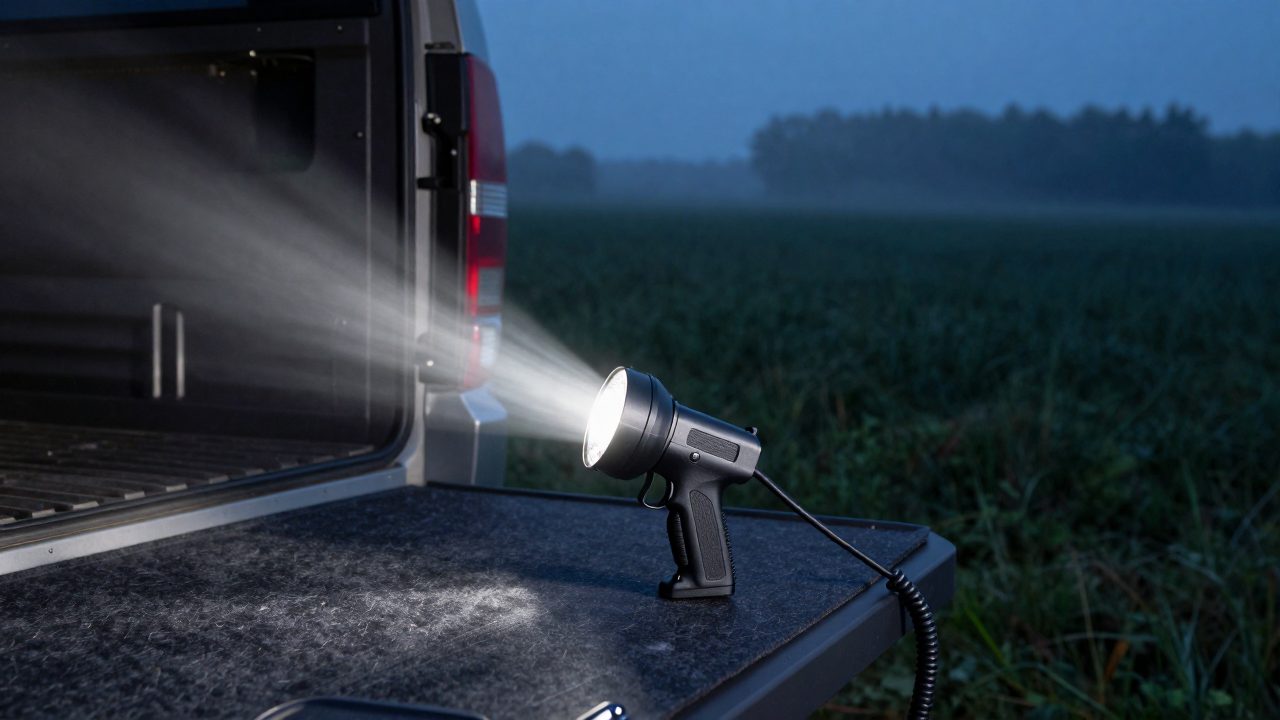
Do not treat a deer spotlight as ordinary outdoor gear
Using artificial light around deer can be regulated or prohibited, especially at night and especially when firearms, bows, vehicles, or hunting activity are involved. The rule is often broader than a person expects: a spotlight may include a handheld light, vehicle-mounted light, infrared equipment, night-vision equipment, or thermal imaging device. It can also matter whether a person merely possesses the light with other equipment in recognised deer habitat. Before going out, read the current wildlife rules for the exact state, province, territory, park, or private property involved.
Why the legal context comes first
“Spotlighting” can describe several different activities: locating wildlife from a road, surveying deer for research, checking livestock boundaries, observing animals from a fixed position, or attempting to hunt at night. Those contexts do not carry the same permissions. A permission for land management or a formal wildlife survey does not create permission for recreational spotlighting. A rule that permits a light for navigation does not necessarily permit aiming it at animals. Local rules can also change by season, species, location, hour, and method of transport.
Do not assume that a rural road, a field edge, or privately owned land removes the restriction. Wildlife law commonly governs the activity and the species, while separate trespass, road-safety, vehicle, and firearm rules may apply at the same time. If the purpose is official research, depredation management, or property protection, obtain the required written authorization and follow its conditions exactly. If there is uncertainty, contact the relevant wildlife agency before the outing rather than relying on an internet forum or an old map.
Safety risks are real even when no hunting is intended
Bright lights can dazzle drivers, disorient people walking near a road, and cause animals to freeze, bolt, or move unpredictably. Deer can enter traffic suddenly after being illuminated. Never sweep a roadway with a high-output beam, shine into homes, approach wildlife with a vehicle, or direct a light toward another person’s face. A vehicle should be stopped in a legal, safe place before anyone uses any handheld light; the driver’s attention belongs on the road.
Wildlife welfare matters too. Repeated illumination can stress animals, separate a young animal from cover, disrupt feeding, or push deer toward roads and fences. The most respectful viewing practice is brief, quiet, and distant. Observe from a lawful location, avoid pursuit, and leave an animal a clear route away. If deer are already reacting, retreat rather than trying to improve the view.
Better ways to observe deer
For ordinary wildlife watching, plan around daylight and use binoculars from a stable position. Dawn and dusk can offer natural viewing without a beam. A trail camera used in compliance with local regulations may document movement without a person repeatedly entering the area, but cameras can also be restricted in some places and should never be positioned to harass wildlife or trespass. For garden or property questions, daytime tracks, browse marks, bedding signs, and camera evidence usually tell a clearer story than a night drive.
If a landowner needs to identify a recurring conflict, focus on the problem rather than on chasing an animal. Photograph damage in daylight, note dates and locations, and ask local extension, conservation, or wildlife staff about lawful exclusion, fencing, vegetation choices, or permit processes. This approach produces information that can be acted on safely and avoids treating a light as a means of control.
What a responsible plan looks like
Write down the location, purpose, date, people present, and the local authority whose rules you checked. Separate observation equipment from hunting equipment; never combine a night light with weapons where the law prohibits that combination. Carry normal safety essentials for the environment, including a charged phone, navigation, weather-appropriate clothing, and a plan for returning before conditions deteriorate. Tell someone where you are going.
When travelling, keep all lighting equipment stowed so it cannot distract the driver or be mistaken for active use. Respect closures, private-property boundaries, and posted signs. If you encounter other people, give them space and lower the light rather than trying to identify them with a high-output beam. A moment of uncertainty is a reason to stop, not to continue because a plan seemed harmless at home.
When to contact an authority
Contact the wildlife agency, park authority, or local law-enforcement non-emergency line when the intended use may involve night activity, a road, a weapon, a thermal device, a vehicle-mounted light, deer habitat subject to special rules, or a research or management purpose. Ask about the current rule for the exact place and date, not a general state-wide summary. Keep the answer and any permit information with you if an authorized project proceeds.
The bottom line
There is no universal “best spotlight for deer” because legality and safety determine whether a light should be used at all. For routine appreciation of wildlife, daylight observation and distance are the better tools. For any specialised work, use the method and authorization required by the local authority. The responsible choice is the one that protects people, roads, and animals while staying within the rules that apply where you are.