

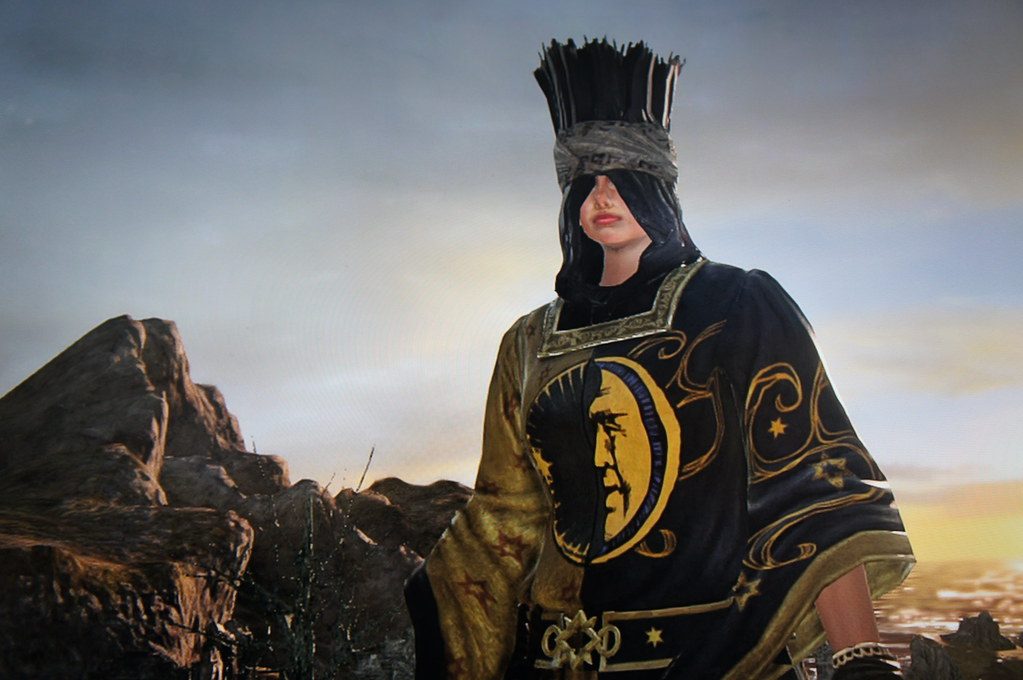
Dark Souls quotes work because they are sparse. A character may have only a few lines, and their meaning changes with the place, quest state, or defeat that triggers them. This selection stays with short excerpts rather than reconstructing speeches. It also corrects two common misattributions: “Thought you could outwit an onion?” is Patches speaking while disguised as Siegward, not Siegward at the Fire Demon; and Prince Lothric says his grave line when the player is defeated, not as a general refusal to link the fire.
Solaire of Astora: “grossly incandescent”
“If only I could be so grossly incandescent!”
Solaire says this in the original Dark Souls while talking about the sun in Anor Londo. It is the best quote to revisit when you want the series at its most warm-hearted and eccentric. The wording is wonderfully excessive, yet it fits Solaire’s sincere search for his own sun. Read it as a statement of aspiration, not as a meme stripped of its speaker: his optimism is unusual precisely because Lordran is so bleak.
The short phrase works on its own because it preserves the joke without trying to reproduce the surrounding conversation. It is also a useful starting point for replaying Solaire’s quest: meet him at the Undead Burg, follow his appearances, and notice how cooperation and personal purpose shape his dialogue.
Andre of Astora: “Don’t get yourself killed.”
“Don’t get yourself killed.”
Andre gives this warning when the player leaves his forge in the Undead Parish. The following sentence refers to going Hollow, but the short opening has enough force by itself. It lands because Andre is not presenting a grand prophecy. He is a working blacksmith offering practical concern to someone repeatedly walking into danger.
Choose Andre’s line when you want a quote that captures the series’ human scale. It works best after spending time at his anvil, reinforcing weapons, and returning from a difficult route. The warmth is understated: it is advice from someone who expects the player to keep trying, not an empty reassurance that the journey will be easy.
Kingseeker Frampt: “Let there be no guilt.”
“Let there be no guilt; let there be no vacillation.”
Frampt says this after the Lordvessel has been placed, when he directs the Chosen Undead toward the holders of the required souls. The line is persuasive precisely because it makes a huge moral instruction sound administrative. It asks the player to suppress doubt before acting, which makes it an excellent quote to revisit when considering how much the first game tells you and how much it withholds.
The quote is not proof that Frampt is lying, nor is it a complete explanation of the ending. Its strength is its pressure. Replay the conversation after meeting the other primordial serpent or after learning more about the Age of Fire, and the certainty in Frampt’s command becomes more interesting than its surface confidence.
Patches: “outwit an onion”
“Thought you could outwit an onion?”
This is Patches, not Siegward. In Dark Souls III, Patches wears Siegward’s armor in the Cathedral of the Deep and springs a trap on the player. The joke works because he uses the disguise to turn Catarina’s onion-shaped armor into an insult. It is a sharp little reminder that Dark Souls comedy often arrives in the middle of betrayal.
Use this quote for a replay focused on NPC questlines and imposture. The necessary context matters more than the words: seeing the disguise, crossing the narrow path, and realizing that the apparent Catarina knight was Patches gives the line its punch. Calling it a Siegward quote removes the very twist that makes it funny.
Prince Lothric: “This spot marks our grave.”
“This spot marks our grave.”
Lothric says this after the player is slain by the Twin Princes in Dark Souls III. It is a death line, delivered from the boss arena, rather than the speech that starts the fight. That timing makes it feel less like a threat and more like an invitation to share the exhaustion of the place. The full sentence continues the thought, but this short clause is enough to convey its fatalistic calm.
Choose it when revisiting the Twin Princes after learning their relationship and their refusal of the Lord of Cinder’s role. The quote does not summarize every detail of Lothric lore. It gives a defeated player a moment of stillness before the next attempt, which is why it can feel more haunting than a conventional victory taunt.
The Locust Preacher: “Fear not, the dark”
“Fear not, the dark, my friend.”
The friendly White-faced Locusts in The Ringed City repeat this refrain while preaching around the city. Their speeches differ, but the repeated line is followed by the invitation to begin the feast. It is memorable because the voice is reassuring and the speaker is unsettling. The contradiction turns a familiar Souls idea about darkness into something predatory.
Replay this one in the DLC rather than treating it as a detached slogan. The physical setting, the locust’s appearance, and the repeated references to the Abyss make the line uncomfortable in a way a written quotation cannot fully carry. It is a good choice for readers who prefer the series’ horror and ambiguity to its heroic speeches.
Aldia: “There is no path.”
“There is no path.”
Aldia speaks this at the end of Dark Souls II: Scholar of the First Sin if the player leaves the Throne of Want after meeting the required conditions. The short sentence begins his final reflection on what might lie beyond light and dark. Quoting only these four words keeps the excerpt brief while preserving the uncertainty that makes the ending distinct.
This is the line to choose for a replay of Dark Souls II’s alternate ending. Do not treat it as a simple instruction to reject both choices or as a resolution to the cycle. Aldia is voicing a question, and the scene deliberately leaves the answer open. That restraint is why the quote remains effective long after the cutscene ends.
How to revisit a Dark Souls quote well
- Check the trigger: many memorable lines are tied to a death, a quest stage, or a specific location.
- Keep excerpts short: a few words preserve the voice without replacing the game’s scene.
- Verify the speaker: disguises, repeated refrains, and fan shorthand cause easy misattributions.
- Replay the context: a line gains force from the route, boss attempt, or NPC relationship around it.
The best Dark Souls quotes are not detachable life lessons. They are small pieces of performance, placement, and uncertainty. Solaire’s hope, Andre’s concern, Frampt’s certainty, Patches’s joke, Lothric’s resignation, the preacher’s invitation, and Aldia’s question all land because the games make the player earn the moment in which they are heard.