

As an Amazon Associate and eBay Partner, toptenpick.com earns from qualifying purchases. Prices and availability are subject to change.
The VT1100’s engine, transmission and clutch all share one oil supply, and the clutch is a wet, multi-plate unit that grips using friction between oil-soaked plates. That single fact is the whole buying rule for this bike: check the JASO rating on the back label before anything else, because the viscosity number on the front tells you nothing about whether the oil will let the clutch grip properly.
The trap is that a lot of automotive engine oil — including some sold as general-purpose or high-mileage four-stroke oil right next to the motorcycle-specific bottles on the same shelf — is formulated with friction modifiers, usually a moly-based additive package, specifically to reduce friction for better fuel economy in a car. Put one of those through a wet clutch and the plates can’t bite properly: the clutch slips under load, most noticeable pulling away from a stop or accelerating hard, even though the oil itself is otherwise perfectly good and won’t damage the engine. The label giveaway is anything marked “Energy Conserving” or “Resource Conserving” on the API service circle — that’s an automotive fuel-economy claim, and it’s the one to walk away from on this bike.
JASO’s MA and MA2 marks exist specifically to rule that additive package out. Both certify the oil is free of the friction modifiers that cause clutch slip; MA2 is the tighter of the two specs on friction performance. Look for the JASO square logo with MA or MA2 printed inside it on the bottle itself — that’s the actual certification mark, not just wording in the marketing copy.
Once JASO is confirmed, viscosity is a secondary, climate-driven choice. Honda’s own service literature for the VT1100 spans a range from roughly 10W-30 up through 20W-50 depending on ambient temperature, so there’s no single “correct” grade — pick within that range for your riding climate rather than defaulting to whatever the last owner happened to use.
Motorcycle-specific oils — Honda’s own GN4, Motul, Mobil 1 Racing 4T — carry the clearest JASO documentation and are formulated as one product for the shared engine, transmission and clutch duty. A handful of heavy-duty diesel engine oils, notably Shell’s Rotella line, are also JASO MA or MA2 compliant in specific grades and run noticeably cheaper per liter, a long-running choice on cruiser forums — but check the exact grade, since not every variant in a diesel-oil lineup carries the certification.
| # | Product | Price | Where to buy |
|---|---|---|---|
| 1 | Honda GN4 10W-30 / 10W-40 | $8–$12/quart | Amazon · eBay |
| 2 | Shell Rotella T4 15W-40 | $22–$30/gallon | Amazon · eBay |
| 3 | Shell Rotella T6 5W-40 (Full Synthetic) | $30–$42/gallon | Amazon · eBay |
| 4 | Motul 5100 10W-40 | $12–$16/liter | Amazon · eBay |
| 5 | Motul 7100 10W-40 | $16–$22/liter | Amazon · eBay |
| 6 | Castrol Power1 Racing 4T 10W-50 | $14–$20/liter | Amazon · eBay |
| 7 | Mobil 1 Racing 4T 10W-40 | $10–$14/quart | Amazon · eBay |
| 8 | Bel-Ray EXS Synthetic Ester 4T | $14–$20/liter | Amazon · eBay |
| 9 | Valvoline 4-Stroke Motorcycle Oil 10W-40 | $8–$14/quart | Amazon · eBay |
| 10 | AMSOIL 100% Synthetic Metric Motorcycle Oil 10W-40 (MCF) | $12–$18/quart | Amazon |
The picks, in detail

Honda GN4 10W-30 / 10W-40
Honda’s own JASO MA-rated oil, formulated specifically for wet-clutch Honda engines including the VT1100’s shared engine, transmission and clutch oil supply. It’s the reference point other oils get compared against on Shadow forums, and using it removes any guesswork about friction-modifier content.
- JASO MA certified
- Honda-specific formulation for shared engine/clutch/transmission oil
- Multiple viscosity grades (10W-30, 10W-40)
- OEM-recommended for wet-clutch Honda engines
- Purpose-built for Honda wet-clutch engines, zero guesswork
- Widely stocked at Honda dealers
- Long track record on this exact platform
- Costs more per liter than equivalent oils from other brands
- Standard-grade versions need more frequent changes than full synthetics
- Only sold in smaller container sizes at most retailers

Shell Rotella T4 15W-40
A heavy-duty diesel engine oil that happens to carry JASO MA compliance, and is a long-running favorite on Shadow and other wet-clutch cruiser forums for its low cost per liter relative to motorcycle-branded oils. This is the 15W-40 conventional grade specifically — Rotella’s full-synthetic line carries a different rating, covered separately below.
- JASO MA compliant
- 15W-40 viscosity
- CJ-4/SN diesel-rated base
- Sold in large containers (1 gallon+) at auto parts stores
- Much cheaper per liter than motorcycle-specific oils
- Widely available at any auto parts store, not just bike shops
- Strong reputation among high-mileage air-cooled cruiser owners
- Marketed as a diesel oil, not motorcycle-specific, which confuses first-time buyers
- Large container sizes mean leftover oil sits around between changes
- Heavier 15W-40 grade may not suit cold-climate riding

Shell Rotella T6 5W-40 (Full Synthetic)
The full-synthetic Rotella grade, JASO MA2 compliant specifically in the 5W-40 and 15W-40 versions — Shell’s own documentation does not extend that approval to the 0W-40 variant, so the exact bottle grade matters, not just the Rotella name. A common step up from T4 for owners who want full synthetic without motorcycle-brand pricing.
- Full synthetic base
- JASO MA2 compliant in the 5W-40 and 15W-40 grades only, not 0W-40
- CK-4 diesel rating
- Sold in large containers
- Full synthetic protection at diesel-oil pricing
- JASO MA2 is the tighter of the two wet-clutch friction specs
- Widely stocked at auto parts stores
- The 0W-40 version of the same product line is not JASO MA/MA2 approved, an easy mix-up on the shelf
- Large container size means a lot of leftover oil between changes
- Not marketed or labeled as a motorcycle oil, which makes some riders wary

Motul 5100 10W-40
A semi-synthetic ester-blend motorcycle oil, JASO MA2 and API SP rated, sitting between Motul’s mineral 3000 line and full-synthetic 7100 line. It’s a reasonable middle-ground choice for a VT1100 that isn’t tracked or pushed hard, at a lower price than stepping up to the full synthetic.
- Technosynthese semi-synthetic with ester
- JASO MA2, API SP rated
- Multiple viscosity grades including 10W-40
- Motorcycle-specific additive package
- JASO MA2 certified specifically for wet clutches
- Cheaper than the full-synthetic 7100 line
- Sold in motorcycle-shop-friendly liter bottles
- Semi-synthetic base doesn’t match full-synthetic high-temperature stability
- Costs more per liter than car-shelf diesel oils like Rotella
- Shorter recommended service interval than full synthetic

Motul 7100 10W-40
Motul’s full-synthetic ester motorcycle oil line, JASO MA2 and API SP certified, aimed at riders who want the longest service life and best high-temperature stability the brand offers. It costs meaningfully more than the 5100 semi-synthetic for a V-twin cruiser that mostly sees moderate street use, so it’s worth weighing against the mid-tier options here.
- 100% synthetic ester base
- JASO MA2, API SP certified
- Multiple viscosity grades including 10W-40
- Motorcycle-specific, not an automotive oil adapted for the job
- Top-tier synthetic protection and longer change intervals within Motul’s motorcycle range
- Certified friction properties for wet clutches
- Strong reputation among performance riders
- Priced well above semi-synthetic and diesel-oil alternatives
- More oil than a stock VT1100 arguably needs for moderate street use
- Smaller bottle sizes mean more purchases per full oil change

Castrol Power1 Racing 4T 10W-50
A fully synthetic motorcycle oil, API SL and JASO MA2 rated, sold specifically for high-performance four-stroke engines. The 10W-50 grade runs thicker than what most VT1100 owners run day to day, so it suits hotter climates, or an already-worn engine, better than a stock bike in a mild climate.
- Fully synthetic
- API SL, JASO MA2 rated
- 10W-50 viscosity
- Motorcycle-specific additive package
- JASO MA2 certified for wet-clutch compatibility
- Widely available at auto parts and motorcycle retailers
- Full synthetic protection
- API SL is an older automotive rating that some rivals have since superseded
- 10W-50 runs thicker than Honda’s typical recommendation for this bike in mild weather
- Premium pricing relative to Rotella-class alternatives

Mobil 1 Racing 4T 10W-40
Mobil’s full-synthetic motorcycle oil, formulated to meet or exceed both JASO MA and MA2 for engine, transmission and wet-clutch use in a single shared-sump oil — exactly the VT1100’s layout. Mobil markets this explicitly as a 3-way oil for engine, gearbox and clutch, rather than a car oil adapted for the job.
- Full synthetic
- Meets or exceeds JASO MA and MA2
- Formulated for shared engine/transmission/wet-clutch use
- 10W-40 (also sold in 15W-50)
- Explicitly 3-way rated for engine, transmission and wet clutch in one oil
- Strong brand reputation and consistent quality control
- Widely available at auto parts stores
- Costs more than diesel-oil alternatives at the same viscosity
- 10W-40 can run thin in hot climates compared with the 20W-50 some owners prefer for this V-twin
- Smaller bottle sizes than Rotella’s jugs

Bel-Ray EXS Synthetic Ester 4T
Bel-Ray’s full-synthetic ester motorcycle oil, qualified against JASO MA, MA1 and MA2, aimed at riders who want a specialist lubricant brand without motocross-line pricing. Bel-Ray built its reputation in racing and off-road applications before expanding into street-oriented four-stroke oils.
- Full synthetic ester base
- JASO MA/MA1/MA2 qualified
- Motorcycle-specific additive package
- Multiple viscosity grades
- Broad JASO qualification covers both MA and the tighter MA2 spec
- Ester base gives strong film strength at high temperature
- Well-regarded specialist motorcycle-oil brand
- Less commonly stocked on general auto-parts-store shelves than Mobil 1 or Rotella
- Pricing sits at the synthetic-motorcycle-oil premium
- Smaller aftermarket presence for cruiser-specific reviews versus sport-bike use
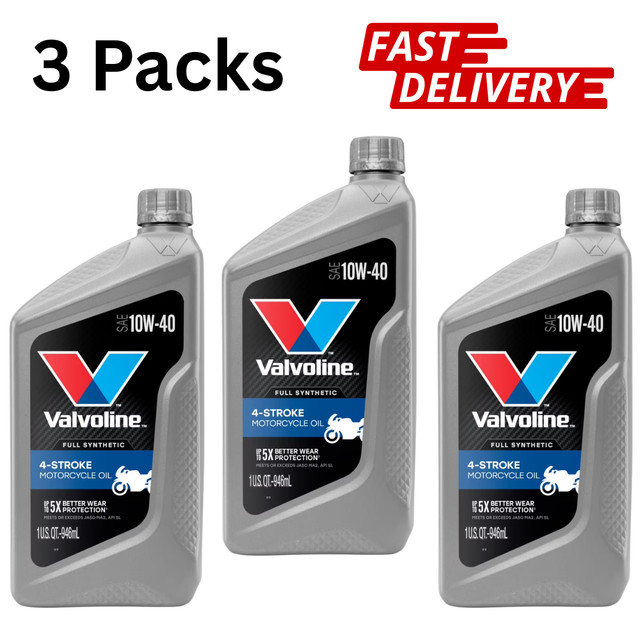
Valvoline 4-Stroke Motorcycle Oil 10W-40
Valvoline’s motorcycle-specific line, meeting API SL and JASO MA2, sold in both conventional and full-synthetic versions across grades including 10W-40 and 20W-50 — useful since Honda’s own literature for the VT1100 spans that same range depending on climate. A mainstream, easy-to-find option for owners who don’t want to special-order a boutique brand.
- API SL, JASO MA2 rated
- Sold in conventional and full-synthetic versions
- Multiple viscosity grades including 10W-40 and 20W-50
- Anti-friction formulation for wet clutches
- Wide availability at mainstream auto parts retailers
- Both conventional and synthetic options at different price points
- Grade range matches Honda’s climate-based recommendations for this bike
- Conventional-grade version needs more frequent changes than full synthetics
- API SL is an older rating than some rivals now carry
- Marketed broadly across many bike brands, so it lacks a cruiser-specific reputation
AMSOIL 100% Synthetic Metric Motorcycle Oil 10W-40 (MCF)
AMSOIL’s full-synthetic metric-motorcycle oil, JASO MA2 rated and explicitly formulated with no friction modifiers, aimed at riders who want maximum shear resistance in a shared engine, transmission and wet-clutch sump like the VT1100’s. It’s sold direct and through a dealer network rather than sitting on general auto-parts shelves.
- 100% synthetic
- JASO MA2 rated, no friction modifiers
- Formulated for shared engine/transmission/wet-clutch sumps
- Shear-resistant for combined gearbox duty
- No friction-modifier content by design, removing any ambiguity for the wet clutch
- Strong shear resistance claimed for combined engine and gearbox duty
- Long-standing synthetic-oil specialist brand
- Not sold in as many brick-and-mortar stores as Mobil 1 or Rotella, often ordered online or through a dealer
- Premium pricing versus diesel-oil alternatives
- Smaller container options than Rotella’s jugs
Buying tips
- Check the bottle for the JASO square logo with MA or MA2 printed inside it — wording alone in the marketing copy isn’t the certification.
- Skip anything labeled “Energy Conserving” or “Resource Conserving” on the API circle; that’s a fuel-economy friction-modifier package aimed at cars, not wet clutches.
- Match viscosity to your climate within Honda’s 10W-30 to 20W-50 range for the VT1100 rather than defaulting to whatever grade is cheapest.
- If you switch from a motorcycle-specific oil to a JASO-rated diesel oil like Rotella, double-check the exact grade — not every variant in a diesel-oil lineup carries JASO certification.
- Change the oil filter every time you change the oil, not every other change — it’s the same shared sump feeding the clutch, so filter debris matters more here than on a dry-clutch bike.
- Warm the engine to full operating temperature before draining so the oil carries contaminants out with it rather than leaving them settled in the sump.
- If the clutch starts slipping under load right after an oil change, check what you just put in before suspecting worn clutch plates — a friction-modified oil is a common and reversible cause.
- Keep the receipt or bottle from whatever oil you use so you can confirm the exact JASO rating later if you ever need to troubleshoot a clutch complaint.
As an Amazon Associate and eBay Partner, toptenpick.com earns from qualifying purchases. Prices and availability are subject to change.