

As an Amazon Associate and eBay Partner, toptenpick.com earns from qualifying purchases. Prices and availability are subject to change.
Before you buy anything, check which Arlo you own. The original Arlo Wire-Free (VMC3030/VMC3040) and Arlo Go take four user-replaceable CR123A cells each; Arlo Pro, Pro 2, Pro 3, Ultra and Essential use a proprietary rechargeable pack instead and no CR123A will fit them. If you have the Wire-Free, the battery you choose genuinely changes how often you climb the ladder — a good 3V lithium primary holds roughly 1,400–1,600 mAh, keeps working down to about −40 °C, and sits on the shelf for a decade. Below are the cells worth buying, plus the rechargeable route and the real catch that comes with it.
| # | Product | Price | Where to buy |
|---|---|---|---|
| 1 | Panasonic CR123A Industrial Lithium | $1.50–$3 per cell in bulk | Amazon · eBay |
| 2 | Duracell Ultra CR123A (DL123A) | $2.50–$4 per cell | Amazon · eBay |
| 3 | Energizer 123 Lithium (EL123AP) | $2.50–$4 per cell | Amazon · eBay |
| 4 | Tenergy CR123A 3V Lithium (16-pack) | $1.30–$2 per cell in a 16-pack | Amazon · eBay |
| 5 | SureFire SF123A / Boxed 12-pack | $2–$3.50 per cell | Amazon · eBay |
| 6 | Streamlight CR123A Lithium (6 or 12 pack) | $1.50–$2.50 per cell | Amazon · eBay |
| 7 | Amazon Basics 123A Lithium (12-pack) | $1–$1.60 per cell | Amazon · eBay |
| 8 | Varta CR123A Professional Lithium | $2–$3.50 per cell | Amazon · eBay |
| 9 | Titanium Innovations CR123A (bulk box) | $1.20–$2 per cell | Amazon |
| 10 | Tenergy RCR123A 3.7V 650 mAh Rechargeable + Charger Kit | $25–$45 for an 8–12 cell kit with charger | Amazon · eBay |
| 11 | EBL RCR123A Rechargeable Kit (12-pack + charger) | $30–$50 for a 12-cell kit | Amazon · eBay |
The picks, in detail

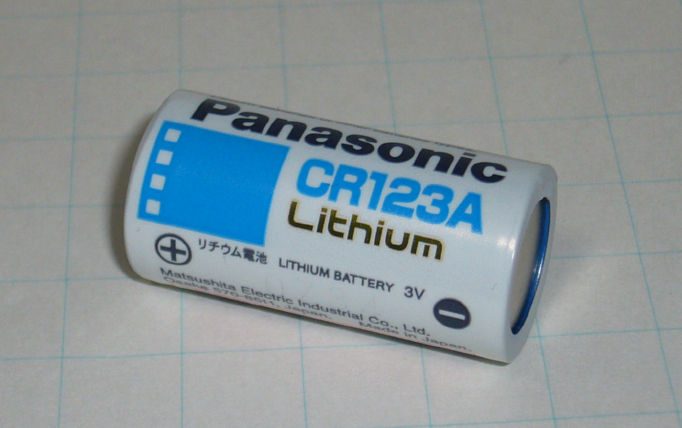
Panasonic CR123A Industrial Lithium
The default answer for an outdoor Arlo. Panasonic’s CR123A is widely treated as the reference cell for this format, and the specification that matters here is the temperature range — it keeps delivering down to roughly −40 °C, which is the difference between a camera that works through a cold snap and one that reports empty at 6 a.m.
- 3V lithium manganese dioxide, roughly 1,550 mAh
- Rated to about −40 °C to +60 °C
- Around a 10-year shelf life
- Sold in industrial bulk packs as well as retail blisters
- Best cold-weather behaviour of the mainstream brands
- Very consistent cell-to-cell, so all four run down together
- Bulk industrial packs bring the per-cell price right down
- Bulk packs are a common counterfeit target — buy from a seller you trust
- Industrial packaging has no retail blister, so loose cells need storing carefully

Duracell Ultra CR123A (DL123A)
The safe supermarket pick. Around 1,500 mAh with a slightly higher peak voltage than average, and Duracell explicitly markets this cell for alarm sensors, flashlights and wireless security cameras — Arlo among them. If you want to buy batteries without researching batteries, buy these.
- 3V lithium, roughly 1,500 mAh
- 10-year storage life
- Sold in 2, 6, 12 and 24 packs
- Duracell leak-protection warranty
- Available almost everywhere, including physically today
- Well-controlled date coding, so stock is usually fresh
- Backed by a leakage guarantee
- Costs more per cell than the bulk industrial options
- Nothing about it outperforms Panasonic — you are paying for availability

Energizer 123 Lithium (EL123AP)
The other big-brand primary, and the one most often sitting on a shelf when you need cells immediately. Energizer’s 123 is a straight competitor to the Duracell Ultra on capacity and shelf life, and in Arlo cameras the practical difference between the two is nil.
- 3V lithium, roughly 1,500 mAh
- 10-year shelf life
- Rated for use in extreme temperatures
- Common in 2, 6 and 12 packs
- Stocked in most pharmacies and hardware stores
- Reliable date coding and fresh stock
- Frequently discounted in multi-packs
- Premium price for no measurable Arlo advantage
- Blister packaging is genuinely hard to open

Tenergy CR123A 3V Lithium (16-pack)
The value pick that reviewers keep landing on for Arlo specifically. Rated at about 1,600 mAh — at or above the big three — with built-in protection and UL certification, and sold in 12 or 16 cell boxes that fill three or four cameras in one order. Tenergy also happens to be the brand Arlo itself has pointed at for the rechargeable version, which says something about how well the company knows this format.
- 3V lithium, about 1,600 mAh rated capacity
- UL certified with built-in protection
- Around a 10-year shelf life
- Sold in 12 and 16 cell boxes
- Best capacity-per-dollar of the non-bulk options
- Box quantity matches how many an Arlo actually eats
- Consistent performance in cold outdoor use
- Less widely stocked in physical shops than Duracell or Energizer
- The 16-pack is only good value if you actually run several cameras

SureFire SF123A / Boxed 12-pack
Made for high-drain tactical flashlights, which is a harder job than an Arlo asks for. That over-specification is the point: SureFire cells are chosen when the device absolutely must fire, they hold voltage under load, and they store for a decade. Overkill for a doorway camera, exactly right if the camera is somewhere you cannot easily reach.
- 3V lithium, roughly 1,550 mAh
- Built for high-drain flashlight use
- 10-year shelf life
- Boxed in 12 and 72 cell quantities
- Excellent voltage stability under load
- Very low failure rate — reputation built on flashlight use
- Bulk boxes are competitive per cell
- Priced as a tactical brand rather than a camera brand
- The high-drain advantage is largely wasted in an Arlo

Streamlight CR123A Lithium (6 or 12 pack)
Streamlight’s own-brand cells routinely top CR123A comparison tests, and they are usually the cheapest way to get flashlight-grade quality. Same 3V chemistry, same 10-year shelf life, sold in the same 6 and 12 packs — the sensible alternative if SureFire’s pricing puts you off.
- 3V lithium, roughly 1,500 mAh
- 10-year storage life
- Sold in 6, 12 and 400 cell quantities
- Marketed for professional flashlight use
- Frequently the best price for flashlight-grade cells
- Strong showing in independent CR123A comparisons
- Easy to find in bulk
- Packaging gives you no useful date information
- Availability comes and goes on the big marketplaces

Amazon Basics 123A Lithium (12-pack)
The cheapest way to keep an Arlo running that is still a known quantity. Capacity and shelf life sit slightly behind the premium brands, and cold-weather performance is the first thing to give, but for a camera under a porch roof in a temperate climate the price per cell is hard to argue with.
- 3V lithium, roughly 1,500 mAh claimed
- 10-year claimed shelf life
- 12-pack is the standard quantity
- Fits every CR123A device
- Consistently the lowest price per cell from a first-party seller
- No counterfeit risk buying direct
- 12 cells fills three Arlo cameras exactly
- Runtime reports vary more than with the premium brands
- Weaker in genuine sub-zero cold

Varta CR123A Professional Lithium
The European staple, and worth knowing about if the big US brands are expensive where you are. Varta is named alongside Panasonic, Sony and the American brands in CR123A roundups, and its photo/professional lithium line targets exactly this kind of low-temperature, long-storage duty.
- 3V lithium, roughly 1,430–1,600 mAh depending on pack
- 10-year shelf life
- Wide operating temperature range
- Common in 1, 2 and 6 cell blisters
- Often much cheaper than Duracell or Energizer outside the US
- Established name in photographic and professional cells
- Reliable fresh stock through electronics retailers
- Harder to find in North America
- Smaller pack sizes mean more orders
Titanium Innovations CR123A (bulk box)
The bulk-buyer’s option. Sold in large boxes aimed at flashlight and security-device owners who go through CR123A by the dozen, at a per-cell price that undercuts every retail brand here. Worth it when you are feeding several Wire-Free cameras and swapping batteries every few months.
- 3V lithium, roughly 1,500 mAh
- 10-year shelf life
- Sold in 12, 24 and larger boxes
- Aimed at flashlight and security-device users
- Among the lowest per-cell prices available
- Box quantities suit multi-camera households
- Consistent performance reports from flashlight users
- Available mainly through specialist battery retailers
- No high-street fallback if you run out

Tenergy RCR123A 3.7V 650 mAh Rechargeable + Charger Kit
The rechargeable route, and the specific brand Arlo has historically pointed owners toward — because unlike many no-name RCR123A cells these carry proper over-charge and over-discharge protection circuitry. The economics are excellent if you are replacing batteries monthly. Read the caveat in the buying tips first, though: 650 mAh is under half a primary’s capacity, so you will swap far more often, and the camera’s battery gauge will not read them correctly.
- 3.7V lithium-ion, 650 mAh, 16340 size
- Built-in protection circuit
- Sold as 8 or 12 cell kits with a matched charger
- Several hundred recharge cycles
- Pays for itself quickly on a busy camera
- Protection circuitry is present, unlike many cheap alternatives
- Kit includes the correct charger
- Roughly 650 mAh against 1,500 mAh for a primary — noticeably shorter runtime
- Arlo’s battery indicator misreads 3.7V cells and can jump from full to dead
- Poor cold-weather performance compared with lithium primaries

EBL RCR123A Rechargeable Kit (12-pack + charger)
The higher-volume rechargeable alternative. Twelve cells and a charger covers three Wire-Free cameras with a full spare set on charge at all times, which is the only way rechargeables really work for a camera that is triggered constantly. Same voltage caveat as any RCR123A applies.
- 3.7V lithium-ion, 16340 size
- 12 cells plus a multi-bay charger
- Protection circuitry on each cell
- Hundreds of charge cycles
- Enough cells to run one set while another charges
- Lowest long-run cost of anything on this list
- Multi-bay charger handles a full camera’s worth at once
- Same battery-gauge inaccuracy as all 3.7V cells
- Much shorter runtime per swap than a primary
- Quality across the RCR123A market is uneven — stick to known brands
Buying tips
- Check your model before you order anything. Only the original Arlo Wire-Free (VMC3030/VMC3040) and Arlo Go take CR123A cells — four per camera. Arlo Pro, Pro 2, Pro 3, Ultra and Essential all use a proprietary rechargeable pack, and no amount of CR123A will help you.
- Arlo’s own recommendation is a non-rechargeable 3V CR123A lithium primary. That is what the camera’s battery gauge is calibrated against, and it is why the whole top half of this list is primaries.
- The rechargeable catch is the gauge, not the danger. RCR123A cells are 3.7V nominal rather than 3V. Modern Arlo hardware tolerates that fine, and quality cells carry protection circuits — but the camera’s percentage readout is calibrated for 3V and will misreport, often showing plenty of charge and then dying without warning. Plan swaps by the calendar, not the app.
- Capacity is the other rechargeable catch. A typical RCR123A holds around 650 mAh against roughly 1,500 mAh for a lithium primary. You will get well under half the runtime per swap, which is why the 12-cell kits exist — one set in the camera, one set on the charger.
- Change all four cells at once, and never mix. Mixing brands, mixing chemistries, or mixing a fresh cell with three tired ones drags the whole set down to the weakest one and can push the weak cell into deep discharge.
- Cold is what actually kills runtime. A camera that lasts four months in summer can manage six weeks in a hard winter. If your Arlo is genuinely exposed, buy the cells with the best low-temperature rating — Panasonic and the flashlight brands — and expect to swap more often regardless.
- Buy fresh, and buy from somewhere accountable. CR123A is one of the most counterfeited cell formats there is, precisely because bulk boxes are normal for it. Check the expiry date on arrival, and prefer a first-party seller or a specialist battery retailer over an unknown marketplace listing.
- Cut the drain before you cut the battery bill. Dropping recording quality from Best to Optimised, trimming the motion sensitivity, shortening the clip length and narrowing the activity zone will do more for battery life than any brand on this list. A camera pointed at a busy pavement will empty premium cells in weeks.
As an Amazon Associate and eBay Partner, toptenpick.com earns from qualifying purchases. Prices and availability are subject to change.