

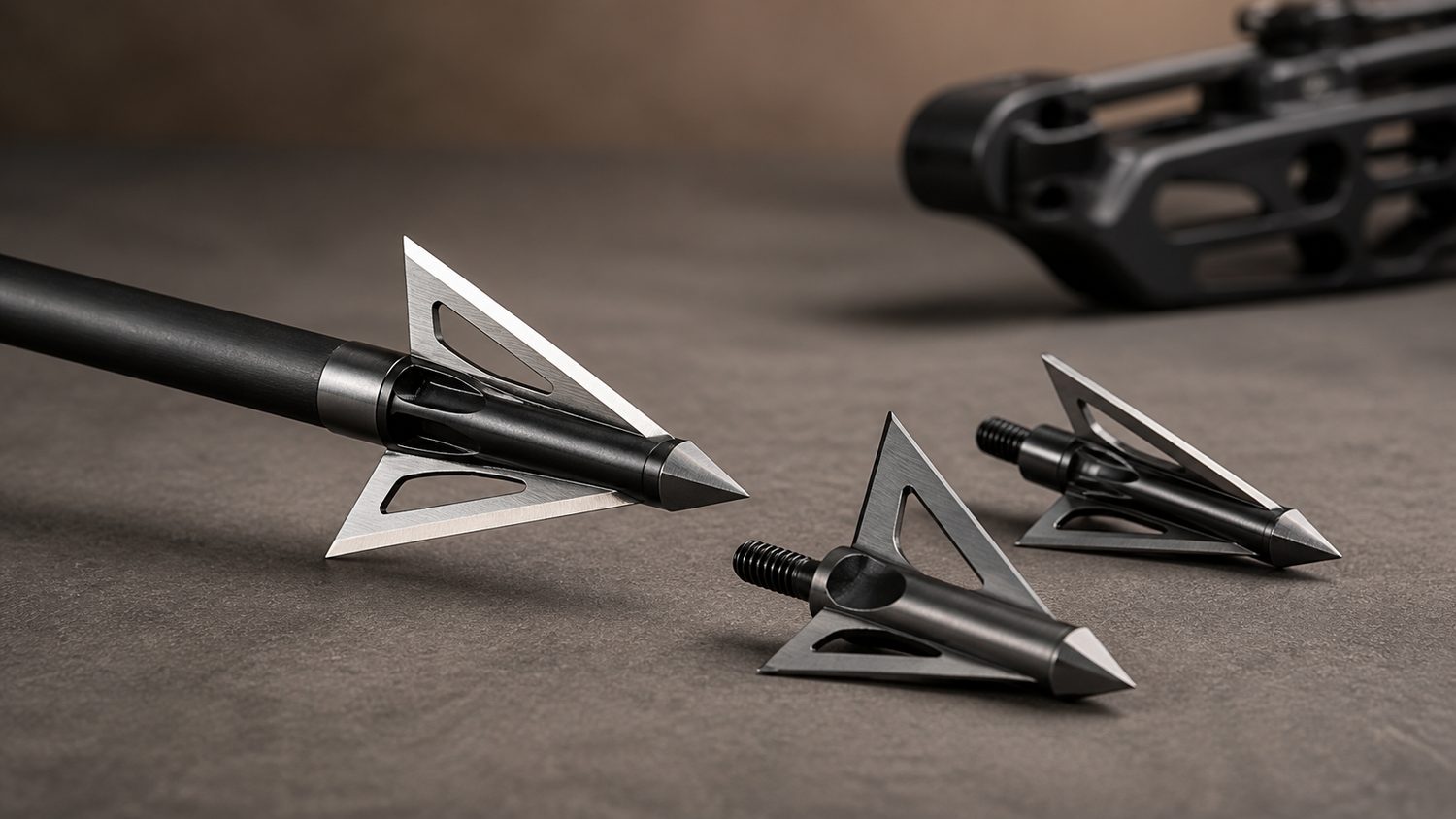
The Barnett Jackal is a discontinued compound crossbow platform, so the useful starting point is not a shopping list but the bow’s actual setup. Broadheads are cutting projectiles used with hunting arrows and are regulated differently across jurisdictions. This guide is general equipment and safety information, not a purchase recommendation or hunting instruction. Before changing any arrow component, consult the Jackal documentation, a qualified archery technician, and the rules that apply where you intend to use the equipment.
Start with the complete arrow system
A crossbow arrow is a matched system: shaft, nock, insert, point, fletching and the bow’s draw weight and rail geometry all affect how it behaves. The point’s published grain weight is only one part of total arrow mass. Changing it changes front-of-center balance, total weight and often point of impact. A point that is physically the usual threaded size is not automatically an appropriate setup. Confirm the arrow length, nock style and minimum arrow-weight guidance for the specific Jackal before assembling anything.
Crossbow arrows should be inspected before every session. Look for cracks, splinters, crushed carbon, loose inserts, damaged vanes and nock damage under strong light. Flex a carbon shaft only as its maker permits; when in doubt, retire it. A damaged shaft can fail during launch and can seriously injure the person shooting or standing nearby. Never shoot an arrow that has struck a hard surface without a careful inspection, even if the broadhead itself appears intact.
Fixed-blade and mechanical designs are different mechanisms
A fixed-blade broadhead has blades held in their cutting position at all times. Its main setup issue is alignment: blade planes that are not concentric with the shaft can steer an arrow like small wings. Mechanical broadheads keep blades folded until impact. Their setup issues include deployment mechanism integrity, blade retention and whether the particular design is suitable for the energy and arrow combination being used. Neither type is automatically better. The right question is whether the complete, undamaged arrow groups consistently and whether the local rules allow that design.
Do not assume a field-point group proves that a broadhead setup is sound. Broadheads present a different surface to the air, so they can reveal small problems with arrow straightness, insert alignment, vane clearance or bow tune. A qualified range or pro shop can help diagnose a repeatable difference safely. Make adjustments conservatively and recheck that the rail, string, cables and retention spring are clear of the finished arrow before loading.
Weight, balance and compatibility
Grain weight is a unit of mass, not an indicator of blade quality. Moving from one point weight to another changes the arrow’s balance and can change its flight. A heavier finished arrow may reduce speed while increasing total mass; a lighter finished arrow may raise speed but must never fall below the crossbow maker’s minimum recommendation. The safe practice is to weigh finished arrows on a suitable scale rather than estimating from package labels. Keep a written record of shaft model, length, insert, nock, point and measured total weight for each matched set.
Threaded point interfaces need to seat squarely against the insert. Dirt, damaged threads, a bent ferrule or an insert that is not fully bonded can create a visible wobble. Use the assembly method specified by the component makers and do not force mismatched parts together. After installation, spin-test the complete arrow using an appropriate arrow spinner or have a technician check concentricity. A wobble is a setup fault to correct, not a cosmetic detail to ignore.
Handling and transport
Broadheads are sharp tools. Cover them before transport, keep them in a rigid case that prevents edges contacting other arrows, and keep hands away from the blades while loading, unloading or inspecting the bow. Do not carry an assembled crossbow with a broadhead-tipped arrow installed. Keep the bow pointed in a safe direction whenever it is handled, keep fingers and loose clothing below the flight deck, and follow the manufacturer’s loading and unloading procedure exactly.
Many crossbow injuries happen before a shot: from dry firing, using the wrong nock, allowing a hand into the string path, or handling a damaged arrow. An anti-dry-fire device is a safeguard, not permission to test it. Verify that an arrow is properly seated against the string and retained as specified. Eye protection is sensible during any setup or inspection work. Children and bystanders should remain clear while a crossbow is being handled.
Legal and ethical checks
Hunting seasons, legal species, minimum draw-weight rules, blade requirements, mechanical-head restrictions and discharge rules are set locally and can change. Some places prohibit crossbows during particular seasons or require specific permits. A retailer’s listing or a forum post is not a legal source. Check the current wildlife agency regulations for the exact place and season, and obtain any required training or licence before hunting.
Ethical use also means practising only at an approved range or on land where shooting is lawful and controlled. Use a target designed to stop the arrow safely and ensure a substantial backstop beyond it. Never shoot upward, toward water, across a road, or where people, animals, buildings or trails may be beyond the target. Stop if conditions make the target or backstop uncertain.
A practical inspection checklist
- Confirm the exact Jackal manual and its minimum finished-arrow guidance.
- Use arrows of the correct length and nock type, with no damage or loose components.
- Weigh and label finished arrows rather than mixing unknown assemblies.
- Check point-to-insert seating and spin-test for wobble.
- Keep broadheads covered and transport them in a rigid, secure container.
- Use only a lawful, controlled range with an adequate backstop.
- Seek in-person help from a qualified archery technician when fit, tune or safety is uncertain.
That deliberate process is more valuable than any universal claim about a particular head. A compatible, inspected, consistently grouping arrow system—and compliance with current local rules—are the essentials for a Jackal owner evaluating broadhead-style equipment safely.