

As an Amazon Associate and eBay Partner, toptenpick.com earns from qualifying purchases. Prices and availability are subject to change.
Buckley published more than fifty books, and the majority of them are bound collections of his newspaper columns. That is the single most useful thing to know before you buy one. Titles like Rumbles Left and Right, The Jeweler’s Eye, The Governor Listeth, Inveighing We Will Go, Right Reason and Happy Days Were Here Again are anthologies of three-column pieces written to a deadline about events that were current at the time and are not current now. They are pleasant to dip into and almost impossible to read straight through, and a reader who picks one at random and concludes Buckley is overrated has picked the wrong kind of book rather than a bad one.
The books that hold up are the ones he sat down and wrote as books. There are perhaps a dozen, and they fall into four groups that have almost nothing to do with one another.
The polemics came first. God and Man at Yale in 1951 made him famous at twenty-five, and Up from Liberalism in 1959 is the more carefully argued of the two. Both are period pieces now, which is not the same as being dead — they are the documents in which a particular argument about American universities and American liberalism was first made in the form everyone has used since.
Then the documentaries, which are his most underrated work. Cruising Speed and Overdrive each take a single week of his life and describe it hour by hour: the mail, the deadlines, the dinners, the sheer volume of correspondence. They were mocked on publication as self-regard, and they read now as an unusually honest record of what an American public intellectual’s life actually consisted of.
The sailing books are the ones his political opponents recommend. Airborne and its successors are ocean-crossing narratives with essentially no politics in them, written by a man who was a genuinely obsessive blue-water sailor. If you want to know whether you like Buckley the writer rather than Buckley the position, start there.
And the novels are a real surprise. Blackford Oakes was a CIA officer in a series that ran from 1976 to 2005, and the second book won a National Book Award. They are proper Cold War thrillers, not a public figure’s vanity project.
One practical warning: his son Christopher Buckley is also a well-known author, and the two are constantly shelved and listed together. If a book is a comic novel about Washington, it is Christopher’s.
| # | Product | Price | Where to buy |
|---|---|---|---|
| 1 | God and Man at Yale: The Superstitions of Academic Freedom (1951) | $14–$22 | Amazon · eBay |
| 2 | Up from Liberalism (1959) | $12–$28 | Amazon · eBay |
| 3 | The Unmaking of a Mayor (1966) | $16–$26 | Amazon · eBay |
| 4 | Cruising Speed: A Documentary (1971) | $10–$30 | Amazon · eBay |
| 5 | Overdrive: A Personal Documentary (1983) | $10–$30 | Amazon · eBay |
| 6 | Airborne: A Sentimental Journey | $8–$25 | Amazon · eBay |
| 7 | Atlantic High: A Celebration | $10–$30 | Amazon · eBay |
| 8 | Saving the Queen (1976) | $12–$20 | Amazon · eBay |
| 9 | Stained Glass (1978) | $12–$22 | Amazon · eBay |
| 10 | Miles Gone By: A Literary Autobiography (2004) | $16–$32 | Amazon · eBay |
The picks, in detail

God and Man at Yale: The Superstitions of Academic Freedom (1951)
The book that created him. Written the year after he graduated, it argues that Yale’s faculty were teaching against the religious and economic convictions of the alumni who funded them, and that a university’s claim to neutrality concealed a position. The argument has been rerun in every decade since, usually by people who have not read this. Read it as the origin document rather than as current commentary.
- First published 1951, in print continuously since
- Written at age 25
- Later editions carry Buckley’s own retrospective introduction
- Around 240 pages
- The most historically important thing he wrote
- Short and forcefully argued
- Explains the shape of an argument still being had
- Deeply tied to 1950s Yale specifics
- The economics chapters have aged worse than the religion chapters
- Not a good first taste of his prose

Up from Liberalism (1959)
The better-argued of the two early polemics and the one to read if you want the case rather than the controversy. Buckley works through what he took to be the internal contradictions of mid-century American liberalism at greater length and with less heat than in the Yale book, and the prose is already recognisably his. The first edition carried an introduction by Barry Goldwater.
- Originally published 1959
- Goldwater introduction in the original edition
- Several reprint editions in circulation
- Around 200 pages
- More sustained argument than God and Man at Yale
- Shows the National Review position being assembled
- Widely available cheaply used
- Reprint editions vary a lot in typesetting quality
- Assumes 1950s political furniture the reader may not know
- Dated examples throughout

The Unmaking of a Mayor (1966)
His account of his own run for Mayor of New York in 1965, a campaign he entered without expecting or wanting to win. It is the funniest thing he wrote and also a genuinely sharp piece of city reporting: New York’s finances, its unions, its press and its race politics in the year before everything came apart. The famous line about what he would do if he won is in here, in context.
- Covers the 1965 New York mayoral race
- Reissued by Encounter Books with a new foreword
- Includes campaign documents and press exchanges
- Around 350 pages
- Very funny and genuinely self-aware
- Real reporting on 1960s New York
- The reissue is well produced and easy to find
- Long stretches of primary-source campaign material
- Assumes some familiarity with New York politics
- Almost no interest in the outcome, because there was none

Cruising Speed: A Documentary (1971)
One week of Buckley’s life, recorded in detail: the magazine, the column, the television programme, the lecture circuit, the correspondence, the friends. He invented the form for himself and it works better than it has any right to. If you want to understand how one person produced that much output, and at what cost, this is the book that tells you rather than the biographies.
- Covers a single week, November 1970
- First of his two week-in-the-life documentaries
- Includes extensive reproduced correspondence
- Around 250 pages
- Unusual form, executed well
- The most revealing thing he wrote about himself
- Excellent on the mechanics of a writing life
- Name-dense in a way that dates it
- Reads as self-regarding if you are not already interested
- Harder to find new than the reissued titles

Overdrive: A Personal Documentary (1983)
The sequel, twelve years on, and the more notorious of the pair — its serialisation in The New Yorker drew a famous mauling for its unembarrassed descriptions of limousines, a private harpsichord and a heated swimming pool. Read now, that reaction is half the interest. It is a portrait of a man who genuinely could not see why anyone would find any of it remarkable.
- Covers one week in 1983
- Originally serialised in The New Yorker
- Later editions include his reply to the critics
- Around 280 pages
- Richer and more assured than Cruising Speed
- The controversy is itself instructive
- The epilogue answering critics is excellent
- The wealth-display that annoyed reviewers in 1983 still annoys
- Repeats the structure of the earlier book
- Mostly out of print, so used copies only

Airborne: A Sentimental Journey
The first of the sailing books, and the one to hand a reader who cannot stand his politics. It is an Atlantic crossing with friends and family aboard, told with real technical seriousness about weather, navigation and the boat, and interleaved with memoir. The politics are simply absent. Several of the people who wrote the hardest against him in print named this as the book of his they liked.
- Narrative of a transatlantic passage
- First of four ocean-voyage books
- Includes navigation and seamanship detail
- Illustrated in most editions
- Completely apolitical
- Genuinely good sailing writing
- The best introduction to his prose
- Assumes some sailing vocabulary
- Long digressions into family memoir
- Used copies vary in condition and illustration quality

Atlantic High: A Celebration
The second crossing book, and the more polished of the two — a second Atlantic passage with a different crew, better photographs, and a writer who by now knew exactly what this form could do. Buy it alongside Airborne rather than instead of it; the pleasure of the sailing books is cumulative, and this one has the better set of characters aboard.
- Second transatlantic narrative
- Heavily illustrated with voyage photography
- Includes menus, logs and crew portraits
- Large-format first edition
- Better produced than Airborne
- Warm and very readable
- Works fine without having read the first
- The large-format edition is bulky and pricier used
- Less narrative tension than Airborne
- Digressions are longer here
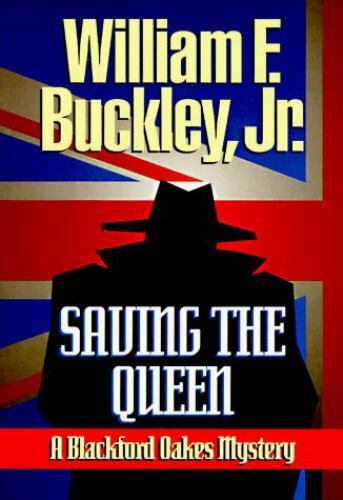
Saving the Queen (1976)
The first Blackford Oakes novel, and the one that surprised everyone by being a real thriller. Oakes is a young CIA officer sent to London to find a leak inside the royal household; the plot is brisk, the period detail is good, and Buckley clearly enjoyed writing it far more than another column collection. Start here — the series is broadly chronological and later books lean on this one.
- First of the Blackford Oakes novels
- Published 1976, series ran to 2005
- Set in early 1950s London and Washington
- Around 250 pages
- Genuinely entertaining spy fiction
- The right entry point to the series
- Available new in reissued paperback and audio
- The royal-seduction plot is of its era and lands awkwardly now
- Oakes is drawn as a paragon rather than a character
- Weaker than the two books that follow it

Stained Glass (1978)
The second Oakes novel and the one that won a National Book Award. Oakes is in occupied Germany, working against a popular German politician whose reunification campaign is inconvenient to Washington, and the moral problem — the agency’s interests against an honourable man’s — is handled with more weight than the first book attempts. This is the best of the series and the strongest argument that Buckley could write fiction.
- Second Blackford Oakes novel
- National Book Award winner
- Set in early 1950s Germany
- Around 270 pages
- The best-written novel he produced
- Real moral complication, not just plot
- Stands alone if you read no others
- Slower opening than Saving the Queen
- Cold War German politics needs a little context
- Ending divides readers

Miles Gone By: A Literary Autobiography (2004)
The late-career anthology that is actually worth owning, because he assembled it himself and chose the pieces that mattered to him rather than whatever the syndicate had run that year. Boyhood, Yale, National Review, the sailing, the friendships, the eulogies. It is the most efficient way to find out which Buckley you want more of before committing to a whole book.
- Self-selected autobiographical anthology
- Published 2004, four years before his death
- Draws on memoirs, essays and eulogies
- Around 600 pages
- The best single-volume sampler of his range
- Chosen by the author, not a publisher
- Widely available new and used
- Long, and uneven by design
- Overlaps material in the sailing and documentary books
- Not a chronological memoir despite the subtitle
Buying tips
- Check whether the book you are buying is a column collection. If the subtitle contains the words reflections, collection, notes, or a book about, it is an anthology of dated newspaper pieces rather than a sustained argument.
- Do not start with God and Man at Yale, however famous it is. It is the least characteristic thing he wrote and the most dependent on 1950s specifics.
- Start with a sailing book if you are unsure whether you like him. Airborne has no politics in it at all, which makes it the fair test of the prose.
- Read Cruising Speed and Overdrive as a pair. Twelve years apart with the same structure, they show what changed and what did not, which is most of their value.
- Read the Blackford Oakes novels in publication order. They are broadly chronological in Oakes’s career and the later books assume the earlier ones.
- Watch for the other Buckley. His son Christopher Buckley writes comic Washington novels and the two are routinely shelved and recommended together — if it is funny about lobbyists, it is not the father.
- Buy used for the out-of-print middle period. Cruising Speed, Overdrive and the later sailing books have not been reissued the way the early polemics and the novels have, and good used copies are a few dollars.
- If you want the speaking voice rather than the writing, the Firing Line episodes are archived online and free. The books are a different register, and people who came for the television persona are sometimes surprised by that.
As an Amazon Associate and eBay Partner, toptenpick.com earns from qualifying purchases. Prices and availability are subject to change.