

As an Amazon Associate and eBay Partner, toptenpick.com earns from qualifying purchases. Prices and availability are subject to change.
VLSI design spans device physics, circuit-level CMOS design, and system-level digital design, and no single book covers all three well. These six are the textbooks consistently named the standard references and classroom texts for VLSI courses, from beginner-friendly circuit texts to the device-physics and timing-analysis references used in later coursework.
| # | Product | Price | Where to buy |
|---|---|---|---|
| 1 | CMOS VLSI Design: A Circuits and Systems Perspective (Weste & Harris) | $80-$150 | Amazon · eBay |
| 2 | Digital Integrated Circuits: A Design Perspective (Rabaey, Chandrakasan, Nikolic) | $70-$140 | Amazon · eBay |
| 3 | CMOS Digital Integrated Circuits: Analysis and Design (Kang & Leblebici) | $90-$160 | Amazon · eBay |
| 4 | Fundamentals of Modern VLSI Devices (Taur & Ning) | $70-$120 | Amazon · eBay |
| 5 | Logical Effort: Designing Fast CMOS Circuits (Sutherland, Sproull, Harris) | $50-$90 | Amazon · eBay |
| 6 | Digital Design and Computer Architecture / RTL Design (Vahid) | $60-$120 | Amazon · eBay |
The picks, in detail

CMOS VLSI Design: A Circuits and Systems Perspective (Weste & Harris)
Consistently rated the best entry point for VLSI design — balanced coverage of device basics, CMOS circuits, and layout for classroom or self-study.
- Device basics through system-level design
- Layout and interconnect coverage
- Widely used as a primary course textbook
- Most beginner-friendly of the major VLSI textbooks
- Comprehensive single-volume coverage
- Large book — not a quick-reference text

Digital Integrated Circuits: A Design Perspective (Rabaey, Chandrakasan, Nikolic)
Widely called the industry-standard textbook for introductory VLSI courses, with a strong design-methodology focus.
- Design-methodology focused
- Covers static and dynamic logic families
- Standard in many university curricula
- Treated as the benchmark reference in many programs
- Strong bridge between theory and practical design
- Denser writing style than Weste & Harris

CMOS Digital Integrated Circuits: Analysis and Design (Kang & Leblebici)
An analysis-heavy alternative that goes deeper into circuit-level transistor behavior than the more design-flow-oriented texts.
- Strong circuit-analysis focus
- Detailed transistor-level treatment
- Common secondary/reference text
- Good for students who want deeper analytical grounding
- Complements Rabaey or Weste & Harris well
- Less design-methodology guidance than the other two core texts
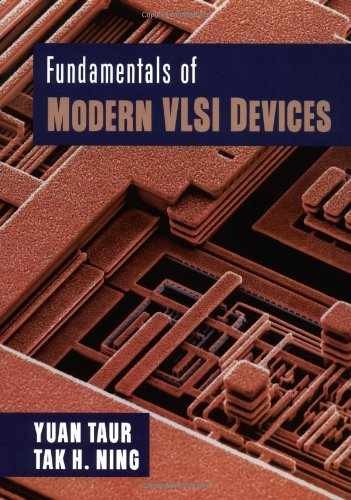
Fundamentals of Modern VLSI Devices (Taur & Ning)
The device-physics reference described as one of the best available today — essential once coursework moves past circuit design into device behavior.
- Deep MOSFET device physics
- Scaling theory coverage
- Graduate-level reference
- Considered the standout device-physics text in the field
- Essential for advanced VLSI/semiconductor coursework
- Not a circuit-design text — pairs with, doesn’t replace, Weste & Harris or Rabaey
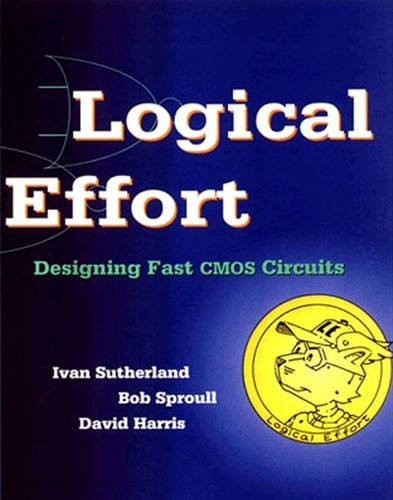
Logical Effort: Designing Fast CMOS Circuits (Sutherland, Sproull, Harris)
A focused, shorter text on the logical-effort method for sizing transistors and estimating circuit delay — a standard reference for timing-driven design.
- Logical effort methodology
- Timing/delay estimation techniques
- Shorter, focused text
- Directly useful for timing-driven design coursework and interviews
- Much shorter than the full-length core textbooks
- Narrow scope — a supplement, not a primary course text
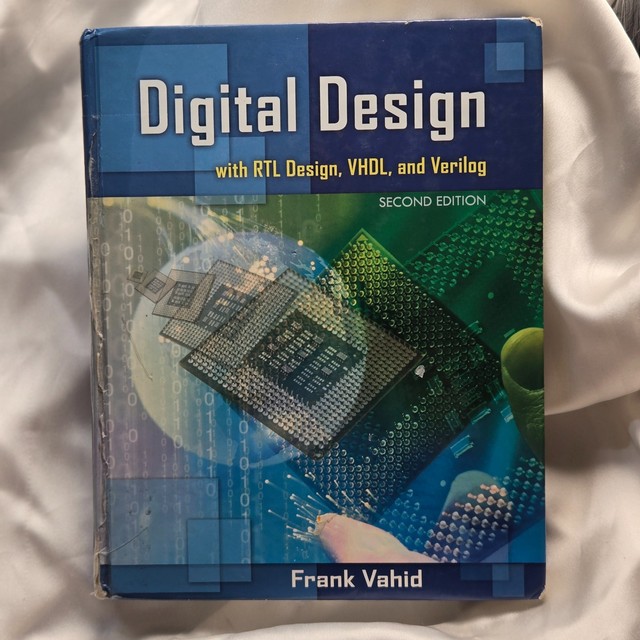
Digital Design and Computer Architecture / RTL Design (Vahid)
A modern digital-design-to-RTL text bridging the gap between logic design fundamentals and HDL-based (VHDL/Verilog) implementation used before VLSI physical design.
- RTL design with VHDL and Verilog
- Progresses from basics to modern practice
- Common prerequisite-course text
- Good bridge from digital logic into HDL-based VLSI flows
- Modern, accessible writing style
- Prerequisite-level text, not a VLSI physical design reference
Buying tips
- Start with Weste & Harris (or Rabaey) for circuit-level fundamentals before moving to Taur & Ning for device physics or Sutherland/Sproull/Harris for timing methodology.
- Check which text your specific course or program has standardized on — Weste & Harris and Rabaey are both common primary texts, and problem sets often follow one directly.
- Older editions (used copies) of these texts are usually adequate for fundamentals; CMOS scaling theory is the one area where a newer edition matters more.
- Pair a textbook with your fab or foundry’s design-rule documentation — none of these books substitute for process-specific PDK documentation in real tapeouts.
As an Amazon Associate and eBay Partner, toptenpick.com earns from qualifying purchases. Prices and availability are subject to change.