


As an Amazon Associate and eBay Partner, toptenpick.com earns from qualifying purchases. Prices and availability are subject to change.
CATIA V5 is unusual among CAD packages in that the books are still the best way to learn it. Dassault’s own documentation assumes you already know the vocabulary, the video market is thin compared with SolidWorks or Fusion, and the software is used in aerospace and automotive where the workflows are specific enough that generic CAD tutorials do not transfer. The result is a small, stable set of textbooks that have been revised across releases for two decades and are genuinely relied on by university courses and OEM training departments. One thing to settle before buying: these books are release-specific in their screenshots but not in their substance. A book written for R21 teaches the same Sketcher and Part Design workbenches you will use today, and buying an older edition second-hand is usually a sensible economy. Ten titles below, sorted roughly by where they fit in a learning path.
| # | Product | Price | Where to buy |
|---|---|---|---|
| 1 | CATIA V5 Workbook by Richard Cozzens | $60–$110 | Amazon · eBay |
| 2 | CATIA V5-6R for Engineers and Designers by Sham Tickoo | $50–$100 | Amazon · eBay |
| 3 | An Introduction to CATIA V5 by Kristie Plantenberg | $55–$100 | Amazon · eBay |
| 4 | CATIA V5-6R2017 Basics by Tutorial Books | $25–$50 | Amazon · eBay |
| 5 | CATIA V5-6R2015 Basics Part III by Tutorial Books | $25–$50 | Amazon |
| 6 | CATIA V5 Design Fundamentals: A Step by Step Guide by Jaecheol Koh | $35–$70 | Amazon · eBay |
| 7 | CATIA V5 Surface Design with Applications by Jaecheol Koh | $40–$80 | Amazon · eBay |
| 8 | CATIA V5 FEA Tutorials by Nader G. Zamani | $40–$90 | Amazon · eBay |
| 9 | VB Scripting for CATIA V5 by Emmett Ross | $30–$60 | Amazon · eBay |
| 10 | CATIA V5 FEA Tutorials by Jaecheol Koh | $35–$70 | Amazon |
The picks, in detail
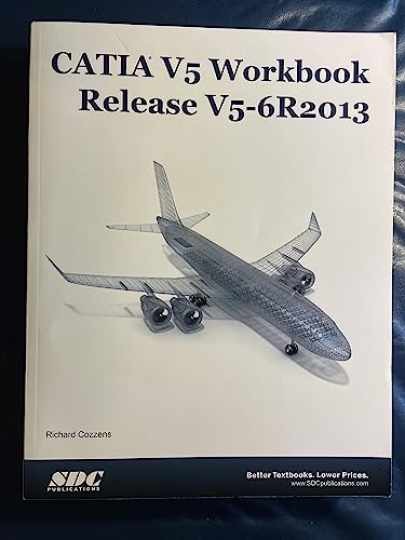
CATIA V5 Workbook by Richard Cozzens
The standard classroom text and the one most likely to be on a university reading list. Pure hands-on: you learn by building parts, not by reading about them.
- Lesson-based structure with progressive exercises
- Covers Sketcher, Part Design, Assembly Design and Drafting
- Written for classroom and self-study use
- Published by SDC Publications across many releases
- Includes review questions and practice problems
- The hands-on approach suits how CATIA is actually learned — by doing
- Widely adopted in engineering programmes, so used copies are plentiful and cheap
- Exercises build on each other rather than being disconnected demos
- Assumes you have access to CATIA while reading; useless as a reference on a train
- Screenshots date quickly across releases
- Light on the surfacing and analysis workbenches
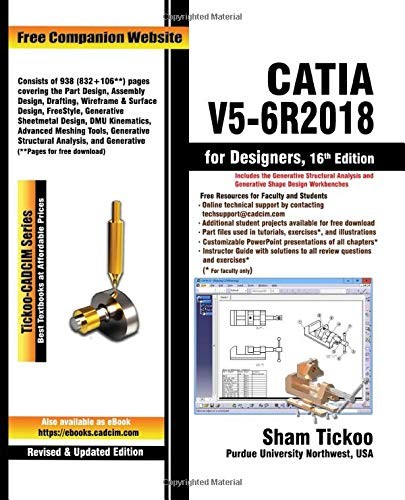
CATIA V5-6R for Engineers and Designers by Sham Tickoo
The comprehensive one. If you buy a single book and want it to still be useful in year three, this is the most complete treatment in print.
- CADCIM Technologies series, revised across releases
- Covers Part, Assembly, Drafting, Sheet Metal, Wireframe and Surface Design
- Tutorial-driven with self-evaluation tests
- Typically 1,000+ pages
- Free instructor resources and part files
- Breadth is unmatched — it covers workbenches most other books skip entirely
- Works as both a course text and a long-term desk reference
- Tickoo’s series is consistent, so the SolidWorks and CATIA volumes feel familiar
- The size is genuinely intimidating for a first-time CAD user
- Writing is functional rather than engaging
- Some editions have noticeable typesetting and editing lapses

An Introduction to CATIA V5 by Kristie Plantenberg
The best book for someone coming from another CAD package. It builds each mechanical design workbench from the ground up rather than assuming CATIA is your first system.
- Ground-up coverage of Sketcher, Part Design, Wireframe and Surface Design, Assembly Design and Drafting
- Hands-on learning approach
- Structured for both beginners and CAD switchers
- SDC Publications, multiple releases available
- Includes engineering-drawing fundamentals alongside the software
- Explains why CATIA does something a particular way, which is exactly what a SolidWorks user needs
- Covers drawing standards, not only button-pushing
- Clear, well-paced writing — the most readable book on this list
- Older releases are common on the used market and screenshots differ from current builds
- Does not reach the advanced surfacing or analysis workbenches
- Less exhaustive than Tickoo as a reference
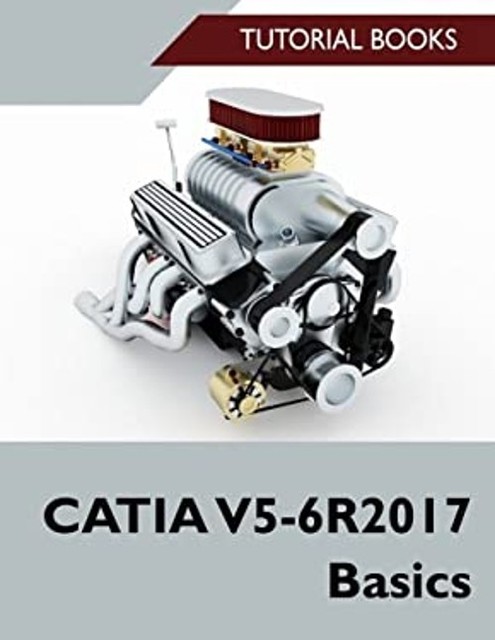
CATIA V5-6R2017 Basics by Tutorial Books
The cheap, fast on-ramp. It gets you making parts, assemblies and drawings in a weekend without any theory you do not immediately need.
- Covers the interface, basic tools and core modelling
- Parts, assemblies, drawings, sheet metal and complex shapes
- Available in print and as an eBook
- Deliberately concise format
- Part of a multi-volume Tutorial Books series
- Cheapest credible starting point, especially as an eBook
- Short enough that you will actually finish it
- Touches sheet metal and complex shapes, which most beginner books omit
- Shallow — it shows you the tools rather than teaching design intent
- Editing quality is below the SDC and CADCIM titles
- You will outgrow it quickly and need a second book
CATIA V5-6R2015 Basics Part III by Tutorial Books
The follow-on volume that covers the four workbenches beginners hit next: assembly, drafting, sheet metal and surface design.
- Assembly Design, Drafting, Sheetmetal Design and Surface Design
- Continues directly from the earlier Basics volumes
- Exercise-driven
- Print and eBook editions
- Compact format
- Fills exactly the gap left by most introductory texts
- Inexpensive way to add surfacing and sheet metal to your skill set
- Can be read standalone if you already know Part Design
- Assumes the earlier volumes; jumping in cold is harder than it looks
- Same brevity trade-off as the rest of the series
- Older release edition

CATIA V5 Design Fundamentals: A Step by Step Guide by Jaecheol Koh
Koh writes the clearest step-by-step instructions of anyone in this field. This is the book to hand someone who gets lost between steps in other tutorials.
- Strictly sequential, step-by-step instruction
- Focus on core part and assembly design
- Independently published, frequently updated
- Heavy use of annotated screenshots
- Companion volumes cover surfacing and analysis
- Almost impossible to lose your place — every click is accounted for
- Excellent for genuinely self-taught learners with no instructor to ask
- Part of a coherent series you can continue into
- The step-by-step density means less explanation of underlying principles
- Self-published production values
- Can feel mechanical if you already understand CAD concepts

CATIA V5 Surface Design with Applications by Jaecheol Koh
Surfacing is where CATIA earns its reputation and its price, and it is the weakest area of every general textbook. This is the dedicated treatment.
- Generative Shape Design and surface modelling workflows
- Application-driven examples rather than abstract exercises
- Covers curve quality, continuity and surface repair
- Same step-by-step method as Koh’s fundamentals book
- Independently published
- Directly relevant to automotive and aerospace work, which is where CATIA jobs are
- Surfacing is badly under-served elsewhere — there is little competition for this book
- Application examples make the theory concrete
- Genuinely difficult material; not a second book for a beginner
- Requires solid Part Design competence first
- Self-published, with the production quality that implies

CATIA V5 FEA Tutorials by Nader G. Zamani
The standard text for the Generative Structural Analysis workbench, revised across releases from R12 to R21 and used in university FEA courses.
- Covers the Generative Structural Analysis workbench
- Progressive tutorials from single parts to assemblies
- Editions available for many releases including R16, R19, R20 and R21
- SDC Publications
- Written by a mechanical engineering academic
- The recognised reference for FEA inside CATIA — there is no real alternative
- Teaches you to sanity-check results, not just generate colourful plots
- Older editions are cheap and substantively current
- Assumes a working knowledge of finite element theory
- Requires the analysis licence, which not every CATIA seat includes
- Dry, academic tone

VB Scripting for CATIA V5 by Emmett Ross
The book that turns you from a CATIA user into someone the department cannot replace. Macros for the repetitive work nobody wants to do by hand.
- Teaches CATIA macro programming in VB
- Practical automation examples for real workflows
- Assumes no prior programming experience
- Supported by the author’s ongoing scripting resources
- Focused on time-saving rather than computer science
- Immediate practical payoff — one working macro can save hours a week
- Genuinely accessible to engineers who have never programmed
- A differentiating skill on a CV in aerospace and automotive
- Only useful once you already know CATIA well
- VB is dated as a language, though it is what CATIA V5 exposes
- Narrow subject; not a general CAD book
CATIA V5 FEA Tutorials by Jaecheol Koh
A gentler route into the same analysis workbench Zamani covers, for people who want to run a stress check without a formal FEA background.
- Generative Structural Analysis workbench
- Step-by-step method consistent with Koh’s other titles
- Static, frequency and buckling analysis coverage
- Worked examples with interpretation of results
- Independently published
- Far more approachable than Zamani if theory is not your background
- Consistent style if you already own Koh’s fundamentals book
- Explains how to interpret output, not only how to produce it
- Less rigorous than Zamani — you will not learn the underlying theory here
- Self-published production values
- Same licence requirement for the analysis workbench
Buying tips
- Buy the older edition. These books are revised release by release, but the Sketcher, Part Design and Assembly workbenches have barely changed in fifteen years. A used R19 or R21 copy at a third of the price teaches the same material; you will occasionally see a differently-coloured icon. The exception is anything covering the newer 3DEXPERIENCE interface, which is genuinely different software.
- Match the book to your CATIA licence, not your ambition. The FEA and advanced surfacing books require workbenches that many seats simply do not include. Check what your licence actually opens before buying a book you cannot follow along with.
- You need the software in front of you. CATIA is not learnable by reading. If you do not have a work or university seat, the student edition and the various time-limited trials exist — sort that out before ordering, or the book will sit unopened.
- Pick one primary book and finish it. The common failure is owning four CATIA books and having read the first three chapters of each. Cozzens or Plantenberg for structure, Tickoo if you want reference depth. Add the specialist titles only once the general one is done.
- Do the exercises with your own parts too. Working the book’s example is how you learn the tool; remodelling something from your own job is how you find out what you actually did not understand. Every serious CATIA user has hit the point where their own part will not constrain properly, and that is the real lesson.
- Learn Generative Shape Design if you want the aerospace and automotive jobs. Solid modelling in CATIA is competent but not special — plenty of packages do it. Surfacing is why those industries standardised on CATIA in the first place, and it is where the pay premium sits.
- Check whether part files are included before buying used. Many of these titles ship with downloadable exercise files tied to a code in the book, and a second-hand copy may have a used code. The SDC and CADCIM titles are usually fine; verify before assuming.
As an Amazon Associate and eBay Partner, toptenpick.com earns from qualifying purchases. Prices and availability are subject to change.