

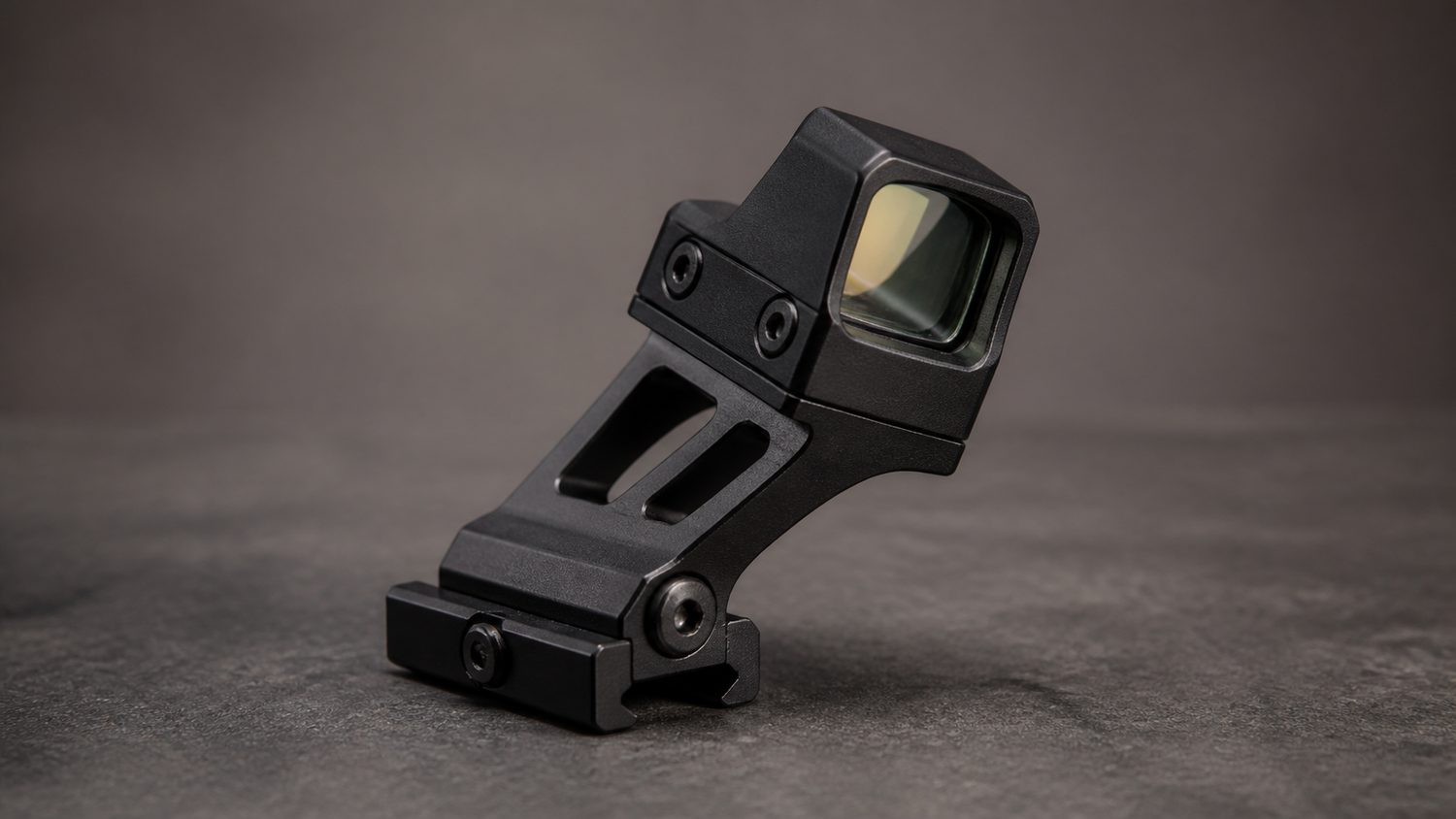
A 45-degree RMR mount is an offset interface that places a miniature reflex sight at an angle beside a primary optic. It is often discussed as a quick transition option, but it is also a firearm accessory. That means the useful question is not which mount to buy; it is how the interface, host firearm and handling process work together. This guide is informational only. It does not recommend products or provide affiliate links.
What the 45-degree position changes
An offset mount normally places the secondary optic about forty-five degrees from the top centerline of the firearm. Rotating the firearm slightly brings that sight into the line of sight while the primary optic remains installed. The arrangement changes where the optic sits relative to the bore, handguard, controls and ejection path. It also changes how the firearm is held during the transition. Those changes are why a setup that clears on one host can interfere on another.
“RMR” is often used loosely for a compact-reflex-sight footprint, but footprint compatibility is a mechanical question. The mounting screw pattern, locating bosses, recoil lugs and plate geometry must correspond to the specific optic and interface. Do not assume that an optic described as RMR-style shares every dimension with another miniature sight. Read the optic maker’s footprint information and the mount maker’s drawing, then inspect the actual parts before installation.
Interface and clearance checks
Start with the attachment method. A Picatinny-railed receiver or handguard uses cross-slot engagement and clamp hardware; an M-LOK handguard needs an appropriate M-LOK interface and sufficient internal clearance for its T-nuts. These are not interchangeable attachment systems. M-LOK hardware must sit in a compatible slot and clear the barrel, gas system, wiring, handguard liner and any accessory inside the handguard. Picatinny hardware must engage a true slot rather than bridge an unsupported area.
Next, look at the whole installed system from every side. Check clearance from the primary optic, turret caps, magnification lever, backup sights, sling hardware, lights, laser housings, charging handle, ejection port and controls. Also consider the support hand. An offset optic placed where fingers, a sling or a cable can contact it may be bumped out of alignment or obstructed at the moment it is needed. A mount that clears when the firearm is empty on a bench can still prove unsuitable once all normal accessories are installed.
Height matters as much as sideways position. The optic centerline above the bore creates mechanical offset at close distances. A tall mount has a different point-of-impact relationship than a low mount, even when both are correctly zeroed. Changing the mount, plate, spacer, optic or rail location changes that relationship. Keep the relevant configuration fixed while evaluating it; moving one component and assuming the prior zero still applies is not a sound practice.
Handedness and control access
Offset placement has a handedness component. A mount that places the optic on one side can alter where the support hand rests and how controls are accessed. The correct direction depends on the shooter, the host firearm, the primary optic and the surrounding accessories; there is no universal left- or right-side answer. Before relying on an arrangement, verify that the selector, charging handle, magazine release, bolt controls and sling are reachable without forcing the fingers across the optic or its mount.
Do this only with the firearm unloaded, pointed in a safe direction and with ammunition stored separately. Follow the manufacturer’s unloading procedure, visually and physically verify the chamber and magazine well as applicable, and obey all range rules. If you are uncertain about manipulation, fitment or the firearm’s condition, stop and seek qualified in-person instruction. A mount does not make a handling process safe by itself.
Zero and confirmation
Zeroing is the process of aligning the sight to a chosen point of impact at a selected distance. The chosen distance, ammunition, barrel, optic height and offset all affect what the sight picture means at other distances. Record the configuration and the selected zero distance rather than treating a zero as a permanent property of an optic. If the optic, mount, screws, rail location or ammunition changes, confirmation is appropriate before relying on the setup.
Use a lawful range and follow its procedures. Confirm that the optic is securely mounted before firing, then make small, deliberate adjustments according to the optic manual. Do not adjust a sight by guesswork or by relying on another person’s settings. Heat, vibration, impacts and repeated removal can change hardware condition. The goal is a controlled confirmation process, not a rapid transition drill.
Retention, screws and inspection
Fasteners and locating surfaces retain the mount under recoil and handling. Use only the screw length, thread specification, torque value and thread-locking instruction supplied by the relevant manufacturer. A screw that is too long can bottom out or contact internal components; one that is too short may not provide sufficient thread engagement. Excess torque can damage threads, deform a mount or stress an optic. Under-torque can allow movement. There is no single torque number that safely applies to every mount, rail and optic combination.
Inspect the assembly before and after range use. Look for loosened clamps, witness-mark movement, damaged screw heads, cracked plates, rail-slot wear, shifted optic position, damaged lenses and contact with nearby accessories. A visual check is not proof of proper torque, but it can reveal a change that warrants stopping use and consulting the maker. Replace damaged hardware with the correct specified part; do not improvise fasteners from an unrelated mount.
Legal and responsible context
Firearm laws, range policies and transportation rules differ by jurisdiction and can change. Comply with the law where you possess, transport or use the firearm, including any rules about configuration, storage and safe handling. Keep the firearm secured from unauthorized users. If an optic setup affects a duty, competition or hunting context, also follow the rules of that organization or land manager.
An offset sight is an accessory interface, not a shortcut around training, safe storage or professional maintenance. If there is any doubt about the compatibility of an RMR-footprint optic, a forty-five-degree mount, a Picatinny rail, an M-LOK handguard or the host firearm, leave it uninstalled until a qualified gunsmith or instructor can examine the setup. That conservative choice protects both equipment and people.