

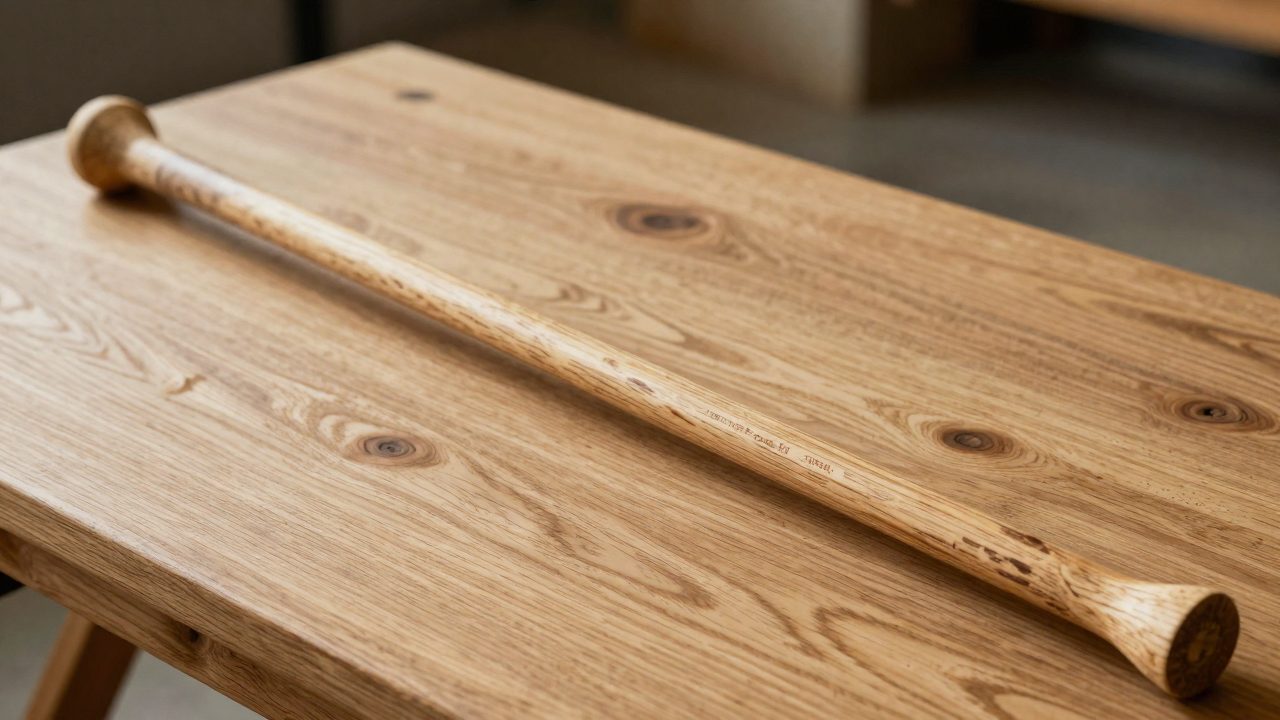
A quarterstaff needs to survive repeated impact without splintering, so the wood matters far more here than in most woodworking projects — the wrong species will crack, warp, or simply weigh too much to use comfortably for an extended session. This guide compares the woods actually used for quarterstaffs, split between species meant for real striking use and the lighter rattan typically used for training.
Hickory — the default choice for a striking staff
Hickory is generally considered the benchmark wood for a quarterstaff meant for actual contact use. It’s a dense, tough hardwood with high shock resistance, the same property that makes it the standard choice for axe handles and hammer handles — tools that take repeated sudden impact without the handle failing. A hickory staff is heavier than an ash or rattan staff of the same dimensions, which some practitioners prefer for a more grounded, powerful feel, and others find tiring over a long practice session.
Ash — the traditional quarterstaff wood
Ash is what most historical quarterstaffs were actually made from, and it remains a strong modern choice. It’s lighter than hickory while still resisting breakage well, the same combination of properties that made it the traditional wood for bows, spear shafts, and tool handles built to flex under load rather than snap. An ash staff generally feels quicker and less fatiguing to swing than an equivalent hickory staff, at a small cost in raw impact durability.
Oak — heavy and very tough, but check the grain
Oak is another traditional option, prized for sheer toughness, but it comes with two caveats worth knowing. First, oak is noticeably heavier than ash or hickory at the same dimensions, which changes the staff’s balance and swing speed. Second, oak’s suitability depends heavily on straight, tight grain — a piece with wavy or diagonal grain running out to the surface is considerably more likely to split under a hard strike than a well-selected hickory or ash staff of similar quality. If you’re buying rather than selecting a stave yourself, grain quality is worth asking about specifically.
Rattan — the standard for training, not striking
Rattan is the wood most training and sparring staffs are made from, and it plays a fundamentally different role than the three hardwoods above. It’s light, extremely flexible, and — critically for a training weapon swung at another person — it tends to splinter and fray at the tip under repeated stress rather than snapping cleanly, a real safety advantage over a rigid hardwood staff. The tradeoff is that rattan isn’t meant to hold up as a long-term striking or demonstration weapon the way hickory or ash is; it’s a consumable training tool that gets replaced periodically.
Other woods worth knowing
Maple, chestnut, and Douglas fir all show up as staff material, generally as a step down in either toughness or availability compared to the four woods above. Maple is reasonably tough but heavier than ash for a comparable swing feel; chestnut is lighter but softer and less impact-resistant; Douglas fir is easy to source as construction-grade lumber but is a softwood, meaning it dents and splinters more readily under hard contact than any true hardwood on this list.
Buying or making one: what actually matters
- Grain orientation matters as much as species — a straight-grained piece of a “good enough” wood will usually outlast a beautiful piece of hickory with grain running diagonally out to the surface.
- Diameter is typically around 1 to 1.25 inches for an adult staff; thicker adds durability and weight, thinner saves weight at some cost to strength.
- Length is traditionally sized to the user’s own height, historically measured to the eyebrow or a raised hand, rather than one universal length.
- Finish with a penetrating oil (boiled linseed oil is the traditional choice) rather than a hard film finish like polyurethane — an oil finish lets you feel and periodically check the wood surface for developing cracks, where a film finish can hide early damage.
- If you want a staff for actual sparring rather than display or solo forms, buy rattan specifically rather than a hardwood — the splintering failure mode is a genuine safety feature, not a defect.
General online marketplaces and specialty martial-arts suppliers both carry pre-made staffs in these woods if you’d rather not select and finish a stave yourself — just confirm the listed species and diameter match what you’re after, since “wood staff” listings vary widely in both.