

As an Amazon Associate and eBay Partner, toptenpick.com earns from qualifying purchases. Prices and availability are subject to change.
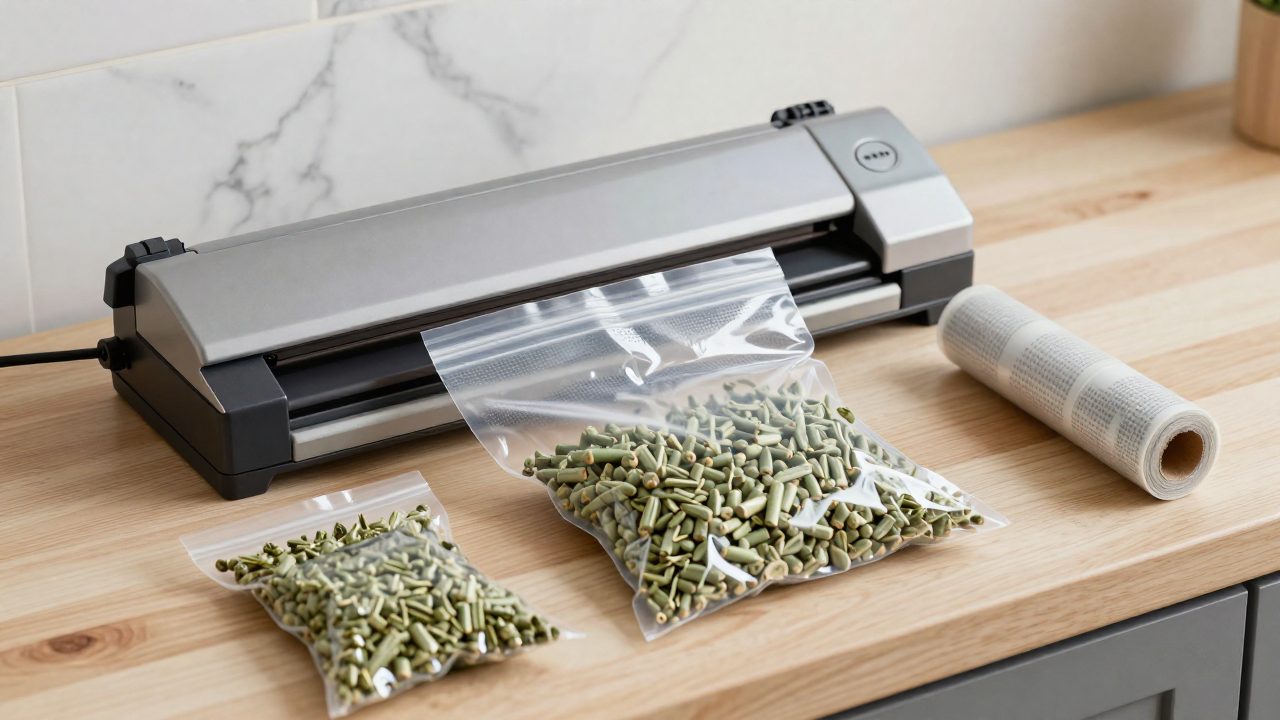
Hops die of oxygen, not of age. A pound of Citra bought in bulk and left in its opened foil will lose most of its aroma inside a few months, and what is left smells of cheese and old paper because the alpha acids have oxidised. Vacuum sealing into small, single-batch portions and freezing them is the cheapest way to make that bulk purchase behave like fresh stock a year later.
The important decision is external versus chamber. An external sealer — the FoodSaver-style machine that grips the end of a bag and sucks — needs textured or embossed bags, because it draws the air out through the channels embossed into the plastic. A chamber sealer puts the whole bag inside a box, evacuates the box, then seals, which means it pulls a deeper vacuum, works with liquids, and will seal any bag including plain foil-lined mylar. That mylar point matters: mylar is a far better oxygen barrier than the polyethylene a vacuum bag is made of, and an external machine cannot seal it properly because smooth mylar has no channels for the air to travel along.
For most homebrewers, an external sealer plus a freezer is entirely good enough — cold slows oxidation enough that the imperfect barrier stops mattering. If you buy hops by the kilo and store them for years, or you also seal wort samples and liquids, a chamber machine is the upgrade that actually changes the outcome.
Ten machines below, from a fifty-dollar starter to the commercial chamber sealers, with the hop-specific quirks of each.
| # | Product | Price | Where to buy |
|---|---|---|---|
| 1 | Anova Precision Vacuum Sealer Pro | $100–$160 | Amazon · eBay |
| 2 | NESCO VS-12 Deluxe | $110–$160 | Amazon · eBay |
| 3 | FoodSaver VS3150 Multi-Use | $110–$190 | Amazon |
| 4 | Oliso PRO Smart Hub vacuum sealer | $180–$280 | Amazon · eBay |
| 5 | NutriChef PKVS18SL | $50–$80 | Amazon · eBay |
| 6 | Bonsenkitchen VS3802 | $50–$75 | Amazon · eBay |
| 7 | Avid Armor USV32 chamber vacuum sealer | $400–$550 | Amazon · eBay |
| 8 | VEVOR DZ-260C chamber vacuum sealer | $300–$450 | Amazon · eBay |
| 9 | Weston Pro-2300 | $350–$450 | Amazon · eBay |
| 10 | VacMaster VP215 chamber vacuum sealer | $900–$1,200 | Amazon · eBay |
The picks, in detail

Anova Precision Vacuum Sealer Pro
The external sealer that tests best, and a sensible default for a brewer. Its seal quality is consistently the most even of the mainstream machines, which matters more than suction strength — a hop pack fails at a bad weld, not because the vacuum was 5% weaker. The controls are three buttons, it has a proper pulse mode for delicate cone hops you do not want to crush, and the accessory port handles jar lids for yeast and grain.
- Strong pump with a moist and dry setting
- Manual pulse mode for delicate whole cones
- Accessory hose port for jars and canisters
- Compact — roughly 15 by 4 inches, just over 2 lb
- Most consistent seal quality of the external machines tested
- Pulse mode prevents crushing whole-leaf hops
- Small enough to leave on a shelf
- Requires embossed bags — will not seal plain mylar
- No bag roll storage or built-in cutter
- Pump is audible enough to notice

NESCO VS-12 Deluxe
The one that finishes just behind the Anova on seal quality and ahead of it on convenience. It has one of the strongest pumps in its class at around 130 watts, stores the bag roll inside the machine and includes a cutter, so portioning a pound of pellets into twelve one-ounce packs is one continuous operation rather than a wrestling match with scissors. It is large, which is the price of all that.
- Roughly 130 W pump, among the strongest in its class
- Integrated bag roll storage and cutter
- Double seal option for long-term storage
- Adjustable vacuum pressure for delicate contents
- Built-in roll and cutter makes portioning genuinely fast
- Powerful pump with a reliable double seal
- Excellent value for the capability
- Large footprint — it needs dedicated counter or shelf space
- Embossed bags only, like all external machines
- Controls are less intuitive than the Anova’s
FoodSaver VS3150 Multi-Use
The machine most people already own or inherit, and it is perfectly adequate for hops in a freezer. Its advantage is the ecosystem: FoodSaver bags, rolls, jar attachments and containers are on the shelf in every supermarket, so you are never waiting on a delivery to seal something. Its disadvantage is the same one every external sealer has, plus a pump that is merely adequate rather than strong.
- Retractable accessory hose for jars and canisters
- Moist and dry settings with a marinate mode
- Built-in roll storage and cutter on the VS3180 variant
- Consumables stocked in ordinary shops
- Bags and accessories available everywhere
- Well-proven, simple to use
- Frequently discounted below list
- Pump is weaker than the Anova or NESCO
- Locked into relatively expensive FoodSaver-branded bags
- Cannot seal mylar

Oliso PRO Smart Hub vacuum sealer
The oddity that homebrewers keep recommending specifically for hops. Oliso’s system uses reusable zip-style bags with a valve rather than single-use embossed rolls, so re-opening a pack to take out two ounces and re-sealing the rest costs nothing but a few seconds — which is exactly the pattern hop storage actually follows. The bags are an ongoing investment but you stop throwing plastic away every time you brew.
- Reusable valve bags rather than single-use embossed rolls
- Doubles as a sous-vide circulator hub on some models
- Reseals a partially used pack repeatedly
- Compact countertop footprint
- Resealing a part-used hop pack is genuinely easy
- Much less plastic waste over a year
- Well regarded in homebrewing circles for exactly this use
- Proprietary bags cost more up front
- Vacuum is shallower than a good roll-bag machine
- Valve bags eventually wear out

NutriChef PKVS18SL
The budget entry, and a reasonable one if you are sealing a few ounces at a time into a freezer. It seals cleanly enough, takes standard embossed bags rather than proprietary ones, and costs less than a single bulk hop order. Do not expect it to keep up with sealing forty packs in a sitting — the heat strip needs a rest between seals — but for a brewer portioning one purchase at a time it is fine.
- Takes generic embossed bags, no brand lock-in
- Dry and moist modes
- Automatic and manual operation
- Very compact and light
- Cheapest capable machine here
- Uses inexpensive generic bags
- Small enough for a cupboard
- Needs cooling time between seals
- Weaker pump means a shallower vacuum
- Build quality reflects the price

Bonsenkitchen VS3802
The other credible budget option, and slightly better specified than most at this price — it has a pulse function, which is the feature that matters if you are sealing whole-leaf hops and do not want them compressed into a puck. A compressed pellet pack is fine; compressed cones lose some of the surface area you are paying for. Generic bag compatibility keeps running costs low.
- Pulse mode for delicate contents
- Five sealing modes including dry, moist and gentle
- Generic embossed bag compatibility
- Slim, upright-storable body
- Pulse control at a budget price
- Cheap generic consumables
- Compact and easy to store
- Seal strip is short — limits bag width
- Duty cycle is limited, as with all budget machines
- Plastic construction feels flimsy

Avid Armor USV32 chamber vacuum sealer
The realistic entry point into chamber sealing, and the machine that turns up most often in homebrew forums. Because it evacuates a chamber rather than pulling through the bag, it seals flat mylar — which is the whole reason a brewer would upgrade. Mylar is a dramatically better oxygen barrier than polyethylene, and mylar plus a chamber vacuum plus an oxygen absorber is what gets hops through two years at room temperature rather than one in a freezer.
- Chamber design — seals any flat bag including foil mylar
- Deeper vacuum than any external machine
- Handles liquids and wort samples without drawing them out
- Cheap smooth bags instead of embossed rolls
- Seals mylar, which no external machine can
- Bag costs drop sharply once you leave embossed rolls
- Also useful for liquids, brines and yeast starters
- Three to four times the price of a good external sealer
- Heavy and large
- Chamber size limits bag dimensions

VEVOR DZ-260C chamber vacuum sealer
The cheapest way into a real chamber machine, and it does the important thing — a proper oil-pump vacuum and a seal bar that handles mylar. The compromises are in the finish, the documentation and the support rather than in the physics. Brewers who buy hops by the kilo and want mylar packaging without a four-figure outlay end up here more often than anywhere else.
- Oil-lubricated rotary vane pump
- Full chamber evacuation, mylar-capable seal bar
- Adjustable vacuum and seal times
- Stainless chamber
- Chamber capability at roughly half the branded price
- Adjustable timings suit different bag materials
- Pump is genuinely capable, not a token
- Documentation and support are poor
- Oil pump needs periodic oil changes
- Quality control varies between units

Weston Pro-2300
The heavy-duty external sealer, aimed at hunters packing a whole deer and equally happy portioning ten pounds of hops in one sitting. Where budget machines need a minute between seals, this one has the duty cycle to run continuously, and the 15-inch seal bar takes wide bags. It is still an external machine, so mylar remains off the menu — you are buying throughput, not a deeper vacuum.
- 15-inch seal bar for wide bags
- Commercial-grade duty cycle, no cooling pauses
- Stainless steel housing
- Double-piston pump
- Seals continuously without overheating
- Wide bar handles large-format packs
- Built to last years of heavy use
- Expensive for an external machine
- Very heavy and large
- Still cannot seal flat mylar

VacMaster VP215 chamber vacuum sealer
The machine you buy once. An oil rotary pump, a proper stainless chamber and a duty cycle intended for commercial kitchens — it will seal mylar all afternoon and it will still be working in a decade. Only worth it if hops are one of several things you are sealing seriously, but among people who have bought one, nobody recommends anything cheaper afterwards.
- Commercial oil rotary vane pump
- Deep stainless chamber with programmable cycles
- Continuous-duty operation
- Serviceable — parts and pump rebuilds available
- Deepest, most repeatable vacuum here
- Effectively a lifetime purchase with servicing
- Handles mylar, liquids and heavy production
- Costs as much as a decent brewing system
- Very heavy, effectively a permanent installation
- Requires oil changes and maintenance
Buying tips
- Portion by recipe, not by weight you happen to have. Seal one-ounce or two-ounce packs matching what a single batch uses, so a brew day never means opening a pound and resealing the rest.
- Freeze after sealing. Vacuum plus freezer is worth far more than vacuum alone — cold slows the oxidation reaction that the imperfect plastic barrier will always let happen eventually.
- Mylar is the better barrier, and only a chamber machine can seal it flat. If you plan to store hops at room temperature for more than a few months, this is the reason to spend the extra money.
- Add an oxygen absorber to large mylar packs. It scavenges the residual oxygen a vacuum cannot remove, and they cost pennies.
- Use pulse mode for whole-leaf hops. A full vacuum compresses cones into a solid disc, which makes weighing them out later awkward and damages some of the lupulin glands.
- Label the pack with variety, alpha acid percentage and crop year before you seal it, not after. Handwriting on a frozen, opaque, vacuum-shrunk pack is not something anyone manages twice.
- Double-seal anything going into long-term storage, and leave enough headspace above the seal that you can cut the bag open and reseal it without losing much bag length.
As an Amazon Associate and eBay Partner, toptenpick.com earns from qualifying purchases. Prices and availability are subject to change.