

As an Amazon Associate and eBay Partner, toptenpick.com earns from qualifying purchases. Prices and availability are subject to change.
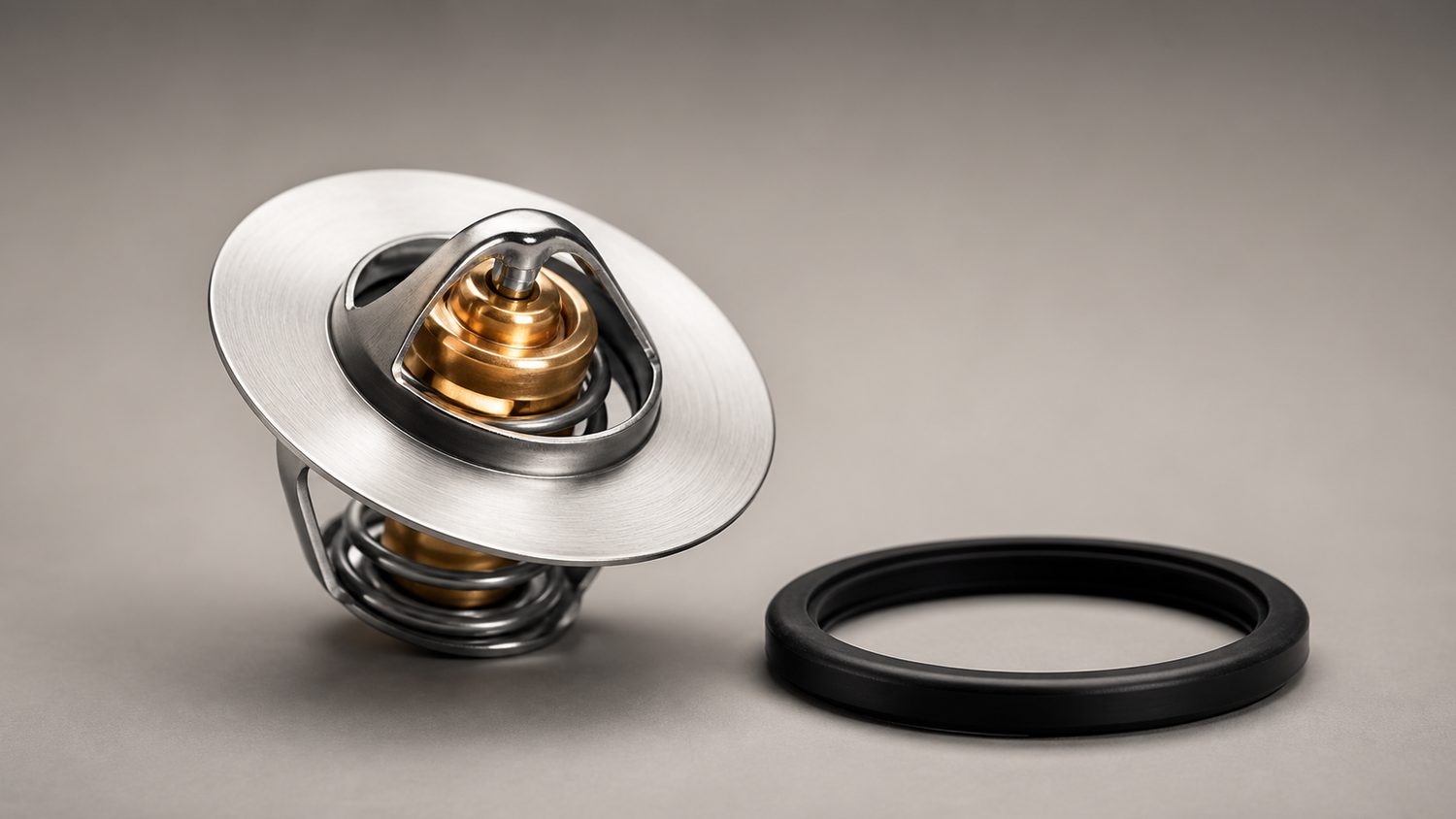
The first thing to know about this job is that the 6.4 Power Stroke does not have a thermostat. It has two, in a dual-thermostat arrangement, and they do different jobs at different temperatures.
That single fact changes the repair in three ways. It means you replace both, always — they are the same age and the same duty cycle, and doing one is paying the labour twice. It means a fault can present strangely, because one stuck thermostat and one working one gives you behaviour that matches neither a clean stuck-open nor a clean stuck-closed diagnosis. And it means the parts cost is roughly double what a single-thermostat truck would suggest, which catches people out when they compare prices against a gasser.
The second thing is what the symptoms actually mean. A thermostat stuck open is the more common failure and the more easily missed: the engine takes a very long time to warm up, the heater blows lukewarm, and the temperature gauge sits low and never quite reaches the middle. That feels harmless and it is not — a diesel running below its designed temperature runs rich, makes more soot, dilutes its oil with fuel, and on an emissions-equipped 6.4 interferes with regeneration, which is where the expensive consequences live.
Stuck closed is more dramatic and less common: the temperature climbs fast, particularly under load, and you notice immediately.
Third, and this is the part people skip: a thermostat is a symptom-level part. If the truck is running hot, a new thermostat is a cheap thing to try and frequently not the answer — the same symptom comes from a plugged radiator or intercooler, a failing water pump, a fan clutch that will not engage, or air trapped in the system after a previous repair. Fitting a thermostat without checking those is how people end up doing the job twice.
Ten picks below, including the tools and the coolant that make the job go correctly the first time.
| # | Product | Price | Where to buy |
|---|---|---|---|
| 1 | Motorcraft Thermostat Pair | $120-$250 for the pair | Amazon |
| 2 | Aftermarket OE-Temperature Thermostat Kit | $60-$150 for the pair | Amazon |
| 3 | Thermostat Housing and Seal Kit | $40-$150 | Amazon |
| 4 | Ford-Spec Coolant | $25-$70 | Amazon |
| 5 | Coolant Vacuum Fill Tool | $50-$150 | Amazon · eBay |
| 6 | Cooling System Pressure Tester | $40-$120 | Amazon · eBay |
| 7 | Infrared Thermometer | $20-$70 | Amazon · eBay |
| 8 | OBD-II Scan Tool with Ford Enhanced Data | $80-$400 | Amazon |
| 9 | Radiator and Intercooler Cleaning Kit | $20-$50 | Amazon |
| 10 | Coolant Filter Kit | $70-$180 | Amazon · eBay |
The picks, in detail
Motorcraft Thermostat Pair
The factory part and the default. The 6.4 uses two thermostats with different opening temperatures as part of one cooling strategy, so buying a matched Motorcraft pair removes any question about whether the two you fitted are designed to work together. Ford specified these temperatures deliberately in an emissions-equipped engine, and the temperature at which the engine runs affects regeneration behaviour. This is not an area to experiment in on a truck you rely on.
- Matched pair at the factory opening temperatures
- OE quality seals and housings
- Correct behaviour for the emissions strategy
- Ford parts warranty
- No question about temperature matching
- Correct for the regeneration strategy
- Available through any Ford dealer
- Most expensive option
- Can require ordering in
Aftermarket OE-Temperature Thermostat Kit
The value route, and a sound one if you buy from an established diesel supplier rather than the cheapest listing. What you want is a kit sold as a pair at the factory opening temperatures, with new seals included. Check both temperatures against the specification rather than assuming a kit is correct — some sellers list generic 6.4 thermostats without distinguishing the two positions, which is precisely the error that leaves you with a truck that runs oddly and no obvious cause.
- Both thermostats supplied as a kit
- Factory opening temperatures
- New seals included
- Typically a one-year warranty
- Substantially cheaper than Motorcraft
- Kits include the seals people forget
- Widely stocked by diesel specialists
- Some listings do not distinguish the two positions
- Quality varies more than the price suggests
Thermostat Housing and Seal Kit
Inspect the housings while everything is apart. Aluminium housings corrode from the inside where the coolant sits, and a pitted sealing face will weep however new the seal is — which turns into a slow leak you chase for months afterwards. Seals are cheap and must be replaced regardless; a housing is only needed if the sealing surface is damaged. Check both carefully with the parts in your hand rather than in the engine bay, where you cannot see the faces properly.
- Replacement housings where corroded
- O-rings and gaskets for both positions
- Bolts supplied in some kits
- Direct fit
- Prevents a slow weep after the job is done
- Seals must be replaced anyway
- No extra labour while apart
- Housings are often unnecessary — inspect first
- Corroded bolts can snap on removal
Ford-Spec Coolant
Use the coolant Ford specifies, and do not mix types. Diesel cooling systems are more chemistry-sensitive than petrol ones: the additive package protects against cavitation erosion on the cylinder liners, which is a genuine failure mode on diesels and not something a generic green coolant addresses. Mixing incompatible coolants can also cause the additives to drop out of solution and form a sludge. Buy the specified type, mix to the correct ratio with distilled water, and note the change interval.
- Meets the Ford specification for this engine
- Cavitation-inhibiting additive package
- Concentrate and pre-mixed versions
- Long-life formulations available
- Protects cylinder liners against cavitation
- Correct chemistry for the system’s materials
- Pre-mixed removes the dilution error
- Dearer than generic coolant
- Mixing types can precipitate a sludge

Coolant Vacuum Fill Tool
The tool that prevents the most common way this job goes wrong: trapped air. A 6.4’s cooling system has high points that hold air pockets, and an air pocket gives you erratic temperature readings, a heater that blows cold and a truck that seems to overheat intermittently — all of which look exactly like a failed thermostat. A vacuum fill tool evacuates the system first, so coolant is drawn in with no air at all. Air-powered, and it turns a frustrating bleed into a five-minute job.
- Evacuates the system with compressed air
- Draws coolant in under vacuum
- Universal radiator neck adapters
- Vacuum gauge to confirm the system holds
- Eliminates air pockets completely
- Doubles as a leak test — the vacuum must hold
- Turns a long bleed into minutes
- Needs a compressor
- Adapters do not fit every filler neck

Cooling System Pressure Tester
The diagnostic that tells you whether you have a thermostat problem at all. A pressure tester pumps the cold system up to its rated pressure and shows whether it holds — a system that cannot hold pressure has a leak, and a leaking system boils at a lower temperature and overheats regardless of what the thermostats are doing. Most kits also test the radiator cap, which is a cheap part that fails quietly and causes exactly the same symptom. Test before you buy anything.
- Hand pump with a gauge
- Adapters for common filler necks
- Radiator cap testing adapter
- Case with the full adapter set
- Finds leaks before you replace the wrong part
- Tests the cap, a cheap and commonly missed failure
- Reusable across every vehicle you own
- Adapter sets vary — check yours is covered
- Cheap gauges lose accuracy
Infrared Thermometer
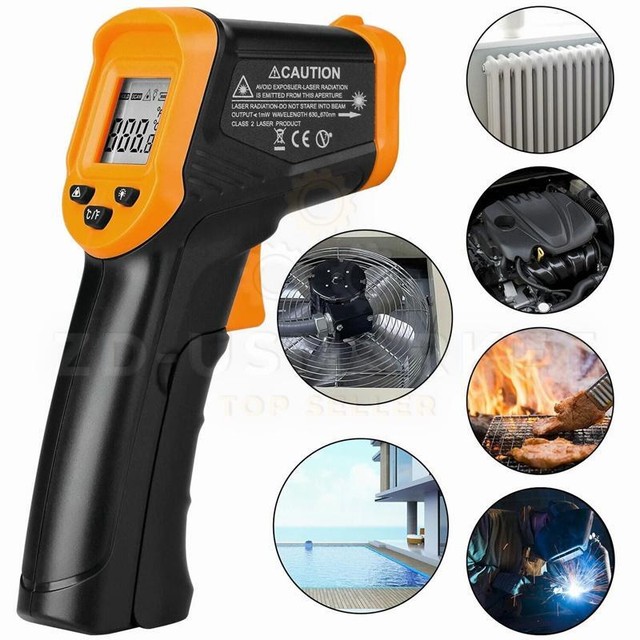
The fastest way to see what the cooling system is actually doing. Pointed at the upper and lower radiator hoses it shows you the temperature difference across the radiator — a good core drops the coolant temperature noticeably, and a plugged one does not. Pointed across the radiator face it finds cold patches where the core is blocked. It also confirms whether a thermostat is opening when the gauge says it should. Under fifty dollars and it prevents the most expensive misdiagnosis here.
- Non-contact infrared measurement
- Range covering coolant temperatures
- Laser aiming
- Emissivity adjustment on better models
- Shows whether the radiator is actually rejecting heat
- Finds blocked core sections by cold spots
- Confirms when the thermostats open
- Reads shiny surfaces inaccurately without adjustment
- Measures surface, not coolant, temperature
OBD-II Scan Tool with Ford Enhanced Data
A gauge on the dash is heavily damped and tells you very little. A tool that reads Ford enhanced data gives you the actual engine coolant temperature sensor value, which is the number the engine is making decisions on — and on a 6.4 that includes regeneration behaviour. Watching that value climb from a cold start tells you precisely when each thermostat opens and whether the warm-up is taking too long. That is the real diagnosis for a stuck-open thermostat, which the dash gauge hides.
- Ford enhanced powertrain data
- Live coolant and oil temperature
- Regeneration status parameters
- Data logging for a full warm-up cycle
- Shows the real temperature, not a damped gauge
- Catches slow warm-up, the commonly missed failure
- Useful for every other 6.4 diagnosis
- Generic readers do not show enhanced data
- Some tools charge extra for the enhanced set
Radiator and Intercooler Cleaning Kit
The cause people miss, and the one an infrared thermometer points you at. Trucks accumulate a mat of dust, chaff and insects between the radiator, the intercooler and the condenser — a sandwich of cores where the middle one cannot be reached without separating them. A dedicated fin cleaner and a gentle rinse restore airflow. Use low pressure and always rinse from the engine side outwards; a pressure washer from the front packs debris deeper and bends the fins flat.
- Foaming fin cleaner
- Fin comb for straightening bent fins
- Soft brushes
- Safe on aluminium
- Restores airflow, a common real cause of running hot
- Very cheap compared with parts
- Fin comb recovers previously damaged cores
- A pressure washer from the front makes it worse
- The middle core is hard to reach without separating them
Coolant Filter Kit
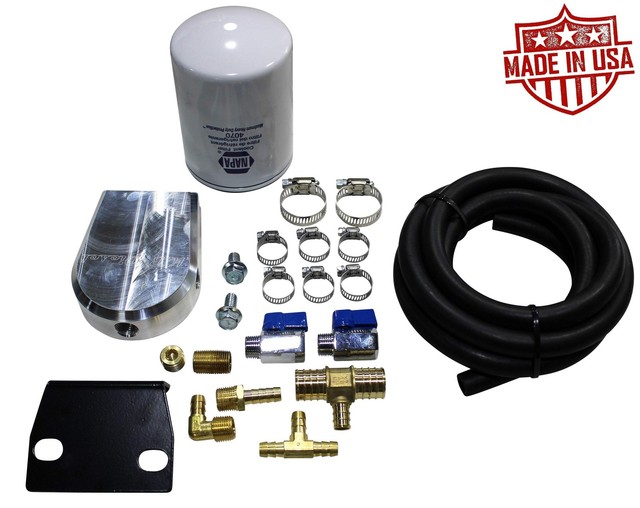
A worthwhile addition on a diesel and particularly on an engine that has had cooling system work. A spin-on coolant filter catches the casting sand, scale and debris circulating in an older system before it reaches the water pump seal and the radiator core — and it is exactly the debris a thermostat replacement can dislodge. Better kits also meter supplemental coolant additive. Fitting one means plumbing in a filter head, so do it while the system is already drained.
- Spin-on filter with a mounting head
- Captures scale and casting debris
- Some meter supplemental coolant additive
- Hose and fittings supplied
- Protects the water pump and radiator from circulating debris
- Easy to fit while the system is drained
- Filter changes are quick afterwards
- Requires plumbing in a filter head
- Ongoing filter cost
Buying tips
- Replace both thermostats, every time. The 6.4 uses two, at different opening temperatures, and they share the same age and duty cycle. Doing one means paying the labour twice, and a mismatched pair produces confusing behaviour that fits neither a stuck-open nor a stuck-closed diagnosis. Buy them as a matched pair.
- Stuck open is the failure people miss. Long warm-up, lukewarm heat and a gauge that never reaches the middle feels harmless. It is not: a diesel running cold runs rich, makes soot, dilutes its oil with fuel and interferes with regeneration on an emissions-equipped truck. If your 6.4 takes a long time to warm up, that is a fault, not a quirk.
- Watch the real coolant temperature, not the dash gauge. Dash gauges are heavily damped and designed to sit still. A scan tool reading the actual sensor value shows you exactly when each thermostat opens during a warm-up from cold, which is the only clean way to diagnose a slow-warming engine.
- Rule out airflow before you replace anything. A mat of debris between the radiator, intercooler and condenser is a very common cause of running hot and costs nothing to check. Point an infrared thermometer across the radiator face — cold patches mean a blocked core. Rinse gently from the engine side outwards; a pressure washer from the front packs the debris deeper.
- Pressure test the system before and after. A system that cannot hold pressure boils at a lower temperature and overheats regardless of the thermostats. The test also covers the radiator cap, which is cheap, fails quietly and causes the same symptom. Doing it afterwards confirms your new seals are not weeping.
- Use a vacuum fill tool, or expect an air pocket. The 6.4’s cooling system has high points that trap air, and a trapped pocket gives erratic temperature readings, cold heat and apparent intermittent overheating — all of which look exactly like the thermostat you just replaced. Vacuum filling removes the problem entirely and doubles as a leak test.
- Use the specified coolant and never mix types. The additive package protects against cavitation erosion on the cylinder liners, which is a real diesel failure mode that generic coolant does not address. Mixing incompatible types can precipitate the additives into a sludge that blocks the very cores you are trying to keep clear.
- If it runs hot, the thermostat is a suspect, not a conclusion. A plugged radiator or intercooler, a failing water pump, a fan clutch that will not engage and trapped air all produce the same symptom. Thermostats are cheap enough to be a reasonable first thing to try, but check the others first or you will be doing the job twice.
As an Amazon Associate and eBay Partner, toptenpick.com earns from qualifying purchases. Prices and availability are subject to change.