

As an Amazon Associate and eBay Partner, toptenpick.com earns from qualifying purchases. Prices and availability are subject to change.
Before you buy a thermostat for a 6.0 Power Stroke, do a test that costs nothing and takes ten minutes, because on this engine specifically it can save you thousands.
Bring the truck to full operating temperature, hold it at high idle, and compare engine oil temperature against engine coolant temperature on a scan tool. On a healthy 6.0 the two track closely. A sustained difference of more than about 15 °F means the engine oil cooler is plugging up.
That matters far more than a thermostat, and here is the chain of consequences that makes it the defining fault of this engine. The oil cooler is a coolant-to-oil heat exchanger with very fine passages, and it silts up with casting sand and scale. As it plugs, oil temperature climbs — and, critically, coolant flow to the EGR cooler falls, because the EGR cooler is fed downstream of the oil cooler. A starved EGR cooler overheats and cracks, which puts coolant into the intake. From there you are into head gaskets and a very expensive weekend. An enormous share of catastrophic 6.0 failures start as a plugged oil cooler that nobody measured.
So the thermostat is worth replacing and it is rarely the whole story. Its own failure modes are straightforward: stuck open gives long warm-ups, weak heat and a gauge that never settles in the middle — which sounds harmless and is not, because a cold-running diesel runs rich, sooty, and dilutes its oil. Stuck closed gives you rapid overheating under load.
One more thing to know before ordering. There is a well-known argument about fitting a lower-temperature thermostat to a 6.0. It does not fix a cooling problem — a thermostat only controls the lowest temperature the engine will run at, not the highest, so an engine that overheats under load will still overheat. And running a diesel cooler than designed has its own costs in combustion efficiency and emissions behaviour.
Ten picks below, starting with the diagnosis.
| # | Product | Price | Where to buy |
|---|---|---|---|
| 1 | Motorcraft Thermostat and Seal | $40-$90 | Amazon |
| 2 | Aftermarket OE-Temperature Thermostat Kit | $20-$60 | Amazon |
| 3 | Engine Oil Cooler | $150-$400 | Amazon · eBay |
| 4 | Coolant Filtration Kit | $100-$250 | Amazon · eBay |
| 5 | OBD-II Scan Tool with Ford Enhanced Data | $100-$500 | Amazon |
| 6 | EGR Cooler | $250-$600 | Amazon · eBay |
| 7 | Ford-Spec Diesel Coolant | $25-$70 | Amazon |
| 8 | Coolant Vacuum Fill Tool | $50-$150 | Amazon · eBay |
| 9 | Cooling System Flush and Descaler | $15-$40 | Amazon |
| 10 | Infrared Thermometer | $20-$70 | Amazon · eBay |
The picks, in detail
Motorcraft Thermostat and Seal
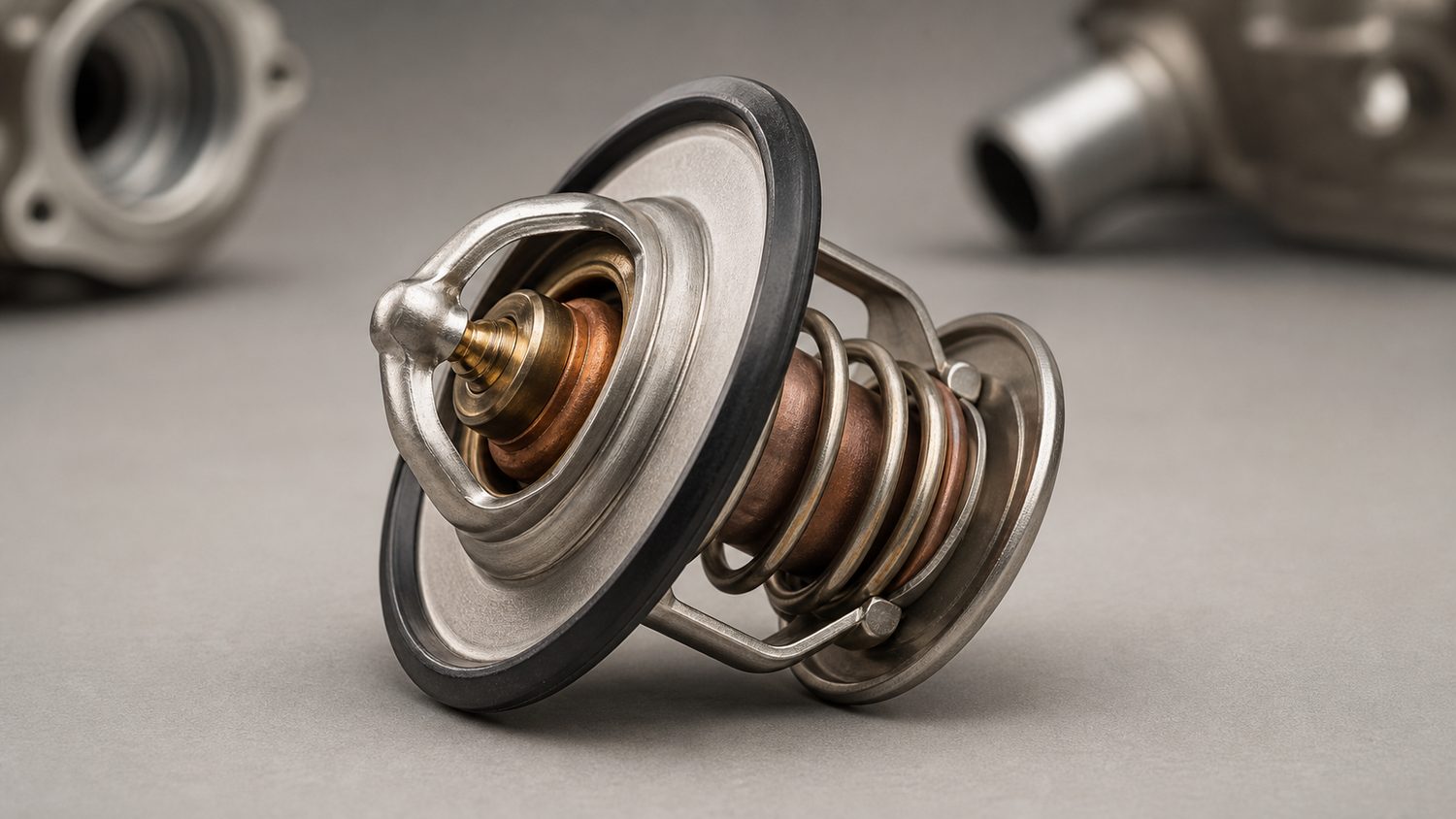
The factory part, at the factory opening temperature, with the correct seal. On an engine where the cooling system’s behaviour is tied into EGR and oil temperature management, running the temperature Ford specified is the sensible default — this is not the place to experiment. The seal matters as much as the thermostat: a reused seal on a cleaned housing is a slow weep waiting to happen, and finding a small coolant leak on a 6.0 later is much harder than fitting a new seal now.
- Factory opening temperature
- New seal included
- OE-quality construction
- Ford parts warranty
- Correct temperature for the engine’s strategy
- No cross-referencing required
- Available at any Ford dealer
- Dearer than aftermarket equivalents
- May need ordering in
Aftermarket OE-Temperature Thermostat Kit
The value option, and a perfectly sound one from an established diesel supplier. What you want is the factory opening temperature with a new seal supplied — not a low-temperature thermostat, for the reason given in the introduction. Kits from the specialist 6.0 suppliers are generally well made and considerably cheaper than the dealer part. Check the stated opening temperature in the listing rather than assuming, since several sellers list low-temp units alongside OE-temp ones under similar titles.
- Factory opening temperature
- Seal included
- Direct fit
- Typically a one-year warranty
- Considerably cheaper than the dealer part
- Widely stocked by diesel specialists
- Seal supplied as standard
- Low-temp units are listed alongside — read carefully
- Quality varies more than the price gap suggests

Engine Oil Cooler
The part the introduction is really about, and the one that determines whether this engine has a long life. The oil cooler’s fine passages silt up with casting sand and scale, oil temperature climbs, and coolant flow to the EGR cooler falls — which is how a cracked EGR cooler and a head gasket job begin. If your oil-to-coolant delta at high idle exceeds about 15 °F, this is the repair, and doing it before the EGR cooler fails is dramatically cheaper than after.
- Coolant-to-oil heat exchanger
- Supplied with new gaskets and O-rings
- OE and improved-flow aftermarket designs
- Direct fit for the 6.0
- Addresses the root cause of the engine’s worst failure chain
- Far cheaper than the head gasket job it prevents
- Restores oil temperature control
- Substantial labour — it sits under the oil filter housing
- Pointless without also cleaning the system that plugged it

Coolant Filtration Kit
The preventative measure that stops the oil cooler plugging again. The 6.0’s cooling system circulates casting sand and scale, and a spin-on coolant filter catches it before it reaches the oil cooler’s fine passages. Fitting one after an oil cooler replacement is close to essential — otherwise the same debris that plugged the first one is still in the system. Many kits also meter supplemental coolant additive, which protects the cylinder walls against cavitation erosion.
- Spin-on filter with a mounting head
- Captures casting sand and scale
- Some meter supplemental coolant additive
- Hoses and fittings supplied
- Protects a newly fitted oil cooler from the same fate
- Easy to fit while the system is drained
- Additive metering protects cylinder walls
- Ongoing filter replacement cost
- Requires plumbing in a filter head
OBD-II Scan Tool with Ford Enhanced Data
The single most valuable purchase on this list, because it is what runs the 15-degree test. You need a tool that shows engine oil temperature and engine coolant temperature simultaneously as live data — generic readers do not expose the oil temperature parameter at all. That one comparison, done at high idle at operating temperature, is the standard 6.0 health check and it tells you whether you are facing a thermostat or an oil cooler. Data logging lets you record a full warm-up.
- Ford enhanced powertrain data
- Live engine oil and coolant temperature
- Data logging for warm-up cycles
- Injector and EGR parameters on better tools
- Runs the oil-to-coolant delta test
- Catches a plugging oil cooler before it cascades
- Essential for every other 6.0 diagnosis
- Generic readers do not show oil temperature
- Better tools are a real investment

EGR Cooler
The part that fails as a consequence, and the reason all of the above matters. When coolant flow through it falls, the EGR cooler overheats and cracks, putting coolant into the intake — white smoke, coolant loss with no visible leak, and a very short path to head gaskets. Improved-design aftermarket coolers exist and are generally worth having. Replacing it without also fixing the oil cooler that starved it guarantees a repeat, so these two jobs belong together.
- Coolant-cooled EGR heat exchanger
- Improved-flow aftermarket designs available
- Gaskets and hardware supplied
- Direct fit
- Cures coolant loss into the intake
- Improved designs resist the original failure mode
- Shares labour with related work
- Fails again if the oil cooler is not addressed
- Significant parts and labour cost
Ford-Spec Diesel Coolant
Use what Ford specifies and do not mix types. The additive package in a diesel coolant protects the cylinder walls against cavitation erosion — a real failure mode where vibrating liners create bubbles that pit the metal — and generic coolant does not address it. Mixing incompatible chemistries can also drop the additives out of solution as a sludge, which then goes to the very heat exchangers you are trying to protect. Buy the correct type, mix with distilled water, and note the change interval.
- Meets the Ford specification for this engine
- Cavitation-inhibiting additives
- Concentrate and pre-mixed
- Long-life formulations available
- Protects cylinder walls against cavitation
- Correct chemistry for the system materials
- Pre-mixed removes dilution errors
- Dearer than generic coolant
- Mixing chemistries can precipitate sludge

Coolant Vacuum Fill Tool
Prevents the most common way this job goes wrong. The 6.0’s cooling system holds air at its high points, and a trapped pocket gives erratic temperature readings, a heater that blows cold and apparent intermittent overheating — all of which look exactly like the thermostat you just fitted. A vacuum tool evacuates the system and draws coolant in with no air at all. It also doubles as a leak test, because a system that will not hold vacuum has a leak you can find before refilling it.
- Evacuates the system with compressed air
- Draws coolant in under vacuum
- Universal filler neck adapters
- Vacuum gauge
- Eliminates air pockets entirely
- Doubles as a leak test before you add coolant
- Turns a long bleed into minutes
- Requires a compressor
- Adapters do not fit every neck
Cooling System Flush and Descaler
Do this as part of any cooling work on a 6.0, because the debris that plugged the oil cooler is still circulating. A proper flush and descaler removes scale and loosens the silt, and running it before you fit a new oil cooler means the new one starts clean. Follow the product’s instructions on contact time and rinse thoroughly — residual flush chemistry left in the system attacks seals. This step costs very little and it is what makes the expensive parts last.
- Scale-dissolving flush chemistry
- Compatible with diesel cooling systems
- Requires thorough rinsing afterwards
- Single-treatment bottles
- Removes the debris that plugs heat exchangers
- Cheap relative to the parts it protects
- Makes a new oil cooler start clean
- Residual chemistry attacks seals if not rinsed out
- Cannot clear an already fully plugged cooler
Infrared Thermometer
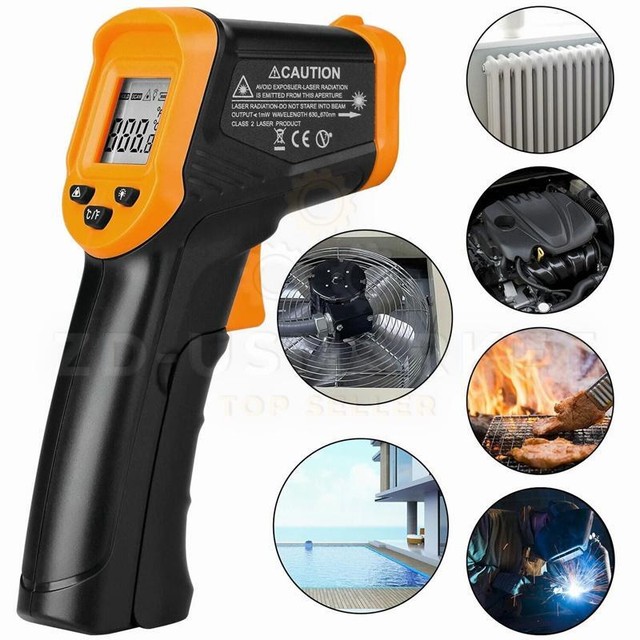
The fast supporting check. Across the radiator face it finds cold patches where the core is blocked; across the upper and lower hoses it shows whether the radiator is actually rejecting heat. Both are causes of running hot that no thermostat will fix, and both take a minute to check rather than an afternoon to guess at. It also confirms when the thermostat opens during a warm-up, which cross-checks what the scan tool is telling you.
- Non-contact infrared measurement
- Range covering coolant temperatures
- Laser aiming
- Emissivity adjustment on better units
- Finds a blocked radiator core in a minute
- Cross-checks the scan tool readings
- Cheap and useful across the truck
- Inaccurate on shiny surfaces without adjustment
- Reads surface, not coolant, temperature
Buying tips
- Run the 15-degree test before you buy anything. At operating temperature and high idle, compare engine oil temperature with engine coolant temperature on a scan tool. A sustained difference above about 15 °F means the oil cooler is plugging. That is the 6.0’s defining fault and it costs nothing to check.
- A plugged oil cooler is what kills the EGR cooler. The EGR cooler is fed downstream of the oil cooler, so when the oil cooler silts up, coolant flow to the EGR cooler falls, it overheats and cracks, and coolant goes into the intake. From there it is head gaskets. Fixing the oil cooler early is dramatically cheaper than dealing with the cascade.
- Do not fit a low-temperature thermostat to fix overheating. A thermostat sets the lowest temperature the engine will run at, not the highest — an engine that overheats under load will still overheat with a cooler thermostat, because the thermostat is already fully open at that point. And running a diesel cooler than designed costs efficiency and affects emissions behaviour.
- Stuck open is the failure people ignore. Long warm-ups, weak cabin heat and a gauge that never reaches the middle feel harmless, and they are not: a cold-running diesel runs rich, makes soot and dilutes its oil with fuel. If your 6.0 takes a very long time to warm up, that is a fault to fix rather than a characteristic to live with.
- Fit a coolant filter after any oil cooler work. The casting sand and scale that plugged the first cooler is still circulating, and a new cooler will go the same way without filtration. The kit is cheap next to the part it protects and the system is already drained, so the labour is close to free at that point.
- Flush the system properly, and rinse thoroughly. A descaler removes the deposits that cause the problem, but residual flush chemistry left in the system attacks seals. Follow the contact time, then rinse until the water runs clear. Skipping the flush means fitting clean parts into a dirty system.
- Vacuum fill, or expect an air pocket. The 6.0 traps air at its cooling system high points, and a pocket gives erratic temperatures, cold heat and apparent intermittent overheating — symptoms identical to the thermostat you just replaced. Vacuum filling removes the problem and tests the system for leaks at the same time.
- Check the radiator and intercooler airflow before concluding anything. A mat of debris between the cores is a common cause of running hot and it costs nothing to look. Point an infrared thermometer across the radiator face — cold patches mean blockage. Rinse gently from the engine side outwards, never with a pressure washer from the front.
As an Amazon Associate and eBay Partner, toptenpick.com earns from qualifying purchases. Prices and availability are subject to change.