

As an Amazon Associate and eBay Partner, toptenpick.com earns from qualifying purchases. Prices and availability are subject to change.
The 80 Series’ front end rides on coil springs, but underneath it’s still built like a solid-axle truck: two radius arms run from the axle straight back to the frame and actually locate the axle fore-and-aft, with a panhard rod handling side-to-side. That geometry means a lift doesn’t just raise the frame — it swings the radius arms through a new arc and drags front caster toward negative. Toyota built this front end so an alignment shop can reset toe and maybe re-center the steering wheel, but cannot dial caster back in themselves; caster correction has to be bought as a part, not set on an alignment rack. Skip it and the truck wanders at highway speed and wears the front tires unevenly, lift or no lift.
There are three ways to put caster back, and they scale with how much you’ve lifted. Rubber caster bushings are the cheapest and easiest to install — no grinding — but they only correct a couple of degrees and are meant for lifts up to about 3 inches. Caster plates correct more, roughly 4-5°, for the 3-to-6-inch range, but need the axle-side mount notched with a grinder to clear. Radius-arm drop brackets, which lower the frame-side mount instead of the axle-side one, correct the most caster of the three and also nudge the axle forward slightly to compensate for the wheelbase shift a big lift causes. Buying the wrong tier for your actual lift height is the most common mismatch in these builds.
The other mistake is picking a spring by the lift number on the box instead of the weight the truck actually carries. Old Man Emu and Dobinsons both rate their coils in pounds of constant load — bull bar, winch, drawers, a long-range fuel tank — for exactly this reason. A spring picked for “3 inches of lift” on an empty truck sags back down once the gear that justified the lift goes back in, which is the opposite of what most buyers are trying to achieve.
Past roughly 3 inches of lift, the fixed-length factory panhard rods stop centering the axle under the frame — the rod pulls the axle sideways as ride height changes — so adjustable panhard rods, front and rear, become part of the lift rather than an optional accessory. The same threshold usually calls for extended brake lines too, particularly on 1993-97 trucks with ABS, since the stock hydraulic lines are only long enough for stock ride height.
None of what follows comes in one “lift kit” box. On this platform the springs, the shocks, and the caster/panhard correction are bought as separate, matched parts, and the ten below cover both halves of that job: the springs and shocks that actually add height, and the geometry-correction parts that keep the truck driving straight once they’re in.
| # | Product | Price | Where to buy |
|---|---|---|---|
| 1 | Old Man Emu Nitrocharger Sport Front Shocks (pair) | $250–$260 | Amazon · eBay |
| 2 | Old Man Emu Front Coil Springs 2420, Constant Load (pair) | $230–$235 | Amazon · eBay |
| 3 | Old Man Emu Rear Coil Springs 2863, 440 lb Constant Load (pair) | $245–$255 | Amazon · eBay |
| 4 | Bilstein B8 5100 Full Shock Kit (front and rear) | $495–$690 | Amazon |
| 5 | Dobinsons Rubber 2.5° Caster Bushing Kit (RB59-522K) | $120–$130 | Amazon |
| 6 | Dobinsons 5° Caster Plate Kit (WA59-514K) | $445–$455 | Amazon |
| 7 | Dobinsons Front Adjustable Panhard Rod (PR59-1408) | $305–$450 | Amazon |
| 8 | Dobinsons Rear Adjustable Panhard Rod (PR59-1405) | $305–$350 | Amazon |
| 9 | Ironman 4×4 Radius Arm Drop Box Brackets | $250–$300 | Amazon |
| 10 | Extended Brake Line Kit, 80 Series 1993-97 (w/ABS, up to 6″ lift) | $120–$130 | Amazon |
The picks, in detail
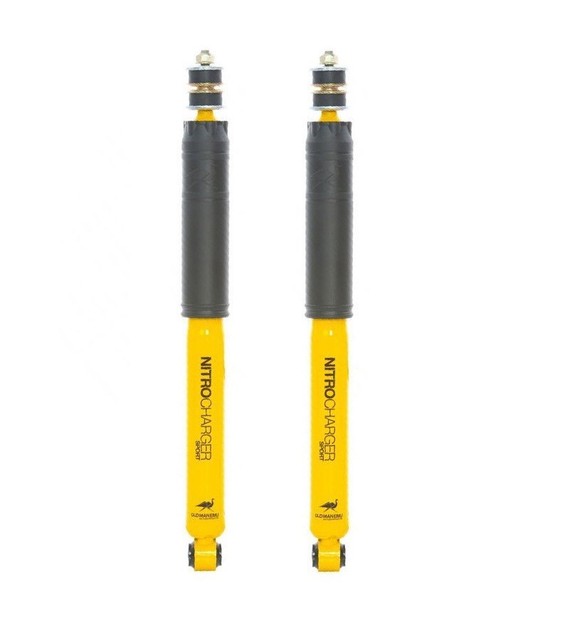
Old Man Emu Nitrocharger Sport Front Shocks (pair)
OME’s mid-range gas shock, tuned as a matched pair with OME’s own coil springs and one of the most common shock choices in the 80 Series aftermarket. It’s a known-good baseline rather than an exotic upgrade — the shock most people reach for first because the valving is already proven with the springs below.
- Gas-charged shock, OME’s “Sport” valving tier
- Direct-fit for 80/105 Series, matched to specific lift heights by part number
- Sold and fitted as a front pair
- Backed by Old Man Emu’s 3-year/60,000 km warranty
- Valving is well-proven alongside OME’s own coil springs on this chassis
- Extensively documented in the 80 Series community
- Long warranty for the category
- Sold in pairs — front and rear are separate purchases to cover all four corners
- Non-adjustable valving
- Has to be matched to the correct spring/lift height or it becomes the limiting factor in travel

Old Man Emu Front Coil Springs 2420, Constant Load (pair)
A direct front coil replacement rated for 110-231 lb of constant added front load at roughly 4.5 inches of lift — sized for a truck actually carrying a winch and bull bar rather than for the lift number alone. It’s one of the most cross-referenced OME part numbers for the 80 Series, which makes it easy to buy alongside a matched shock.
- Pair of front coil springs, direct replacement (not a spacer)
- ~4.5″ lift, 110-231 lb constant-load rating
- Fits 80 and 105 Series
- Old Man Emu factory spring rate published for the part number
- Rated for real added front weight, not just a lift figure
- Well-documented part number for cross-referencing with shocks and caster parts
- Direct bolt-in, no spacer required
- 4.5″ is a large lift for this front end — caster correction stops being optional at this height
- Front only, rear coil sold separately
- Rides firm if the truck’s actual front-end weight is under the rated load

Old Man Emu Rear Coil Springs 2863, 440 lb Constant Load (pair)
A rear coil rated for 440 lb of constant added load — drawers, a fridge slide, a long-range tank — rather than a spring picked purely for ride height. It fits both 80 and 100 Series, which keeps it a common, well-stocked part rather than a niche one.
- Pair of rear coil springs, direct replacement
- 440 lb constant-load rating, ~250 lb/in spring rate
- 18mm bar diameter
- Fits 80 and 100 Series (and LX470)
- Rated for real rear cargo weight, not lift height alone
- Shared fitment across 80/100 Series keeps it a common, well-stocked part
- Direct bolt-in replacement
- Rear only — front spring sold separately
- Rides firm or high if the truck is mostly unloaded
- Needs a shock of matched length or travel is limited
Bilstein B8 5100 Full Shock Kit (front and rear)
One kit number covering all four corners — front and rear monotube shocks sized for 2 to 2.5 inches of lift — instead of sourcing front and rear separately. It’s a common pairing with Old Man Emu springs on this chassis, and the single-kit approach is the simplest way to shock all four corners in one order.
- Monotube gas shocks, digressive velocity-sensitive valving
- Front and rear pairs included in one kit
- Sized for 2-2.5″ of lift
- Fits 1990-97 80 Series
- One part number covers all four corners instead of separate front/rear orders
- Monotube design resists fade better than the factory twin-tube shocks
- Common, well-documented pairing with OME coil springs
- Fixed valving sized for a specific 2-2.5″ lift range only
- Springs not included
- Mid-range price for a shocks-only kit with no springs
Dobinsons Rubber 2.5° Caster Bushing Kit (RB59-522K)
The cheapest and simplest of the three caster-correction options — four rubber eccentric bushings that adjust up to 2.5° of caster without any grinding. It’s the right call for lifts up to about 3 inches; past that, the correction range runs out before the lift does.
- 4 rubber eccentric bushings
- Adjustable 0-2.5° caster correction
- Suits 0-3″ of lift
- No grinding or notching required
- Cheapest of the three caster-correction methods
- No grinding or fabrication needed to install
- Straightforward install with basic hand tools
- Smallest correction range of the three options — inadequate past roughly 3″ of lift
- Rubber bushings compress and wear over time and may need rechecking
- Doesn’t address wheelbase shift the way drop brackets do
Dobinsons 5° Caster Plate Kit (WA59-514K)
Zinc-plated steel caster plates good for roughly 4-5° of correction, built for the 5-to-7-inch lift range where rubber bushings run out of adjustment. It’s a one-time bolt-in fix rather than a wearing rubber part, at the cost of having to notch the axle-side mount for clearance during install.
- Zinc-plated steel caster plates
- ~4-5° caster correction
- Suits 5-7″ of lift on 80/105 Series
- Full mounting hardware included
- Enough correction range for a large lift where bushings alone fall short
- One-time bolt-in fix, not a part that compresses or wears like rubber bushings
- Widely stocked and well documented for this chassis
- Installation requires grinding or notching the axle-side mount for clearance
- More expensive than the rubber bushing kit
- Overkill, and unnecessary cost, on a lift under about 3 inches
Dobinsons Front Adjustable Panhard Rod (PR59-1408)
A direct replacement for the factory front panhard rod with adjustable length, built to re-center the front axle under the frame after 3 to 6 inches of lift. Skipping it on a lift in that range leaves the axle sitting off to one side, which shows up as uneven tire clearance and pulls at speed.
- Direct replacement for the OE front panhard/track rod
- Adjustable length to re-center the axle
- Suits 3-6″ of lift
- Zinc-plated steel construction
- Fixes the off-center-axle symptom a lift in this range causes
- Adjustable, so length can be fine-tuned once ride height settles
- Commonly bought and installed alongside the matching rear rod
- Length has to be set off the vehicle, not adjusted in place
- Only worth the cost past roughly 3″ of lift — wasted spend on a small lift
- Front only; the rear rod is a separate purchase
Dobinsons Rear Adjustable Panhard Rod (PR59-1405)
The rear counterpart to the front panhard rod above — a direct, adjustable replacement with rubber bushings that keeps the rear axle centered under the frame at the same 3-to-6-inch lift range. The two are usually bought and installed as a pair for exactly that reason.
- Direct replacement for the OE rear panhard rod
- Adjustable length, rubber-bushed
- Suits 3-6″ of lift
- Zinc-plated and E-coated for corrosion resistance
- Completes the axle-centering fix started by the front rod
- Rubber bushings preserve articulation similar to stock
- Corrosion-resistant coating for a part that lives in road spray
- Same off-car-adjustment limitation as the front rod
- Rear only
- Unnecessary on lifts under about 3 inches
Ironman 4×4 Radius Arm Drop Box Brackets
The biggest caster fix of the three, and a different mechanism from bushings or plates: these lower the frame-side radius-arm mount about 3 1/8 inches, which corrects up to 3.5° of caster and moves the front axle forward 15mm to compensate for wheelbase change. It’s the option for a large lift where plates alone aren’t enough.
- Lowers the frame-side radius-arm mount ~3 1/8″ (80mm)
- Corrects caster up to 3.5°
- Repositions the front axle forward 15mm for wheelbase correction
- Bolt-on brackets, no cutting of the radius arm itself
- Largest caster correction of any bolt-on option here
- Also corrects wheelbase shift, which bushings and plates don’t address
- Genuine bolt-on installation, no cutting into the radius arm
- Still has to be paired with the actual spring/shock lift — it’s a correction part, not a lift kit by itself
- Most aggressive, and priciest single-bracket, fix here — overkill on a small lift
- Adds another install step beyond springs, shocks, and panhard rods
Extended Brake Line Kit, 80 Series 1993-97 (w/ABS, up to 6″ lift)
A three-line braided kit — two front, one rear — sized specifically for ABS-equipped 1993-97 trucks running up to 6 inches of lift, a fitment detail that’s easy to get wrong since earlier non-ABS trucks need a different kit entirely. Stock rubber lines are the right length at stock ride height only.
- PTFE (Teflon) core hose with stainless-steel braided cover
- Zinc-plated, permanently crimped fittings
- Clear PVC outer jacket for abrasion protection
- Kit includes 2 front lines, 1 rear line, and mounting clips
- Sized specifically for ABS-equipped 93-97 trucks, a common fitment trap
- Braided line resists abrasion and swelling better than aging stock rubber
- Complete 3-line kit rather than piecing lines together separately
- This specific kit fits 93-97 ABS trucks only — 91-92 non-ABS trucks need a different kit
- Doesn’t include any rear proportioning-valve work a big lift may also need
- One more line item on top of springs, shocks, and caster correction
Buying tips
- Match spring rate (the constant-load rating) to what the truck actually carries — a bull bar, winch, rear drawers, and a long-range tank easily add 200+ lb to each end, so buy for that weight, not just a lift height.
- Budget caster correction into the same order as the springs — on this chassis an alignment shop can set toe but cannot dial in caster themselves.
- Rubber caster bushings only take you to about 3 inches of lift and a couple of degrees of correction; past that, step up to caster plates or drop brackets.
- Read the caster plate install notes before ordering if you’re not doing the work yourself — the axle-side mount needs to be notched or ground for clearance.
- Add adjustable panhard rods, front and rear, once you’re past roughly 3 inches of lift, so the axle recenters under the frame instead of just riding higher off-center.
- Extended brake lines are close to mandatory on 1993-97 ABS trucks past a few inches of lift — confirm you’re ordering the ABS-specific kit, not the earlier non-ABS version.
- Buy shocks valved for the spring you’re running rather than mixing brands at random — Old Man Emu and Bilstein both sell their shocks as kits matched to specific spring rates for that reason.
- Recheck caster and toe after the first few hundred miles on new springs and correction parts — bushings settle and rod length can drift slightly from the initial setup.
As an Amazon Associate and eBay Partner, toptenpick.com earns from qualifying purchases. Prices and availability are subject to change.