

As an Amazon Associate and eBay Partner, toptenpick.com earns from qualifying purchases. Prices and availability are subject to change.
“A Spitfire” is not one aeroplane, and a 1/32 model kit box does not make that obvious. Between the Mk.I that fought in 1940 and the Griffon-engined Mk.XIV that fought in 1944, the nose profile, wing planform, canopy, propeller, and exhaust stacks are all different parts. A kit bought on box art alone, without checking which mark is inside, can leave you with the wrong airframe shape for the paint scheme you actually wanted — the mark is the first decision here, before manufacturer or price.
It also pays to check whether a box is new tooling or an old mould in new packaging. A lot of what is currently sold in this scale is not new engineering. Hasegawa’s Mk.Vb dates to 1992 and has been out of production for years, sold only secondhand at whatever price scarcity sets. Hobby 2000’s Mk.Ia and Mk.Va boxes are Revell’s existing injection plastic from the 2010s, repackaged with better Cartograf decals, resin parts, and masks — a real upgrade over Revell’s own box, but not a new kit. Genuinely new 1/32 Spitfire tooling only arrived in 2023, from the boutique New Zealand outfit Kotare Models. Knowing which is which changes what a given price is actually buying.
Then there is the size. 1/32 is one of the largest scales aircraft modelers build in routinely, and the Spitfire’s wingspan — just over 36 feet 10 inches on the real aircraft — comes out to roughly 35cm, about 14 inches, on nearly every kit on this list, because the wing itself barely changed between marks. That figure does not shrink with a cheaper kit or grow with a pricier one; it is closer to a fixed cost of building in this scale at all, before a stand or display case is even considered. Modelers used to 1/48 or 1/72 routinely underestimate how much shelf a finished 1/32 Spitfire actually needs.
Budget spans widely once mark and tooling are sorted out. Tamiya’s Mk.IXc is the engineering benchmark — moving control surfaces, photo-etch, engraved panel lines — and priced like it, well over $150. Revell and the older Hasegawa tooling sit at a fraction of that price with rougher, sometimes raised-line detail. Kotare’s new-tooled early marks and the Pacific Coast/Kitlinx Griffon-engined Mk.XIV sit in between: sharper detail or a mark nobody else currently offers, at the cost of small-batch stock or the fit issues that come with short-run production.
The ten kits below are real, currently or recently produced releases spanning early Merlin marks through the Griffon-engined Mk.XIV, so the mark you actually want is the first filter, not an afterthought.
| # | Product | Price | Where to buy |
|---|---|---|---|
| 1 | Tamiya 60319 Supermarine Spitfire Mk.IXc (1/32) | $150–$190 | Amazon · eBay |
| 2 | Kotare Models K32001 Spitfire Mk.Ia (Mid) (1/32) | $100–$140 | Amazon |
| 3 | Kotare Models K32004 Spitfire Mk.I (Early) (1/32) | $100–$140 | Amazon |
| 4 | Revell 03927 Supermarine Spitfire Mk.IXc (1/32) | $45–$65 | Amazon · eBay |
| 5 | Revell 03986 Supermarine Spitfire Mk.IIa (1/32) | $40–$60 | Amazon · eBay |
| 6 | Hasegawa 08247 Spitfire Mk.IIa ‘Douglas Bader’ (1/32) | $70–$110 | Amazon |
| 7 | Hasegawa 08052 Spitfire Mk.Vb (1/32) | $60–$150 (secondhand, condition-dependent) | Amazon |
| 8 | Hobby 2000 32001 Supermarine Spitfire Mk.Ia (1/32) | $55–$80 | Amazon |
| 9 | Hobby 2000 32003 Supermarine Spitfire Mk.Va (1/32) | $55–$80 | Amazon |
| 10 | Pacific Coast Models / Kitlinx 32015 Spitfire Mk.XIVc (1/32) | $60–$90 | Amazon |
The picks, in detail
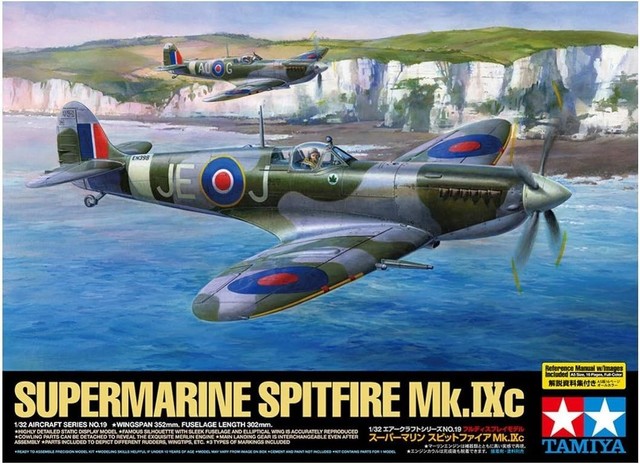
Tamiya 60319 Supermarine Spitfire Mk.IXc (1/32)
Tamiya’s Mk.IXc is the engineering reference for 1/32 Spitfires: ailerons, elevators, and rudder actually move, the panel lines are engraved rather than raised, and the kit includes photo-etch and an optional display stand. It is also the most expensive kit on this list by a wide margin, and it only covers one mark — the mid-war Mk.IXc — so it settles the mark question for you rather than offering a choice.
- 22 plastic sprues plus two photo-etch frets
- moveable ailerons, elevators, and rudder
- optional display stand included
- engraved panel lines with fine rivet detail
- best engineering and fit of any 1/32 Spitfire on the market
- moving control surfaces without aftermarket parts
- fine engraved panel lines and rivet detail
- MSRP well over $150, the most expensive kit in this scale
- only the Mk.IXc is offered, no early or Griffon marks
- 22-plus sprues make it a long build, not a weekend project
Kotare Models K32001 Spitfire Mk.Ia (Mid) (1/32)
Kotare’s Mk.Ia (Mid) was the first genuinely new 1/32 Spitfire tooling in decades when it released in 2023, and reviewers rate its fit and detail above anything else on this list, Tamiya included, for the early-mark Spitfire it represents. It comes from a small New Zealand outfit that sells in limited production runs, so availability is the real constraint — buy it when you see it in stock, not when you get around to it.
- all-new tooling released in 2023, not a rebox of older parts
- 155-plus parts with mark-specific early-production detail
- Cartograf decals included
- 35cm wingspan, in line with every kit on this list
- reviewers rate the engineering and fit above the older Hasegawa and Revell tooling
- mark-specific early-production parts no other 1/32 kit offers
- sharper surface detail than any reissue on this list
- produced in small batches by a boutique company and sells out between runs
- priced above the Revell and Hasegawa kits on this list
- limited to early-mark Spitfires, no Mk.IX or Griffon option
Kotare Models K32004 Spitfire Mk.I (Early) (1/32)
This is Kotare’s earliest-production Spitfire, tooled specifically for parts no other 1/32 kit offers — an unarmoured windscreen, two-blade propeller, exposed fuel tank, and original untrimmed cowling, with three marking options covering 1938 through the start of the Battle of Britain. It’s the most historically specific kit on this list, and also the narrowest: if you want any Spitfire scheme after mid-1940, this isn’t the airframe for it.
- 155 parts with early-production-specific detail: non-armoured canopy, two-blade propeller, exposed fuel tank
- three marking options covering 1938–1940 with Cartograf decals
- same new-tooled family as the Mk.Ia (Mid) above, with early-airframe-specific parts
- 35cm wingspan
- reproduces early-production details no older kit offers, including the ring-and-bead sight and two-blade prop
- praised in independent reviews for fit and engineering
- highly detailed for a mainstream-priced kit
- sells out quickly and is frequently listed as out of stock
- narrow subject window limits it to pre-war and earliest Battle of Britain schemes
- small-batch production means restocks are unpredictable

Revell 03927 Supermarine Spitfire Mk.IXc (1/32)
Revell’s own take on the Mk.IXc covers the same mark as Tamiya’s flagship at roughly a third of the price, with a four-blade propeller, cannon-armed wings, and an optional bomb load among its roughly 150 parts. The panel lines are raised rather than engraved and the cockpit is comparatively plain, but as a first 1/32 build, or a budget second Mk.IXc alongside a display-only Tamiya kit, it does the job.
- about 150 parts in grey styrene
- detailed Mk.IXc cannon-armed wings
- four-blade rotating propeller and optional bomb load
- raised rather than engraved panel lines
- far cheaper than Tamiya for the same mark
- widely stocked and easy to find
- reasonable first kit for a 1/32 build
- raised panel lines read as dated next to Tamiya or Kotare’s engraved detail
- cockpit is sparse without aftermarket resin
- less crisp fit than the newer-tooled kits on this list
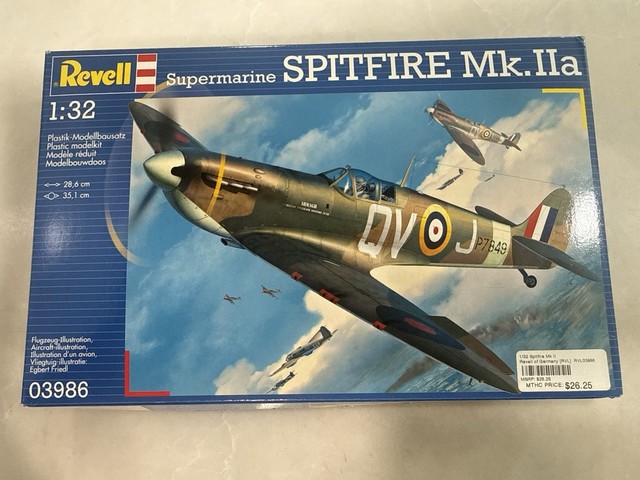
Revell 03986 Supermarine Spitfire Mk.IIa (1/32)
Where the 03927 above covers the mid-war Mk.IXc, this is Revell’s all-new 2014 tool of the earlier Mk.IIa — the Battle of Britain-period airframe, not a later mark wearing the wrong decals. It’s engraved rather than raised-line, roughly the same part count and price as the 03927, and a sensible choice if the scheme you want to build is specifically an early-war Spitfire.
- all-new mould released in 2014, not a reissue of Revell’s older Spitfire kits
- represents the Battle of Britain-period Mk.IIa airframe specifically
- engraved rather than raised panel lines
- kit decals cover more than one RAF scheme
- modern tooling at a mid-range price
- accurate to the specific Mk.IIa airframe rather than a generic Spitfire shape
- good fit reported by reviewers
- only one mark offered, so a Mk.IX or Griffon mark needs a different kit entirely
- cockpit detail still trails Tamiya’s flagship
- cannot be finished as a later-war Spitfire without a different kit
Hasegawa 08247 Spitfire Mk.IIa ‘Douglas Bader’ (1/32)
This is Hasegawa’s 1990s-tooled Mk.IIa, boxed with markings for ace Douglas Bader, and it’s held up well enough that reviewers still call the fit trouble-free and the outline accurate — it’s even one of the few Spitfire kits in any scale that gets the fuselage’s gully-shaped underside right. The panel lines are raised, not engraved, and the cockpit needs help from aftermarket resin to compete with Tamiya’s.
- boxed with markings for ace Douglas Bader’s Mk.IIa
- Hasegawa’s 1/32 Spitfire family tooling, developed in the 1990s
- raised rather than engraved panel lines
- correctly shaped gully under-fuselage detail few other Spitfire kits get right
- accurate outline and dimensions despite its age
- one of the few kits that gets the under-fuselage gully shape correct
- easy, well-fitting assembly reviewers describe as trouble-free
- raised panel line detail is dated next to newer-tooled kits
- cockpit is basic without an aftermarket resin set
- single named-ace decal option limits scheme choice
Hasegawa 08052 Spitfire Mk.Vb (1/32)
The only way to get the mid-war Mk.Vb in mainstream 1/32 injection plastic is this Hasegawa tool, and it’s been out of production since the early 1990s — current buyers are shopping eBay and auction listings, not a retailer shelf. It shares the same accurate outline and easy build as Hasegawa’s Mk.IIa above, but pricing and completeness now depend on whatever a given secondhand listing happens to include.
- original tooling dates to 1992, out of production for years
- represents the mid-war, Merlin-engined Mk.Vb
- shares the same 1/32 Hasegawa family as the Mk.IIa above
- raised panel line detail typical of Hasegawa kits from this era
- same accurate outline and easy assembly as the rest of Hasegawa’s 1/32 Spitfire family
- the Mk.Vb mark is not currently offered by any in-production 1/32 kit
- well documented online with decades of build reviews
- out of production, only available secondhand at prices set by scarcity
- condition and completeness vary listing to listing
- raised panel lines need rescribing for a contest-level finish
Hobby 2000 32001 Supermarine Spitfire Mk.Ia (1/32)
Hobby 2000 doesn’t retool anything — this box holds Revell’s existing 1/32 Mk.Ia plastic, the same tooling Revell sells under its own name, repackaged with Cartograf decals, pre-cut canopy masks, and a resin underwing oil cooler Revell’s own box doesn’t include. That’s a genuine upgrade in decals and detail parts over a stock Revell kit for a modest premium, but the underlying styrene is identical, not new engineering.
- Revell’s 1/32 injection-moulded plastic, repackaged with upgraded extras
- Cartograf decals in place of Revell’s own sheet
- pre-cut pMask canopy masks and a resin underwing oil cooler included
- represents the early-war Mk.Ia airframe
- Revell’s proven plastic with meaningfully better decals and masks than the stock Revell box
- resin oil cooler adds detail Revell’s own kit doesn’t include
- generally cheaper than Kotare for a similarly early mark
- the plastic is the same Revell tooling, not new engineering
- panel line detail is whatever the underlying Revell mould has, not upgraded
- smaller distributor means less consistent stock at major retailers
Hobby 2000 32003 Supermarine Spitfire Mk.Va (1/32)
The companion release to Hobby 2000’s Mk.Ia above, this box uses the same reused-Revell-tooling-plus-extras approach for the definitive Merlin 45-engined Mk.Va — a mark that’s otherwise only available secondhand through the discontinued Hasegawa Mk.Vb. Cartograf decals and pMask masks are included; the plastic underneath is Revell’s, not a new mould, so don’t expect Kotare- or Tamiya-level surface detail at this price.
- same Revell-tooling-plus-extras formula as Hobby 2000’s Mk.Ia, for the Mk.Va instead
- Cartograf decals and pMask masks included
- represents the Merlin 45-engined mid-war Mk.Va
- resin detail parts bundled with the kit
- fills the Mk.Va gap left by Hasegawa’s out-of-production Mk.Vb at a currently in-production price
- better decals and masks than a stock Revell box
- same accessible price tier as Hobby 2000’s other Spitfire releases
- underlying plastic is reused Revell tooling, not new engineering
- less documented in build reviews than the older Hasegawa Mk.Vb it substitutes for
- distribution is patchier than Revell or Tamiya’s own boxes
Pacific Coast Models / Kitlinx 32015 Spitfire Mk.XIVc (1/32)
Every other kit on this list is a Merlin-engined Spitfire; this is the exception — the only injection-moulded 1/32 kit of the Griffon-powered, five-blade-prop Mk.XIVc, and reviewers single it out as the one Mk.XIV in any scale that gets the external lines right. It’s a limited-run kit combining styrene with resin detail parts, so expect the heavier flash and fit issues short-run production brings, and check current stock carefully since it has changed hands between Pacific Coast Models and Kitlinx.
- the only injection-moulded 1/32 kit of the Griffon-engined Mk.XIV on the market
- limited-run production combining styrene sprues with resin detail parts
- Cartograf decals for multiple Mk.XIVc/e schemes
- originally released by Pacific Coast Models, now continued by Kitlinx
- the only way to get an accurate Griffon-engined, five-blade-prop Spitfire in 1/32 without a scratch conversion
- reviewers single it out as the one Mk.XIV kit in any scale that gets the external lines right
- resin parts add cockpit and engine detail beyond a mainstream styrene kit
- limited-run kit with the heavier flash and fit issues short-run injection moulding brings, not Tamiya-level engineering
- changed hands between Pacific Coast Models and Kitlinx, so stock and support are less predictable
- resin parts need clean-up and handling experience styrene alone doesn’t require
Buying tips
- Decide the mark before the manufacturer — a Mk.I early, Mk.IX, and Mk.XIV use different noses, canopies, and propellers, and no single kit covers more than one.
- Measure your shelf before you buy: nearly every 1/32 Spitfire has roughly the same 35cm (about 14in) wingspan regardless of mark or price, so the display footprint doesn’t shrink with a cheaper box.
- Check whether a kit is new tooling or a rebox before comparing prices — Hobby 2000’s boxes use Revell’s existing plastic with better decals, not new engineering, and pricing them against Kotare’s from-scratch tooling is comparing different things.
- If out-of-production tooling like Hasegawa’s Mk.Vb is the only option for a mark you want, budget for secondhand auction pricing rather than retail MSRP.
- Boutique short-run kits like Kotare and Pacific Coast/Kitlinx sell out between production batches — buy when you see stock rather than waiting for a sale.
- Limited-run and resin-augmented kits need basic resin-handling skills, like washing off mould-release residue and careful clean-up, that a mainstream styrene kit doesn’t require.
- Raised panel lines on older tooling like Revell’s or Hasegawa’s can be rescribed with a scriber and straightedge if you want a more contemporary finish without buying a new kit.
- Budget for aftermarket cockpit resin separately if you want Tamiya-level interior detail on a cheaper kit — the airframe accuracy of the Revell, Hasegawa, and Hobby 2000 kits doesn’t extend to their sparse cockpits.
As an Amazon Associate and eBay Partner, toptenpick.com earns from qualifying purchases. Prices and availability are subject to change.