

As an Amazon Associate and eBay Partner, toptenpick.com earns from qualifying purchases. Prices and availability are subject to change.
Before the list, two things that change the answer completely.
First, check which 3020 you actually have. The 1978 original and its descendants — 3020A, 3020B, 3020i, 3020e — are 20-watt class AB integrated amplifiers. NAD has also sold a modern D 3020, which is a completely different class-D amplifier with digital inputs, and a C 3050 besides. Advice written for one is wrong for the other, and a great deal of the advice online does not say which it means. Everything below is about the classic amplifier.
Second, the “only 20 watts” worry is overstated, and this is the interesting part. The 3020’s reputation was built on a power supply that delivers far more current than its modest rating suggests — it drove difficult loads and 4-ohm speakers far better than its specification implied, which is precisely why it became famous rather than merely cheap. You do not need horn-loaded speakers. You do need to be realistic about how loud a large room will go.
What actually matters is voicing. The classic 3020 is a warm, slightly soft-topped amplifier. Pair it with a warm, polite, rolled-off speaker and you get a comfortable mush with no detail in it. Pair it with something a little brighter and more revealing than you would normally choose, and the combination comes alive. This is the single most useful thing anyone can tell you about matching this amp, and it is the opposite of the usual advice to match warm with warm.
And one practical warning. A forty-plus-year-old 3020 almost certainly needs recapping, and its switches and potentiometers will be noisy. Budget for a service before you budget for speakers — an unserviced example will sound worse than any pairing decision you make.
Ten speakers below, current and vintage.
| # | Product | Price | Where to buy |
|---|---|---|---|
| 1 | Q Acoustics 3030i | $350–$500 | Amazon |
| 2 | Q Acoustics Concept 20 | $450–$650 | Amazon · eBay |
| 3 | KEF Q150 | $300–$450 | Amazon · eBay |
| 4 | Wharfedale Diamond 12.1 | $250–$400 | Amazon · eBay |
| 5 | Elac Debut 2.0 B6.2 | $300–$450 | Amazon · eBay |
| 6 | Dali Oberon 1 | $400–$600 | Amazon · eBay |
| 7 | Triangle Borea BR03 | $450–$650 | Amazon · eBay |
| 8 | Klipsch RP-600M | $550–$750 | Amazon · eBay |
| 9 | JBL Stage A130 | $180–$300 | Amazon · eBay |
| 10 | Celestion Ditton 15 (Used, Vintage Pairing) | $150–$500 used | Amazon · eBay |
The picks, in detail
Q Acoustics 3030i
The modern default, and a repeated recommendation with NAD amplification specifically. A larger-than-usual standmount with real bass extension, an easy impedance curve and a voicing that is detailed without being harsh — which is exactly the counterweight a warm amplifier wants. If you want one recommendation and no further thought, this is it.
- 5-inch mid/bass driver in a larger standmount cabinet
- Nominal 6 ohm, easy to drive
- Detailed but not aggressive voicing
- Well-braced cabinet with good damping
- Real bass extension without a subwoofer
- Easy load — comfortable for a 20-watt amplifier
- Balances the 3020’s warmth rather than adding to it
- Large for a bookshelf — needs stands and space behind
- Not the last word in refinement at the top
- Wants a little room from the rear wall

Q Acoustics Concept 20
The step up in the same family, with a heavily damped double-walled cabinet that removes a layer of boxiness from the sound. Repeatedly named as a good NAD partner. Where the 3030i gives you bass, the Concept 20 gives you clarity and a very quiet cabinet — the better choice in a smaller room where you were never going to get deep bass anyway.
- Gelcore double-walled cabinet construction
- Compact standmount format
- Detailed, low-coloration presentation
- Easy nominal impedance
- Exceptionally quiet cabinet for the price
- Clarity suits the 3020’s slightly soft top
- Compact enough for a small room
- Limited bass extension — a small room or a subwoofer
- Costs more than the larger 3030i
- Needs good stands to perform
KEF Q150
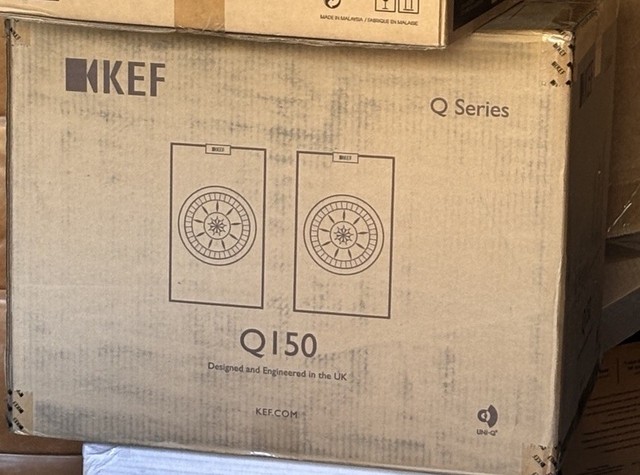
NAD amplifiers and KEFs have been paired for decades, and the Uni-Q coaxial driver is the reason — the tweeter sits at the centre of the mid/bass cone, so the speaker images precisely and is much less fussy about where you sit. Clear and revealing in a way that complements a warm amplifier rather than compounding it.
- Uni-Q coaxial driver array
- 5.25-inch mid/bass with concentric tweeter
- Very wide, consistent dispersion
- 8 ohm nominal
- Imaging and off-axis consistency are outstanding for the price
- Clear, revealing character balances the 3020
- Long-established pairing with NAD
- Modest sensitivity — plays less loud than some options
- Rear port needs space from the wall
- Bass is polite in a large room
Wharfedale Diamond 12.1
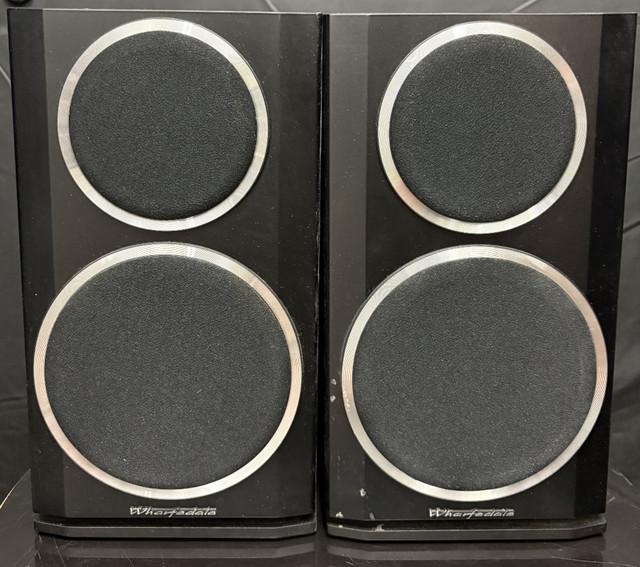
The successor to the Diamond 9.1 that people still recommend with this amplifier, and a genuine bargain in the same tradition — natural, unforced and detailed without being bright. Wharfedale voice these to be listenable for hours rather than impressive for minutes, which suits a vintage amplifier and an evening of records.
- Compact standmount with a woven cone mid/bass
- Easy impedance and forgiving load
- Natural, unforced voicing
- Available in several finishes
- Outstanding value for the performance
- Easy to drive from a modest amplifier
- Pleasant for very long listening sessions
- Warm-leaning voicing can compound the 3020’s warmth
- Limited deep bass
- Less resolving than the KEF or Q Acoustics options

Elac Debut 2.0 B6.2
A larger 6.5-inch standmount with more bass output than most speakers at the price, and a notably even tonal balance. The bigger driver needs a little more from the amplifier than a 5-inch speaker, but the 3020’s current delivery handles it — and in a room where the smaller options sound thin, this is the one that fills it.
- 6.5-inch aramid fibre woofer
- Cloth dome tweeter with a wide waveguide
- Front-ported for placement flexibility
- Large standmount cabinet
- More bass than anything else in its price band
- Front port tolerates being near a wall
- Even, honest tonal balance
- Asks more of a 20-watt amplifier than smaller speakers
- Big cabinet — not subtle in a small room
- Finish quality reflects the price

Dali Oberon 1
NAD and Dali is another long-established pairing, and the Oberon 1 is the current small standmount in that tradition. Dali voice their speakers with an open, slightly forward top end and unusually high sensitivity for the size — both of which are helpful with a modest vintage amplifier, the first for balance and the second for volume.
- Compact standmount with a wood-fibre cone
- Higher sensitivity than most speakers this size
- Open, articulate top end
- Several finishes including light oak
- Higher sensitivity means more volume from 20 watts
- Open treble complements the amplifier’s warmth
- Genuinely small — fits where others do not
- Little deep bass from a cabinet this size
- Forward top end is not to every taste
- Rear ported
Triangle Borea BR03
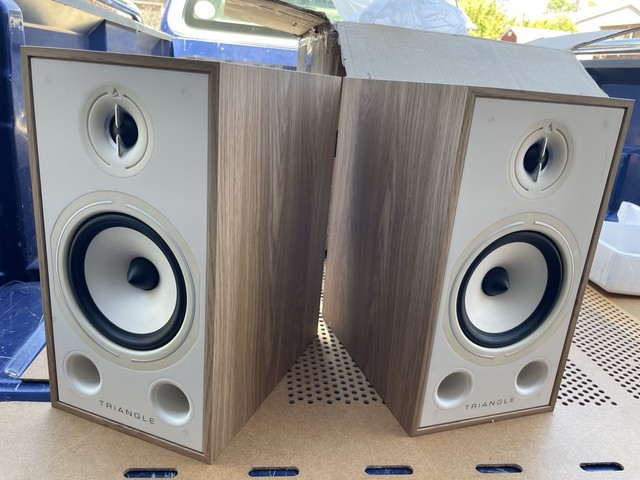
The French option, and the high-sensitivity choice among the modern speakers here. Triangle build for efficiency and speed rather than deep bass, which is an old-fashioned set of priorities that happens to suit an old-fashioned amplifier very well. It goes loud on very little power and it is lively enough to wake up a warm system.
- High sensitivity for its size
- 6-inch cellulose paper mid/bass driver
- Fast, articulate presentation
- Large standmount cabinet
- Plays loud on modest power
- Lively, quick character that suits the 3020
- Good build for the price
- Bright enough to be fatiguing in a hard room
- Needs careful positioning to tame the treble
- Large cabinet

Klipsch RP-600M
The volume answer. Klipsch build horn-loaded tweeters and very high sensitivity, so 20 watts goes much further here than into anything else on this list — this is the pick if your room is large or you listen loud, and the classic 3020 simply is not going to shout. The horn is vivid and detailed, which counteracts the amplifier’s warmth thoroughly.
- Horn-loaded tweeter with very high sensitivity
- 6.5-inch spun-copper woofer
- Rear-firing port with a tractrix geometry
- Large standmount
- Plays far louder on 20 watts than anything else here
- Vivid and detailed — the strongest counterweight to a warm amp
- Substantial bass output
- Horn presentation is divisive and can be forward
- Unforgiving of bright recordings
- Large and visually distinctive

JBL Stage A130
The budget pick that does the important thing right — reasonably high sensitivity and a lively, punchy balance. It is not refined and it will not disappear the way the KEF does, but it makes a modest amplifier sound energetic rather than polite, and it costs a fraction of most speakers here. A sensible pairing for a second system or a first proper hi-fi.
- 5.25-inch woofer with a high-frequency compression-style tweeter
- Good sensitivity for the price
- Front-ported
- Inexpensive
- Energetic and easy to drive
- Excellent value
- Front port tolerates near-wall placement
- Coarser than the better speakers here
- Limited fine detail
- Cabinet is basic

Celestion Ditton 15 (Used, Vintage Pairing)
For anyone who wants the amplifier to be paired with what it was designed against. The Ditton 15 is a sealed British standmount from the same era, easy to drive, and the combination is genuinely period-correct rather than merely nostalgic. Expect to service the speakers as well as the amp: forty-year-old surrounds and crossover capacitors both age.
- Sealed-cabinet British standmount from the 1970s
- Easy load, sympathetic voicing
- Passive radiator in some versions
- Only available used
- Period-correct pairing with real character
- Sealed cabinets are placement-tolerant
- Often inexpensive if you are patient
- Condition is everything — surrounds and capacitors age
- Needs servicing as well as the amplifier
- Warm-with-warm risks the mush this page warns about
Buying tips
- Confirm which 3020 you own first. The classic 3020 series and the modern D 3020 are entirely different amplifiers and take different advice.
- Do not over-correct for the wattage. The classic 3020 delivers far more current than 20 watts suggests and handles 4-ohm loads better than its rating implies.
- Pair warmth with clarity, not with more warmth. This amplifier plus a soft, polite speaker is the most common disappointing combination.
- Sensitivity decides loudness. Three dB of extra sensitivity is worth as much as doubling the amplifier’s power, and it costs nothing.
- Budget for a service before you budget for speakers. A forty-year-old unit needs recapping and its switches will be noisy; that is not a pairing problem.
- Use good stands and get the tweeters to ear height. It costs nothing and changes more than swapping speakers usually does.
- Rear-ported speakers need space behind them. If they must go on a shelf, buy front-ported.
- Check the speaker terminals on the amplifier. The original connectors are dated and a poor connection there will be blamed on the speakers.
As an Amazon Associate and eBay Partner, toptenpick.com earns from qualifying purchases. Prices and availability are subject to change.