

As an Amazon Associate and eBay Partner, toptenpick.com earns from qualifying purchases. Prices and availability are subject to change.
The sealant question has a different right answer depending on what’s actually going into the hole, and that’s the part most buying guides skip. A rubber expansion (Welch-style) plug seals by a screw squeezing a rubber grommet outward against the bore — it needs no sealant at all, and adding one can let the rubber slip instead of gripping. A steel or brass cup plug seals a different way, by friction against a clean, round bore, and most manufacturers rate it to hold on nothing more than a light film of oil. A sealant on a cup plug is a backstop for a bore that’s slightly pitted or worn oversize from old rust, not a fix for a bad hole.
That means surface prep in the bore matters more than which tube you buy. Clean it back to bare metal with a wire brush or a hone, knock down any rust ridge, and make sure the edge is round before the plug goes in. A spotless bore with a cheap sealant will outlast a rusty one with the best product on this list.
One caution worth stating plainly: plain RTV silicone gasket makers are already in most garages, which is part of why they turn up in this job, but installers on more than one forum report that uncured silicone is slippery enough to let a press-fit plug creep or pop out under heat cycling, since these plugs rely on friction rather than a bolted flange. If you use an RTV product from this list, apply it thin and let it skin over before the plug goes in — don’t count on it to save a loose fit.
If you’re replacing a chronically leaking press-fit plug with a screw-in brass one instead, that’s a different job entirely — it needs a PTFE-based pipe thread sealant, not the anaerobic or RTV products that work on a press-fit cup or expansion plug.
The eight picks below cover all three real cases: a compound sold specifically as a cup/core plug retaining sealant, the classic non-hardening brush sealants generations of mechanics have used on press-fit plugs, RTV gasket makers people do use successfully with the caution above, a higher-strength compound for a bore that’s a little worn, and PTFE thread sealant for the screw-in route. That’s a full, honest list for this niche rather than a padded ten — a couple of the more exotic engine-sealant products that show up in generic listicles either duplicate what’s here under a different label or had no verifiable price.
| # | Product | Price | Where to buy |
|---|---|---|---|
| 1 | Permatex Permanent Strength Threadlocker Red & Cup/Core Plug Sealant Retaining Compound, 36 mL | $40–$50 | Amazon |
| 2 | Permatex Aviation Form-A-Gasket No. 3 Sealant, 4 oz | $10–$15 | Amazon · eBay |
| 3 | Permatex Form-A-Gasket No. 2 Sealant, 3 oz | $8–$13 | Amazon · eBay |
| 4 | Permatex The Right Stuff Grey 90-Minute Gasket Maker, 3 oz | $12–$18 | Amazon · eBay |
| 5 | Permatex Ultra Grey Rigid High-Torque RTV Silicone Gasket Maker, 3 oz | $10–$15 | Amazon · eBay |
| 6 | Loctite 620 High-Temperature Retaining Compound, 36 mL | $24–$30 | Amazon · eBay |
| 7 | Loctite 565 PST Thread Sealant, 50 mL | $16–$32 | Amazon · eBay |
| 8 | Permatex Thread Sealant with PTFE, 4 oz | $10–$15 | Amazon · eBay |
The picks, in detail
Permatex Permanent Strength Threadlocker Red & Cup/Core Plug Sealant Retaining Compound, 36 mL
This is the one product on this list actually named for the job — an anaerobic retaining compound formulated to both lock and seal a cup or core plug driven into a clean bore. It cures only in the absence of air, so it sets inside the tight press-fit gap rather than skinning over on the exposed surface the way an RTV product does, which is exactly the behavior you want against a friction-fit plug.
- Anaerobic cure — sets in the confined gap, not on exposed surfaces
- 36 mL bottle
- Permanent-strength (red) formula
- Sold explicitly as a cup/core plug sealant
- Purpose-built for this exact application
- Won’t skin over before the plug is fully seated
- High retained strength for a plug that shouldn’t move
- Priced higher per ounce than the general-purpose sealants below
- Permanent strength makes a future plug removal harder

Permatex Aviation Form-A-Gasket No. 3 Sealant, 4 oz
The old-school brush-top sealant that shows up again and again in freeze-plug forum threads, partly because it’s already sitting on a shelf in most garages. It’s slow-drying and non-hardening rather than a hard-setting adhesive, stays flexible after it sets, and is rated resistant to gasoline, oil, and grease across a -65°F to 400°F range — wide enough to cover a plug that sees both winter cold and running-engine heat.
- Brush-top applicator built into the cap
- Non-hardening, stays flexible after application
- -65°F to 400°F temperature range
- Resists gasoline, oil, and grease
- Long track record specifically on freeze and core plugs
- Stays flexible rather than turning brittle with age
- Brush-top makes a thin, even coat easy to apply
- Slow-drying — allow real cure time before refilling coolant
- Non-hardening means it adds little mechanical retention on its own

Permatex Form-A-Gasket No. 2 Sealant, 3 oz
Permatex’s other classic non-hardening sealant, commonly applied specifically to the corner of a cup plug where the flat face turns 90 degrees into the cylindrical wall — pressing the plug in then spreads it evenly around that critical edge. It’s the cheapest sealant on this list and one of the most cited by name in older mechanic forum threads on this exact job.
- Non-hardening, slow-drying formula
- 3 oz brush-applicable tube
- Reddish-brown color
- Resists oil, gasoline, and water
- Lowest price of any sealant on this list
- Long history of use specifically on cup plug corners
- Stays serviceable if you ever need to pull the plug
- Smaller tube size than the Aviation No. 3 option
- Non-hardening means it relies on the bore fit for most of the seal

Permatex The Right Stuff Grey 90-Minute Gasket Maker, 3 oz
An RTV silicone gasket maker, not a purpose-built plug sealant, but it turns up often enough in freeze-plug threads that it belongs on this list with the caution stated plainly: apply it thin and let it skin over before the plug goes in, since uncured silicone is slippery enough to let a friction-fit plug creep. It cures faster than most RTVs, which shortens that risky uncured window.
- 90-minute cure time, faster than most RTV silicones
- 3 oz tube with applicator tip
- Grey, high-torque formula
- Sensor-safe, non-corrosive formulation
- Fast cure shortens the uncured, slippery window
- Widely stocked at any auto parts counter
- Also useful for other gasket jobs on the same engine
- Not purpose-built for press-fit plugs — apply thin, not a bead
- Some installers avoid straight silicone on friction-fit plugs entirely
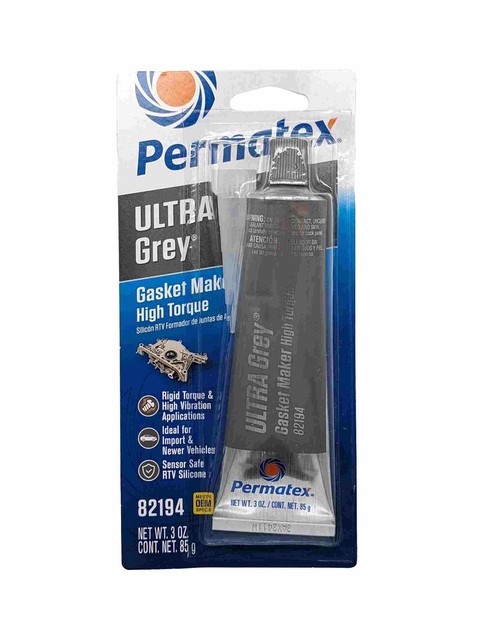
Permatex Ultra Grey Rigid High-Torque RTV Silicone Gasket Maker, 3 oz
Permatex’s other widely-stocked grey RTV, rigid rather than flexible once cured, marketed for high-torque and vibration-heavy joints. Like the Right Stuff above, it isn’t sold as a plug sealant specifically, and the same slippery-while-uncured caution applies — use it thin, and don’t reach for it to paper over a bore that isn’t actually round and clean.
- Rigid, not flexible, cured formula
- 3 oz tube
- Sensor-safe, non-corrosive formulation
- Widely available at auto parts retailers
- Extremely common — easy to find at any parts store
- Rigid cure resists movement once fully set
- Rated for high-vibration applications
- Same uncured-silicone slip risk as other RTV products
- Not marketed by Permatex specifically for core plugs

Loctite 620 High-Temperature Retaining Compound, 36 mL
Loctite’s high-temperature retaining compound, rated to 450°F with over 3,800 psi shear strength on steel, built to lock cylindrical metal parts with up to 0.015 inches of clearance — useful specifically when a bore has worn slightly oversize and a standard-viscosity sealant won’t fill the gap. It’s overkill for a plug going into a clean, tight bore, which is exactly why it’s the right call only for the worn-bore case.
- Rated to 450°F continuous
- Over 3,800 psi shear strength on steel
- Fills up to 0.015-inch diametral clearance
- Anaerobic acrylic ester cure
- Handles a worn or slightly oversize bore other sealants can’t fill
- High temperature rating for an engine bay location
- High shear strength once cured
- More expensive than the general Permatex options
- Full cure takes about 24 hours — plan the timeline
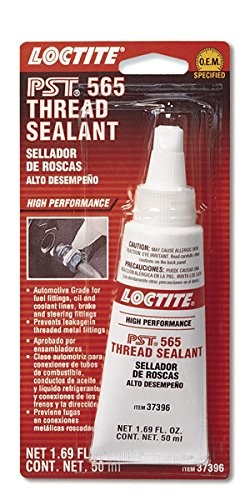
Loctite 565 PST Thread Sealant, 50 mL
Not for a press-fit plug at all — this is the sealant for the different job of switching to a screw-in brass replacement plug instead of a driven cup or expansion plug. It’s a controlled-strength, PTFE-loaded thread sealant for tapered pipe fittings, meant to seal the threads while still allowing the plug to be removed later, which a hard-set epoxy or RTV bead on threads would not.
- PTFE-loaded acrylic thread sealant
- Controlled strength for future disassembly
- Rated for tapered and straight pipe thread fittings
- 50 mL tube
- Correct product for a threaded, screw-in plug conversion
- Stays removable, unlike a permanent thread adhesive
- Seals and locks the threads in one product
- Wrong product entirely for a press-fit cup or rubber expansion plug
- Only relevant if you’re converting to a threaded plug
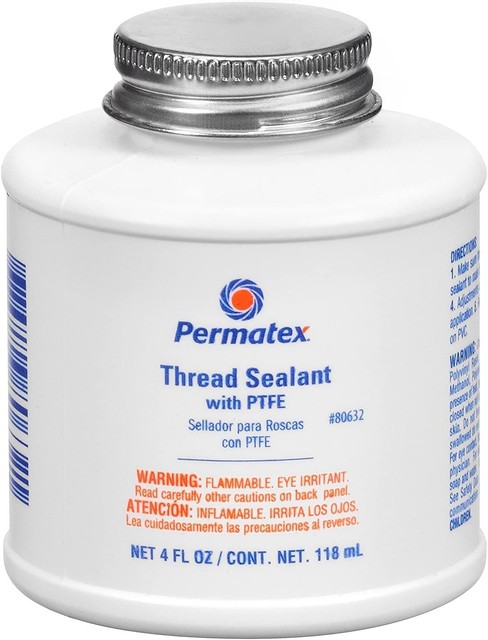
Permatex Thread Sealant with PTFE, 4 oz
A more affordable PTFE thread sealant covering the same screw-in-plug scenario as the Loctite option above, formulated for air, oil, and fuel system fittings. It’s the budget pick if you’re converting a chronically leaking press-fit core plug to a threaded brass replacement and want a sealant that’s overkill-proof rather than the strongest option on the shelf.
- PTFE-based paste formula
- Rated for air, oil, and fuel system threaded fittings
- 4 oz can with brush applicator
- Non-hardening
- Less expensive than the Loctite 565 alternative
- Brush applicator makes thread coverage easy
- Works across multiple fluid types, not just coolant
- Only applicable to threaded plug conversions, not press-fit plugs
- Non-hardening formula relies on thread fit, same as any pipe dope
Buying tips
- Match the sealant to the plug type: skip sealant entirely on a rubber expansion plug — it can let the rubber slip instead of biting into the bore.
- Clean the bore back to bare metal with a wire brush or hone before setting a cup plug; surface prep does more for a leak-free seal than the sealant you pick.
- Use a light, even film on the cylindrical wall of a cup plug, not a thick bead — extra sealant just squeezes out and does nothing once the plug is seated.
- Avoid straight RTV silicone on a press-fit plug you’re not also torquing down; several installers report it can act as a lubricant and let the plug walk under heat cycling.
- Drive brass and steel cup plugs in flat and square with a socket sized to the plug’s outer lip, not a punch on the center, so the sealant film stays even all the way around.
- If a bore is worn, pitted, or slightly oversized from old rust, step up to a stronger retaining compound rather than adding more of a light-duty sealant.
- Switching to a screw-in brass replacement plug instead of a press-fit one is a different job — it needs PTFE pipe thread sealant, not any of the anaerobic or RTV products used on a driven plug.
- Let anaerobic and RTV sealants cure for the time listed on the label before refilling coolant; several of these need hours, not minutes, to reach full strength.
As an Amazon Associate and eBay Partner, toptenpick.com earns from qualifying purchases. Prices and availability are subject to change.