

As an Amazon Associate and eBay Partner, toptenpick.com earns from qualifying purchases. Prices and availability are subject to change.
The most important thing about sawing a deer has nothing to do with the blade. It is which bones you cut, and the reason is prions. Chronic wasting disease concentrates in nervous and lymphatic tissue — brain, spinal cord, eyes, tonsils, spleen and lymph nodes — and has not been found in muscle. A reciprocating saw driven through the spinal column aerosolises exactly that tissue and smears it along a blade you are about to put through meat. State wildlife agencies are consistent about this: avoid sawing the spinal column, do not use a blade that has cut nervous tissue on edible meat, and either soak that blade in a 50/50 bleach-and-water solution for an hour or throw it away.
Which leads to the genuinely useful conclusion: for most of what people buy a saw for, you do not need to cut bone at all. The gutless method — boning the quarters, backstraps and neck off the carcass with a knife and never opening the spine or the body cavity — removes the meat, leaves the lymph nodes and the spinal column behind, and needs no saw whatsoever. If you are processing in a CWD area, that is both the safest and the fastest route, and a great many hunters have moved to it for exactly this reason.
Where a saw still earns its place is splitting the pelvis, taking the head off for a mount or for testing, cutting through the sternum, and portioning bone-in cuts like shanks and osso buco. Those are real jobs. Treat the blade that does them as a dedicated tool that never touches meat afterwards.
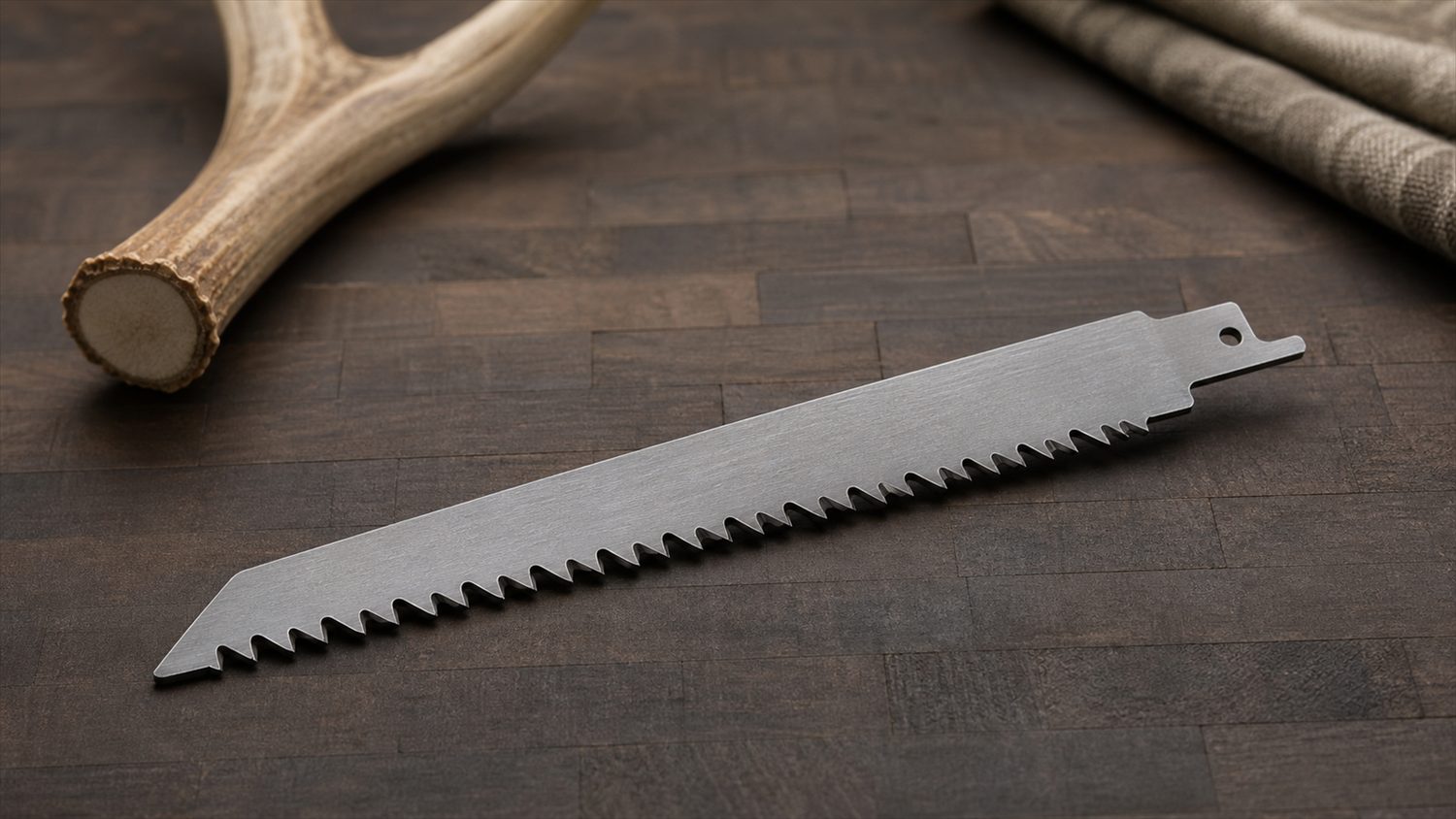
On the blade itself the specification is simple and mostly counterintuitive. Bone wants a coarse tooth count, around 5 to 10 TPI — a fine metal-cutting blade loads up with bone dust and marrow, stops cutting and heats the bone. Length matters more than people expect: a 9 or 12 inch blade clears the carcass and lets you cut straight, where a 6 inch one has you pressing the saw body into the animal. And bimetal construction survives hitting bone far better than plain carbon steel, which bends and takes a set.
One honest note on food-grade claims: a few blades are sold as stainless for game processing, and stainless is genuinely easier to clean and does not rust in a cooler. But no blade is sterile out of the packet, and the cleaning discipline matters much more than the metallurgy.
| # | Product | Price | Where to buy |
|---|---|---|---|
| 1 | Diablo Pruning and Bone Reciprocating Blade, 9 inch | $10–$20 | Amazon · eBay |
| 2 | Outdoor Edge Griz-Saw or Game Processing Blade Set | $18–$35 | Amazon |
| 3 | Milwaukee The Torch / Ax Reciprocating Blades (coarse) | $15–$40 | Amazon · eBay |
| 4 | Stainless Steel Reciprocating Blade for Food Processing | $15–$30 | Amazon · eBay |
| 5 | Diablo Carbide-Tipped Reciprocating Blade | $20–$40 | Amazon · eBay |
| 6 | 12 Inch Coarse Pruning Blade | $12–$22 | Amazon · eBay |
| 7 | Cordless Reciprocating Saw, Compact | $90–$200 | Amazon · eBay |
| 8 | Boning and Breaking Knife Set | $40–$90 | Amazon · eBay |
| 9 | Nitrile Gloves and Bleach for Blade Decontamination | $15–$30 | Amazon |
| 10 | Hand Bone Saw | $20–$45 | Amazon · eBay |
The picks, in detail

Diablo Pruning and Bone Reciprocating Blade, 9 inch
Diablo’s coarse pruning blades are the default choice among hunters using a reciprocating saw, for the straightforward reason that green wood and bone want the same thing: a big aggressive tooth with room to clear the swarf. Bimetal construction survives the shock of hitting bone, and the 9 inch length lets you keep the saw body out of the carcass while cutting straight.
- Coarse tooth pitch aimed at green wood and bone
- Bimetal construction
- 9 and 12 inch lengths
- Universal shank
- Cuts bone fast without loading up
- Bimetal resists bending on a bad angle
- Cheap enough to dedicate one per animal
- Aggressive tooth leaves a rough surface and bone chips
- Not stainless, so it will rust if left damp
- Coarse teeth grab on thin bone
Outdoor Edge Griz-Saw or Game Processing Blade Set
Purpose-made game blades from a hunting brand, usually sold as a set with a coarse blade for bone and a finer one for lighter work. The advantage over a hardware-store blade is not cutting performance but fitness for purpose — stainless or coated construction that cleans up properly and does not leave rust in a cooler, plus lengths chosen for a carcass rather than for a stud wall.
- Stainless or coated blades sold for game
- Coarse bone pitch
- Lengths suited to carcass work
- Often sold as multi-packs
- Cleans up properly and resists rust
- Lengths chosen for the job
- Multi-packs make dedicating a blade easy
- Costs several times a hardware-store blade
- Stainless holds an edge less well than bimetal
- Availability is seasonal

Milwaukee The Torch / Ax Reciprocating Blades (coarse)
Milwaukee’s blades are the durability benchmark in this format, and the coarse Ax pattern intended for nail-embedded wood handles bone well. The reason to spend here is the shank and body strength — these survive the flex and twist of cutting through a joint at an awkward angle better than budget blades, which is where cheap blades snap.
- Coarse tooth patterns for wood and nail-embedded wood
- Heavy-gauge body
- Multiple lengths
- Sold in bulk packs
- Body strength survives twisting in a cut
- Bulk packs are economical for dedicating blades
- Very widely stocked
- Not stainless — rusts if stored damp
- Overkill for one deer a season
- Tooth patterns are labelled for construction, not game

Stainless Steel Reciprocating Blade for Food Processing
Stainless blades sold for butchery and game are the right choice for anything you are doing repeatedly or storing between uses. They do not rust in a damp cooler, they clean fully in hot soapy water, and they tolerate a bleach soak without pitting — which matters given that a bleach soak is the recommendation after cutting a spinal column. They cut slightly slower than bimetal and dull sooner.
- Stainless steel construction
- Tolerates bleach and sanitiser without pitting
- Coarse pitch versions available
- Reusable across seasons
- Handles sanitising without corroding
- No rust in storage or in a cooler
- Easy to clean thoroughly
- Dulls faster than bimetal
- Cuts a little slower through heavy bone
- Costs more per blade

Diablo Carbide-Tipped Reciprocating Blade
The long-life option: carbide teeth stay sharp through far more bone than steel, which is the difference between one blade per animal and one blade per season for someone processing several. It is the blade to buy if you cut a lot of bone-in portions — shanks, osso buco, rib sections. Expensive per blade and it is only worth it at volume.
- Carbide-tipped teeth
- Very long edge life in abrasive material
- Bimetal body
- Several lengths
- Stays sharp through many times more bone
- Cuts cleanly with less chipping
- Economical if you process several animals
- Several times the price of a standard blade
- Carbide teeth chip if the blade is twisted
- Wasteful if you only take one deer a year

12 Inch Coarse Pruning Blade
Length is the underrated specification here. A 12 inch blade lets you split a pelvis or take a sternum in one straight pass with the saw body well clear of the carcass, which produces a cleaner cut and keeps your hands out of the mess. On a large-bodied animal it is the difference between one confident stroke and several awkward ones from different angles.
- 12 inch length
- Coarse pruning tooth pitch
- Bimetal body
- Standard universal shank
- Reaches across large bone in one pass
- Keeps the saw body clear of the carcass
- Cheap
- Flexes noticeably at full extension
- Unwieldy for fine or confined cuts
- Longer blades need more clearance than some saws allow

Cordless Reciprocating Saw, Compact
The tool rather than the blade, and worth a line because a compact one-handed saw is genuinely better for this than a full-size demolition saw: it is controllable in a confined space, it runs off the battery platform you already own, and it will not rip through a carcass under its own weight. Battery life is the constraint — take two, because cold weather drops runtime sharply.
- One-handed compact body
- Runs on common battery platforms
- Variable speed trigger
- Tool-free blade change
- Controllable in tight spaces and awkward angles
- No cord in a field or a barn
- Tool-free blade change matters with wet hands
- Battery runtime drops significantly in the cold
- Less powerful through heavy pelvis bone
- Getting one properly clean afterwards takes effort

Boning and Breaking Knife Set
On the list because for the gutless method this genuinely replaces the saw. A stiff boning knife and a breaking knife will take every quarter, the backstraps, the neck meat and the tenderloins off an animal without opening the spine or the body cavity once — which is the processing method wildlife agencies point to for CWD areas, and which is also faster than most people expect.
- Stiff boning knife plus breaking knife
- Food-safe non-slip handles
- High-carbon stainless blades
- Dishwasher-safe on most sets
- Removes the need to saw bone at all
- Recommended approach where CWD is present
- Easy to clean and sanitise properly
- Needs sharpening part-way through an animal
- A learned technique rather than a purchase
- No use for bone-in cuts or a European mount
Nitrile Gloves and Bleach for Blade Decontamination
Unglamorous and specifically recommended. The guidance after cutting a spinal column is to soak the blade in a 50/50 household bleach and water solution for an hour, or dispose of it, and to keep the blade that touched nervous tissue away from meat entirely. Long-cuff nitrile gloves and a bucket cost a few dollars and are the part of this job that actually protects you.
- Long-cuff nitrile gloves
- Household bleach for a 50/50 soak
- Dedicated bucket or tub
- Disposable rather than reused
- Directly implements the published agency guidance
- Costs very little relative to the risk
- Gloves also make the whole job cleaner
- Bleach pits non-stainless blades
- An hour of soak time to plan around
- Nitrile tears on bone edges — take spares
Hand Bone Saw
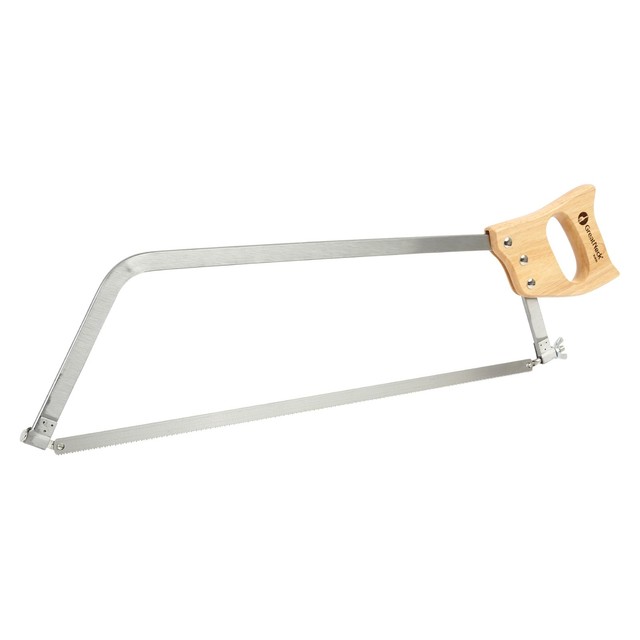
The old answer, and still the right one for a single cut in the field. A hand saw has no battery to die, it is trivially easy to clean thoroughly, and — importantly for this subject — it does not throw bone dust the way a powered blade does. It is slower, which for the two or three bone cuts a typical animal actually needs is not a meaningful cost.
- Fixed or folding frame with replaceable blades
- Coarse bone tooth pitch
- Stainless blades on most models
- No power source
- Throws far less bone dust than a powered saw
- Cleans thoroughly with no motor housing to worry about
- Works anywhere, in any weather
- Slow and physically hard work on a pelvis
- Blades dull quickly on bone
- Awkward alone without a second pair of hands
Buying tips
- Do not saw the spinal column if you can avoid it. Prions concentrate in brain, spinal cord, eyes, tonsils, spleen and lymph nodes — not in muscle — and a powered blade through the spine spreads exactly that tissue.
- Learn the gutless method and most of the sawing disappears. Quarters, backstraps, neck and tenderloins all come off with a knife without ever opening the spine or the body cavity.
- Keep the bone blade and the meat blade separate, and never swap them. A blade that has cut nervous tissue should not then cut anything you intend to eat.
- Soak a blade that has cut the spine in 50/50 household bleach and water for an hour, or throw it away. That is the published wildlife-agency guidance, not a folk remedy.
- Buy coarse, around 5 to 10 TPI. A fine metal-cutting blade packs with bone dust and marrow, stops cutting and starts burning the bone.
- Go long — 9 or 12 inches. A short blade puts the saw body into the carcass and forces the awkward angles that snap blades and make ragged cuts.
- Choose bimetal for cutting and stainless for anything you will sanitise and store. Bimetal survives the shock better; stainless survives the bleach and the cooler.
- Check your state’s CWD rules and testing requirements before the season, not during it. Carcass transport across county or state lines is restricted in many places, and that changes how you butcher in the field.
As an Amazon Associate and eBay Partner, toptenpick.com earns from qualifying purchases. Prices and availability are subject to change.