

As an Amazon Associate and eBay Partner, toptenpick.com earns from qualifying purchases. Prices and availability are subject to change.
The spec that actually decides which receiver a JBL system needs is not on the receiver at all — it is on the back of the speaker. Look for two numbers: sensitivity (in dB) and impedance (in ohms). JBL has built its house sound around horn-loaded and waveguide tweeters for decades specifically to get sensitivity numbers most other speaker brands cannot match — the Stage and Arena lines sit around 90-91 dB, and even the L100 Classic bookshelf speaker is rated at 90 dB. A speaker that efficient needs far less amplifier power to play loud than a ‘150 watts per channel’ spec sheet implies; most JBL bookshelf and tower pairings are genuinely fine on a modest 60-100W-per-channel receiver.
The number that actually catches people out is impedance, not power. Most JBL home speakers are rated 6 or 8 ohms, which every receiver on the market handles without a second thought. A few — the L100 Classic and the older 4312/4310-derived studio-monitor line it descends from — are rated 4 ohms nominal, and a handful of budget AV receivers are conservatively rated no lower than 6 ohms and will protection-trip or run hot if pushed into that load. That is the real compatibility question for a JBL system, and it is almost never raised in generic best-receiver roundups: check the impedance rating on the receiver’s own spec sheet, not just its wattage claim, before buying to drive a 4-ohm JBL model.
Beyond that, the right receiver depends on what the JBL speakers are actually doing. A pair of passive bookshelf or tower speakers for two-channel listening wants a stereo receiver with a decent phono stage if a turntable is in the picture. A full JBL Stage or Arena 5.1 or 7.1 home theater setup wants a multichannel AV receiver with enough amplifier channels and power-supply headroom to drive all of them at once — running every channel simultaneously stresses a receiver’s power supply more than any single-speaker spec sheet shows.
The list below spans both cases across three budget tiers: entry AV receivers under $450 that suit efficient JBL bookshelf and small-tower pairs, mid-range and premium AV receivers built for a full JBL surround system, and two picks — one AV, one stereo — with enough current-delivery headroom that a 4-ohm JBL speaker stops being a spec to double-check. None of these have been tested against JBL speakers by this site; the pairings are built from each side’s published sensitivity, impedance, and power specifications.
| # | Product | Price | Where to buy |
|---|---|---|---|
| 1 | Denon AVR-S570BH | $300–$350 | Amazon · eBay |
| 2 | Yamaha RX-V4A | $400–$450 | Amazon · eBay |
| 3 | Sony STR-DH590 | $300–$400 | Amazon · eBay |
| 4 | Onkyo TX-NR6100 | $650–$800 | Amazon · eBay |
| 5 | Denon AVR-X2800H | $600–$700 | Amazon · eBay |
| 6 | Marantz Cinema 50 | $2,000–$2,800 | Amazon · eBay |
| 7 | Yamaha RX-V6A | $600–$800 | Amazon · eBay |
| 8 | Yamaha R-N1000A | $1,700–$1,800 | Amazon · eBay |
| 9 | Sony STR-DH190 | $180–$220 | Amazon · eBay |
| 10 | Onkyo TX-8260 | $350–$400 | Amazon |
The picks, in detail

Denon AVR-S570BH
An entry-level 5.2-channel AV receiver sized for exactly a JBL Stage or Arena small-to-mid home theater bundle. It has enough channels for a real 5.1 layout plus a height pair, current HDMI 2.1 pass-through, and Denon’s entry amplifier section has a solid reputation for running 6-8 ohm home speakers without drama.
- 5.2-channel, roughly 70W per channel (8-ohm, 2ch driven)
- HDMI 2.1 with 4K/120 and 8K passthrough
- Built-in Bluetooth
- Audyssey room correction
- Lowest price of any full AV receiver on this list
- Enough channels for a genuine 5.1 JBL setup, not just a soundbar substitute
- Denon’s entry AVR line has a strong reliability track record
- No published 4-ohm rating, so it is not the pick for the L100 Classic or similar low-impedance JBL models
- Only 2 HDMI inputs, tight for a media-heavy setup
- Power reserve is thin for large JBL towers pushed loud

Yamaha RX-V4A
A similarly priced 5.2-channel alternative to the Denon S570BH, with somewhat more rated power per channel and Yamaha’s YPAO automatic room correction, which is worth having if the JBL speakers are going into an irregularly shaped room.
- 5.2-channel, 80W per channel (8-ohm)
- HDMI 2.1, 8K/60 and 4K/120 passthrough
- YPAO automatic room calibration
- MusicCast multi-room streaming
- More headroom per channel than most receivers at this price
- YPAO correction is genuinely effective in uneven rooms
- MusicCast adds whole-home streaming without extra hardware
- Costs more than the Denon S570BH for a broadly similar feature set
- Still not rated for 4-ohm speakers
- MusicCast is a soft ecosystem lock-in if you want matching streaming speakers elsewhere
Sony STR-DH590
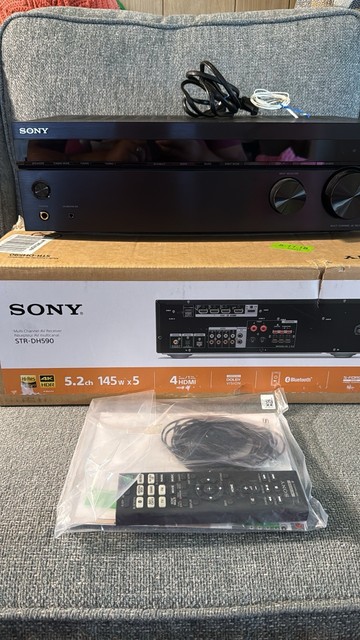
A budget 5.2-channel option worth naming specifically so it can be flagged rather than assumed safe: Sony rates its minimum load at 6 ohms, which is a fine match for most 8-ohm JBL Arena or Stage speakers but the wrong choice for a 4-ohm-rated JBL model like the L100 Classic.
- 5.2-channel, 145W peak per channel (8-ohm)
- Minimum rated speaker impedance of 6 ohms
- 4K HDR video passthrough
- Built-in Bluetooth
- One of the cheaper full AV receivers with real HDMI passthrough
- Enough channels for a basic JBL 5.1 layout
- Simple menu system with a low learning curve
- 6-ohm minimum rating rules out several JBL models outright
- Fewer HDMI inputs than Denon or Yamaha competitors at this price
- Discontinued by Sony, so new stock is thinning

Onkyo TX-NR6100
A genuine step up for a full JBL Stage or Arena 7.1 system. Onkyo publishes an explicit 4-16 ohm speaker impedance rating on this model, making it one of the few receivers under $700-800 that can be pointed at a 4-ohm JBL speaker without a caveat.
- 7.2-channel, 100W per channel (8-ohm) / 210W (6-ohm)
- Rated for 4-16 ohm speaker loads
- THX Select certification
- Dolby Atmos and DTS:X with height-channel support
- Explicit 4-ohm rating removes the guesswork for L100 Classic-type JBL speakers
- Two extra channels over the entry AVRs above for a real surround layout
- THX certification means it has been bench-tested at real output levels
- Costs roughly twice the entry-level receivers on this list
- 7.2 channels is more than a simple 2-speaker JBL setup needs
- Denser setup menus than Denon or Yamaha
Denon AVR-X2800H
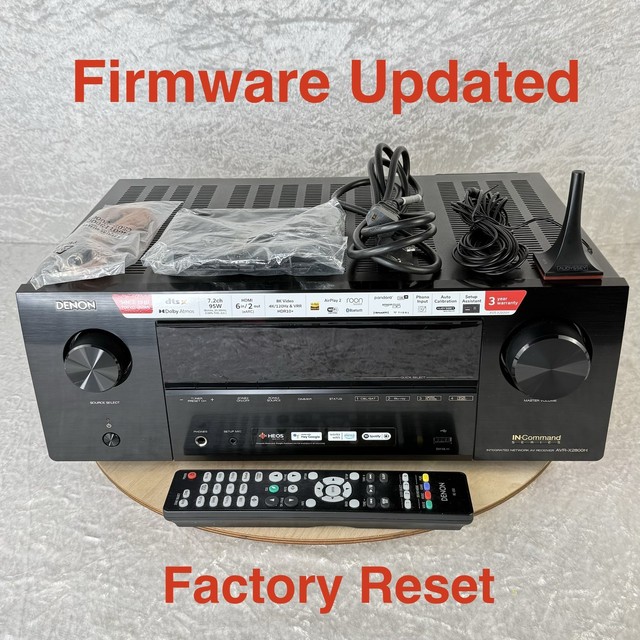
Denon’s mid-tier X-series receiver, built on the same current-capable amplifier architecture Denon shares with sister brand Marantz. A documented lineage of tolerating demanding, lower-impedance speaker loads is a more reliable signal for a JBL pairing than a single published wattage number.
- 7.2-channel, 95W per channel (8-ohm, 2ch driven)
- HDMI 2.1 across 6 inputs / 2 outputs
- 8K/60 and 4K/120 video passthrough
- HEOS multi-room built in
- More current-delivery headroom than Denon’s entry S-series for demanding JBL towers
- Full HDMI 2.1 spec across more ports than cheaper competitors
- HEOS adds streaming without a separate box
- Does not publish an explicit 4-ohm rating the way the Onkyo TX-NR6100 does, so confirm before assuming it suits an L100 Classic
- A meaningful price jump over the S570BH/RX-V4A tier
- More channels and features than a stereo-only JBL bookshelf pair needs

Marantz Cinema 50
The premium pick on this list, worth considering if the JBL speakers are large floorstanders being pushed hard in a bigger room. Marantz’s HDAM current-feedback amplifier design, a lineage shared with Denon but tuned differently, has a long-standing reputation among AV forums for driving demanding, lower-impedance loads cleanly rather than just on paper.
- 9.4-channel, 110W per channel (8-ohm)
- HDAM current-feedback amplifier stage
- 7 HDMI inputs, all 8K-capable
- Dirac Live room correction
- Highest per-channel power and channel count on this list
- Amplifier topology with a genuine reputation on hard-to-drive speakers, not just a spec claim
- Dirac Live room correction outperforms the correction on every cheaper option here
- By far the most expensive receiver on this list
- 9.4 channels and this much power is wasted on a simple 2-speaker JBL bookshelf setup
- A large investment to make on published specs alone without an in-room audition

Yamaha RX-V6A
A middle ground between the entry 5.2-channel receivers and the pricier Onkyo and Denon step-ups: 7.2 channels for a fuller JBL surround layout at a price close to the cheaper 5.2-channel models, worthwhile if the extra channels matter more than an explicit 4-ohm rating.
- 7.2-channel, 100W per channel (8-ohm)
- YPAO room calibration
- Dolby Atmos Height Virtualization
- 7 HDMI inputs
- Two extra channels over the entry-level 5.2 receivers for close to the same money
- YPAO correction carried over from pricier Yamaha models
- Strong HDMI input count for the price
- Still an 8-ohm-focused rating, not a 4-ohm pick
- Height Virtualization is a software substitute for real height speakers, not equivalent to them
- No explicit low-impedance spec published, the same caveat as the Denon X2800H
Yamaha R-N1000A
The pick for a pure two-channel JBL setup — bookshelf speakers plus a turntable, no home theater involved. It is the one receiver on this list with a published 4-ohm dynamic rating (220W into 4 ohms) high enough that the L100 Classic’s impedance dip is not a concern, and retailers sell this exact receiver bundled with JBL’s L100 Classic as a stereo system.
- 2-channel, 100W into 8 ohms and 120W into 6 ohms continuous, 220W into 4 ohms dynamic
- Built-in moving-magnet phono stage
- ES9080Q DAC
- HDMI ARC, AirPlay 2, and MusicCast
- Explicit 4-ohm dynamic headroom that no AV receiver on this list publishes as clearly
- Built-in phono stage means no separate preamp for a turntable
- Sold as an actual retailer bundle with JBL’s L100 Classic
- Highest price on this list for a receiver with no surround or HDMI-passthrough functionality
- Two channels only, no home theater use case
- Phono stage is moving-magnet only, no moving-coil support

Sony STR-DH190
The cheapest real option on this list, and a sensible one for a small pair of efficient JBL bookshelf speakers — Stage or Arena models at 6-8 ohms and around 90dB sensitivity — plus a turntable, since it includes a phono stage that many budget receivers skip entirely.
- 2-channel, 90W per channel (8-ohm)
- Built-in phono stage for moving-magnet cartridges
- A+B speaker outputs for two speaker pairs
- Bluetooth 4.2 streaming
- Lowest price of any receiver on this list
- Phono stage built in at this price point is unusual
- A+B outputs let you run a second pair of JBL speakers in another room
- Not rated below 8 ohms, so it is not a match for a 4-ohm JBL model
- 90W is enough for most JBL bookshelf pairs but not large, inefficient towers
- No HDMI or home-theater functionality at all
Onkyo TX-8260
A step above the Sony STR-DH190 for a two-channel JBL bookshelf or tower setup that also wants network streaming — Chromecast, AirPlay, and DTS Play-Fi built in — without moving up to a full AV receiver’s channel count and price.
- 2-channel, 80W per channel (8-ohm)
- Built-in Wi-Fi, Bluetooth, and Chromecast
- DTS Play-Fi multi-room streaming
- Phono input included
- More streaming options built in than the cheaper Sony stereo receiver
- Phono input included for a turntable-based JBL system
- More per-channel power than the Sony STR-DH190
- Like the other budget stereo receivers here, not rated for 4-ohm JBL speakers
- Onkyo’s recent ownership changes have made some buyers cautious about long-term support
- No HDMI, so it cannot double as a home-theater receiver later
Buying tips
- Find the sensitivity (dB) and impedance (ohms) rating for your specific JBL model before shopping for a receiver — it is usually printed on the back panel or in the manual, and it matters more than any receiver’s wattage claim.
- If your JBL speakers are rated 4 ohms nominal (the L100 Classic and its 4312-derived siblings are the common case), confirm the receiver’s spec sheet explicitly supports 4-ohm loads rather than assuming a high wattage number covers it.
- For a turntable-based two-channel JBL system, buy a stereo receiver with a built-in phono stage rather than adding a separate phono preamp — several options on this list include one.
- Match channel count to your actual JBL speaker count: a 5.2-channel receiver is wasted money on a 2-speaker bookshelf pair, and a 2-channel stereo receiver cannot run a JBL surround system at all.
- Run the receiver’s automatic room correction — Audyssey, YPAO, or Dirac Live, depending on brand — after setup; it measurably changes how efficient JBL speakers integrate with a subwoofer and the room.
- Leave ventilation space above and around any receiver driving JBL speakers near their rated impedance floor; low-impedance loads run the amplifier section hotter than an 8-ohm speaker does.
- Do not assume more watts automatically means louder or better sound with JBL speakers specifically — their horn-loaded tweeters are unusually efficient, so a modest receiver often reaches full, clean volume well before it runs out of power.
- Check current retailer stock before buying an older or discontinued model from this list; confirm you are getting new stock, not old warehouse inventory sold at full price.
As an Amazon Associate and eBay Partner, toptenpick.com earns from qualifying purchases. Prices and availability are subject to change.