

As an Amazon Associate and eBay Partner, toptenpick.com earns from qualifying purchases. Prices and availability are subject to change.
Before the list, the part that matters more than any scope on it: the bandwidth question everybody asks is the least important one, and the probe question nobody asks is the one that can kill you.
Audio is a 20 Hz to 20 kHz business. Even allowing for ringing, oscillation and square-wave edges, tube amp work does not need anything above about 50 MHz — and every oscilloscope sold today comfortably exceeds that. Buying 200 MHz over 100 MHz for amp work buys you nothing you will ever use. Sample memory, channel count and vertical resolution are all more useful than bandwidth here.
Now the dangerous part. A tube amp runs 300 to 500 volts DC on the plate supply, and the filter capacitors hold that charge after the amp is unplugged — sometimes for a long time. The 10x probe that came in the box with your scope is typically rated for a few hundred volts at most. Put it on a B+ rail and it can flash over internally, which destroys the scope’s front end and puts the full rail voltage somewhere it should never be. Buy a 100:1 high-voltage probe before you probe any supply rail. It is the cheapest item on this page and the only one that is not optional.
Second safety point, and the one that catches experienced people: your oscilloscope’s ground clip is connected to mains earth through the power cord. Clip it to a chassis that is at a different potential and you have made a path through the scope. Work through an isolation transformer, and never float the scope by cutting its earth pin — that makes the whole instrument live instead.
Third: never run a tube amp without a load. An output transformer with no speaker attached will arc over internally, and that is an expensive repair on an amp you were trying to fix. A dummy load is bench equipment, not an accessory.
Ten items below: six scopes worth owning, and the four other things that make the bench actually work.
| # | Product | Price | Where to buy |
|---|---|---|---|
| 1 | Rigol DS1054Z 4-Channel Oscilloscope | $350–$450 | Amazon · eBay |
| 2 | Siglent SDS1104X-E 4-Channel Oscilloscope | $450–$600 | Amazon · eBay |
| 3 | Siglent SDS1202X-E 2-Channel Oscilloscope | $350–$480 | Amazon · eBay |
| 4 | Rigol DS1202Z-E Oscilloscope | $400–$550 | Amazon · eBay |
| 5 | Rigol DHO804 12-Bit Oscilloscope | $400–$550 | Amazon · eBay |
| 6 | Siglent SDS800X HD Series 12-Bit Oscilloscope | $600–$900 | Amazon |
| 7 | 100:1 High-Voltage Oscilloscope Probe (2kV+ Rated) | $30–$150 | Amazon · eBay |
| 8 | Bench Isolation Transformer | $100–$350 | Amazon |
| 9 | Non-Inductive Dummy Load (8Ω, 100W+) | $60–$250 | Amazon · eBay |
| 10 | Siglent SDG1032X Function Generator | $300–$450 | Amazon · eBay |
The picks, in detail
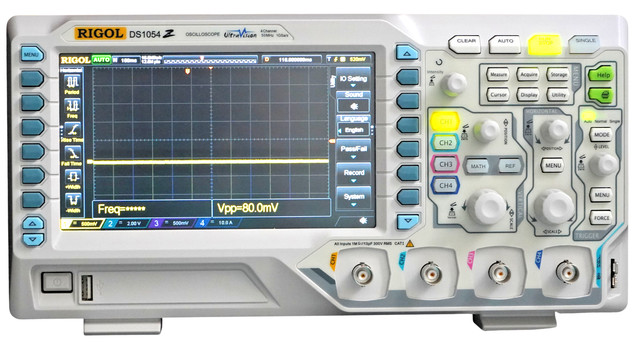
Rigol DS1054Z 4-Channel Oscilloscope
The scope that made benchtop test equipment affordable, and still the standard recommendation for amp work. Four channels at 50 MHz with 24 Mpts of memory, for less than most single-channel scopes cost a decade ago. Four channels matters more than it sounds: you can watch input, phase inverter and both output tubes at once, which is how you find an imbalance rather than guessing at it.
- 4 channels, 50 MHz bandwidth
- 1 GSa/s sample rate
- 24 Mpts memory depth
- 7-inch display with built-in measurements
- Four channels at this price is still remarkable
- 50 MHz is well beyond anything audio needs
- Enormous community and documentation
- Older interface than current models
- 8-bit vertical resolution
- Fan noise is noticeable on a quiet bench

Siglent SDS1104X-E 4-Channel Oscilloscope
The other default, and generally the better instrument of the two classics — 100 MHz across four channels with a faster waveform update rate and a more modern interface. For tube work the update rate is what you actually feel: intermittent faults and crackle show up as a flicker on the trace, and a scope that redraws quickly catches them where a slow one does not.
- 4 channels, 100 MHz bandwidth
- 1 GSa/s sample rate
- 14 Mpts memory
- Fast waveform update rate
- Better at catching intermittent faults than slower scopes
- Modern interface and good measurement set
- Four channels for tracing a whole signal path
- 8-bit vertical resolution
- More expensive than the DS1054Z
- Menu system takes some learning

Siglent SDS1202X-E 2-Channel Oscilloscope
The two-channel version, cheaper and entirely adequate if you mostly compare an input against an output. 200 MHz of bandwidth you will never need for audio, but the same fast update rate and good triggering. Buy this over the four-channel if the budget is tight — two channels handle almost all fault-finding, and the money is better spent on a high-voltage probe.
- 2 channels, 200 MHz bandwidth
- 1 GSa/s sample rate
- 14 Mpts memory
- Same processing platform as the 4-channel model
- Excellent value for a capable scope
- Two channels covers most amp diagnosis
- Leaves budget for probes and safety gear
- Two channels limits multi-point comparison
- 8-bit resolution
- Bandwidth well beyond what audio needs — you are paying for headroom you cannot use

Rigol DS1202Z-E Oscilloscope
Two channels at 200 MHz with 24 Mpts of memory, which is a lot of record length for the money. Deep memory is genuinely useful in amp work: you can capture several seconds at a usable sample rate and then zoom into the moment a fault appeared, rather than trying to trigger on something that happens every few minutes.
- 2 channels, 200 MHz bandwidth
- 1 GSa/s sample rate
- 24 Mpts memory depth
- Built-in measurement and analysis tools
- Deep memory for long captures of intermittent faults
- Good value against other 200 MHz scopes
- Familiar Rigol interface
- Only two channels
- 8-bit resolution
- Bandwidth is surplus to audio requirements

Rigol DHO804 12-Bit Oscilloscope
The interesting modern option, and the one whose specification genuinely helps audio work rather than just reading well. Twelve-bit vertical resolution means sixteen times the amplitude detail of an 8-bit scope — so small distortion artefacts, crossover notches and low-level hum are visible on the trace instead of being lost in quantisation. Silent, thin, and it takes up almost no bench space.
- 12-bit vertical resolution
- 4 channels, 70 MHz
- Fanless and very compact
- Modern touchscreen interface
- 12-bit resolution genuinely matters for audio distortion work
- Silent operation — a real benefit on a listening bench
- Very small footprint
- Lower bandwidth than the 8-bit classics, though ample for audio
- Smaller memory than the deep-memory Rigols
- Newer product with a smaller body of community knowledge
Siglent SDS800X HD Series 12-Bit Oscilloscope
Siglent’s answer in the same category — 12-bit resolution with a large touchscreen and deep memory. For looking at an amplifier’s output waveform at the onset of clipping, or examining crossover distortion in a push-pull stage, the extra vertical resolution shows you shapes an 8-bit scope averages away. The most capable audio-focused instrument on this list.
- 12-bit vertical resolution
- 4 channels with deep memory
- Large touchscreen
- Modern analysis and measurement suite
- Best vertical resolution here for examining distortion
- Deep memory and good triggering
- Large, readable display
- Most expensive scope on this list
- More instrument than a hobbyist amp bench requires
- Learning curve on the analysis features

100:1 High-Voltage Oscilloscope Probe (2kV+ Rated)
The item to buy before you switch the scope on. A 100:1 probe rated to 2kV or more divides a 450V plate rail down to a few volts the scope handles comfortably, with proper insulation between you and it. The standard 10x probe supplied with your scope is not rated for this and can flash over internally — taking the front end of the scope with it, and putting the rail somewhere it must not be.
- 100:1 attenuation ratio
- Typically 2kV or higher rating
- Insulated body and long barrel
- Compensation adjustment for your scope’s input
- The single most important safety purchase on this page
- Protects the scope’s front end as well as you
- Cheap relative to everything it protects
- 100:1 attenuation reduces resolution on small signals
- You still need a 10x probe for ordinary signal tracing
- Cheap unbranded probes vary in genuine voltage rating
Bench Isolation Transformer
The other safety item, and the one experienced people still skip. Your scope’s ground clip is bonded to mains earth through its power cord. An isolation transformer breaks the connection between the amp under test and mains earth, which is what makes it safe to attach that clip to a chassis. Never solve this by cutting the earth pin on the scope — that makes the whole instrument live rather than making the amp safe.
- Mains isolation between supply and the equipment under test
- Typically 250VA to 1kVA for amp work
- Often combined with a variac in bench units
- Overload protection on better models
- Makes attaching a scope ground to a chassis survivable
- Essential for any older or non-earthed equipment
- Also useful for bringing a rebuilt amp up slowly if paired with a variac
- Heavy and takes real bench space
- Adds meaningful cost to the setup
- Does not make the amp’s internal voltages any less lethal

Non-Inductive Dummy Load (8Ω, 100W+)
Run a tube amp with no speaker attached and the output transformer can arc over internally — an expensive repair on the amp you were trying to fix. A non-inductive resistive load lets you drive the amp to full output silently, at any hour, while watching the waveform. Use non-inductive resistors; wirewound types are inductive and will misrepresent the amplifier’s behaviour at high frequencies.
- 8Ω load, 100W or higher continuous rating
- Non-inductive resistor construction
- Often includes 4Ω and 16Ω taps
- Heatsinked or fan-cooled on higher-power units
- Protects the output transformer during testing
- Silent full-power testing
- Gives a clean, predictable load for waveform work
- Gets extremely hot under sustained load
- Inductive wirewound loads give misleading high-frequency results
- A real speaker still behaves differently from any resistor

Siglent SDG1032X Function Generator
A scope shows you what is there; a function generator gives you something known to look at. Sine waves for frequency response and distortion onset, square waves for checking ringing and phase behaviour, and a clean repeatable amplitude so that today’s measurement is comparable to last month’s. Two channels is worth having for stereo or for comparing a reference against the amp’s output.
- 2 channels, 30 MHz
- Sine, square, triangle, arbitrary waveforms
- Precise amplitude and frequency setting
- Sweep and modulation modes
- Turns a scope into an actual measurement bench
- Repeatable signals make comparisons meaningful
- Square-wave testing reveals stability problems quickly
- Another instrument to find bench space for
- Far more capability than audio work requires
- A phone app and a soundcard will do the basics for nothing
Buying tips
- Bandwidth is the wrong thing to optimise. Audio work never needs more than about 50 MHz; spend the difference on a high-voltage probe.
- Buy the 100:1 probe before the first measurement. A standard 10x probe is not rated for a 450V plate rail and can flash over internally.
- Your scope’s ground clip is earthed through its power cord. Use an isolation transformer rather than clipping it to a chassis at an unknown potential.
- Never defeat the scope’s earth pin. That makes the whole instrument live instead of making the amp safe.
- Discharge the filter capacitors and then measure to confirm it. They hold a lethal charge after the amp is unplugged, sometimes for a long time.
- Never run a tube amp without a load. An unloaded output transformer can arc over internally and that is the expensive part of the amp.
- Four channels earns its keep. Watching the phase inverter and both output tubes at once turns guessing into measurement.
- 12-bit vertical resolution matters more than bandwidth here. Crossover notches and small distortion artefacts are visible at 12 bits and averaged away at 8.
As an Amazon Associate and eBay Partner, toptenpick.com earns from qualifying purchases. Prices and availability are subject to change.