

As an Amazon Associate and eBay Partner, toptenpick.com earns from qualifying purchases. Prices and availability are subject to change.
There is one rule that matters more than any product on this page: if a boot has no room over the bunion, no amount of breaking in will create it. Skate boots are built to hold your foot rigidly — that is their entire function — so a boot that presses on the joint on day one will press on it forever. Walk away from it.
What actually solves this is a combination of three things. Width, so the forefoot is not compressed to begin with. Heat mouldability, so the boot forms around the shape of your foot rather than asking your foot to conform to it. And spot punching — a skate technician applying localised heat and a ball-shaped tool to push out a pocket exactly where the bunion sits. That last one is the real fix, it takes about ten minutes, and most decent skate shops will do it for a small fee or free with a purchase.
That also explains why this page cannot tell you which boot is right for you. Brands differ in last shape more than in stated width: Jackson runs generally wider, Edea runs narrower with a roomier toe box, Bauer and CCM have quite different forefoot volumes at the same nominal size. Fit is individual.
Ten boots and accessories below, figure and hockey, chosen for width, mouldability and punchability.
| # | Product | Price | Where to buy |
|---|---|---|---|
| 1 | Jackson Ultima Fusion series | $250–$450 | Amazon · eBay |
| 2 | Jackson Ultima Freestyle | $180–$300 | Amazon · eBay |
| 3 | Edea Overture | $250–$380 | Amazon · eBay |
| 4 | Riedell 255 Motion | $280–$420 | Amazon · eBay |
| 5 | Bauer Vapor Hyperlite (Fit 1) — and why it is the wrong one | $400–$900 | Amazon · eBay |
| 6 | Bauer Supreme (Fit 3) | $250–$800 | Amazon · eBay |
| 7 | CCM Tacks (wide / D and EE widths) | $200–$700 | Amazon · eBay |
| 8 | Professional spot punch and heat fitting | $0–$35 | Amazon |
| 9 | Bunion gel sleeves and toe spacers | $8–$20 | Amazon · eBay |
| 10 | Heat-mouldable custom footbeds | $40–$90 | Amazon |
The picks, in detail

Jackson Ultima Fusion series
The usual first recommendation for figure skaters with bunions, for two reasons: Jackson’s last runs wider than most through the forefoot, and the Fusion boots are properly heat mouldable so a technician can shape them around a joint rather than merely stretching them. Widths run up to C and beyond in many models, which is where most bunion sufferers need to be.
- Heat mouldable boot construction
- Wider last than most figure brands
- Multiple width fittings available
- Punches well at the first metatarsal head
- Wide last means less punching needed to start with
- Genuinely mouldable, not just marketing
- Widely stocked so fitting in person is realistic
- Moulding needs a competent fitter
- Mid to upper price bracket
- Stiffness options need matching to your level

Jackson Ultima Freestyle
The step below the Fusion line and a sensible choice for recreational and early-competitive skaters. It keeps the wider Jackson last that makes the brand a bunion-friendly starting point, at a price that does not assume you are training daily. Still takes a spot punch well, which is the thing that actually relieves the joint.
- Wider Jackson last through the forefoot
- Moderate stiffness for recreational use
- Available in multiple widths
- Accepts spot punching readily
- Bunion-friendly shape at a moderate price
- Comfortable for longer recreational sessions
- Good availability
- Less mouldable than the Fusion line
- Support may be insufficient for advanced jumps
- Stock blade is basic

Edea Overture
Edea’s entry boot, and worth knowing about because the brand’s shape is genuinely different: narrower through the heel with a noticeably roomier, more rounded toe box. For bunions specifically that combination is often ideal — the joint gets space while the heel stays locked. All Edea boots are heat mouldable. The catch is that a narrow heel does not suit everyone.
- Roomy rounded toe box with a narrow heel
- Fully heat mouldable
- Very light for its stiffness
- European sizing — try before ordering
- Toe box shape genuinely suits bunions
- Extremely light on the foot
- Excellent heel lock reduces movement
- Narrow heel is wrong for wide-heeled feet
- European sizing confuses first-time buyers
- Limited stockists in some regions

Riedell 255 Motion
A well-regarded mid-level figure boot available in a proper range of widths, which is the specification that matters most here. Riedell’s fitting system is one of the more granular in the market, so there is a realistic chance of finding a stock width that already accommodates the joint before any punching is needed.
- Multiple width fittings across the range
- Moderate stiffness for developing skaters
- Heat mouldable construction
- Established fitting system at specialist shops
- Genuine width options rather than one last
- Well supported by specialist fitters
- Comfortable break-in relative to stiffness
- Requires a knowledgeable fitter to size properly
- Mid to upper price
- Less common outside North America

Bauer Vapor Hyperlite (Fit 1) — and why it is the wrong one
Listed as a warning, because Vapor is Bauer’s narrow line and it is the most commonly mis-bought hockey skate for this problem. Fit 1 is the tapered anatomical fit — excellent for narrow feet, actively painful over a bunion. If someone recommends Vapor for bunions, they have confused the fit lines. Know the name so you can avoid it.
- Fit 1: tapered, low volume forefoot
- Excellent heel lock for narrow feet
- Fully heat mouldable
- Premium hockey construction
- Outstanding boot — for the right foot shape
- Very responsive for agile skating
- Top-tier materials
- Narrow forefoot is the opposite of what bunions need
- Frequently mis-recommended
- Expensive to discover the mistake

Bauer Supreme (Fit 3)
The Bauer line to look at instead. Fit 3 is the widest, highest-volume option in the range, built for feet that fill a boot, and it is fully heat mouldable — Bauer’s baking process is well established and most hockey shops do it as standard with a purchase. This is the mainstream hockey answer for a wide forefoot.
- Fit 3: widest and highest volume Bauer fitting
- Full heat moulding as standard at most shops
- Available across several price tiers
- Takes a spot punch well
- Genuinely wide forefoot in a mainstream boot
- Baking included at most retailers
- Available at many price points
- Fit naming confuses buyers — insist on Fit 3
- High volume can leave heel slip on slim heels
- Premium tiers get expensive quickly

CCM Tacks (wide / D and EE widths)
CCM’s Tacks line is the traditional-fit option — a more generous forefoot than the tapered Jetspeed line, and available in EE width in many models. Combined with CCM’s heat moulding it gives a second mainstream hockey route for a wide foot, and the last shape differs enough from Bauer’s that if one brand pinches, the other is genuinely worth trying.
- Traditional wider forefoot fit
- D and EE widths in many models
- Heat mouldable construction
- Different last shape from Bauer
- Genuine EE width availability
- Distinct last gives a real second option
- Strong retail support for baking
- Line naming changes between model years
- EE stock is thinner in smaller sizes
- Break-in is longer than lighter boots
Professional spot punch and heat fitting
Not a product, and the single most effective item on this page. A fitter applies localised heat and a ball-shaped punch tool to push a pocket outward exactly where the bunion sits. It takes minutes, costs little, and relieves the pressure point without loosening the rest of the boot. Most shops include it with a purchase and will do it on boots you already own for a small fee.
- Localised heat plus a ball punch tool
- Creates a pocket exactly at the joint
- Usually ten to fifteen minutes
- Can be repeated or deepened later
- The most effective single intervention available
- Cheap, often free with a purchase
- Works on boots you already own
- Needs a competent fitter — a bad punch can distort the boot
- Limited on very stiff high-end boots
- Cannot create room that the last never had
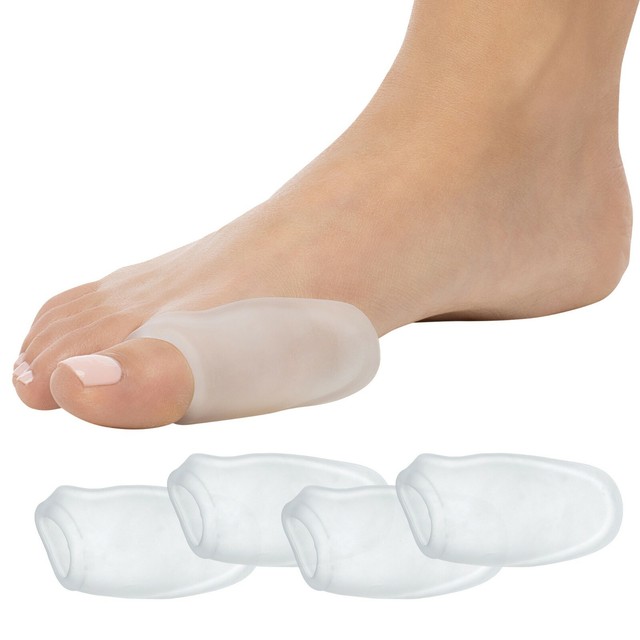
Bunion gel sleeves and toe spacers
Thin gel sleeves that sit over the joint and spread pressure across a wider area. They are a genuine help for mild cases and for skaters mid-break-in, and they cost very little. Be aware of the trade-off: anything you add inside the boot also takes up volume, so in an already tight boot a sleeve can make the pressure worse rather than better.
- Thin silicone gel sleeve over the joint
- Spreads rather than removes pressure
- Washable and reusable
- Toe spacer variants for alignment
- Very cheap and immediately available
- Useful during break-in
- No modification to the boot required
- Adds volume — can worsen a tight boot
- Manages symptoms rather than fixing fit
- Wears out and needs replacing
Heat-mouldable custom footbeds
A supportive footbed changes how your foot sits in the boot, and for bunions caused or worsened by the foot rolling inward, controlling that motion reduces the pressure on the joint directly. Moulded footbeds are standard practice in good skate shops and are frequently the difference between tolerable and comfortable.
- Heat moulded to your foot in-store
- Controls pronation that aggravates the joint
- Replaces the thin stock insole
- Transferable between boots in some cases
- Addresses a root cause rather than the symptom
- Improves fit and power transfer generally
- Lasts across several seasons
- Adds volume — may need the boot punched anyway
- Costs meaningfully more than a stock insole
- Needs fitting properly to be worth it
Buying tips
- If there is no room over the joint, walk away. Skate boots are designed to hold the foot rigidly. A boot that presses on day one will press forever — this is the one rule that overrides every other consideration.
- Ask for a spot punch. A fitter can push a pocket out exactly where the bunion sits in about ten minutes. It is cheap, often free with a purchase, and it is the single most effective thing on this page.
- Know the fit lines before you shop hockey skates. Bauer Vapor is narrow and Supreme Fit 3 is wide; CCM Jetspeed is tapered and Tacks is traditional. Buying the wrong line is the most common and most expensive mistake here.
- Get fitted late in the day, when your feet have swollen slightly. A boot fitted first thing in the morning is a boot that hurts by evening.
- Wear the socks you actually skate in — thin ones. Thick socks make a boot feel comfortable in the shop and cause slipping and pressure on the ice.
- Remember that anything added inside the boot takes up volume. A gel sleeve or a thicker footbed can worsen a tight forefoot even while it cushions the joint.
- Buy from a shop with a fitting service and a returns policy. Fit at this level is individual, and ordering online without trying the last is how people end up with expensive boots they cannot wear.
As an Amazon Associate and eBay Partner, toptenpick.com earns from qualifying purchases. Prices and availability are subject to change.