

As an Amazon Associate and eBay Partner, toptenpick.com earns from qualifying purchases. Prices and availability are subject to change.
Hose-end sprayers are sold with a stated reach — 25 feet, 30 feet, sometimes more. Those numbers are real and they are also nearly useless for tree work, for a reason worth understanding before you spend anything.
A hose-end sprayer’s reach is set by your water pressure, and it produces a coarse stream rather than a fine spray at the top of its range. The two requirements pull apart: to go high you need a solid, heavy jet, and to actually coat the underside of leaves you need a fine, well-distributed mist. At 25 feet you are getting the jet, not the mist, and most of it runs straight off the foliage and onto the ground. The manufacturer’s number describes where water lands, not where treatment works.
There is a second problem that is genuinely the deciding factor: drift. Spraying anything upwards into a tree means it comes back down, onto you, onto neighbouring plants, and onto whatever is downwind. Even a light breeze moves a fine spray a long way at height. This is why the most effective tree treatments are frequently not sprays at all — soil drenches applied around the root zone are taken up by the tree and distributed through the whole canopy, including the parts no sprayer will ever reach, with no drift at all.
The third thing to know is about dilution. A hose-end sprayer works by siphoning concentrate into the water stream at a ratio, and that ratio varies with your water pressure, so the same setting gives a different mix at different times of day and on different properties. For anything where concentration matters, mixing in a tank sprayer gives you a dose you actually know.
And one that applies to every product here: read the label, and treat it as binding. On any pesticide the label is a legal document specifying what may be treated, at what rate, and what protective equipment is required. Ten picks below, sprayers and the alternatives that often work better.
| # | Product | Price | Where to buy |
|---|---|---|---|
| 1 | High-Reach Hose-End Sprayer with an Adjustable Nozzle | $20-$50 | Amazon · eBay |
| 2 | Hose-End Sprayer with a Separate Concentrate Jar | $25-$60 | Amazon · eBay |
| 3 | Extendable Spray Wand | $25-$80 | Amazon · eBay |
| 4 | Backpack Sprayer with a Wand | $60-$180 | Amazon · eBay |
| 5 | Battery-Powered Backpack Sprayer | $120-$300 | Amazon · eBay |
| 6 | Soil Drench Applicator | $25-$80 | Amazon |
| 7 | Hose Splitter, Quick Connects and a Pressure Gauge | $20-$50 | Amazon |
| 8 | Chemical-Resistant Gloves and Eye Protection | $25-$80 | Amazon |
| 9 | Pump Sprayer for Accurate Mixing | $20-$60 | Amazon · eBay |
| 10 | Sprayer Cleaning and Neutralising Kit | $15-$40 | Amazon |
The picks, in detail

High-Reach Hose-End Sprayer with an Adjustable Nozzle
The straightforward answer for moderate heights. A hose-end sprayer with an adjustable nozzle lets you trade between a tight, far-reaching jet and a wider fan, which is the only control you have over the reach-versus-coverage problem. Look for a metal or reinforced nozzle rather than plain plastic, a dial with clearly marked dilution ratios, and a deflector for spraying upwards. Realistically expect useful coverage somewhat below the stated maximum reach.
- Adjustable jet-to-fan nozzle
- Marked dilution ratio dial
- Deflector for upward spraying
- Standard hose thread connection
- Lets you trade reach against coverage
- No mixing or pumping required
- Covers a large area quickly
- Useful coverage falls well short of the stated reach
- Dilution ratio varies with your water pressure

Hose-End Sprayer with a Separate Concentrate Jar
The refillable version, and much more useful than the single-product bottles sold pre-filled. A sprayer with its own jar lets you use whatever concentrate you need, mix at the ratio you choose, and see how much is left. The important features are a jar that seals properly — leaks run down your arm — and a ratio dial with real numbers rather than vague settings. Rinse the jar and the siphon tube thoroughly between different products.
- Refillable concentrate jar
- Multiple dilution ratio settings
- Sealed jar lid
- Siphon tube reaching the jar base
- Use any concentrate rather than one product
- Visible level so you know when it runs out
- Cheaper per application than pre-filled bottles
- Must be rinsed thoroughly between products
- Cheap jar seals leak down your arm

Extendable Spray Wand
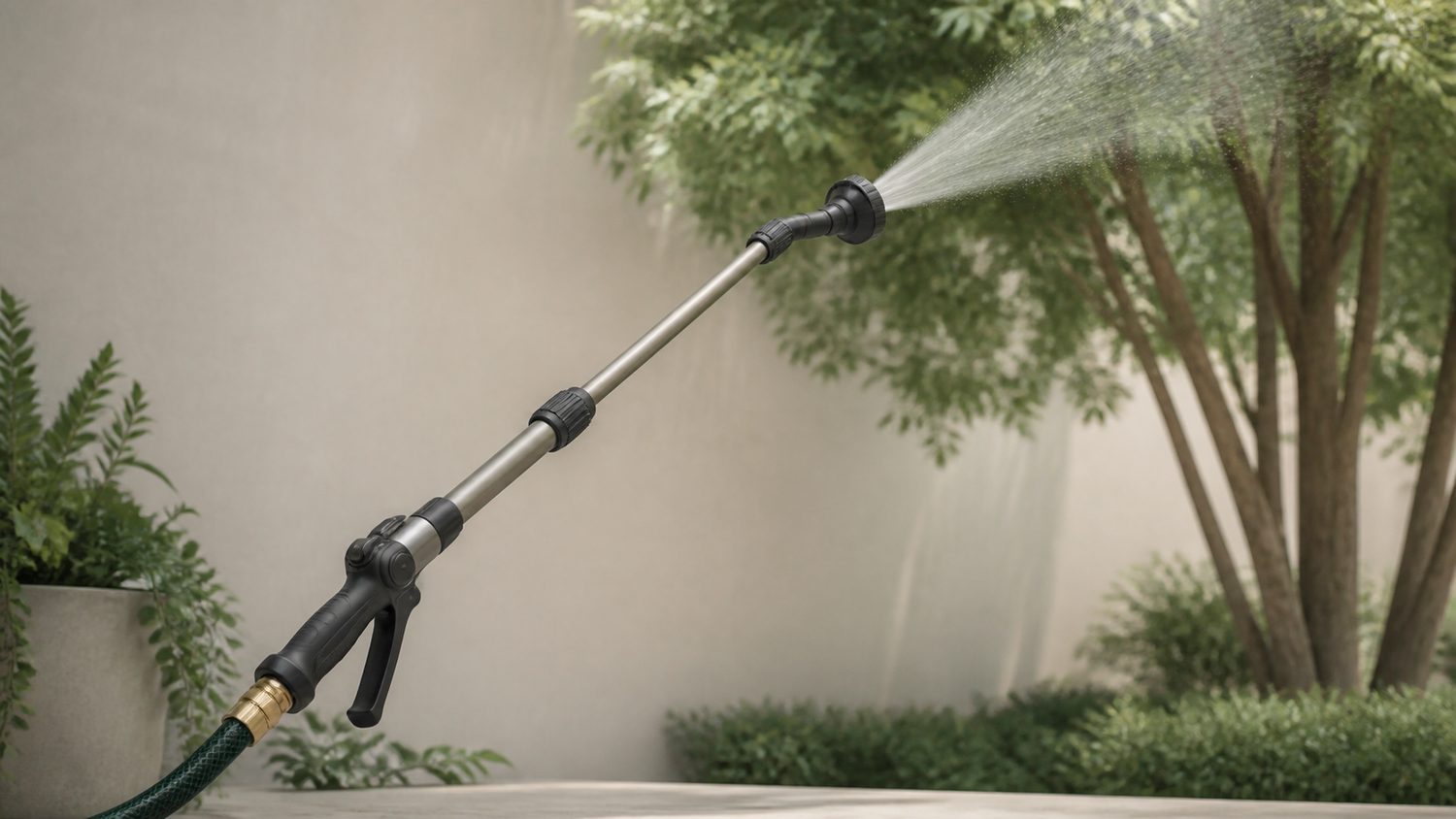
The mechanical way to get higher, and frequently the better one. An extending wand adds four to twelve feet of physical reach, which means the nozzle is closer to the target and you can use a fine spray rather than a jet — solving the reach-versus-coverage tension rather than trading within it. It also aims far more precisely, which reduces drift onto everything nearby. The cost is weight and awkwardness: a long wand full of water is heavy at arm’s length.
- Telescoping wand, typically 4 to 12 ft
- Locking collar
- Angled or swivel head
- Fits hose-end or tank sprayers
- Fine spray at height instead of a coarse jet
- Far more precise aiming, so less drift
- Works with a tank sprayer too
- Heavy and awkward when full and extended
- Locking collars slip when wet

Backpack Sprayer with a Wand
The step up in control. A backpack sprayer holds mixed solution at a pressure you set with a hand pump, which means the concentration is exactly what you mixed — not whatever your water pressure produced — and the spray quality is consistent from the first minute to the last. Combined with an extension wand it handles small and medium trees properly. Four gallons of liquid is heavy on your back, which is the honest limitation, but the control is in a different class.
- 3-4 gallon tank worn on the back
- Manual pressure pump
- Wand with interchangeable nozzles
- Padded straps and hip belt on better models
- You know exactly what concentration you applied
- Consistent spray quality throughout
- Takes an extension wand for height
- Four gallons is genuinely heavy
- Needs pumping periodically as you work

Battery-Powered Backpack Sprayer
The same thing without the pumping, and for anything more than a small garden it is worth the money. A battery pump maintains constant pressure, which means a genuinely consistent spray pattern rather than one that degrades between pump strokes — and consistent pressure is what produces the fine, even mist that actually coats foliage. It also removes the fatigue that makes people rush the last tree. Check the run time against the tank capacity; a good unit empties several tanks per charge.
- Battery pump maintaining constant pressure
- 3-4 gallon tank
- Adjustable pressure on better models
- Several tanks per charge
- Constant pressure gives a genuinely even spray
- No pumping, so no fatigue on a long job
- Adjustable pressure suits different nozzles
- Heavier than a manual sprayer
- Battery to charge and eventually replace
Soil Drench Applicator
Often the right answer for a tall tree, and the one this article keeps pointing at. A systemic treatment applied to the soil around the root zone is taken up by the tree and carried throughout the canopy — including the top, the interior and the undersides of leaves, none of which any sprayer reaches properly. There is no drift, no spray equipment, and no ladder. Timing matters, since uptake depends on the tree actively moving water, and the label will tell you when. Follow it exactly.
- Measured application around the root zone
- Systemic uptake through the tree
- No spray equipment or drift
- Measuring container and mixing instructions
- Reaches the whole canopy, which no sprayer does
- Zero drift onto people, pets or neighbouring plants
- No ladder and no height risk
- Timing is critical and label-specific
- Not appropriate near water or for every situation — read the label
Hose Splitter, Quick Connects and a Pressure Gauge
The plumbing that makes a hose-end sprayer predictable. A pressure gauge on the tap tells you what you are actually working with, which matters because the sprayer’s dilution ratio and its reach both depend on it — and mains pressure varies by time of day and by property. Quick connects let you swap between sprayer and plain nozzle without unscrewing anything wet. A splitter means you can leave the sprayer connected between jobs rather than fighting the threads each time.
- In-line pressure gauge
- Quick-connect fittings
- Two-way tap splitter with individual valves
- Standard hose threads
- Gauge explains why reach and dilution vary
- Quick connects save fighting wet threads
- Splitter keeps the sprayer permanently connected
- Every extra fitting is a potential leak
- Cheap quick connects lose pressure
Chemical-Resistant Gloves and Eye Protection
Not optional, and particularly not when spraying upwards. Anything you send into a tree comes back down, and it comes down onto your face, arms and head — which is the exposure route the label’s protective equipment requirement exists for. Chemical-resistant gloves, sealed goggles rather than glasses, and long sleeves are the minimum for most garden chemicals. Check the specific label: some require more, and the label is a legal specification rather than a suggestion.
- Nitrile or chemical-resistant gauntlets
- Sealed goggles rather than open glasses
- Long-sleeved coverall or overshirt
- Respirator where the label requires one
- Directly addresses the exposure upward spraying creates
- Sealed goggles stop drift reaching the eyes
- Cheap relative to the risk
- Hot and uncomfortable in summer
- Requirements vary by product — read each label

Pump Sprayer for Accurate Mixing
The small hand-pumped tank sprayer, and worth owning alongside anything else because it solves the dilution problem completely. You mix a known quantity of concentrate into a known quantity of water and you know exactly what you applied — which a hose-end sprayer cannot give you, since its siphon ratio moves with your water pressure. For spot treatment, for anything where the rate genuinely matters, and for small trees, this is the accurate tool.
- 1-2 gallon hand-pumped tank
- Adjustable cone nozzle
- Pressure relief valve
- Translucent tank with volume markings
- You know the exact concentration applied
- Accurate for spot treatment
- Cheap and simple
- Limited capacity for a large tree
- Needs re-pumping frequently
Sprayer Cleaning and Neutralising Kit
The step that prevents an expensive accident. Residue left in a sprayer from a herbicide will damage or kill whatever you spray with that equipment next, and the residue survives a casual rinse — it clings inside hoses, in the siphon tube and in the nozzle. A proper tank cleaner neutralises it. The safer discipline on top of that is to keep entirely separate, clearly labelled sprayers for herbicides and for everything else, and never to swap them.
- Tank and line cleaner concentrate
- Neutralises herbicide residue
- Nozzle cleaning brushes
- Labels for dedicating equipment
- Prevents herbicide residue damaging other plants
- Cleans the lines and nozzle, not just the tank
- Cheap relative to a killed hedge
- A casual rinse is genuinely not enough
- Separate dedicated sprayers are safer still
Buying tips
- The stated reach is where water lands, not where treatment works. Reaching 25 feet requires a coarse jet, and a coarse jet runs off foliage instead of coating it. Expect useful coverage well below the maximum figure, and judge a sprayer on whether it can produce a fine spray at a useful height rather than on its headline number.
- Consider a soil drench instead of spraying. A systemic treatment applied at the root zone is carried through the whole canopy — including the top, the interior and the undersides of leaves, which no sprayer reaches properly — with no drift and no ladder. For a genuinely tall tree this is very often the more effective approach, and the label will specify the timing.
- Hose-end dilution changes with your water pressure. The sprayer siphons concentrate into the stream at a ratio that depends on flow, so the same dial setting gives a different mix at different times of day and on different properties. Where the rate genuinely matters, mix in a tank sprayer so you know what you applied.
- Never spray upwards in any breeze. Everything you send into a tree comes back down, and even a light wind carries a fine spray a long way at height — onto you, onto neighbouring plants, and onto whatever is downwind. Early morning or evening, when the air is still, and stop if it picks up.
- An extension wand beats a longer-reaching sprayer. Getting the nozzle physically closer to the target lets you use a fine spray instead of a jet, aims far more precisely, and reduces drift substantially. It solves the reach-versus-coverage tension rather than trading within it, and it works with a tank sprayer as well as a hose-end.
- Read the label and treat it as binding. On a pesticide the label is a legal document specifying what may be treated, at what rate, at what time of year, and what protective equipment is required. It is not marketing copy and it is not advisory. Where it requires a respirator or specific gloves, that requirement is the law.
- Keep separate sprayers for herbicides. Residue survives a casual rinse and clings inside hoses, siphon tubes and nozzles, and the next thing you spray with that equipment will show it. Dedicated, clearly labelled sprayers are the reliable answer; a tank cleaner is the fallback when you have no choice.
- Know when to call an arborist. A tree tall enough that you cannot reach its canopy from the ground is a tree where diagnosis, timing and dose all matter and where the consequences of getting it wrong are a mature tree. A professional has equipment and licences you do not, and the visit often costs less than the second round of products you would otherwise buy.
As an Amazon Associate and eBay Partner, toptenpick.com earns from qualifying purchases. Prices and availability are subject to change.