

As an Amazon Associate and eBay Partner, toptenpick.com earns from qualifying purchases. Prices and availability are subject to change.
The Horus Heresy is over fifty numbered novels published between 2006 and 2019, plus anthologies, novellas, audio dramas and a separate nine-book finale. It is one of the longest continuous series in genre fiction, and reading it in publication order is the single most reliable way to stop reading it.
The reason is structural rather than a matter of taste. The series was written by many different authors with no single showrunner, and it does not tell one story front to back — it tells a central story interleaved with a large number of side stories about other Legions, other characters and other theatres, some of which are excellent and some of which have very little to do with anything. Published order puts those in the sequence they were commissioned, not the sequence that makes narrative sense. So a reader who starts at book one and works forward hits a wall somewhere in the teens, usually without understanding why they have lost interest, and concludes the series is not for them.
What works is a curated path. Start with Horus Rising and False Gods — the opening that establishes the fall, and the two books essentially everyone agrees on — then follow the central thread and read the side material only where it is genuinely good or genuinely necessary. Several well-maintained reading orders exist online and they broadly agree with each other. Following one is the difference between finishing and stalling.
Two more things worth knowing before you spend.
Siege of Terra is a separate, self-contained arc — the final act, rebooted under its own numbering — and unlike the main series it must be read in order, because it is one continuous battle told across consecutive books. There is no dipping in.
And quality genuinely varies. Abnett, McNeill and Dembski-Bowden are the names most consistently recommended, and a series this long written by this many hands is not uniform. That is not snobbery; it is the practical reason a curated path exists at all.
Ten picks below.
| # | Product | Price | Where to buy |
|---|---|---|---|
| 1 | Horus Rising (Book 1) | $10-$20 | Amazon · eBay |
| 2 | False Gods (Book 2) | $10-$20 | Amazon · eBay |
| 3 | Galaxy in Flames (Book 3) | $10-$20 | Amazon · eBay |
| 4 | Horus Heresy Opening Trilogy Omnibus | $18-$35 | Amazon · eBay |
| 5 | A Thousand Sons | $10-$20 | Amazon · eBay |
| 6 | Prospero Burns | $10-$20 | Amazon · eBay |
| 7 | The Solar War (Siege of Terra, Book 1) | $12-$25 | Amazon · eBay |
| 8 | Saturnine (Siege of Terra, Book 4) | $12-$25 | Amazon · eBay |
| 9 | Audiobook Editions | $15-$30 each | Amazon · eBay |
| 10 | Horus Heresy Ebook Bundles | $25-$70 per bundle | Amazon · eBay |
The picks, in detail
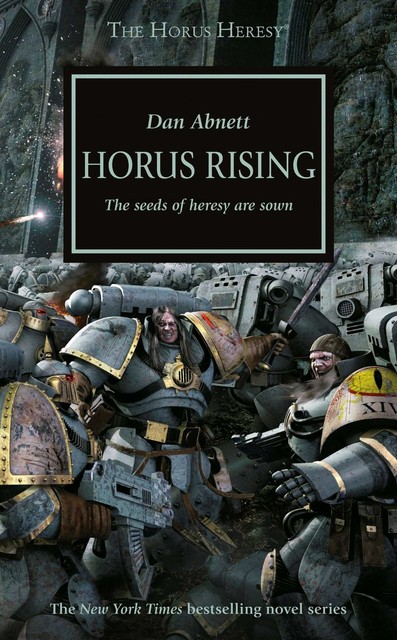
Horus Rising (Book 1)
The starting point, and there is no argument about this one. It opens with the Imperium at its height and Horus newly raised to Warmaster, and its real achievement is making you like these people before anything goes wrong — which is what gives the fall its weight. Abnett writes the Astartes as characters rather than as armour, and the book works as a novel for someone who has never encountered Warhammer 40,000 at all. If you read one and stop, you will still have read a good book.
- Book 1 of the Horus Heresy
- Dan Abnett
- Establishes Horus, the Luna Wolves and the setting
- Available in paperback, ebook and audiobook
- Universally recommended as the entry point
- Works as a standalone novel
- No prior Warhammer knowledge required
- The pace is deliberate — it is setup
- You will want book two immediately
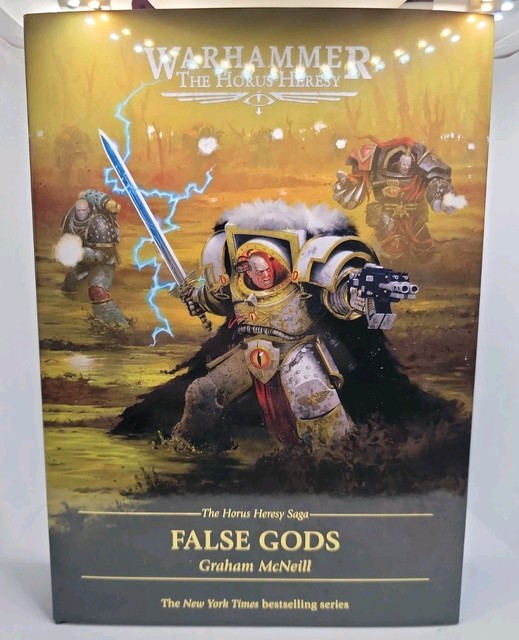
False Gods (Book 2)
The other half of the opening, and effectively inseparable from the first. This is where the fall actually happens — the mechanism by which Horus turns, which is the hinge the entire fifty-book series swings on. Read it immediately after Horus Rising and treat the pair as one purchase. Between them they give you everything you need to follow the central thread, and they are the two books every recommended reading order starts with regardless of what it does afterwards.
- Book 2 of the Horus Heresy
- Graham McNeill
- Covers the fall of Horus
- Direct continuation of Horus Rising
- The pivotal event of the entire series
- Reads as one book with Horus Rising
- Every reading order includes it
- Meaningless without book one
- A change of author from the opening
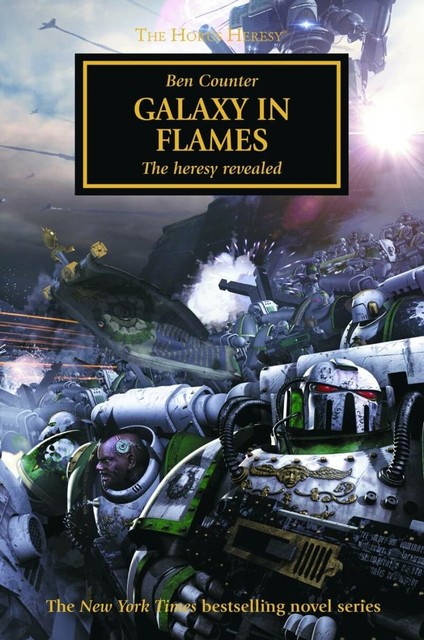
Galaxy in Flames (Book 3)
The third of the opening trilogy, and the point at which the series stops being setup. These three were written to be read together and they close out the opening movement — after this the series fans out into its many threads, which is exactly where a publication-order reader starts to struggle. Buy the opening three as a unit, read them, and then decide whether you want the full commitment. Three books is a fair test of whether the series is for you.
- Book 3 of the Horus Heresy
- Ben Counter
- Completes the opening trilogy
- Often sold as an omnibus with books 1 and 2
- Completes a satisfying opening arc
- A fair three-book test of the series
- Frequently available as an omnibus
- Third author in three books, and the voice shifts
- The series structure changes sharply after it

Horus Heresy Opening Trilogy Omnibus
The economical way to buy the entry point, and the right first purchase for most people. The first three books collected in one volume costs considerably less than three paperbacks and gives you the complete opening arc in one object. It is also the honest test: if you finish the omnibus and want more, you are in, and if you do not, you have spent one book’s worth of money rather than three. Check which books a given omnibus actually contains, since several different collections exist.
- Books 1 to 3 in one volume
- Cheaper than three paperbacks
- Complete opening arc
- Several omnibus editions exist
- Much cheaper per book
- The complete opening in one purchase
- A fair test of the whole series
- Heavy and awkward to read in bed
- Different omnibuses collect different books — check

A Thousand Sons
The book most often named when people are asked for the best in the series, and the strongest argument for a curated path rather than publication order. It tells the destruction of the Thousand Sons Legion from their own side, and it makes a tragedy out of what the setting had previously treated as a footnote. It also pairs with Prospero Burns, which tells the same events from the opposing Legion’s perspective — the two together are one of the series’ genuine achievements.
- Graham McNeill
- The Thousand Sons Legion’s destruction
- Pairs with Prospero Burns
- Frequently named the best in the series
- Consistently the highest-rated entry
- Works with only the opening trilogy behind it
- The paired-perspective structure is genuinely clever
- Much better read alongside Prospero Burns
- Deep in the numbering despite being an early recommendation

Prospero Burns
The companion volume, and it is genuinely a different book rather than the same story retold. Abnett tells the Space Wolves’ side through an outsider’s eyes, and the structural choice — a human remembrancer rather than an Astartes viewpoint — makes it read very differently from its pair. Read it directly after A Thousand Sons; the order matters, because the second book recontextualises the first. Together they are the answer to anyone asking whether the series justifies its length.
- Dan Abnett
- The Space Wolves’ perspective on the same events
- Human outsider viewpoint
- Read immediately after A Thousand Sons
- Recontextualises its companion volume
- Distinctly different in voice and structure
- Widely considered among Abnett’s best in the setting
- Loses most of its effect read out of order
- The outsider viewpoint frustrates some readers
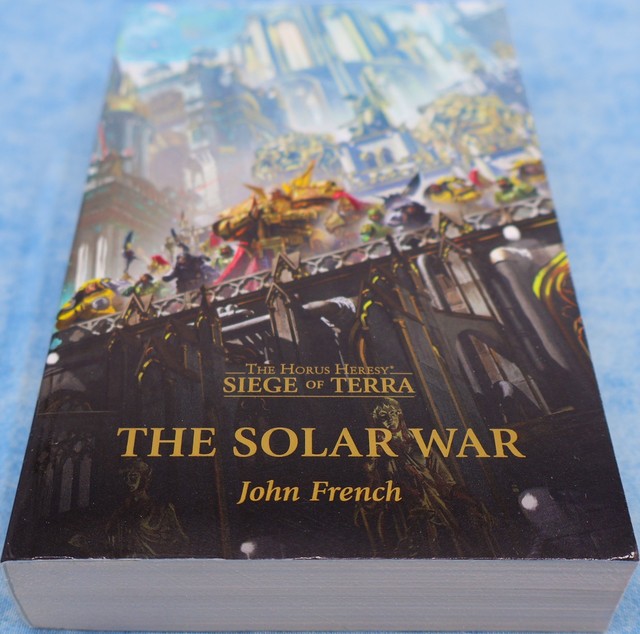
The Solar War (Siege of Terra, Book 1)
The start of the finale, and the point at which the reading-order question changes completely. Siege of Terra is a separate nine-book arc telling one continuous battle, and unlike the main series it must be read strictly in order — there is no dipping in and no skipping. The Solar War is where it begins. Do not start here: it assumes the main series, and reading the finale first is the one ordering mistake that genuinely spoils things.
- Book 1 of Siege of Terra
- John French
- Separate numbering from the main series
- Must be read in sequence
- The beginning of the payoff the series builds to
- Tighter and more focused than the main run
- Clear, unambiguous reading order
- Assumes the main series — not a starting point
- Commits you to eight further books
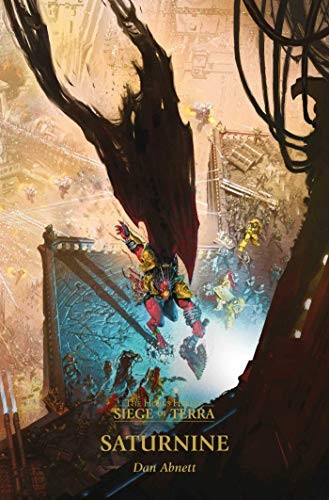
Saturnine (Siege of Terra, Book 4)
Widely described as the book the whole siege was building towards, and the one that most often converts a reader who was flagging. Abnett brings the accumulated characters and the scale together in a way the preceding books set up but do not deliver. It is not a starting point and it is a good reason to keep going through the earlier siege books if you are wavering. Note the novellas: Fury of Magnus is generally read before it.
- Book 4 of Siege of Terra
- Dan Abnett
- Widely regarded as the high point of the arc
- Read Fury of Magnus first
- The payoff the preceding siege books set up
- Abnett at his best in the setting
- Converts readers who were flagging
- Requires the three siege books before it
- Novella ordering around it is easy to get wrong
Audiobook Editions
Worth serious consideration for a series this long, and Black Library’s productions are unusually good — full-cast audio dramas as well as straight narration, with narrators who have become associated with particular characters. Fifty-plus books is a lot of reading time and very little of it has to be sitting down. The caution is the reverse of the usual one: the audio dramas are separate works rather than readings of the novels, so check which you are buying if you are following a reading order.
- Narrated novels and full-cast audio dramas
- Consistent narrators across the series
- Available through major audiobook platforms
- Audio-exclusive stories exist
- Makes a fifty-book series fit into a commute
- Production quality is genuinely high
- Consistent narration builds character familiarity
- Audio dramas are separate works, not readings of the novels
- Some stories are audio-exclusive and hard to slot into an order

Horus Heresy Ebook Bundles
The practical way to own a series this size. Fifty-plus paperbacks is a shelf problem as well as a cost problem, and Black Library regularly bundles multiple volumes at a substantial discount over individual ebooks. Buying in bundles also removes the small friction of choosing the next book each time, which sounds trivial and is one of the reasons long series get abandoned. Check what a bundle contains against your reading order before buying, since bundles are grouped by publication rather than by narrative.
- Multiple volumes at a discount
- No shelf space required
- Grouped by publication order
- Regular promotional pricing
- Far cheaper per book than paperbacks
- Removes the friction of choosing the next book
- No storage problem for a fifty-book series
- Bundles group by publication, not by reading order
- You will own books a curated path tells you to skip
Buying tips
- Do not read in publication order. The series interleaves a central story with a large number of side stories, sequenced as they were commissioned rather than as they read. Starting at book one and working forward is how people hit a wall in the teens and conclude the series is not for them. Follow one of the well-maintained reading orders instead.
- Start with the opening trilogy and treat it as one purchase. Horus Rising, False Gods and Galaxy in Flames were written to be read together, they establish everything the rest depends on, and the omnibus costs about the same as one and a half paperbacks. Finishing it is a fair test of whether you want the other fifty.
- Siege of Terra is different and must be read in order. It is a separate nine-book arc telling one continuous battle, with its own numbering. Unlike the main series there is no skipping and no dipping in — and it assumes everything before it, so starting there spoils the thing it exists to pay off.
- Quality genuinely varies, and that is why curated paths exist. Fifty-plus books by many authors with no single showrunner is not a uniform product. Abnett, McNeill and Dembski-Bowden are the names most consistently recommended. Skipping the weaker entries is not missing out, it is how people finish.
- Read A Thousand Sons and Prospero Burns as a pair, in that order. They tell the same events from opposing Legions, and the second recontextualises the first. Read alone or reversed, most of the effect is lost. Together they are the strongest argument that the series justifies its length.
- Mind the novellas around the siege books. Several short works slot at specific points — Sons of the Selenar before The Last Wall, Fury of Magnus before Saturnine, Garro before Warhawk. They are easy to miss because they are not in the main numbering, and reading them late costs you setup the novels assume.
- Consider audio for the bulk of it. Fifty books is an enormous amount of sitting-down time, and Black Library’s productions are strong. Check what you are buying though — the full-cast audio dramas are separate works rather than readings of the novels, and slotting audio-exclusive stories into a reading order takes a little care.
- Buy the first three before committing to bundles. Ebook bundles are much cheaper per book and they group by publication order, which means you will own books your reading order tells you to skip. That is fine once you know you are staying — it is a poor first purchase if you are still finding out.
As an Amazon Associate and eBay Partner, toptenpick.com earns from qualifying purchases. Prices and availability are subject to change.