

As an Amazon Associate and eBay Partner, toptenpick.com earns from qualifying purchases. Prices and availability are subject to change.
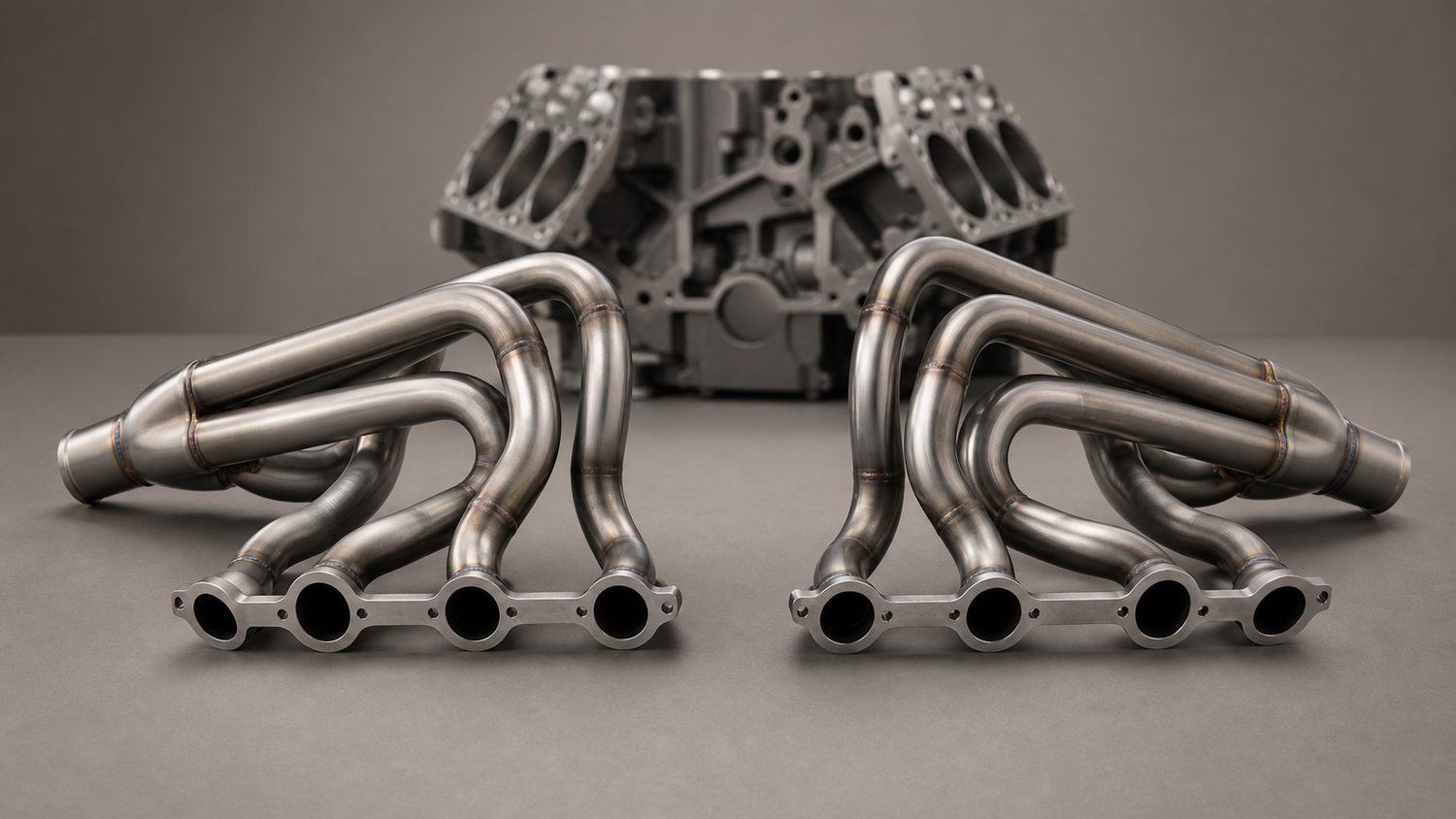
In a V8 S10 the header is not chosen for flow. It is chosen for what it clears. The engine bay was designed around a four-cylinder or a 4.3 V6, and dropping a small block into it leaves very little room on either side. The steering shaft on the driver’s side is the notorious obstruction — it runs diagonally straight through the space a long-tube primary wants to occupy — and on the other side the starter, the oil filter housing and the frame rail all compete for the same air. Plenty of people have bought headers on a dyno graph and then spent a weekend discovering the graph is irrelevant if the tube touches the steering shaft.
So the real decision is a shape, and there are four of them. Block huggers wrap tight against the head and are the easiest fit by a wide margin, at the cost of flow and, notoriously, of cooking the spark plug boots. Shorty headers are slightly longer and a common compromise. Mid-length headers gain real flow while staying within the frame rails on many swap combinations. Full-length long tubes flow best and are the hardest to fit — and on a lowered truck they hang low enough to be the first thing that meets a speed bump.
The second thing that decides fitment is not the header at all: it is the mounts. Swap mount kits from different manufacturers place the engine at different heights and set it forward or back by an inch or so, and that inch is exactly the tolerance a header is working within. A header that fits perfectly on one mount kit fouls on another. Pick the mounts first, then buy headers listed for that combination — and when asking for advice, say which mounts you used, because otherwise the answer is meaningless.
Two details that come up constantly and cost real money. The steering shaft clearance problem is usually solved with a header specifically designed around it or with a borgeson-style replacement shaft, and you should decide which before buying. And plug access: on a tight install with block huggers you may not be able to get a socket on a plug without lifting the engine, which turns a twenty-minute service into a day.
On coatings: ceramic costs more and is worth it here for a reason specific to this swap — a cramped bay with headers close to the steering shaft, the starter and the plug wires is a heat-soak problem, and a ceramic coating keeps that heat in the pipe rather than radiating it into everything around it.
| # | Product | Price | Where to buy |
|---|---|---|---|
| 1 | Block Hugger Headers, Small Block Chevy | $180–$350 | Amazon · eBay |
| 2 | Shorty Headers, Small Block Chevy | $200–$400 | Amazon · eBay |
| 3 | Swap-Specific S10 V8 Headers | $400–$800 | Amazon · eBay |
| 4 | Mid-Length Headers | $350–$700 | Amazon · eBay |
| 5 | Long Tube Headers | $500–$1,000 | Amazon · eBay |
| 6 | Borgeson-Style Steering Shaft | $200–$450 | Amazon |
| 7 | Ceramic-Coated Header Set | $450–$900 | Amazon · eBay |
| 8 | Header Wrap | $30–$70 | Amazon · eBay |
| 9 | Header Bolts and Gaskets | $25–$60 | Amazon · eBay |
| 10 | Generic Headers Bought on a Dyno Graph | $150–$400 | Amazon |
The picks, in detail

Block Hugger Headers, Small Block Chevy
The easiest fit in a tight bay and the reason they exist. Primaries wrap tightly around the head and dive straight down, so they clear the steering shaft, the frame rails and most engine mount variations without drama. Flow is the worst of any header here and the tubes sit close to the plugs, which cooks boots. For a mild swap where the goal is a running truck, this is the pragmatic answer.
- Tight-radius primaries hugging the head
- Shortest overall length
- Widest mount and chassis compatibility
- Painted or ceramic coated
- Fits where nothing else will
- Cheapest and quickest to install
- Tolerant of different swap mount kits
- Worst flow of any header type
- Tubes run close to plugs and cook boots
- Plug access can be genuinely awkward
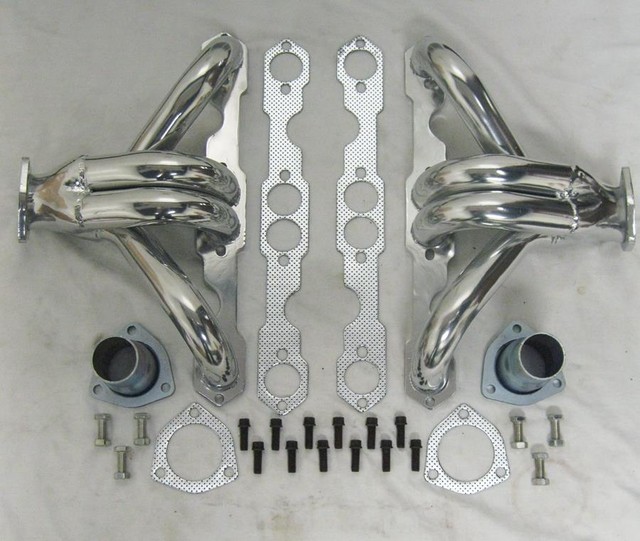
Shorty Headers, Small Block Chevy
The sensible middle ground and the most common choice for a street S10 swap. Longer primaries than a block hugger gives noticeably better flow, while the overall package still stays within the frame rails and clears most steering shafts. It is the header most swap kits are designed around, which means listings are more likely to be honest about fitment.
- Short primaries collecting near the block
- Fits within the frame rails
- Broad aftermarket availability
- Ceramic coated options
- Better flow than block huggers with similar fitment ease
- Most documented option for this swap
- Good ground clearance
- Still well short of long-tube flow
- Clearance depends on which swap mounts you used
- Cheaper sets have poor flange flatness

Swap-Specific S10 V8 Headers
Headers designed and sold for this exact conversion, usually by the same people who make the mount kits. They are built around the known obstructions — the steering shaft in particular — rather than adapted to them, which removes most of the guesswork. Buy the mounts and the headers from the same source if you can; it is the single biggest reduction in fitting risk available.
- Designed around the S10 V8 swap specifically
- Routed to clear the steering shaft
- Often sold alongside matching mount kits
- Mid-length or shorty geometry
- Engineered around the actual obstructions
- Matching mounts remove the compatibility question
- Better flow than block huggers
- Tied to a particular mount kit
- Small-volume manufacturing means longer lead times
- Costs more than generic headers

Mid-Length Headers
The best flow you can generally fit without fabricating. Primaries run further before collecting, which is where the real gains over a shorty live, and the collectors still sit inboard of the frame rails on many combinations. Whether they fit depends entirely on engine placement, so this is the category where checking against your specific mount kit matters most.
- Longer primaries than a shorty
- Collectors typically inside the frame rails
- Better scavenging than short designs
- Available coated
- Meaningful flow gain over shorty headers
- Usually clears the frame without modification
- Good compromise for a street truck
- Fitment is mount-kit dependent — verify before ordering
- Less ground clearance than shorties
- May require steering shaft attention

Long Tube Headers
The flow answer and the fitment problem. Equal-length long primaries scavenge properly and make the power the dyno graphs promise, and in an S10 bay they are the hardest thing on this list to install — steering shaft, frame rails and ground clearance all fight you, and a lowered truck will meet the collectors on the first speed bump. Worth it on a build with a clear performance goal and a fabricator on hand.
- Long equal-length primaries
- Best scavenging and peak power
- Collectors hang below the frame rails
- Ceramic coating strongly advised
- Genuinely the best performing option
- Proper scavenging across the rev range
- The right choice for a serious build
- Hardest fit in this chassis by a wide margin
- Poor ground clearance, worse on a lowered truck
- Frequently needs steering shaft modification
Borgeson-Style Steering Shaft
The component that turns a clearance problem into a solved one. The stock steering shaft runs right through where a good header wants to be, and a replacement shaft with a different joint arrangement routes around the header rather than through it. Deciding between a header that dodges the shaft and a shaft that dodges the header is the central choice in this swap, and this is the second option.
- Replacement steering shaft with revised joint geometry
- Routes clear of header primaries
- Usually includes U-joints and a support bearing
- Vehicle-specific and universal versions
- Opens up header options that otherwise will not fit
- Often improves steering feel over a worn stock shaft
- Permanent solution rather than a compromise
- A significant extra cost on top of the headers
- Steering components warrant careful, correct installation
- Universal kits need measuring and cutting
Ceramic-Coated Header Set
Not a different shape but a different finish, and in this swap it earns its price. A cramped engine bay with headers inches from the steering shaft, the starter solenoid and the plug wires is a heat-soak problem, and ceramic coating keeps radiant heat in the pipe. It also stops the headers rusting to orange within a winter, which plain painted headers reliably do.
- Ceramic thermal barrier coating inside and out
- Substantially reduced radiant heat
- Corrosion resistant
- Available on most header styles
- Directly addresses the heat-soak problem of a tight bay
- Protects the starter solenoid and plug wires
- Does not rust like painted headers
- Adds significantly to the price
- Coating chips if the headers are removed and refitted often
- Cheap coatings burn off within a season

Header Wrap
The cheap version of the same idea, and worth knowing the trade-off before wrapping. Wrap keeps heat in the pipe very effectively, which is exactly what you want in a cramped bay. It also holds moisture against the steel and raises the pipe’s own temperature, which shortens header life — noticeably on cheap thin-wall tubing. Fine on a coated header, harder to justify on a bare one you want to keep.
- Fibreglass or basalt fibre tape
- Stainless locking ties supplied
- Rated to high continuous temperature
- Cheap and easy to fit
- Very cheap way to cut radiant heat
- Basalt handles heat better than fibreglass
- Fits any header
- Traps moisture and accelerates corrosion
- Raises pipe temperature and shortens header life
- Smokes for the first several heat cycles
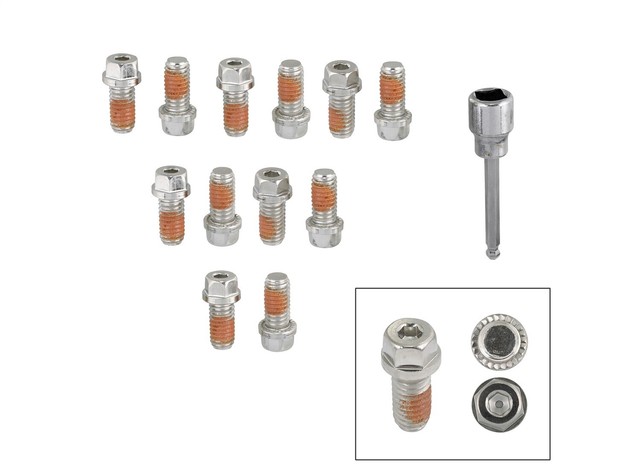
Header Bolts and Gaskets
The small parts that decide whether the job stays done. Header bolts back out as the flange heats and cools, so a set with locking washers or a thread-locking compound matters, and a proper multi-layer steel or composite gasket handles the movement a header flange makes. Buying a header and reusing old bolts and a paper gasket is how a leak appears three weeks later in a place you cannot reach.
- Header-specific bolts with locking hardware
- Multi-layer steel or composite gaskets
- Sometimes includes collector gaskets
- Stainless options available
- Prevents the loosening that causes late leaks
- Proper gaskets survive thermal cycling
- Cheap relative to redoing the job
- Easy to overtighten and warp a thin flange
- Stainless bolts gall without anti-seize
- Access on a tight swap makes retorquing awkward
Generic Headers Bought on a Dyno Graph
Named because it is the mistake this article exists to prevent. A set of headers advertised with a power figure and a flattering photograph, with no reference to the S10 chassis or to any particular swap mount kit, is a coin flip. The graph was measured on an engine stand or in a different vehicle, and in this bay the binding constraint is the steering shaft, not the primary diameter. Check fitment for your mounts before you check the dyno sheet.
- Marketed on flow and power figures
- Generic small-block fitment listing
- No chassis-specific clearance information
- Frequently the cheapest option
- Cheap
- Sometimes genuinely fits, by luck
- No S10-specific clearance verification
- Power claims measured in a different installation
- Returns are expensive once a set has been test-fitted
Buying tips
- Choose the shape before the brand. Block hugger, shorty, mid-length and long tube are four different fitment problems, and in this chassis the shape decides whether the header goes in at all.
- Pick your engine mounts first, then buy headers listed for that kit. Different swap mounts place the engine an inch apart in height and fore-aft, and that inch is the whole tolerance a header works within.
- Solve the steering shaft question deliberately. Either buy a header routed around the stock shaft or fit a replacement shaft routed around the header — decide which before ordering.
- State your mount kit when asking for advice. A header that fits one combination fouls on another, so ‘does this fit an S10 swap’ has no single answer.
- Check spark plug access during the test fit, not after. On a tight install you may not get a socket onto a plug without lifting the engine, which turns a service into a day’s work.
- Pay for ceramic coating in this bay. Headers inches from the steering shaft, starter and plug wires create a heat-soak problem, and coating keeps that heat in the pipe.
- Think about ground clearance if the truck is lowered. Long tube collectors hang below the frame rails and will find the first speed bump you meet.
- Buy proper header bolts and gaskets, and retorque after a few heat cycles. Flanges move as they heat, bolts back out, and the leak always appears somewhere you cannot reach.
As an Amazon Associate and eBay Partner, toptenpick.com earns from qualifying purchases. Prices and availability are subject to change.