

As an Amazon Associate and eBay Partner, toptenpick.com earns from qualifying purchases. Prices and availability are subject to change.
The extra inch of scale length does far less than people expect, and the arithmetic is worth doing before you spend money on it. String tension scales with the square of the speaking length, so moving from a standard 25.5-inch scale to a 26.5-inch baritone is a 3.9 percent increase in length and about 8 percent more tension at the same pitch and gauge. Eight percent is real, but it is roughly half of one string gauge step — going from a .059 low string to a .064 buys you around 18 percent. Scale length is the refinement. Gauge is the fix.
Which sounds like an argument against baritones, and it is not. What the longer scale actually buys you is the ability to use those heavier low strings without the top three feeling like fencing wire. On a 25.5-inch guitar strung heavily enough to hold Drop B properly, the plain strings go stiff and bending gets unpleasant. The extended scale lets the wound strings carry the tension while the unwound ones stay playable. That is the whole trade, and it is why multiscale guitars — 27 inches under the low string, 25.5 under the high — are such a natural fit for this tuning specifically.
The cheaper obstacle is the one that stops most conversions dead: the nut. A factory 25.5-inch electric has its sixth-string nut slot cut for something around a .046 to .052. A Drop B set wants a .060 to .068 there, and that string will not sit in the slot — it perches on top, buzzes, and pulls sharp. The bridge saddle often runs out of travel before the string intonates properly, too. So a guitar that has been set up for the tuning genuinely plays better than a longer-scale guitar that has not, and a nut slot file or twenty minutes of a technician’s time is the cheapest upgrade available here.
One clarification, because tab sites are inconsistent. On a six-string, Drop B normally means B–F#–B–E–G#–C#: the whole guitar in B standard with the sixth string dropped a further whole tone, two and a half steps below standard tuning. Some players get to the same place on a seven-string by leaving the low B alone and playing in B standard, which is why several seven-strings appear on this list. If a tab is ambiguous, count the intervals rather than trusting the label.
And one thing no guitar fixes: pickup voicing. A very hot ceramic humbucker that sounds enormous in E standard often turns to mush two and a half steps down, because the extra output is all in the low mids you now have far too much of. Tighter, lower-output or actively voiced pickups usually sound clearer in Drop B — a cheaper change than a new guitar, and one worth trying first.
| # | Product | Price | Where to buy |
|---|---|---|---|
| 1 | Jackson X Series Soloist SLA6 DX Baritone | $500–$750 | Amazon · eBay |
| 2 | ESP LTD M-201HT Baritone | $500–$650 | Amazon · eBay |
| 3 | ESP LTD EC-1000 Baritone | $1,100–$1,500 | Amazon · eBay |
| 4 | Ibanez RGIB21 Iron Label Baritone | $700–$950 | Amazon · eBay |
| 5 | Ibanez RGMS7 Multiscale Seven-String | $500–$750 | Amazon · eBay |
| 6 | Jackson X Series Dinky DKAF7 MS Multiscale | $450–$650 | Amazon · eBay |
| 7 | Schecter Omen-7 | $450–$600 | Amazon · eBay |
| 8 | Jackson JS22-7 Dinky | $250–$380 | Amazon · eBay |
| 9 | Squier Paranormal Baritone Cabronita Telecaster | $450–$600 | Amazon |
| 10 | Gretsch G5260 Electromatic Jet Baritone | $550–$750 | Amazon · eBay |
The picks, in detail

Jackson X Series Soloist SLA6 DX Baritone
A 26.5-inch scale Soloist built specifically for down-tuning, with the Jackson through-body construction and compound-radius fingerboard that make the top strings comfortable while the bottom end stays tight. It arrives properly strung for low tunings rather than expecting you to fix the setup, which on this list is less common than it should be. A sensible first baritone for anyone already comfortable with a Jackson neck.
- 26.5 inch baritone scale
- Neck-through construction
- Compound radius fingerboard
- High-output humbuckers with Floyd or hardtail options
- Set up for low tuning out of the box
- Neck-through sustain with a fast profile
- Priced well below the ESP baritones
- 26.5 inches is the shortest baritone scale here
- Stock pickups are hot and can muddy in Drop B
- Floyd Rose versions complicate tuning changes
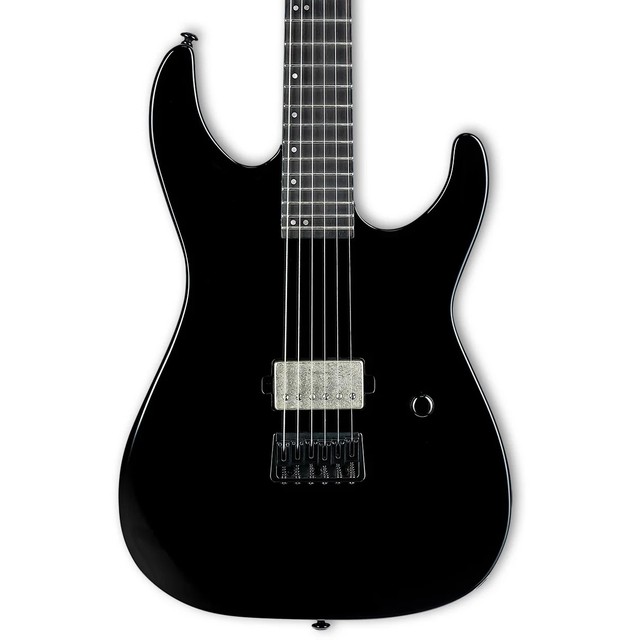
ESP LTD M-201HT Baritone
The value pick and the one to buy if you want to find out whether a baritone suits you without a serious outlay. A 27-inch scale, a hardtail bridge — which matters more than it sounds, because a fixed bridge makes experimenting with gauges painless — and a thin U neck. The extra half inch over the Jackson is worth a little more tension and a slightly wider fret spacing to get used to.
- 27 inch baritone scale
- Fixed hardtail bridge
- Thin U neck profile
- Passive humbuckers
- Hardtail makes gauge experiments trivial
- 27 inches holds Drop B with less string mass
- Genuinely inexpensive for a purpose-built baritone
- Basic hardware and stock pickups
- Fret spacing takes adjustment coming from 25.5 inches
- Finish options are limited

ESP LTD EC-1000 Baritone
The grown-up version: a 27-inch scale in the single-cut EC body, with proper hardware, set-neck construction and active pickups as standard on most variants. Active electronics are a genuine advantage in this tuning because the preamp keeps the low end defined instead of letting it bloom, which is exactly the failure mode of a hot passive pickup at B. This is the one you keep.
- 27 inch baritone scale
- Set-neck single-cut construction
- Active pickups on most configurations
- Locking tuners and TonePros hardware
- Active pickups keep low notes defined
- Hardware quality is a clear step up
- Holds tuning notably well with heavy strings
- Two to three times the price of the M-201
- Heavy instrument over a long set
- Battery dependency that some players dislike

Ibanez RGIB21 Iron Label Baritone
At 28 inches this is the longest conventional six-string scale here, and that changes the character rather than just the tension: notes are tighter and more piano-like, and with a 28-inch scale you can hold Drop B on lighter strings than a 26.5-inch guitar needs. The Iron Label specification strips out anything decorative and adds a killswitch, which tells you who it is for.
- 28 inch baritone scale
- Nitro satin finished Wizard-style neck
- Passive humbuckers with killswitch
- Fixed bridge
- Longest scale means the tightest low end
- Holds Drop B on comparatively light gauges
- Thin Ibanez neck despite the scale
- 28 inches is a real stretch in the first position
- Stock strings usually need replacing immediately
- Bare-bones cosmetics will not suit everyone
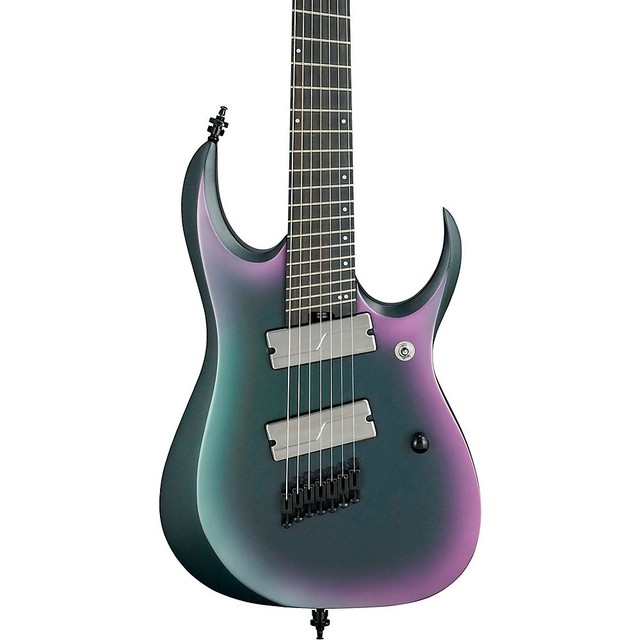
Ibanez RGMS7 Multiscale Seven-String
The most intelligent answer to the tension problem on this list, and one of the cheapest. The fanned frets give roughly 27 inches under the lowest string and 25.5 under the highest, so the bottom end gets baritone tension while the top three strings stay exactly as bendable as a standard guitar. The angled frets look alarming and take about twenty minutes to stop noticing.
- Multiscale 25.5 to 27 inches
- Seven strings, fixed bridge
- Thin Wizard-style neck
- Passive humbuckers
- Solves the tension trade-off rather than splitting it
- Very inexpensive for a multiscale instrument
- Fixed bridge, simple to restring
- Seventh string is redundant if you only want six-string Drop B
- Fanned frets take genuine adjustment
- Stock pickups are the obvious upgrade

Jackson X Series Dinky DKAF7 MS Multiscale
Jackson’s take on the same idea, and the alternative to the Ibanez if you prefer a Dinky body and a slightly beefier neck. The fan puts the longer scale where it does the work and leaves the treble strings alone. As with all multiscale guitars, the thing to check before buying is whether a bridge with individually angled saddles bothers you when palm muting — most people adapt, a few never do.
- Multiscale seven-string design
- Arched top Dinky body
- Compound radius fingerboard
- Fixed multiscale bridge
- Baritone tension on the low strings, normal feel on top
- Comfortable Dinky body for long sessions
- Competitively priced against the Ibanez
- Angled saddles change the palm-muting hand position
- Seven strings for a six-string tuning question
- Replacement strings for a fanned bridge need care to seat
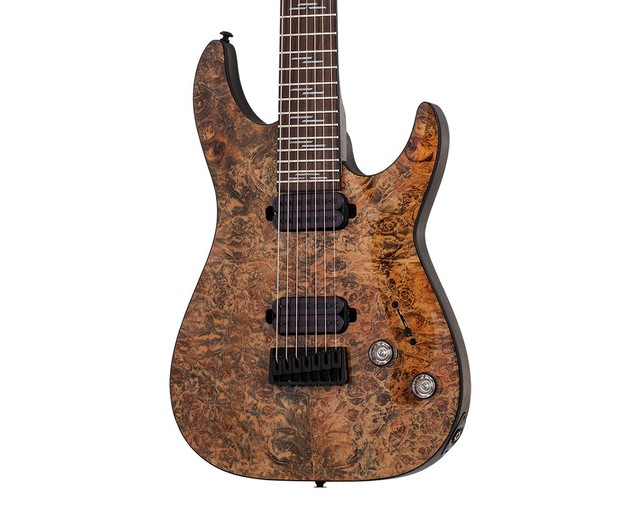
Schecter Omen-7
The straightforward budget seven-string route into B: a 26.5-inch scale, a fixed bridge and Schecter’s generally generous approach to fretwork at this price. Left in B standard with no drop at all it covers most of what a six-string in Drop B is reaching for, and the extra string means you keep a full six-string range above it rather than trading the top end away.
- 26.5 inch scale, seven strings
- Fixed tune-o-matic style bridge
- Thin C neck profile
- Schecter Diamond passive pickups
- Cheap way into extended range
- Good fretwork for the price bracket
- Fixed bridge keeps setup simple
- Heavy body compared with the Ibanez
- Stock pickups are ordinary
- 26.5 inches is modest for a seven-string low B

Jackson JS22-7 Dinky
The cheapest credible instrument here by a wide margin, and a genuinely sensible way to test whether you actually want to play down at B before committing. A 26.5-inch seven-string with a bolt-on neck and a fixed bridge. Everything about it is entry-level, but the scale length and the fixed bridge — the two things that matter for this tuning — are correct, and the rest can be upgraded later.
- 26.5 inch scale, seven strings
- Bolt-on maple neck
- Fixed string-through bridge
- Passive ceramic humbuckers
- Costs less than a decent set of pickups
- Correct scale and bridge for the job
- Easy to resell or keep as a backup
- Fret ends and factory setup usually need attention
- Ceramic pickups sound muddy low down
- Tuners are the first thing to replace
Squier Paranormal Baritone Cabronita Telecaster
The non-metal answer, and a reminder that Drop B is not only a heavy-guitar tuning. A 27-inch scale Telecaster with Fideli-Tron style humbucking pickups, which gives you low-tuned clarity with a completely different voice — jangly, hollow-sounding, good for baritone surf, post-rock and anything where a high-gain guitar would be wrong. Cheap, well made and much more versatile than its looks suggest.
- 27 inch baritone scale
- Fideli-Tron style humbucking pickups
- Telecaster body with string-through bridge
- C-profile maple neck
- A genuinely different tonal palette at this tuning
- Excellent build for a Squier
- Clean tones stay articulate in Drop B
- Pickups are not built for modern high gain
- Baritone Telecaster is an acquired look
- Stock strings are light for Drop B specifically
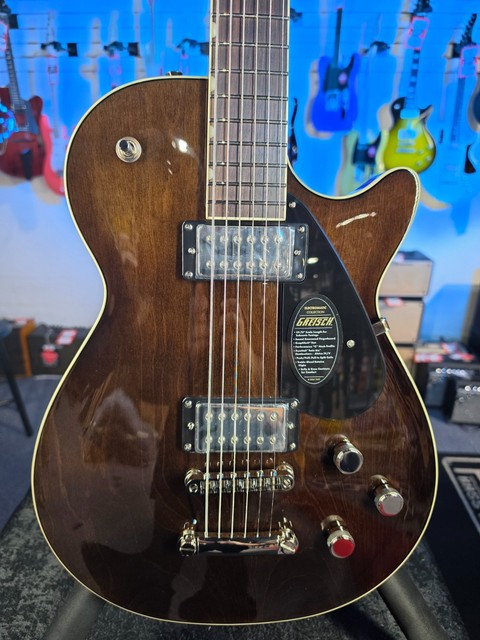
Gretsch G5260 Electromatic Jet Baritone
The longest scale on this list at 29.75 inches, which is closer to a short bass than a guitar and produces exactly the tight, woody, articulate low end that makes baritone guitar interesting outside metal. At this length Drop B sits comfortably on relatively light strings. The Broad’Tron pickups are warm rather than aggressive, which suits the instrument’s character.
- 29.75 inch baritone scale
- Broad’Tron humbucking pickups
- Chambered Jet body
- Anchored Adjusto-Matic bridge
- Exceptionally clear and tight at low tunings
- Holds Drop B on light gauges
- Distinctive voice unlike anything else here
- 29.75 inches is a genuine stretch for small hands
- Not intended for high-gain playing
- Baritone strings for this scale are a specialist order
Buying tips
- Do the tension arithmetic before buying scale length. Going from 25.5 to 26.5 inches is about 8 percent more tension — roughly half a string gauge — so gauge is the primary fix and scale is the refinement.
- Check the nut slot before anything else. A factory 25.5-inch guitar’s sixth-string slot is cut for around a .046 to .052, and a Drop B set’s .060 to .068 will perch on top of it and pull sharp.
- Prefer a fixed bridge if you expect to experiment. Changing gauges on a Floyd Rose means resetting spring tension and re-levelling every time, which discourages exactly the experimentation that finds the right set.
- Consider multiscale rather than a straight baritone. Fanned frets put 27 inches under the low string and 25.5 under the high, which is precisely the compromise this tuning wants.
- Try a pickup change before a guitar change. Very hot ceramic humbuckers pile output into the low mids you already have too much of at B — tighter or actively voiced pickups usually clear it up for a fraction of the cost.
- Count the intervals if a tab says Drop B. On six strings it normally means B–F#–B–E–G#–C#, but the label is used loosely and some tabs mean B standard on a seven-string.
- Buy a purpose-made baritone string set rather than a heavy standard set. The winding and core ratios differ, and a standard set with a fat sixth string gives you a lopsided instrument.
- Expect to adjust the truss rod after the first restring. Two and a half steps of pitch change plus heavier gauges alters neck relief substantially, and nothing will play well until that is reset.
As an Amazon Associate and eBay Partner, toptenpick.com earns from qualifying purchases. Prices and availability are subject to change.