

As an Amazon Associate and eBay Partner, toptenpick.com earns from qualifying purchases. Prices and availability are subject to change.
The antenna’s spec sheet is the least useful number in this purchase. Every whip below lists a gain figure in dBi, and that figure assumes the antenna sits on a solid, continuous sheet of conductive metal — a full-size vehicle roof, effectively. A quarter-wave or half-wave whip needs that metal underneath to act as a ground plane, reflecting radio energy upward instead of losing it into the chassis. Bolt the same antenna to a magnetic mount stuck on an aluminum hood, a fiberglass UTV roof, or a plastic bumper, and the gain figure doesn’t survive contact with reality: the antenna reads a poor match, and a real share of your transmit power turns into heat in the coax instead of signal on the air.
The fix is the mount, not a better antenna. Dead center of a bare steel roof, on a through-hole NMO mount, beats every magnetic option regardless of price. If drilling isn’t happening, a magnet on a steel hood or trunk lid still works — steel still supplies the ground plane. The failure case is specifically aluminum, fiberglass, and plastic panels, which are common on late-model trucks and on nearly every UTV cab. For those, buy an antenna explicitly sold as a No Ground Plane (NGP) design, or a mount that carries its own built-in counterpoise plate, rather than assuming any whip will do.
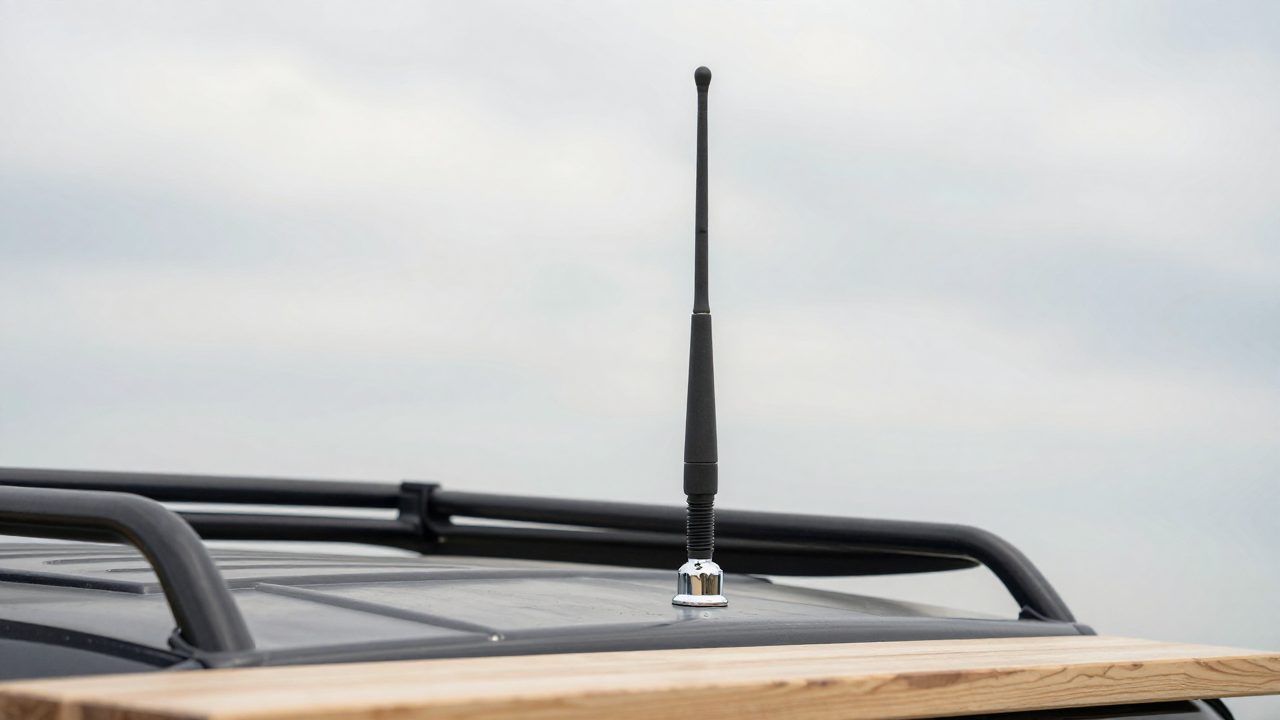
Two more real-world wrinkles. A roof rack or light bar close to the antenna isn’t just inconvenient to route around — the bars aren’t a ground plane, they’re an unpredictable parasitic radiator, and the usual separation guidance is roughly 18 inches for 2 meters and as little as 10 for 70 centimeters. Height has a genuine trail cost too: a tall, rigid, high-gain whip reaches further on open fire road but has nothing to flex when it meets a branch at trail speed, where a short spring-base or flexible whip just bends and springs back.
One thing trail groups get backward often enough to say plainly: none of this is legal to transmit on without a license. The bands these antennas are tuned for — 2 meters and 70 centimeters — require passing the FCC’s Technician exam first. If your group only needs short-range convoy chatter and doesn’t want to study for a test, GMRS is the real license-without-an-exam alternative: a $35, ten-year FCC license that covers most of what trail groups actually use radios for, with shorter range and no access to the amateur repeater network that makes 2m/70cm worth the extra step.
| # | Product | Price | Where to buy |
|---|---|---|---|
| 1 | Larsen NMO2/70SH | $70–$95 | Amazon · eBay |
| 2 | Comet SBB-5NMO | $63–$80 | Amazon · eBay |
| 3 | Diamond NR770HNMO | $60–$75 | Amazon · eBay |
| 4 | Comet SBB-1NMO | $40–$60 | Amazon · eBay |
| 5 | Comet CA-2X4SR | $70–$80 | Amazon · eBay |
| 6 | Larsen NMO150B | $75–$85 | Amazon · eBay |
| 7 | Tram 1185 | $35–$50 | Amazon · eBay |
| 8 | Workman UV-325 | $18–$25 | Amazon |
| 9 | Rugged Radios VHF NGP Antenna Kit with Magnetic Mount | $80–$98 | Amazon · eBay |
| 10 | Larsen NMO2/70B | $95–$116 | Amazon · eBay |
The picks, in detail

Larsen NMO2/70SH
This is the antenna Larsen built specifically for off-road rigs: a 19-inch dual-band whip on a wound spring base rather than a rigid ferrule, so a branch or a low garage header flexes the whip instead of cracking the mount. At 2.14 dBi on 2 meters and 4 dBi on 70cm it isn’t a gain champion, but on a Jeep or UTV roof that survivability matters more than another dB.
- 144-148/440-450 MHz dual-band coverage
- 19-inch height on a coil spring base
- 2.14 dBi (2m) / 4 dBi (70cm) gain
- 100W handling, threaded NMO connector
- Purpose-built spring base absorbs branch strikes
- Short enough to clear most garages and carports
- Covers both 2m and 70cm repeaters
- Modest gain next to taller fixed-mount whips
- NMO mount sold separately on most listings
- Premium price for a 19-inch antenna

Comet SBB-5NMO
The SBB-5NMO trades the off-road whip’s short stature for reach: at 38 inches with 3 dBi on 2m and 5.5 dBi on 70cm, it noticeably outperforms shorter antennas on open fire-road and highway driving. A fold-over hinge lets it lay flat for a low garage or an overhanging branch, then springs upright once clear.
- 144-148/430-450 MHz dual-band, 3/5.5 dBi gain
- 38-inch length with fold-over hinge
- 200W PEP power handling
- NMO mount, stainless whip sections
- Noticeably more gain and range than short off-road whips
- Fold-over hinge for low-clearance situations
- Well regarded for build quality in amateur reviews
- 38 inches of mostly rigid rod is a lot to snag on brush even folded
- No spring base — a hard side impact stresses the hinge, not a flexible mount
- Taller than most riders want on a UTV cage

Diamond NR770HNMO
Diamond’s NR770HNMO is the direct rival to the Comet SBB-5NMO: same 38-inch class, same fold-over hinge, a similar 3/5.5 dBi gain split across 2m and 70cm, and the same 200W handling. It’s the common pick for drivers who already run other Diamond gear or simply found it in stock when the Comet wasn’t.
- 144-148/440-450 MHz dual-band, 3 dBi (2m) / 5.5 dBi (70cm)
- 38.2-inch length, fold-over NMO mount
- 200W PEP power rating
- Stainless steel whip
- High gain for a mobile whip in this size class
- Fold-over hinge clears low garages and carports
- Widely stocked, easy to source a replacement whip
- Same trail-snag risk as any 38-inch rigid rod
- No spring base for lateral impacts
- Taller profile means more wind noise at highway speed than a short whip

Comet SBB-1NMO
The SBB-1 shrinks the whip itself to 16 inches, cased in flexible rubber the way a handheld’s rubber duck is — Comet markets it as one of the few mobile antennas that spring-bends going into a low garage rather than needing to be folded down first. Gain is modest, but for a rig that lives under trees, that flexibility is the entire point.
- 144-148/440-450 MHz dual-band coverage
- 16-inch flexible rubber-coated whip
- PL-259 or NMO mount versions available
- Compact, low-profile design
- Genuinely flexible — bends on contact instead of snapping
- Short enough to ignore garage and low-branch clearance
- Less expensive than the taller high-gain whips here
- Lowest gain of the dual-band whips in this list
- Rubber coating can stiffen and crack after years of UV exposure
- Not the pick if range matters more than survivability

Comet CA-2X4SR
The CA-2X4SR is a 40-inch dual-band whip with a fold-over hinge and 3.8 dB gain, and Comet sells an optional spring section that swaps in for the lower rod to add impact protection without losing the fold-over feature — worth pricing in if trail durability matters more than the stock configuration.
- 144-148/430-450 MHz dual-band, 3.8 dB gain
- 40-inch length, fold-over hinge
- 200W power rating
- Optional bolt-on spring section sold separately
- Strong gain-to-length ratio for a mobile whip
- Fold-over hinge handles low clearance
- Upgradeable to a spring base without buying a new antenna
- Stock configuration has no spring — that’s an extra ~$32 purchase
- 40 inches is tall for tight trail work under canopy
- Fold hinge is a wear point that needs periodic tightening

Larsen NMO150B
For rigs running a 2m-only mobile rather than a dual-bander, the NMO150B is a dedicated 5/8-wave whip with a spring mounted a few inches above the base, positioned to flex under lateral impact while keeping the radiating element’s electrical length intact — not true of every generic antenna sold as “impact resistant.”
- 144-174 MHz single-band, roughly 5.1 dBi gain
- Spring base positioned near the ferrule
- 200W power rating
- Field-tunable whip length
- Real spring base, not just a flexible whip
- Higher gain than dual-band off-road whips, since it isn’t splitting performance across two bands
- Field-tunable to the exact frequency range you run
- 2m only — no 70cm coverage if your radio or local repeaters need it
- More expensive than several dual-band alternatives here
- Field tuning means an SWR meter and adjustment, not bolt-on-and-go

Tram 1185
The Tram 1185 is a complete magnet-mount kit — whip, 3-inch magnetic base, 12 feet of RG-58, and a PL-259 connector — aimed at drivers who want to move the antenna between vehicles or skip drilling. Buy it with eyes open: a 3-inch magnet is a poor substitute for a full vehicle ground plane, and it won’t form one at all on aluminum, fiberglass, or plastic.
- 144-148/430-450 MHz dual-band
- 3-inch magnetic mount with 12ft RG-58 coax
- PL-259 connector, no drilling required
- Complete kit — antenna, mount, and cable included
- No drilling — mounts and removes in seconds
- Complete kit, no separate mount or cable purchase
- Portable between vehicles
- Small magnet base is a weaker ground plane than a roof-center through-hole mount, even on steel
- Does nothing useful on an aluminum, fiberglass, or plastic panel — the SWR shows it
- PL-259 rather than NMO, less common on purpose-built off-road mounts
Workman UV-325
The UV-325 is the budget end of the dual-band NMO category — a center-loaded design covering both amateur bands at a fraction of the name-brand price, with 3 dB gain and 150W handling. It’s a reasonable choice for a spare or a second vehicle, with the trade-offs you’d expect from a budget antenna.
- 144-148/440-450 MHz dual-band, 3 dB gain
- Center-loaded coil design
- 150W power handling
- NMO mount
- Lowest price of any dual-band whip here
- Adequate performance for local repeater and simplex use
- Cheap enough to treat as a disposable spare
- No spring base — a solid branch strike is more likely to bend or snap it
- Lower power handling than the name-brand antennas on this list
- Build-quality reviews are mixed against Larsen or Comet

Rugged Radios VHF NGP Antenna Kit with Magnetic Mount
This is the direct answer to the ground-plane problem on a non-metal body: a half-wave antenna engineered to perform without one, paired with a magnetic mount and 13 feet of coax as a complete kit. It’s the right category of product for a fiberglass UTV cab or a plastic bumper, where a standard whip on a magnet would read a poor match no matter how good the antenna itself is.
- 144-174 MHz VHF half-wave, no-ground-plane design
- 2.4 dB gain, 200W rating
- 39.8-inch stainless steel whip
- Magnetic mount with 13ft coax included
- Purpose-engineered to work without a metal ground plane
- Complete kit — no separate mount or cable to buy
- Sensible choice for fiberglass or plastic-bodied UTVs
- VHF (2m) only — no 70cm coverage in this kit
- Still a magnetic mount, less secure at speed over rough terrain than a bolted or through-hole mount
- Even NGP designs perform somewhat better with some ground plane present, so don’t expect full 5/8-wave numbers
Larsen NMO2/70B
The NMO2/70B is the taller, higher-gain sibling to the NMO2/70SH — 34.5 inches with an exposed helical coil rather than an enclosed spring, delivering 3.8 dBi on 2m and 5.2 dBi on 70cm. It’s a legitimate pick for a rig that mostly runs graded fire roads and highway; less so for tight singletrack, since the coil has no flex and nothing protects it from a direct branch strike.
- 144-148/440-450 MHz dual-band, 3.8/5.2 dBi gain
- 34.5-inch length with exposed black coil
- 100W power handling, NMO mount
- Higher gain than the short off-road-specific whip
- More gain and range than the spring-base short whips
- Field-proven design used in commercial and public-safety fleets
- NMO mount fits the same hardware as every other antenna here
- Exposed coil has no spring protection — a hard branch strike can bend or snap it
- Taller than ideal for low tree canopy or tight trail sections
- No fold-over feature for garage clearance
Buying tips
- Mount on bare steel where you can — the center of the roof is the best ground plane on the vehicle and gives the most even radiation pattern.
- If your body panel is aluminum, fiberglass, or plastic, buy an antenna explicitly sold as NGP (“no ground plane”) or a mount with a built-in counterpoise disc — a standard whip on a magnet stuck to a non-conductive panel will read a poor match no matter how good the antenna is.
- Keep at least 18 inches of clear roof between a 2m antenna and a roof rack or light bar, and 10 inches for 70cm — closer than that and the rack becomes an unpredictable parasitic radiator instead of a clean ground plane.
- For actual trail use rather than parking-lot driving, choose a spring-base or flexible whip over a tall rigid gain antenna — a branch bends a spring back into shape and snaps a rigid rod.
- A short, lower-gain whip radiates more of its signal close to the horizon, which suits close-range convoy chatter between rigs better than a tall antenna optimized for flat-ground distance.
- Confirm you hold a valid amateur license before transmitting on 2m or 70cm — Technician class covers both. If your group only needs short-range trail chatter and doesn’t want to test, GMRS is the license-without-an-exam alternative many groups run instead.
- Route the coax away from sharp trim edges and pinch points, and leave a drip loop before it enters the cabin so water runs off instead of into the connector.
- If range is disappointing after installing on what should be a good ground plane, check the mount base for corrosion or paint under the NMO ferrule before assuming the antenna itself is faulty.
As an Amazon Associate and eBay Partner, toptenpick.com earns from qualifying purchases. Prices and availability are subject to change.