

As an Amazon Associate and eBay Partner, toptenpick.com earns from qualifying purchases. Prices and availability are subject to change.
A Les Paul’s weight and its neck dive are two separate problems, and it is easy to buy a strap that only solves one of them. Neck dive comes from where the strap attaches: one button on the back of the top horn and one at the tail, so nearly all the guitar’s mass sits in front of that upper pivot point and the neck rotates down the instant you let go of it. A locking strap end stops the strap from slipping or unclipping off that button — a real concern, since a full Les Paul is a genuine risk to drop on a hard floor — but it does nothing about the rotation itself. That only responds to the strap: its width, and how much the material grips a shoulder rather than sliding across it.
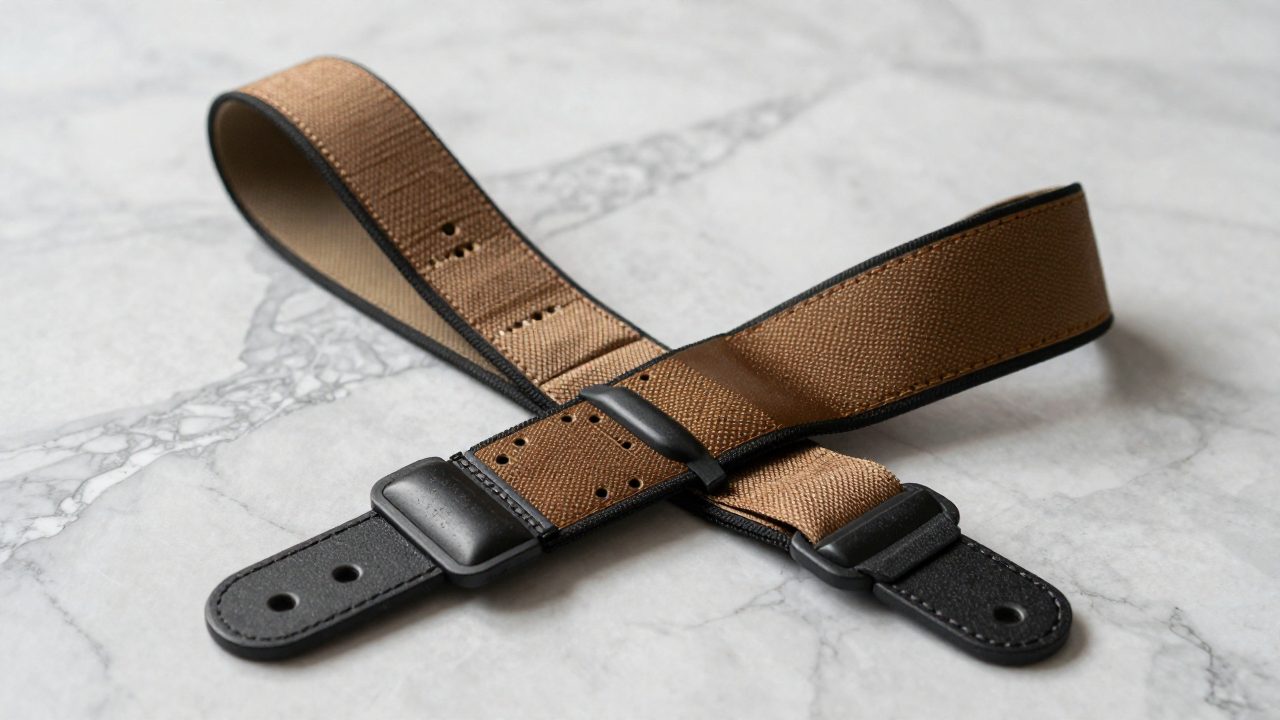
Width and grip do more for the dive itself than padding does. A narrow strap concentrates the same weight into a smaller contact patch and lets the guitar swing more freely on it; 2.5 to 3 inches is the range most Les Paul players settle on. Padding is worth having too, but it solves shoulder fatigue over a long set, not the dive — a padded strap in a slick, glossy finish can still let the guitar slide forward. The material that actually resists rotating is one with real friction against a shirt: suede backing, rougher garment leather, or a grippy synthetic, rather than the polished leather that looks the most ‘vintage rock’ on a rack.
Locking hardware solves a separate, sharper problem: the guitar physically leaving the strap. Two approaches exist. Clip-style systems, like D’Addario’s Auto Lock, snap over an existing strap button with no change to the guitar. Pin-and-collar systems, like Schaller’s or Dunlop’s, replace the strap button itself with a locking one — generally reported as more secure, but it means new hardware goes into the guitar. That matters specifically on a Gibson: older Schaller lock screws use a narrower thread than Gibson’s stock strap-button screw, so forcing one into a vintage or reissue Les Paul’s existing hole can strip it. Current Schaller S-Lock hardware ships with a screw sized to fit Gibson’s button without modification, but it is worth confirming before installing on an older or original-parts guitar.
None of this was tested in-house — no guitar here was strapped on and played — so treat the width, material, and locking notes below as what manufacturers and long-time owners report, not a verdict from playing each one. What follows mixes leather and padded straps built for a heavy solidbody, both styles of locking hardware, and one inexpensive add-on for anyone who wants to keep their current strap and just stop it sliding.
| # | Product | Price | Where to buy |
|---|---|---|---|
| 1 | Levy’s MSS2 Garment Leather Guitar Strap | $35–$70 | Amazon · eBay |
| 2 | Levy’s Padded Leather Guitar Strap | $40–$75 | Amazon · eBay |
| 3 | Franklin Strap Original Glove Leather | $40–$85 | Amazon · eBay |
| 4 | D’Addario Neoprene Comfort Strap | $20–$35 | Amazon · eBay |
| 5 | Comfort Strapp | $25–$40 | Amazon · eBay |
| 6 | D’Addario Auto Lock Guitar Strap | $15–$25 | Amazon · eBay |
| 7 | Schaller S-Locks Strap Locks | $20–$35 | Amazon · eBay |
| 8 | Dunlop Straplok Dual Design | $12–$20 | Amazon · eBay |
| 9 | Guitar Gummy Non-Slip Grip Strips | $10–$15 | Amazon · eBay |
| 10 | Ernie Ball Stretch Comfort Strap | $15–$25 | Amazon · eBay |
The picks, in detail

Levy’s MSS2 Garment Leather Guitar Strap
The default Les Paul recommendation in most gear forums, and for a straightforward reason: 3-inch garment leather with a suede back that grips a shirt instead of sliding, wide enough to spread a solidbody’s weight across the shoulder. No padding and no locking hardware, just the width and surface that actually fight neck dive on this guitar, at a price well below the premium leather options.
- 3-inch garment leather, multiple colors
- Suede backing for shoulder grip rather than a slick finish
- Adjustable roughly 39-58 inches
- Fits any standard strap button, no hardware changes needed
- Wide enough to visibly reduce dive on a heavy solidbody
- Suede back stays put on a shirt instead of sliding
- Inexpensive for genuine leather
- No locking mechanism — pairs well with a separate strap lock
- New leather needs a break-in period before it softens

Levy’s Padded Leather Guitar Strap
Levy’s padded line, aimed specifically at instruments reviewers describe as over roughly nine pounds — a Les Paul’s typical weight class. A foam core under the leather softens the shoulder load on a long set without giving up the width that helps with balance, a reasonable step up from a plain garment-leather strap when fatigue, not just dive, is the complaint.
- Foam-padded core under top-grain or garment leather
- Typically 3-inch body for weight distribution
- Suede or leather backing depending on finish
- Adjustable standard length range
- Noticeably reduces shoulder soreness over a long session
- Still wide enough to help with balance, not just comfort
- Padded strap end holds its shape over time
- Bulkier than an unpadded strap in a gig bag
- Costs more than the plain garment-leather version

Franklin Strap Original Glove Leather
A premium 2.5-inch glove leather strap that owners specifically call out as comfortable on a Les Paul, with a suede back doing the same grip job as Levy’s at a higher finish level. Reported to soften and develop a patina with age rather than staying stiff, priced like a strap kept for years rather than replaced.
- 2.5-inch soft glove leather
- Suede backing for shoulder grip
- Reinforced stitching at the strap-button ends
- Multiple leather and stitching color combinations
- Owners report it softening and improving with age
- Suede back holds position on a shirt
- Specifically well regarded for heavier guitars
- Among the pricier leather options here
- 2.5-inch width is narrower than the 3-inch straps also on this list

D’Addario Neoprene Comfort Strap
A wide neoprene strap built around weight distribution rather than leather tradition — the padding is worked into a stretch material instead of sitting under a stiff leather face, which several reviewers single out as more comfortable specifically for heavy guitars. Not a locking strap and no leather break-in, but a genuine alternative for shoulder fatigue.
- Wide neoprene body with padded core
- Non-slip backing surface
- Standard adjustable length
- Easy to wipe clean, no leather care needed
- Reviewers specifically recommend it for heavier guitars over standard leather
- No leather break-in period
- Comfortable across long sessions
- Bulkier, sportier look than a traditional leather strap
- No locking mechanism built in

Comfort Strapp
A stretch neoprene strap built for bass and heavy-guitar players, distinct from D’Addario’s version in construction — it flexes with the shoulder instead of sitting rigid, which some players find does more for a heavy instrument than padding alone. Worth trying if a stiff leather or foam strap still feels like dead weight by the end of a set.
- Stretch neoprene construction
- Wide body for weight spread
- Adjustable length
- Marketed specifically at bass and heavy-guitar players
- Flexes with movement instead of staying rigid
- Popular specifically among players with heavier instruments
- Comfortable over long playing sessions
- Less traditional look than leather, which matters on stage for some players
- No locking hardware built in

D’Addario Auto Lock Guitar Strap
A clip-style locking strap that snaps over an existing strap button and releases with a push on the latch — no drilling, no swapped hardware, and it moves between guitars without leaving anything behind. Solves the guitar-leaving-the-strap problem specifically, not the dive itself, so it pairs naturally with a wider, grippier strap rather than replacing one entirely.
- Spring-loaded clip locks over the stock strap button
- No modification to the guitar
- Push-latch release mechanism
- Works across acoustic and electric strap buttons
- Zero permanent changes to a vintage or reissue Les Paul
- Long-term owners report it holding up reliably over years of use
- Easy to move between guitars
- Some owners report it not fitting oversized aftermarket strap buttons
- Solves security, not balance — still needs a wide, grippy strap alongside it

Schaller S-Locks Strap Locks
The long-standing pin-and-collar standard, widely reported as more secure than a clip-on system since the strap button itself is replaced. The genuine catch on a Gibson: older Schaller lock screws are threaded narrower than Gibson’s stock strap-button screw, so forcing one into an existing hole risks stripping it. Current S-Lock hardware ships with a screw sized to fit Gibson’s hole, but confirm before installing on a vintage or original-parts guitar.
- Pin-and-collar locking mechanism
- Replaces the guitar’s existing strap buttons
- Multiple finishes to match existing hardware
- Current version ships with Gibson-compatible screw sizing
- Widely regarded as very secure over decades of use
- Invisible once installed — strap looks stock
- Fits a strap to any guitar carrying Schaller buttons
- Requires installing new hardware in the guitar, unlike a clip-on lock
- Older-generation screws can mismatch vintage Gibson thread sizing

Dunlop Straplok Dual Design
A budget-friendly alternative to Schaller’s system using the same replace-the-button approach — a 360-degree groove-and-ball lock the maker rates to a very high pull force, and long-term owners report it reliable across decades of gigging. Installation can be fiddly on some strap-button holes, and the release bearing benefits from a drop of lubricant at setup.
- Groove-and-ball 360-degree locking design
- Replaces existing strap buttons
- Case-hardened steel construction
- Available in nickel, black, brass, and gold finishes
- Noticeably cheaper than Schaller’s system
- Long track record among gigging players
- Free rotation once locked in
- Some owners report stiff installation or a screw that doesn’t fully seat
- Release bearing can need occasional lubrication

Guitar Gummy Non-Slip Grip Strips
A peel-and-stick silicone strip for the underside of a strap already owned — it does not touch the guitar’s hardware at all, it just adds the friction a slick strap is missing. The cheapest fix here for a Les Paul that is diving specifically because the current strap is too smooth to hold a shoulder, rather than because the strap is the wrong width.
- Peel-and-stick silicone strip, sold as a set
- Adheres to leather, nylon, suede, and vinyl straps
- Reusable and repositionable per the maker
- No guitar or strap-button modification
- Cheapest way to test whether grip alone fixes the dive
- Works on a strap already owned
- No tools or hardware changes required
- Does not help if the strap is also too narrow for the guitar’s weight
- An adhesive add-on, not a permanent construction change

Ernie Ball Stretch Comfort Strap
A 2-inch stretch-elastic strap that lets the guitar settle into a natural position instead of hanging rigidly — genuinely comfortable by most accounts, but worth going in with the right expectation: reviewers specifically report it does not fix neck dive on a heavy instrument, and its edges can dig in under real weight. Better suited to a lighter guitar or as a second, practice-only strap.
- 2-inch stretch elastic fabric body
- Leather strap ends
- Adjustable length
- Lightweight, packable design
- Genuinely comfortable stretch fit for lighter guitars
- Inexpensive
- Packs down small for a gig bag
- Reviewers report it does not resolve neck dive on a heavy solidbody
- Thin material edges can dig in under a Les Paul’s weight
Buying tips
- Width and material do more for neck dive than padding does — a 2.5 to 3 inch strap with a grippy suede or rough-leather back resists sliding better than a padded strap in a glossy finish.
- Locking hardware and dive control are two different fixes — a strap lock keeps the guitar from leaving the strap, but it will not stop a narrow, slick strap from letting the guitar rotate forward.
- Check screw threading before installing pin-style locks like Schaller’s on a vintage or original-parts Les Paul — older lock hardware can use a narrower thread than Gibson’s stock strap-button screw.
- Clip-on locks such as D’Addario’s Auto Lock need no modification to the guitar and move between instruments, which matters if the strap has to work on more than one guitar.
- A Les Paul’s neck dive comes from having only one strap button, up on the back of the horn — nearly all the guitar’s weight sits in front of that single pivot point.
- A peel-and-stick grip strip is worth trying before buying a new strap entirely, if the current one is simply too smooth to hold a shirt in place.
- Test a new strap sitting down as well as standing — a strap that feels secure standing can behave differently once the guitar’s angle changes.
- Neoprene and stretch-fabric straps trade some of leather’s traditional look for genuine weight-distribution comfort on a long set; decide which matters more before choosing a material.
As an Amazon Associate and eBay Partner, toptenpick.com earns from qualifying purchases. Prices and availability are subject to change.