

As an Amazon Associate and eBay Partner, toptenpick.com earns from qualifying purchases. Prices and availability are subject to change.
LGA 1150 covers Haswell and Devil’s Canyon — the i5-4590, i5-4690K, i7-4770K and i7-4790K, roughly 2013 to 2015. This is a meaningfully stronger starting point than the Sandy Bridge generation before it, and the practical ceiling is correspondingly higher.
Which chip you have changes the answer substantially. An i7-4790K has four cores and eight threads at high clocks and remains genuinely usable for 1080p gaming today; it will feed a mid-range modern card without embarrassing itself. An i5-4590 has four cores and four threads at lower clocks, and it runs out of headroom much sooner in anything CPU-heavy.
Two platform limits apply to every card here. PCIe 3.0 x16 is fine for most cards, but modern budget models with an x8 or x4 interface lose real performance on a 3.0 slot — check interface width, not just generation. And no Resizable BAR, which rules out Intel’s Arc cards: they depend on it and lose a large, well-documented share of their performance without it.
Ten cards below, with the ceiling marked honestly for each CPU tier.
| # | Product | Price | Where to buy |
|---|---|---|---|
| 1 | AMD Radeon RX 6600 | $180–$230 | Amazon · eBay |
| 2 | NVIDIA GeForce RTX 3060 12GB | $230–$300 | Amazon · eBay |
| 3 | AMD Radeon RX 6600 XT | $220–$280 | Amazon · eBay |
| 4 | NVIDIA GeForce GTX 1660 Super | $120–$170 | Amazon · eBay |
| 5 | AMD Radeon RX 580 8GB | $70–$130 | Amazon · eBay |
| 6 | NVIDIA GeForce RTX 2060 | $150–$210 | Amazon · eBay |
| 7 | NVIDIA GeForce GTX 1650 Super | $110–$160 | Amazon · eBay |
| 8 | AMD Radeon RX 6500 XT — and why to avoid it | $120–$160 | Amazon · eBay |
| 9 | NVIDIA GeForce GTX 1070 | $110–$170 | Amazon · eBay |
| 10 | A quality 550 W 80+ power supply | $55–$95 | Amazon · eBay |
The picks, in detail
AMD Radeon RX 6600
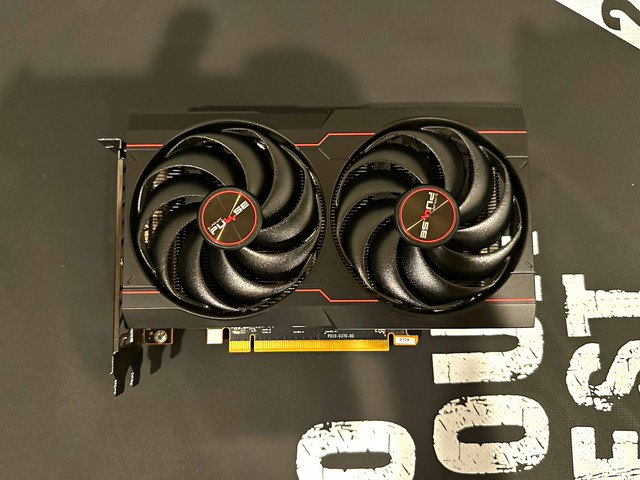
The sweet spot for most LGA 1150 systems. It drives 1080p at high settings comfortably, draws about 130 W so an older quality PSU usually copes, and its PCIe 4.0 x8 interface behaves well on a 3.0 slot. Behind an i7-4790K it is a genuinely balanced pairing; behind an i5-4590 it will sometimes wait on the CPU, but it is still the card that stops being the limit.
- 8 GB VRAM
- Roughly 130 W
- PCIe 4.0 x8, no meaningful loss on 3.0
- Strong 1080p high-settings performance
- Best balance of price, power and performance here
- 8 GB VRAM has genuine headroom
- Modest PSU demands
- Bottlenecked by four-thread i5s in CPU-heavy games
- Weak ray tracing performance
- Overkill for older titles

NVIDIA GeForce RTX 3060 12GB
The realistic ceiling behind an i7-4790K, and the card most often named for that chip. 12 GB of VRAM is unusually generous for its tier and ages well, DLSS is genuinely useful for squeezing more from an older platform, and it runs a full PCIe x16 interface so nothing is lost on a 3.0 slot. Behind an i5-4590 it is more card than the CPU can use.
- 12 GB VRAM, generous for the tier
- Full PCIe 4.0 x16 interface
- DLSS support
- Roughly 170 W
- Large VRAM buffer ages well
- DLSS meaningfully extends the platform’s life
- Full x16 interface, no 3.0 penalty
- Clearly bottlenecked by a four-thread i5
- Needs a reasonable PSU with a 8-pin connector
- Priced above what the platform strictly justifies

AMD Radeon RX 6600 XT
A step up from the plain 6600 and a good match specifically for the i7-4790K. It handles 1080p ultra and will stretch to light 1440p, which is about where Haswell’s fastest chip stops being able to keep up. If your card will migrate to a newer build later, this is a sensible thing to buy now and carry forward.
- 8 GB VRAM
- Roughly 160 W
- PCIe 4.0 x8
- 1080p ultra with 1440p headroom
- Well matched to the i7-4790K specifically
- Good resale and future-build value
- Efficient for its performance
- Wasted behind an i5-4590
- x8 interface, so check against a 3.0 slot
- Diminishing returns over the plain 6600

NVIDIA GeForce GTX 1660 Super
The best-value used option for this platform and a very comfortable match for an i5-4590. 6 GB of GDDR6 makes it noticeably stronger than the old GTX 1060 in newer titles, power draw is modest at around 125 W, and prices on the used market are low. Includes NVENC, which matters if you record or stream.
- 6 GB GDDR6
- Roughly 125 W
- PCIe 3.0 x16 native
- NVENC encoder
- Excellent used value
- Well matched to four-thread i5s
- Low power and heat
- 6 GB is becoming a real limit
- No DLSS or modern upscaling
- Often priced near an RX 6600

AMD Radeon RX 580 8GB
The budget workhorse, and still a sensible fit here. 1080p medium to high in most titles, 8 GB of VRAM that has aged far better than the 4 GB version, and very low used prices. The catch is power: around 185 W and two PCIe connectors, which many older prebuilt power supplies cannot provide.
- 8 GB VRAM — buy this, not the 4 GB
- Roughly 185 W, two PCIe connectors
- PCIe 3.0 x16 native
- Abundant on the used market
- Excellent price for the performance
- 8 GB ages well for textures
- Native x16 interface
- Power hungry for its performance tier
- Runs hot and loud on budget coolers
- Mining-used examples are common

NVIDIA GeForce RTX 2060
A good middle option with DLSS support, which is the feature that matters most for keeping an older platform viable — rendering at a lower internal resolution and upscaling takes load off both the card and, indirectly, the CPU. 6 GB of VRAM is the limitation. Prices on the used market have fallen to sensible levels.
- 6 GB VRAM
- DLSS and hardware ray tracing support
- Roughly 160 W
- PCIe 3.0 x16 native
- DLSS genuinely helps on an older CPU
- Good used pricing now
- Native x16 interface
- 6 GB VRAM limits texture settings
- Ray tracing is technically present but slow
- Runs warmer than the 1660 Super

NVIDIA GeForce GTX 1650 Super
The pick when the power supply is the constraint. Many versions need no supplementary PCIe connector at all, drawing what they need from the slot, which makes them fittable in an OEM prebuilt with a small proprietary PSU — a very common situation with surviving Haswell machines. Performance sits around the old GTX 1060.
- Roughly 100 W, often no PCIe power cable needed
- 4 GB VRAM
- Compact, fits slim cases
- PCIe 3.0 x16
- Frequently avoids a PSU upgrade entirely
- Fits cramped prebuilt cases
- Efficient and quiet
- 4 GB VRAM is limiting for modern textures
- Barely faster than cheaper used cards
- Scarce new

AMD Radeon RX 6500 XT — and why to avoid it
Named as a warning. The RX 6500 XT runs a PCIe x4 interface, and on a PCIe 3.0 board that halves its already limited bandwidth — it performs measurably worse on this platform than on a modern one, and the 4 GB buffer compounds it. It is a poor buy on LGA 1150 specifically, even though reviews on current platforms are more forgiving.
- PCIe 4.0 x4 interface — a real problem on 3.0
- 4 GB VRAM
- Roughly 107 W
- No hardware video encode
- Low power draw
- Compact
- Cheap new
- x4 interface loses significant performance on PCIe 3.0
- 4 GB VRAM is genuinely limiting
- No encoder for streaming or recording

NVIDIA GeForce GTX 1070
A solid used option that pairs well with the faster Haswell i7s. 8 GB of VRAM keeps it relevant for texture settings, and performance sits comfortably above the 1660 Super in most titles. It is a large card, so check case clearance, and the older feature set means no upscaling support.
- 8 GB VRAM
- Roughly 150 W
- PCIe 3.0 x16 native
- Strong 1080p performance
- 8 GB VRAM at a low used price
- Well matched to the i7-4790K
- Native x16 interface
- Physically large — check clearance
- No DLSS or FSR hardware acceleration
- Ageing feature set

A quality 550 W 80+ power supply
The unglamorous purchase that makes the rest possible, and the one most often skipped. Surviving Haswell prebuilts frequently shipped with 300 W units and a single PCIe connector, which rules out most cards here. A decent 550 W unit with two 6+2 pin connectors opens the whole list — and an ageing no-name PSU driving a new card is a genuine fire-risk, not just a performance one.
- 550 W with two 6+2 pin PCIe connectors
- 80+ Bronze or better efficiency
- Modern protections against over-current and short circuit
- Typically a 5–10 year warranty
- Unlocks every card on this list
- Replaces a component that is now a decade old
- Quieter and more efficient than the original
- Adds meaningfully to the upgrade budget
- Proprietary OEM form factors complicate fitting
- Not a performance upgrade in itself
Buying tips
- Which Haswell chip you have changes the answer. An i7-4790K feeds an RTX 3060 or RX 6600 XT respectably; an i5-4590 runs out of threads long before that and should stop around the RX 6600 or GTX 1660 Super.
- Check the PCIe interface width, not just the generation. A card with an x4 interface — the RX 6500 XT especially — loses real performance on a 3.0 slot. x8 cards are generally fine; x4 cards are not.
- Avoid Intel Arc on this platform. These cards depend on Resizable BAR, which LGA 1150 does not support, and the performance loss without it is large and not fixable by driver updates.
- Check the power supply’s PCIe connectors before anything else. Many Haswell prebuilts have a 300 W unit and one connector, which limits you to the GTX 1650 Super or a PSU upgrade first.
- Watch CPU and GPU load while gaming before you buy. If the CPU is pinned near 100% while the GPU sits below 70%, the processor is the limit and a faster card will change very little.
- Confirm you have 16 GB of RAM. DDR3 is cheap now, and 8 GB causes stutter in modern titles that looks exactly like a graphics problem.
- Be honest about the target. This is a 1080p, 60 fps platform. High refresh gaming is not something a four-core Haswell chip will deliver regardless of the card in front of it.
As an Amazon Associate and eBay Partner, toptenpick.com earns from qualifying purchases. Prices and availability are subject to change.