

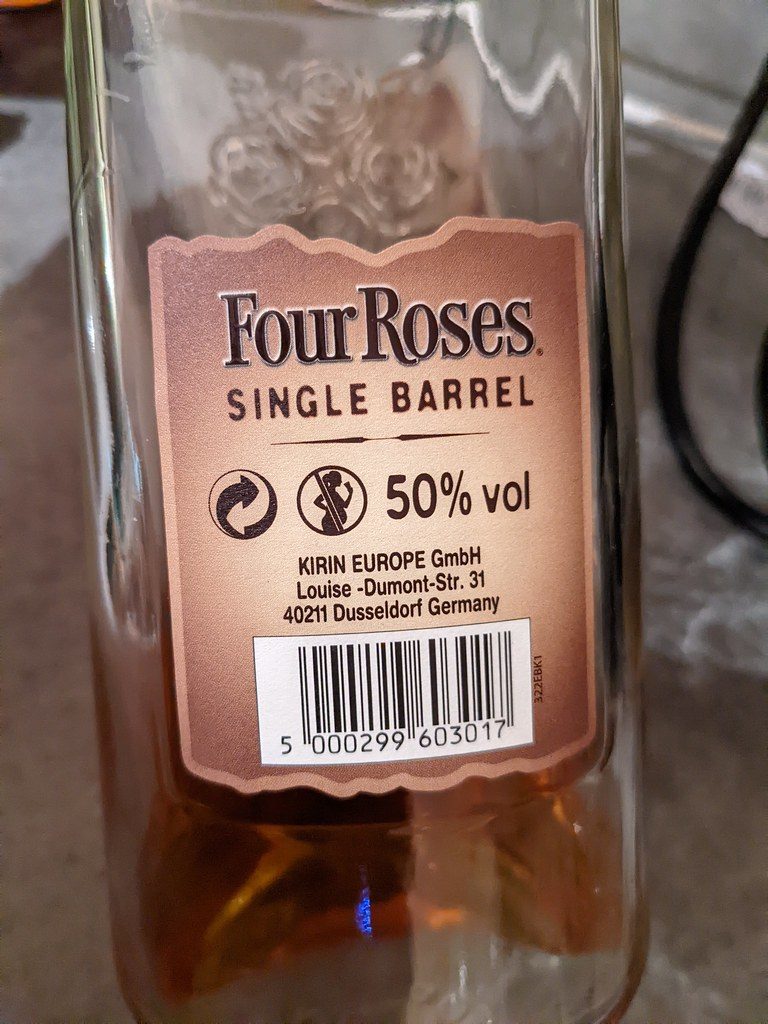
There is no single best Four Roses Private Selection for every bourbon drinker because the recipe code identifies the distillate’s mash bill and yeast strain, while the individual barrel still has its own age, warehouse history, proof, and tasting character. The useful choice is a flavor direction, not a universal ranking. Four Roses’ current official material uses the phrase Private Barrel Selections for selected barrels, and the bottle or seller information for a particular release is the source for that barrel’s own details.
Four Roses is unusual because it makes ten bourbon recipes by combining two mash bills with five proprietary yeast strains. A Private Barrel Selection can make one of those recipes easier to study on its own. That does not make every bottle with the same code identical, and it does not justify assigning an expected price, proof, age, or retail availability to a code. Read the release’s actual label and tasting material, then use the recipe as a starting point.
Read the four-letter recipe code first
Four Roses explains the code as production facility, mash bill, distillation process, and yeast strain. The first letter is O for the Four Roses Distillery and the third is S for straight whiskey. The informative characters for choosing a recipe are the second letter, B or E, and the final yeast letter, V, K, O, Q, or F.
Mash bill B is 60% corn, 35% rye, and 5% malted barley. Mash bill E is 75% corn, 20% rye, and 5% malted barley. B therefore uses more rye, while E uses more corn. The yeast letters are V for delicate fruit, K for slight spice, O for rich fruit, Q for floral essence, and F for herbal notes. Those are Four Roses’ recipe descriptors, not a promise that every barrel will taste the same way to every person.
Best starting direction for rye and delicate fruit: OBSV
OBSV combines the B mash bill with V yeast. Four Roses describes the recipe as “delicate fruit and rye.” It is a useful first code for someone who wants to understand how the rye-heavier B mash bill sits beside the distillery’s fruit-focused V yeast. The current core Single Barrel OBSV bottling also makes this recipe a recognizable reference point within the Four Roses range.
That familiarity is a reason to compare, not a reason to assume a Private Barrel Selection will reproduce the core bottling. A single barrel may be older or younger, at a different proof, and drawn from a different warehouse position. Look for OBSV when the release notes suggest a balanced intersection of fruit and rye; pass when the particular barrel’s documented profile does not sound appealing.
Best starting direction for baking spice: OESK
OESK combines the E mash bill with K yeast. Four Roses’ recipe page lists it as “baking spice,” and a dedicated distillery feature describes the lower-rye mash bill and spicy yeast as producing a balanced, mellow, rich bourbon. The official current bourbon page also uses baking spices, mellow oak, earthy tea leaves, caramel, and a smooth finish in its tasting description for the OESK Single Barrel expression.
Choose OESK as a recipe direction when baking spice is more attractive than an overtly rye-led profile. The E mash bill has less rye than B, but that does not mean it is flavorless or that every OESK will be sweet. Barrel maturation and bottling details still shape the release. Treat the code as a map to the base recipe and the label as the evidence for the actual bottle.
Best starting direction for rich fruit and vanilla: OESO
OESO pairs the E mash bill with O yeast. Four Roses describes it as “rich fruit and vanilla.” This makes it the logical code to examine when a drinker wants the distillery’s rich-fruit yeast character alongside the more corn-forward E mash bill. It is not a claim that the bottle will taste like a flavored product; these are the distillery’s flavor descriptors for the underlying recipe.
Compare an OESO selection with the barrel’s published notes if available. A note emphasizing fruit and vanilla may align with the official recipe profile, while notes stressing oak or spice can reflect the particular barrel. The point is not to reject a barrel that differs from an expectation, but to avoid buying by code alone.
Best starting direction for floral character: OBSQ and OESQ
Q is Four Roses’ floral yeast strain. OBSQ is described as “rye and light floral character,” while OESQ is described as “delicate grains and floral character.” These two codes are the clearest comparison for someone interested in floral notes because the yeast stays the same while the mash bill changes from rye-heavier B to more-corn E.
The distillery’s OESQ feature describes aromas of lavender, honeysuckle, and rose petals and says the E mash bill gives a slightly sweeter impression than OBSQ. Those details are useful vocabulary, not a guarantee. Floral notes can be subtle, and a person who strongly dislikes that profile should not select a barrel merely because it is an uncommon recipe code. Compare proof, age statement if shown, and the release’s own notes before making a decision.
Best starting direction for herbal notes: OBSF and OESF
F is the herbal yeast strain. Four Roses lists OBSF as “delicate rye and mint” and OESF as “light grain and mint.” These codes let a drinker compare the same herbal yeast direction through the two mash bills. The distillery’s Small Batch Select material identifies OBSF and OESF among the recipes in that blend, which is another official indication that F contributes a distinct herbal and mint character.
Choose an F recipe only when herbal or mint-like notes sound appealing. Do not treat either code as a guaranteed “rare” or “best” bottle, and do not infer a current distribution pattern from old retailer pages. The correct question is whether the actual private-barrel release supplies enough information for its recipe and barrel character to make sense for your palate.
The remaining recipe directions
OBSK combines the B mash bill and K yeast; Four Roses calls it “rye and baking spice.” OBSO combines B and O for “rich fruit.” OESV combines E and V for “delicate fruit and caramel.” These are not lesser recipes because they are not placed at the top of a ranking. They simply offer different starting points: OBSK for rye with baking spice, OBSO for B-mash-bill rich fruit, and OESV for the E-mash-bill version of delicate fruit plus caramel.
A useful tasting comparison is to keep one variable fixed. Compare OBSK with OESK to focus on B versus E with the K yeast, or OBSV with OESV to focus on B versus E with the V yeast. Compare OESK with OESO to focus on K versus O yeast inside the E mash bill. This will teach more than treating the ten codes as a single quality ladder.
How to evaluate a particular Private Barrel Selection
- Confirm the exact product name and recipe code. Do not confuse a core Four Roses Single Barrel, Small Batch Select, a Limited Edition blend, and a Private Barrel Selection.
- Read the four-letter code. Use B or E for the mash-bill direction and the final letter for the yeast direction.
- Read the individual barrel information. Consider the stated proof, age if listed, warehouse or barrel information if provided, and the selector’s tasting notes.
- Do not use a recipe as a price guide. A code does not establish a current retail price or indicate that the bottle is currently stocked in a particular place.
- Compare within a shared variable. Two codes that share the same yeast or mash bill make a more informative comparison than a broad “best recipe” claim.
The best Four Roses Private Selection is the one whose actual barrel information supports a flavor direction you want to explore. OBSV is a useful fruit-and-rye reference; OESK is a baking-spice route; OESO points toward rich fruit and vanilla; Q recipes explore floral character; and F recipes explore herbal or mint notes. Use the official ten-recipe grid to decode the label, then let the particular barrel—not an old ranking or price claim—settle the choice.