

As an Amazon Associate and eBay Partner, toptenpick.com earns from qualifying purchases. Prices and availability are subject to change.
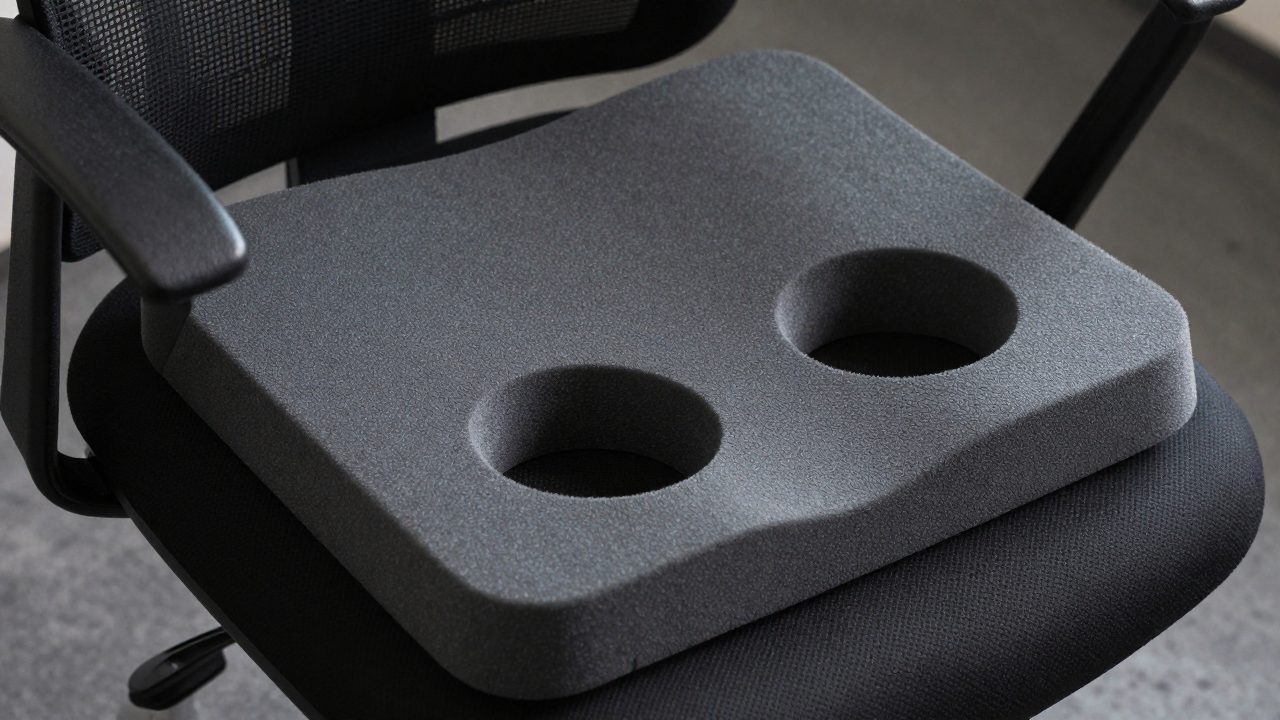
Padding does not relieve pressure on a bone. Only a hole does. That is the whole principle, and it is why so many people buy an expensive memory-foam cushion, feel better for twenty minutes, and are back to where they started by lunchtime. Foam compresses. Sit on it long enough and your weight arrives at the same two points it always did, just more slowly. If the goal is to take load off the ischial tuberosities — the two bony points you can feel under each buttock — then what has to be under them is open space.
Which brings up the mistake that sends most of this money to the wrong product. The overwhelming majority of cushions sold for “tailbone and sciatica relief” have a single U-shaped notch cut out of the back edge. That notch is for the coccyx. The coccyx sits at the base of the spine, behind and between the sit bones, and a cushion shaped for it does nothing whatsoever for ischial bursitis — your sit bones land on solid foam either side of the notch. What this condition needs is two separate openings, one under each sit bone, positioned laterally rather than centrally. They look quite different once you know to look.
Placement decides whether any cutout cushion works at all. Sit bone spacing varies between people by a couple of inches, and a cushion whose openings are too close or too far apart puts the rim of the hole directly under the bone — which concentrates your entire weight onto a narrow edge of foam and is worse than no cutout at all. Measure before you buy: sit on a piece of corrugated card on a hard chair for a minute, stand up, and the two compressed marks are your spacing, centre to centre.
The supporting foam matters too, and firmer is usually better. A soft cushion lets you sink until the bone finds the bottom; a firm one holds the thighs and glutes up so the openings stay open under load.
Two honest caveats. A cushion manages a symptom while you sit; it does not treat a bursa. Ischial bursitis is commonly linked to prolonged sitting on hard surfaces, and to tight or overloaded hamstrings, which attach right at that bone — which is why the thing that usually helps most is standing up more often, not shopping. And pain in this area has several possible causes, some of which need a clinician rather than a cushion. If it is not improving, or it radiates down the leg, get it looked at properly.
The list runs from twin-opening designs through to the general-purpose cushions that help for different reasons.
| # | Product | Price | Where to buy |
|---|---|---|---|
| 1 | Aylio Socket Seat Cushion | $45–$70 | Amazon · eBay |
| 2 | ComfiLife Gel Enhanced Seat Cushion | $35–$50 | Amazon · eBay |
| 3 | Inflatable Ring Cushion (donut) | $15–$30 | Amazon · eBay |
| 4 | Purple Double or Royal Seat Cushion | $60–$120 | Amazon · eBay |
| 5 | Vaunn Medical Coccyx and Sit Bone Relief Cushion | $30–$50 | Amazon |
| 6 | Wedge Cushion | $25–$45 | Amazon · eBay |
| 7 | Sheepskin or Fleece Seat Pad | $25–$60 | Amazon · eBay |
| 8 | Gel Seat Cushion, Honeycomb Type | $20–$40 | Amazon · eBay |
| 9 | Bicycle Saddle with Central Cutout | $40–$120 | Amazon |
| 10 | Standing Desk Converter | $120–$300 | Amazon · eBay |
The picks, in detail

Aylio Socket Seat Cushion
The design that matches the anatomy: two contoured openings roughly 3.5 inches across and spaced about 6 inches centre to centre, so each sit bone sits over open air while firm foam carries the thighs and glutes. It is the least-compromised version of the idea on the mass market, and it is built firm rather than plush, which is correct here even though it feels less inviting in the shop.
- Twin sit-bone openings, around 6 inches centre to centre
- Firm high-density foam
- Removable washable cover
- Non-slip base
- Openings positioned for the sit bones, not the coccyx
- Firm enough that the openings stay open under load
- Also relieves hamstring attachment pressure
- Fixed opening spacing suits a range, not everyone
- Firm foam feels unforgiving for the first week
- Bulky in a car seat
ComfiLife Gel Enhanced Seat Cushion
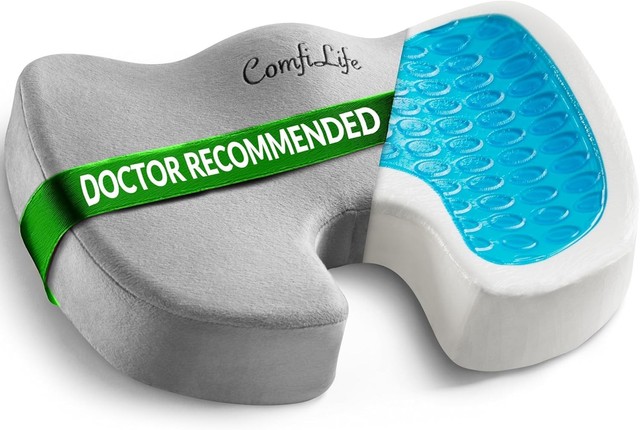
The best-selling cushion in this category and a reasonable general-purpose choice, with the honest caveat that its cutout is the U-shaped coccyx type at the rear. It helps ischial pain indirectly — high-density foam with a gel layer distributes load better than a chair does, and the front slopes to reduce thigh pressure — but it is not offloading your sit bones, and it is worth understanding that before buying.
- U-shaped coccyx cutout at the rear
- High-density foam with a gel layer
- Non-slip rubber base
- Washable cover
- Genuinely good general-purpose cushion
- Gel layer resists bottoming out better than plain foam
- Cheap and widely available
- The cutout is for the tailbone, not the sit bones
- Still solid foam directly under each ischial tuberosity
- Gel adds weight

Inflatable Ring Cushion (donut)
The oldest version of the idea and still effective for the simple reason that a ring puts a genuine hole under the whole sitting surface rather than under two specific points. The inflatable version has one real advantage over foam here: you can adjust the pressure, which effectively adjusts how deep the opening is and how much of the rim you rest on. Cheap enough to try before a serious cushion.
- Inflatable ring with adjustable firmness
- Packs flat when deflated
- Fabric or flocked cover
- Very light
- Adjustable pressure tunes the effective relief
- Cheapest way to test whether offloading helps
- Packs away for travel and work
- The rim can put pressure on the outer thighs and perineum
- Unstable to sit on — some find it worse
- Slow leaks are common

Purple Double or Royal Seat Cushion
A different engineering answer to the same problem: a grid of hyperelastic polymer columns that buckle under concentrated load and stay supportive elsewhere, so the material itself gives way beneath a bony point rather than compressing uniformly. It is the closest thing to a cutout without having one, and the grid also breathes far better than foam, which matters over a full working day.
- Hyperelastic polymer grid that buckles under point load
- Open grid structure for airflow
- Non-slip cover
- Heavy — around 7 lb
- Column collapse under bony points mimics a cutout
- Runs notably cooler than foam or gel
- Very durable
- Expensive
- Heavy to move between chairs
- Some find the grid texture odd through thin clothing
Vaunn Medical Coccyx and Sit Bone Relief Cushion
A medical-supply version that combines a rear coccyx cutout with contoured wells for the sit bones, which is a sensible compromise if you are not certain which structure is actually sore — and plenty of people are not, because the area is small and the pain refers. Firm orthopaedic foam rather than plush, and built for chair or wheelchair use.
- Coccyx cutout plus contoured sit-bone wells
- Firm orthopaedic-grade foam
- Medical supply construction
- Non-skid base
- Covers both structures if the diagnosis is uncertain
- Firm enough not to bottom out
- Built for all-day use
- Wells are contoured rather than open, so relief is partial
- Plain clinical appearance
- Fit depends on matching the contours to your spacing
Wedge Cushion
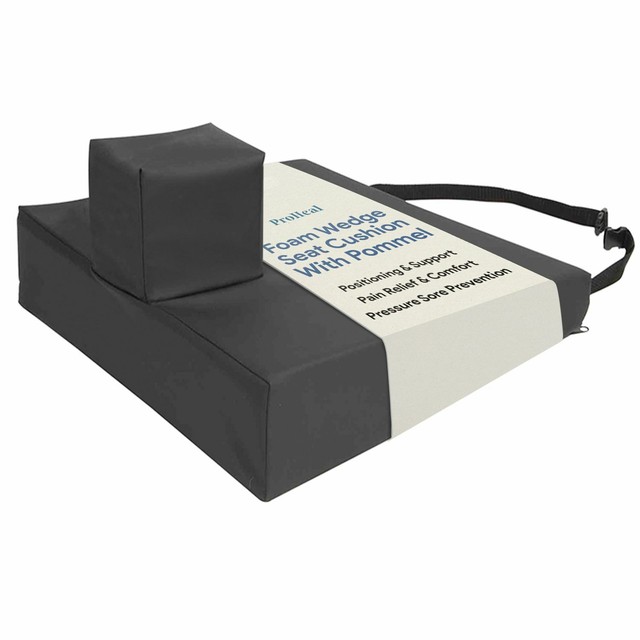
Not a cutout at all, and worth understanding because it works on a different mechanism: tilting the pelvis forward rotates the sit bones backwards and shifts contact off the bursa onto the soft tissue in front of it. It also opens the hip angle, which relieves the hamstring tension that often accompanies this condition. The cheapest thing on the list that addresses the actual cause rather than the pressure.
- Sloped foam wedge, thicker at the rear
- Available in several angles
- Some versions add a coccyx cutout
- Light and portable
- Changes pelvic angle rather than just padding
- Helps the hamstring component, not only the pressure
- Inexpensive and light
- Alters your posture, which some chairs and desks do not suit
- Can slide forward on a slippery seat
- Too steep an angle causes its own back ache

Sheepskin or Fleece Seat Pad
A pressure-care staple rather than a bursitis-specific product, and it earns a place because a lot of people with this condition also have skin sensitivity at the same spot from sitting. Natural sheepskin distributes pressure and manages moisture and heat better than any foam. It will not offload the bone, but as a layer over a cutout cushion it solves a second problem the cutout creates.
- Natural or synthetic sheepskin pile
- Pressure distribution and moisture management
- Machine washable in most cases
- Works layered over another cushion
- Excellent for heat and moisture over long sitting
- Pairs well on top of a firm cutout cushion
- Comfortable on hard edges and rims
- No offloading — it is a surface, not a structure
- Natural sheepskin needs careful washing
- Hot in summer despite the moisture handling
Gel Seat Cushion, Honeycomb Type
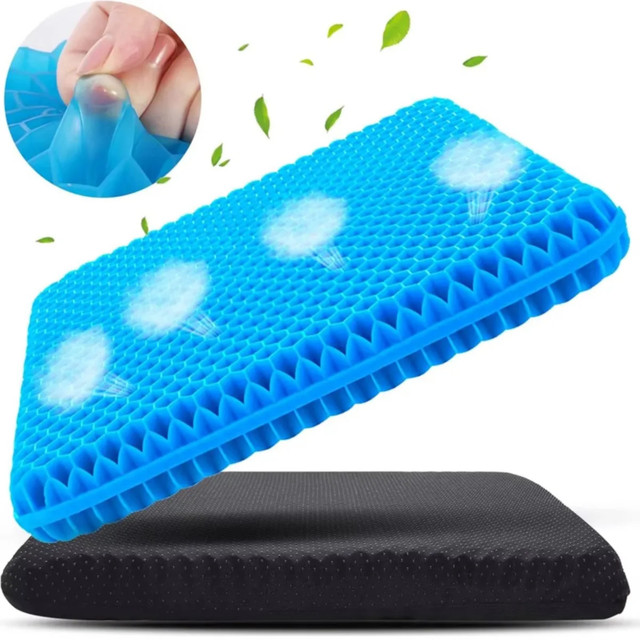
An open honeycomb of soft elastomer, which flexes under load while leaving actual air gaps through the structure. It is the cheap approximation of the polymer-grid idea, and it has the useful property of being completely washable and not absorbing anything. Thin ones bottom out on a hard chair, so buy the thicker version if the chair underneath is unforgiving.
- Open honeycomb elastomer structure
- Fully washable
- Available in several thicknesses
- Breathable by construction
- Air gaps through the structure rather than solid fill
- Wipes clean completely
- Cheap
- Thin versions bottom out on a hard seat
- Elastomer gets slippery and can slide
- Firmness changes noticeably with temperature
Bicycle Saddle with Central Cutout
Included because cycling is one of the common aggravators of this condition and a lot of people arrive at this article from that direction. A saddle with a relief channel and, more importantly, the correct width for your sit bone spacing is what stops a bike making it worse — most bike shops will measure that spacing on a gel pad in a few minutes and it is the single most useful fitting number there is.
- Central relief channel or full cutout
- Sold in specific widths by sit bone spacing
- Various padding densities
- Standard rail fitment
- Addresses the aggravating activity rather than the office chair
- Width matching is measurable and objective
- Shops will measure your spacing free
- Only relevant if you cycle
- Wrong width makes things distinctly worse
- Soft saddles are counterproductive — firmer is usually correct
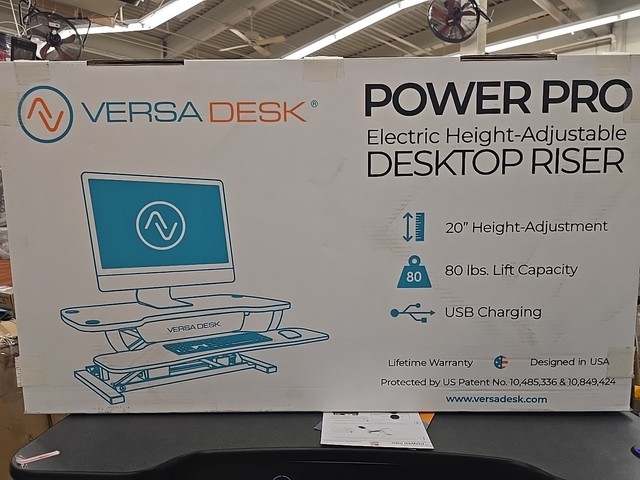
Standing Desk Converter
The least fun recommendation on the page and the one most likely to actually fix it. This condition is strongly associated with prolonged sitting, and no cushion changes the fact that you are still loading the same structure for eight hours. A converter that sits on an existing desk is the cheap route to breaking the day up, and alternating is what helps — standing all day simply moves the problem somewhere else.
- Sits on an existing desk, no replacement needed
- Gas-spring or manual height adjustment
- Single and dual monitor sizes
- No assembly on most models
- Addresses the cause rather than the symptom
- Works with the desk you already own
- Benefits are not limited to this condition
- Considerably more expensive than any cushion
- Heavy, and takes up desk depth
- Standing all day causes its own problems — alternate
Buying tips
- Check which cutout you are buying. A single U-shaped notch at the back edge is for the tailbone; ischial bursitis needs two separate openings, one under each sit bone, set out to the sides.
- Measure your sit bone spacing before ordering. Sit on corrugated card on a hard chair for a minute, stand, and measure between the two compressed marks — a cushion whose rim lands under the bone is worse than no cutout.
- Choose firm over plush. Soft foam lets you sink until the bone reaches the bottom; firm foam holds the thighs up so the openings stay open under your weight.
- Remember that padding cannot relieve a bony prominence — only open space can. That single fact explains why most memory-foam cushions stop helping after twenty minutes.
- Look at your hamstrings, not just your chair. They attach at the same bone, and tightness or overload there is a common driver — which is why stretching and load management often do more than any purchase.
- Set a timer to stand up every 30 to 45 minutes. It is the intervention with the best evidence behind it and it costs nothing.
- Check the saddle if you cycle. Saddle width should match your sit bone spacing, most shops measure it free, and a too-soft saddle usually makes this worse rather than better.
- See a clinician if it is not improving, if it woke you at night, or if the pain travels down the leg. Several different problems present in this exact spot and a cushion is the right answer to only one of them.
As an Amazon Associate and eBay Partner, toptenpick.com earns from qualifying purchases. Prices and availability are subject to change.