

As an Amazon Associate and eBay Partner, toptenpick.com earns from qualifying purchases. Prices and availability are subject to change.
Before the ranking, the thing that explains why this argument never resolves: Corrosion of Conformity is three different bands wearing one name, and most people arguing about “the best COC album” are arguing about which band they mean.
There is the 1984–85 hardcore and crossover band — fast, political, Mike Dean shouting, closer to Black Flag than to anything with a riff you could call Southern. There is the 1991 Blind band, with Karl Agell singing and a new guitarist named Pepper Keenan, which is heavy metal rather than hardcore and sounds like neither the thing before it nor the thing after. And there is the band from Deliverance onward, with Keenan on lead vocals, which is a Southern heavy rock group with Sabbath in its bones and almost nothing left of the hardcore record that started it.
So a ranking has to say which of those it is ranking, and this one ranks all three against each other honestly. If you came from punk, the top of this list will look wrong. If you came from Deliverance, the bottom will. That is the band, not the list.
One practical note that shapes the whole discography: the Keenan-era records are the ones that sold, and it is not close. Deliverance was certified gold by the RIAA in 2023 for over 500,000 US sales and Rolling Stone put it at number 31 among the best rock albums of 1994; Wiseblood had managed around 130,000 by 1999. The hardcore records sold in the thousands. Commercial reach and artistic reputation point in genuinely different directions here, which is the other half of why the argument persists.
Ten albums below, ranked, with the pressings worth buying.
| # | Product | Price | Where to buy |
|---|---|---|---|
| 1 | Deliverance (1994) | $12–$35 | Amazon · eBay |
| 2 | Blind (1991) | $12–$35 | Amazon · eBay |
| 3 | Animosity (1985) | $12–$30 | Amazon · eBay |
| 4 | Wiseblood (1996) | $10–$30 | Amazon · eBay |
| 5 | In the Arms of God (2005) | $12–$35 | Amazon · eBay |
| 6 | No Cross No Crown (2018) | $12–$35 | Amazon · eBay |
| 7 | America’s Volume Dealer (2000) | $10–$28 | Amazon · eBay |
| 8 | Corrosion of Conformity (2012, self-titled) | $12–$30 | Amazon · eBay |
| 9 | Technocracy (1987, EP) | $10–$25 | Amazon · eBay |
| 10 | Eye for an Eye (1984) | $12–$30 | Amazon · eBay |
The picks, in detail

Deliverance (1994)
The record that made them, and the one that most people mean. Pepper Keenan’s first album as lead singer turns a metal band into a Southern rock band with a bad mood, and “Clean My Wounds” and “Albatross” are the two songs that got them onto radio and stayed there. Certified gold in 2023, thirty years after release, which is its own kind of verdict.
- Released 1994 on Columbia
- First album with Pepper Keenan as lead vocalist
- RIAA certified gold in 2023
- Rolling Stone ranked it #31 among the best rock albums of 1994
- The band’s definitive statement and best-known songs
- Holds together as an album rather than a run of singles
- Widely available on CD and vinyl
- Almost nothing here for a listener who came for the hardcore records
- Long — the back half sags slightly on a single sitting

Blind (1991)
The strangest record in the catalogue and, for a certain kind of listener, the best. Karl Agell sings, Keenan has just joined on guitar, and the band is somewhere between the hardcore they were and the Southern rock they became — which gives it a tension none of the later albums have. “Vote With A Bullet” is sung by Keenan and is the clearest signpost to where they went next.
- Released 5 November 1991
- Karl Agell on lead vocals; Pepper Keenan on guitar
- Bridges the hardcore and Southern metal eras
- Includes “Vote With A Bullet”, Keenan’s first lead vocal
- A genuinely distinctive record that sounds like no other COC album
- The tension between two eras is the point, not a flaw
- Strong riffs throughout
- Orphaned by the fanbase — neither camp fully claims it
- Agell’s vocals divide opinion sharply
- Long running time
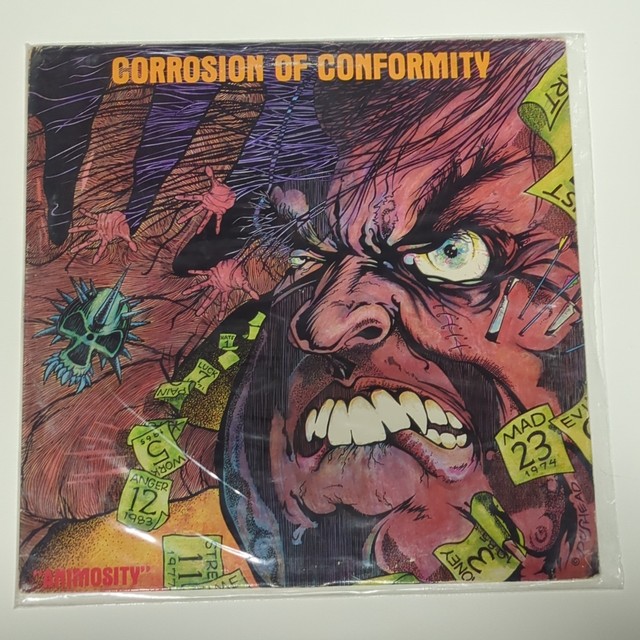
Animosity (1985)
The crossover record, and the one the hardcore half of the argument is defending. Released in October 1985 with Mike Dean on vocals and bass, it is faster, angrier and far more political than anything the band made later, and it is routinely cited as one of the records that welded punk and thrash together. Short, violent and nothing like Deliverance.
- Released 25 October 1985
- Mike Dean on vocals and bass
- Crossover thrash — punk tempos with metal riffing
- Frequently cited as a foundational crossover record
- Historically the most important thing they did
- Relentless and short — no filler
- The definitive document of the early band
- Raw 1985 production that some listeners cannot get past
- Nothing in common with the band most people know
- Vocals are shouted rather than sung

Wiseblood (1996)
The follow-up to Deliverance, heavier and darker and commercially a step down — roughly 130,000 copies by 1999 against Deliverance‘s eventual gold. James Hetfield guests on “Man or Ash”, which tells you where the band sat in the mid-nineties. A better record than its sales suggest, and the one that longtime fans most often say is underrated.
- Released 1996 on Columbia
- James Hetfield guest vocal on “Man or Ash”
- Around 130,000 US copies by 1999
- Heavier and less radio-oriented than Deliverance
- Heavier and more consistent than its reputation
- The strongest guitar tone on any COC record
- Cheap secondhand
- No single as strong as “Clean My Wounds”
- Sits in Deliverance’s shadow and always will

In the Arms of God (2005)
The most musically ambitious album in the catalogue, with Stanton Moore of Galactic on drums bringing a genuinely different feel — looser, funkier, more willing to sit in a groove than a riff. It is the Keenan-era record that rewards repeat listening most, and the one most likely to be somebody’s surprise favourite once they get past the first two.
- Released 2005 on Sanctuary
- Stanton Moore (Galactic) on drums
- Looser, groove-oriented playing
- The last Keenan album before a long hiatus
- The most interesting drumming on any COC record
- Grows substantially on repeat listens
- Ambitious without losing the riffs
- Long and demanding — not a first COC album
- The looser feel frustrates listeners who want the punch of Deliverance

No Cross No Crown (2018)
Keenan’s return after more than a decade, and a far better record than a reunion album has any right to be. It goes back to the Deliverance and Wiseblood template deliberately rather than trying to modernise, and the short instrumental interludes between tracks give it a shape the mid-period albums lacked. The best starting point among the recent records.
- Released 2018 on Nuclear Blast
- Pepper Keenan’s first album back since 2005
- Short instrumental interludes between tracks
- Modern production of the classic-era sound
- A genuinely good late-career record, not a nostalgia exercise
- Best-sounding production in the catalogue
- Widely available new
- Covers ground the band already covered better in 1994
- The interludes divide listeners

America’s Volume Dealer (2000)
The most melodic and most accessible thing they made, and for that reason the most argued-about. The Southern rock element is fully in charge, the hardcore is gone entirely, and the songs are shorter and cleaner. If you liked Deliverance for the tunes rather than the weight, this is the one. If you liked it for the weight, this is where you get off.
- Released 2000 on Sanctuary
- The most melodic album in the catalogue
- Shorter, more conventional song structures
- Fully Southern rock in orientation
- The easiest COC album to play to somebody else
- Strong songwriting throughout
- Inexpensive used
- The lightest record here by some distance
- Divides the fanbase more than any other album
- Production is of its moment

Corrosion of Conformity (2012, self-titled)
The reunion nobody expected — the Animosity trio back together with Mike Dean singing and no Pepper Keenan at all. It is not a hardcore record, but it is recognisably the same three people, and it sounds genuinely like a band rather than a legacy act going through it. The best album here for anyone whose COC is the early one.
- Released 2012 on Candlelight
- The Animosity-era trio, Mike Dean on vocals
- No Pepper Keenan
- Sludgier and more Sabbath-leaning than the early records
- A real record, not a cash-in
- The early-era fanbase’s best modern option
- Excellent bass playing throughout
- Listeners expecting Keenan will be disappointed
- Less immediate than anything from the Columbia years

Technocracy (1987, EP)
A six-track EP with Simon Bob Sinister on vocals, and the odd one out in every sense — a third singer, a transitional sound and barely twenty minutes long. Worth owning as the missing link between Animosity and Blind, and worth knowing about before you buy, because an EP arriving when you expected an album is the most common complaint about it.
- Released 1987
- Simon Bob Sinister on vocals
- Six tracks, EP length
- Transitional between the hardcore and metal eras
- Fills the gap between two very different eras
- Short and focused
- Cheap
- It is an EP, not an album — check before buying
- A third vocalist who appears nowhere else
- Hard to find on vinyl

Eye for an Eye (1984)
The debut, and a genuine hardcore record — fast, raw and recorded on almost nothing. It is historically important and it is not where anyone should start; the fidelity is punishing and the songs go past before they register. Buy it when you already love Animosity and want to hear where that came from.
- Debut album, released 1984
- Hardcore punk, before the crossover sound
- Very short songs, very raw production
- Mike Dean on vocals
- The true origin point of the band
- Uncompromising in a way nothing later is
- Essential context for the early era
- Production is genuinely difficult for most listeners
- The worst possible first COC album
- Reissue pressings vary in quality
Buying tips
- Decide which band you want before you buy. Hardcore COC and Southern-rock COC share a name and almost nothing else.
- Start with Deliverance if you have never heard them, and Animosity if Deliverance disappoints you — those two are the poles.
- Blind is the record most often skipped and most often regretted. It belongs to neither camp, which is what makes it interesting.
- Check whether you are buying an album or an EP. Technocracy is six tracks, and that surprises people at checkout.
- Vinyl reissues of the early records vary a lot. Read the pressing details rather than assuming a new repress sounds better than the CD.
- The Columbia-era albums are cheap secondhand. Deliverance and Wiseblood turn up constantly for a few dollars.
- If you like In the Arms of God, listen to Stanton Moore’s other work — the drumming is why that record sounds different.
- Sales and reputation point different ways here. The gold record and the historically important record are not the same album.
As an Amazon Associate and eBay Partner, toptenpick.com earns from qualifying purchases. Prices and availability are subject to change.