


As an Amazon Associate and eBay Partner, toptenpick.com earns from qualifying purchases. Prices and availability are subject to change.
Carbon fiber pool cue shafts trade a bit of the traditional wood feel for lower deflection, more consistent performance across humidity, and durability a maple shaft can’t match. These six shafts, from the industry benchmark to a hybrid carbon-wood option, cover the range serious players actually buy in 2026.
| # | Product | Price | Where to buy |
|---|---|---|---|
| 1 | Predator REVO Carbon Fiber Shaft | $400-$500 | Amazon · eBay |
| 2 | Cuetec Cynergy CTCF Carbon Fiber Shaft (12.5mm) | $200-$350 | Amazon · eBay |
| 3 | Mezz Ignite Carbon Fiber Shaft | $430-$460 | Amazon · eBay |
| 4 | McDermott Defy Carbon Fiber Shaft | $395-$480 | Amazon · eBay |
| 5 | Jacoby Black V4 Carbon Fiber Shaft | $350-$450 | Amazon · eBay |
| 6 | Lucasi Pro Carbon InFUZED Shaft | $300-$400 | Amazon · eBay |
The picks, in detail

Predator REVO Carbon Fiber Shaft
The shaft everyone else is measured against, with the lightest front-end mass and lowest deflection Predator makes.
- Proprietary carbon fiber composite construction
- Lightest front-end mass and lowest rate-of-rise taper in Predator’s lineup
- About 5-10% more accurate than Predator’s third-generation shafts depending on shot type
- Industry benchmark for low-deflection performance
- Smooth finish and durable construction
- Most expensive shaft on this list

Cuetec Cynergy CTCF Carbon Fiber Shaft (12.5mm)
The best-value carbon shaft, with a medium-stiff flex profile that gives more feedback than an ultra-rigid shaft.
- 12.5mm tip diameter
- Medium-stiff flex profile with noticeable “give”
- Available as a standalone shaft or full Cynergy cue
- Strong low-deflection performance well under the REVO’s price
- Popular as a standalone upgrade shaft
- Flex profile feels softer than Predator or Mezz to players used to a stiffer hit

Mezz Ignite Carbon Fiber Shaft
A Japanese-engineered shaft using a different fiber geometry and vibration-dampening core than Predator or Cuetec.
- Ignite Composite Laminate Technology (silencer foam, IG plate ferrule, IG tip plate)
- Available in 12.2mm and 12.6mm tip diameters
- Wavy joint or United joint options
- Hit feels closer to a high-grade Japanese maple shaft than most carbon options
- Vibration dampening reduces unwanted feedback
- Joint system must match your existing cue

McDermott Defy Carbon Fiber Shaft
A US-made shaft using aerospace-derived SmacWrap technology for a quiet, soft-feeling hit.
- SmacWrap vibration-dampening technology
- Super-smooth coating that glides through the fingers like wood
- Stays straight regardless of humidity, lifetime warranty including warpage
- Warranty covers warpage, a genuine concern with humidity swings
- Made in the USA
- Similar price bracket to Mezz Ignite without the same brand cachet among purists
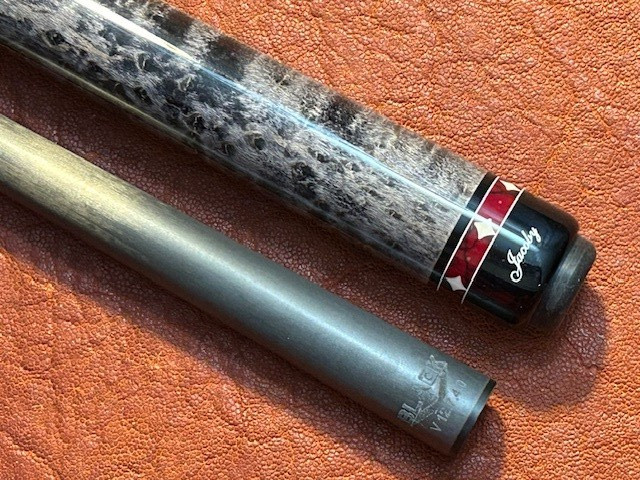
Jacoby Black V4 Carbon Fiber Shaft
A shaft built around a uniquely soft-hitting fill, with a thinned tip-end wall to cut squirt.
- Machined ferrule with thinner wall near the tip to reduce tip mass
- Available in 11.8mm, 12.3mm, and 12.7mm tip diameters
- Distinctively soft hit versus other carbon shafts
- Softer feel than most carbon shafts, closer to premium wood
- Multiple tip diameters to match playing style
- Less widely stocked than Predator or Cuetec

Lucasi Pro Carbon InFUZED Shaft
A hybrid carbon-wood shaft that keeps 10-splice low-deflection technology while preserving the feel of a maple shaft.
- 10-splice construction infused with carbon fiber
- Positioned as a bridge between pure carbon and traditional wood
- Compatible with Uni-Loc and radial joint systems
- Good option for players who want some carbon benefits without giving up wood feel entirely
- Compatible with common joint standards
- Doesn’t match a pure carbon shaft’s deflection numbers
Buying tips
- Tip diameter (11.8-12.7mm across these shafts) affects cue ball control more than brand — match it to your current shaft rather than assuming bigger is better.
- Joint system compatibility (Uni-Loc, radial, Wavy, United) determines whether a shaft will fit your existing cue butt — always check this before buying a standalone shaft.
- If you’re on the fence about going full carbon, a hybrid like the Lucasi InFUZED is the lower-risk way to try the technology.
As an Amazon Associate and eBay Partner, toptenpick.com earns from qualifying purchases. Prices and availability are subject to change.