

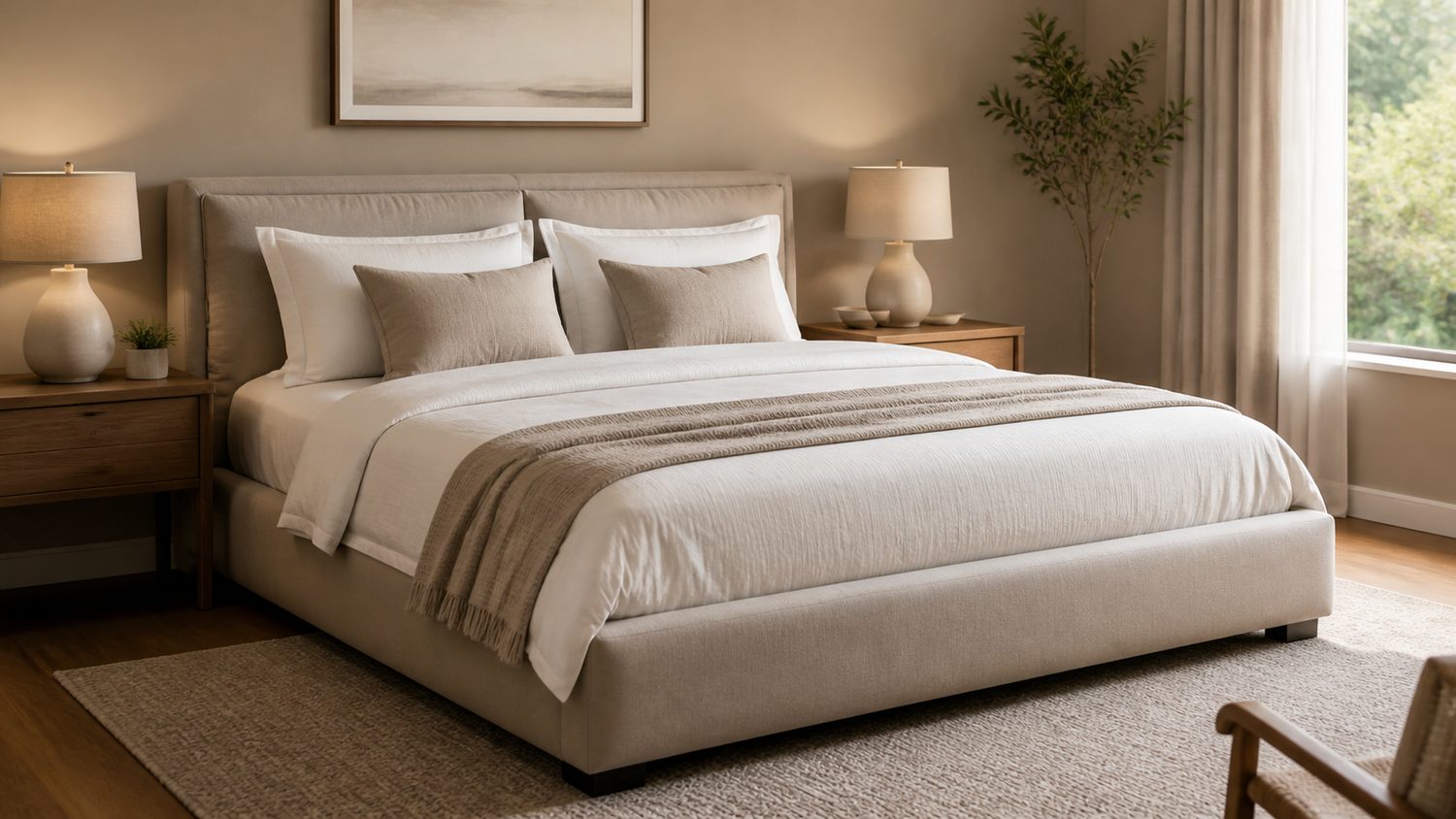
The best bed size for an Airbnb is the size that lets guests sleep comfortably and still use the room. For most one-bed listings and ordinary guest rooms, that is a queen. A queen mattress is 60 by 80 inches, giving two adults a real shared bed without taking as much floor space as a king. The final decision should start with the room, the listing type, and the guests you want to serve—not with the largest mattress that can be squeezed through the door.
Airbnb’s own definition of a Room requires a private bedroom with a door, intended exclusively for the guest, as well as access to common space. That makes the bedroom experience part of the promise a host is making. A bed that technically fits but blocks the closet, luggage area, bedside access, or door can make a private room feel poorly planned. Measure the finished bed footprint, including frame, headboard, nightstands, and opening doors, rather than relying only on mattress dimensions.
Best all-round choice: a queen bed
A queen is the practical default because it balances sleep space and layout flexibility. Its standard 60-by-80-inch mattress gives a couple considerably more width than a full while retaining the same 80-inch length used by a king. That makes it a strong choice for a one-bedroom entire-place listing, a primary bedroom in a two-bedroom home, or a guest room intended for solo travelers and couples.
It also keeps the room versatile. A host can usually retain room for bedside surfaces, a suitcase bench, hooks, or a small desk if the floor plan permits. Those small functions affect a stay more than a theoretical capacity number. Photograph the room after it is fully furnished and make the listing’s sleeping arrangement clear; a queen means one shared sleeping surface, not two separate beds.
Choose a king only when the room supports it
A standard king mattress is 76 by 80 inches: the same length as a queen but 16 inches wider. It can be an excellent primary-suite feature for listings that genuinely have the floor space and target couples who value a larger bed. It can also help an upscale listing communicate its intended experience, provided the rest of the room remains usable.
Do not make “king” a substitute for layout. The extra width can consume the walkway, crowd a dresser, or put guests in the awkward position of climbing over a partner to leave the bed. A king works best after you have checked real pathways from the door to the bed, bathroom, closet, and luggage area. If that test leaves the room cramped, a queen with clear circulation is the better guest experience.
A California king answers a different shape problem. At 72 by 84 inches, it is narrower than a standard king and longer. It is useful only when the room and guest profile justify that specific length; it should not be described simply as a larger king. Confirm the fitted-sheet and protector supply before choosing an uncommon size, because fast turnover depends on having clean backup linens that actually fit.
Two twins or twin XLs for flexible group space
Twin beds are useful in a second bedroom intended for children, friends, or work travelers who do not want to share. A standard twin is 39 by 75 inches, while a twin XL is 39 by 80 inches. The extra length makes a twin XL a better option for many adult guests. Two separate beds can make a family listing more bookable than a second queen because guests with different sleep schedules or unrelated travelers have a clearer arrangement.
Describe the configuration precisely. “Two twins” should mean two independent beds, with current photos that show their spacing and the route around them. Do not advertise a pair as a king unless the mattresses are deliberately joined, the gap is addressed, and the bedding supports that claim. Separate beds also create a linen and cleaning workload: budget for duplicate protectors, sheets, pillows, and blankets.
Use a full bed only for a defined small-room job
A full mattress is 54 by 75 inches. It can be reasonable in a compact room for one adult, teenagers, or a children’s room, but it offers less length and width than a queen. It is rarely the strongest primary bed for an Airbnb that expects adult couples. Calling it “double” without stating its actual setup can create disappointment when guests expect a queen-sized surface.
A full earns its place when it preserves a workable room or lets a host offer a distinct additional sleeping space. If it is the only permanent bed in the listing, make the mattress size visible in the amenities and the room photos. Honest capacity information protects reviews better than an optimistic headline.
Make the layout decision before buying
- Map the room at full scale. Include the bed frame, open doors, drawers, radiators, vents, and the route a guest takes with luggage.
- Match beds to likely parties. A queen suits most couples; a king suits a spacious primary room; two twin XLs suit flexible second-bedroom use.
- Keep the sleeping claim specific. State the number and type of beds rather than converting every surface into a capacity promise.
- Plan linens and replacements. Choose a common size when easy backup sheets and protectors matter to your turnover routine.
- Check the finished room from a guest’s view. Can someone reach both sides of the bed, set down a case, close the door, and use the closet?
For most hosts, start with a queen in the primary room, then use a king only in a room that remains generous after furnishing it. Use twin XLs when separate sleepers are the point, and reserve a full for a deliberately compact or secondary space. The best bed size is the one the photos, listing details, and real room all support.