

As an Amazon Associate and eBay Partner, toptenpick.com earns from qualifying purchases. Prices and availability are subject to change.
The single most confusing thing about Axis & Allies is the naming, and clearing it up settles most of the purchase decision.
The year in the title is the in-game starting date, not the publication date. “1942 Second Edition” does not mean it came out before “1940 Second Edition” — it means the game begins in 1942, after the war is already underway, while the 1940 games start earlier and cover more of it. The 1940 games are in fact the later, larger, more complex design. People reasonably assume a higher year means a newer product and buy backwards into the series.
The second thing: these are not editions of one game in the sense that newer supersedes older. They are differently scaled games sharing a family resemblance, and they are aimed at genuinely different appetites. A game that takes an evening and a game that takes an entire weekend are both legitimate products, and choosing by “which is newest” gets you the wrong one about half the time.
Which leads to the recommendation the community converges on and which is worth stating plainly. If you are new, or returning after years away, buy 1942 Second Edition. Larger board than the original, more pieces, cleaner components, and a scale you can finish. If you are experienced and want the full thing, the 1940 games are what you want — and they are two separate boxes, Europe 1940 Second Edition and Pacific 1940 Second Edition, which combine into the single enormous game usually called Global 1940. That is the part that catches people: “Global 1940” is not a product you can buy in one box.
And a practical note before you commit to the big one. Global 1940 needs a table you can leave set up. The combined board is very large and a game runs many hours across multiple sessions. If your table has to be cleared for dinner, that is a real constraint on which version suits your life.
Ten picks below.
| # | Product | Price | Where to buy |
|---|---|---|---|
| 1 | Axis & Allies 1942 Second Edition | $50-$90 | Amazon · eBay |
| 2 | Axis & Allies Europe 1940 Second Edition | $80-$140 | Amazon · eBay |
| 3 | Axis & Allies Pacific 1940 Second Edition | $80-$140 | Amazon · eBay |
| 4 | Both 1940 Boxes Together (Global 1940) | $160-$280 for both | Amazon · eBay |
| 5 | Axis & Allies Anniversary Edition | $100-$400 used | Amazon · eBay |
| 6 | Axis & Allies 1941 | $30-$55 | Amazon · eBay |
| 7 | Axis & Allies & Zombies | $40-$70 | Amazon · eBay |
| 8 | Battle Box or Storage Solution | $25-$70 | Amazon |
| 9 | Plexiglass or Acrylic Board Cover | $30-$90 | Amazon |
| 10 | Dice Tower and Dice Tray | $20-$50 | Amazon · eBay |
The picks, in detail
Axis & Allies 1942 Second Edition
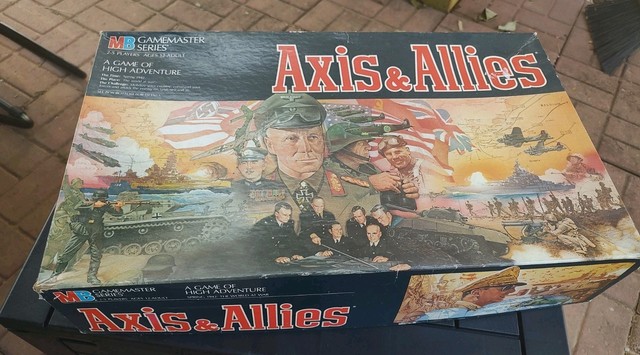
The default recommendation and the right first purchase for almost everyone. It takes the classic design and gives it a much larger board — around 40 by 26 inches — with substantially more miniatures, plastic control markers instead of cardboard chits, and setup cards that get you playing without a forty-minute argument about where things go. The 1942 start date means the war is already in motion, which cuts the slow opening turns. It is the version most likely to actually get played rather than admired.
- Roughly 40 x 26 inch board
- Large plastic miniature count
- Plastic control markers and setup cards
- Starts in 1942, mid-war
- Finishable in a long evening rather than a weekend
- Setup cards remove the worst part of the classic game
- The version most people should start with
- Less strategic depth than the 1940 games
- Mid-war start removes the early-war decisions some players want

Axis & Allies Europe 1940 Second Edition
One half of the big game, and a complete game on its own — which is the point people miss. Played by itself it is a focused European theatre game with a full set of rules, a large board and the deeper systems the 1940 line introduced. Bought with the Pacific box it becomes half of Global 1940. Either way it is a bigger, longer, more demanding proposition than 1942, with mechanised infantry, tactical bombers, air bases and naval dockyards adding real decisions.
- Complete standalone European theatre game
- Combines with Pacific 1940 for Global
- Mechanised infantry, tactical bombers, air and naval bases
- Large board and high piece count
- Plays as a full game on its own
- Deeper unit and construction systems
- Half the price of committing to Global at once
- Long even as a standalone
- Rules complexity is a real step up from 1942
Axis & Allies Pacific 1940 Second Edition
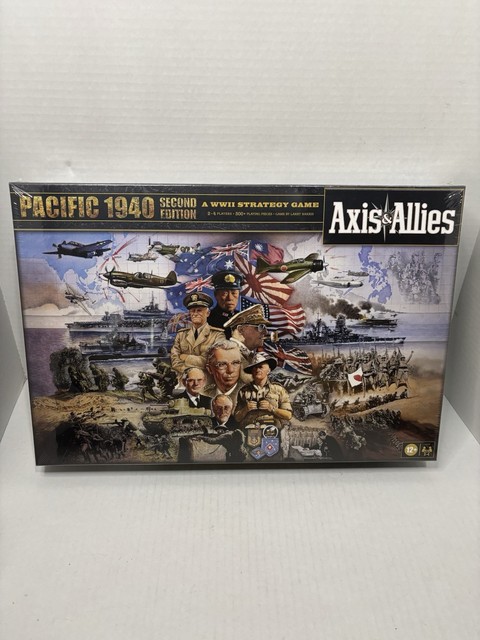
The other half, and equally a complete game alone. The Pacific theatre plays quite differently from Europe — it is dominated by naval movement and island positioning rather than the land fronts that define the European board — so as a standalone it is not simply a smaller version of the other box. If you only ever buy one of the pair, choose by which theatre interests you rather than by size. Combined with Europe 1940 it forms the Global game.
- Complete standalone Pacific theatre game
- Naval and island-focused play
- Combines with Europe 1940 for Global
- Same rules generation as Europe 1940
- Plays very differently from the European board
- Complete game on its own
- Naval focus suits players who find land fronts static
- Fewer players than Europe as a standalone
- Same complexity step up from 1942
Both 1940 Boxes Together (Global 1940)
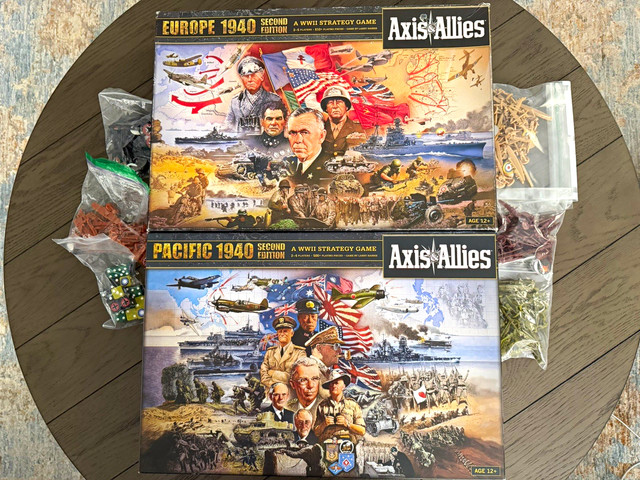
The full experience, and it is worth being explicit that this is two purchases rather than one product. The two boards butt together to make a single enormous world map with six Allied and three Axis factions, and the game that results is the one veterans mean when they talk about Axis & Allies. It is genuinely excellent and it is a commitment — many hours across multiple sessions, on a table large enough to leave it standing. Buy it because you want that, not because it is the biggest.
- Two boxes combining into one world map
- Six Allied and three Axis factions
- Research and technology system
- Multi-session game length
- The definitive version of the game
- Enormous strategic scope
- Each box also plays standalone
- Two full-price purchases, not one
- Needs a table you can leave set up for days

Axis & Allies Anniversary Edition
The collector’s version, and a genuinely different design rather than a reprint with better components. It sits between 1942 and the 1940 games in scope, introduces Italy as a separate power, and came with sculpted pieces and a wooden box in its original release. It has a devoted following and it is out of print, which means second-hand prices vary enormously. Worth seeking out if you want the middle scale; not worth paying collector prices for unless the components matter to you.
- Scope between 1942 and the 1940 games
- Italy as a separate power
- Premium components in the original release
- Out of print
- A distinct design rather than a reprint
- Italy adds a genuine strategic dimension
- Middle scale suits groups who find Global too long
- Out of print with volatile second-hand pricing
- Component condition varies on used copies

Axis & Allies 1941
The short version, and the honest answer for a family or a group that will not sit down for six hours. 1941 is a deliberately trimmed design on a smaller board with fewer territories, aimed at a two to three hour game — which is to say, a game that ends. It is not a lesser 1942; it is a different target. If your group has bounced off Axis & Allies before because it never finished, this is the version to try rather than concluding the series is not for you.
- Smaller board and reduced territory count
- Two to three hour play time
- Simplified from the standard rules
- Lower price
- Actually finishes in an evening
- Good introduction for younger or newer players
- Cheapest entry into the series
- Noticeably less strategic depth
- Experienced players will outgrow it quickly
Axis & Allies & Zombies
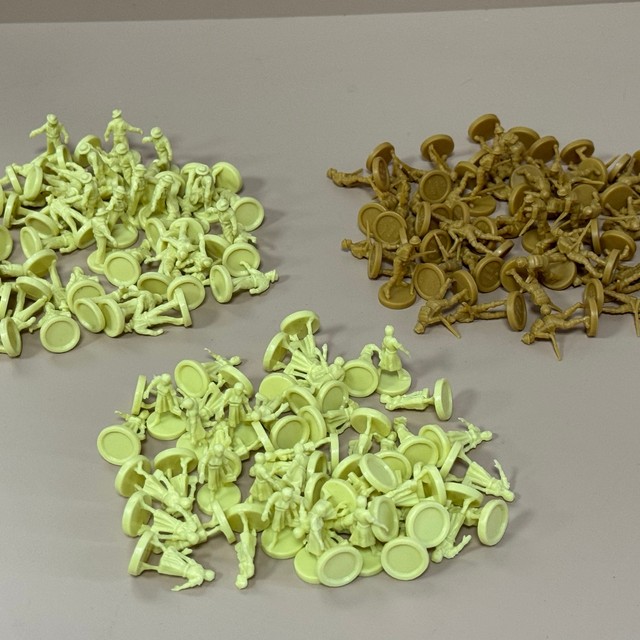
Included because it is a real product and people are surprised by it. It takes the core system and adds a zombie faction that grows on the board and threatens both sides, which changes the calculation from a two-way war into something with a shared problem. It is played for fun rather than as a serious wargame, and on those terms it works — the zombies force cooperation between players who are otherwise enemies. Not the version to buy if you want the historical game.
- Core Axis & Allies system with a zombie faction
- Zombies threaten all players
- Standard-sized board
- Lighter tone
- The shared threat changes the dynamic genuinely
- More approachable for reluctant players
- Works as a lighter evening
- Not the historical game at all
- Serious players will find it frivolous
Battle Box or Storage Solution
The accessory that decides whether a big version gets played again. Global 1940 has an enormous number of small plastic pieces in nine colours, and the factory insert does not sort them — so setup and teardown become a sorting exercise that adds an hour to every session. Compartmented storage boxes, one per nation, turn that into minutes. It is the single most impactful purchase alongside the game itself and it is what stops a large edition quietly becoming a shelf ornament.
- Compartmented plastic storage boxes
- One box or tray per nation
- Latching lids that survive transport
- Sized for standard game pieces
- Cuts setup and teardown from an hour to minutes
- The difference between a game played and a game stored
- Cheap relative to the game
- Takes more shelf space than the original box
- Cheap latches pop open and spill everything
Plexiglass or Acrylic Board Cover
Directly addresses the constraint the introduction names. A large game left set up for days is a game that gets knocked, dusted, and occasionally rearranged by a cat — and a clear rigid sheet over the board protects the position while letting you see it. It also gives you a surface to rest dice and drinks on that is not the map. Cut to the board size, with polished edges. Cheap from a local plastics supplier and far cheaper than restarting a twelve-hour game.
- Clear acrylic or plexiglass sheet
- Cut to board dimensions
- Polished edges
- Protects a game left in progress
- Protects a multi-session game from knocks and pets
- Gives a safe surface for dice and drinks
- Cheap from a local supplier
- Large sheets are awkward to store
- Acrylic scratches and will need replacing eventually
Dice Tower and Dice Tray
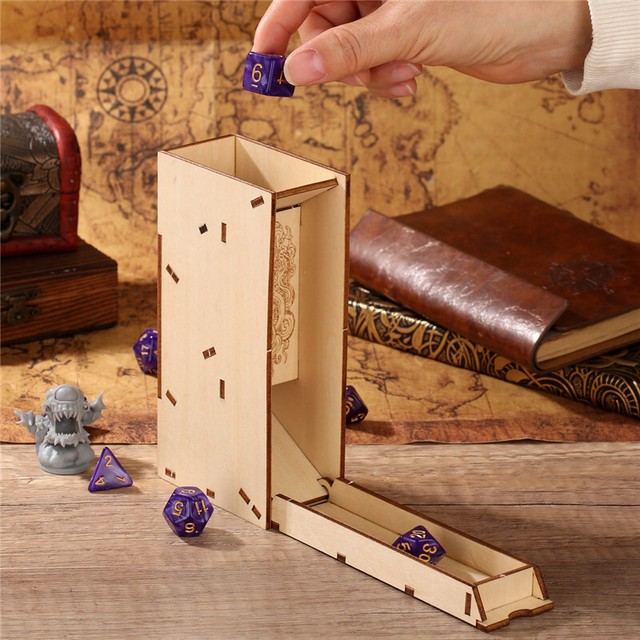
Practical on any version and close to essential on the big ones. Axis & Allies resolves combat with large handfuls of dice, and rolling those across a board covered in carefully placed plastic pieces is exactly as bad an idea as it sounds — a single misthrown handful can cost you the position and a long argument about where things were. A tower with a tray catches everything in one place and randomises properly. Folding ones pack flat into the game box.
- Dice tower with an integrated catch tray
- Handles large handfuls at once
- Folding versions pack flat
- Felt-lined trays for quieter rolling
- Keeps dice off a carefully set-up board
- Randomises better than a hand roll
- Folding versions store in the game box
- Another thing on an already crowded table
- Cheap towers jam with large dice
Buying tips
- The year is the in-game start date, not the publication date. 1942 Second Edition is a newer product than the name suggests, and the 1940 games are the later, larger design despite the lower number. Assuming a higher year means a newer product is the single most common way people buy the wrong box.
- Global 1940 is two boxes, not one. Europe 1940 Second Edition and Pacific 1940 Second Edition are sold separately and combine into the big game. There is no single Global box to buy. Each also plays as a complete game alone, so you can buy one now and the other later without owning anything useless.
- Buy 1942 Second Edition if you are new or returning. It is the version most likely to get played rather than admired — a large board, good components, setup cards, and a scale you can finish in an evening. Starting with Global because it is the biggest is how a group plays once and never again.
- Be honest about your table. The combined Global board is very large and a game runs many hours across multiple sessions, so it needs somewhere it can stay set up for days. If your table has to be cleared for dinner, that is a genuine constraint and 1942 or 1941 is the better purchase.
- Buy storage before you play a big version twice. Global 1940 has an enormous number of small pieces in nine colours and the factory insert does not sort them. Compartmented boxes turn an hour of sorting at each end into a few minutes, and that is often the difference between a game that gets played and one that stays on the shelf.
- Try 1941 if your group has bounced off the series. The usual complaint is that games never finish, and 1941 is deliberately built to end in two or three hours on a smaller board. That is a different target rather than a worse game, and it is the right answer for a family or a group with limited evenings.
- Use a dice tower on any version. Combat is resolved with large handfuls of dice and the board is covered in small plastic pieces that are meaningful where they stand. One misthrown handful costs you the position and a long argument. A folding tower packs into the box and removes the problem entirely.
- Check second-hand copies for completeness before buying. These games have hundreds of small pieces and out-of-print editions in particular turn up missing units, national control markers or the setup cards. Ask the seller for a piece count against the manifest rather than assuming, because a missing nation’s infantry is not something you can easily replace.
As an Amazon Associate and eBay Partner, toptenpick.com earns from qualifying purchases. Prices and availability are subject to change.