

As an Amazon Associate and eBay Partner, toptenpick.com earns from qualifying purchases. Prices and availability are subject to change.
Most listings for a 2 meter beam sell you on gain first, and that is the wrong number to check first. What actually decides whether the antenna works is polarization: FM and repeater contacts run vertically polarized — the same orientation as the rubber duck on a handheld or the whip on a mobile — while SSB and CW weak-signal work runs horizontally polarized. Cross the two and the mismatch costs on the order of 20 dB, enough that a beam with real gain, mounted the wrong way for your mode, can hear less than the plain vertical whip it replaced. Decide FM or SSB before shopping for gain figures.
The second trap is element count. Listings stack up like a horsepower war — more elements reads as more antenna — but the physics that actually sets forward gain is boom length, not the number of elements bolted to it. Documented long-boom Yagi designs make the pattern clear: a 12-element antenna on a 2.85-wavelength boom nets roughly 14.7 dBi, while a 19-element design on a longer 5.6-wavelength boom reaches roughly 17.2 dBi. Gain tracks boom length. A short antenna with extra elements crammed on to hit a bigger number on the box can end up with less gain than a longer, more sparsely spaced design carrying fewer of them.
There is a related unit trap once you are comparing gain figures directly: dBd (referenced to a dipole) reads about 2.15 dB lower than dBi (referenced to a theoretical isotropic point source) for the identical antenna. Cushcraft and M2 publish dBd or dBi consistently and say which; some budget imports advertise a dBi number with no independent measurement behind it. A 9 dBi import and a 9 dBd name-brand beam are not the same antenna — the dBd one is roughly 2 dB hotter. Line up units before ranking spec sheets against each other.
Once polarization and units are sorted, what is left to choose between is genuinely mission-specific: a compact handheld Yagi you rotate by hand to chase polarization shift during a satellite pass, a fixed base-station beam for repeater work or weak-signal SSB DX, a cross-polarized design that runs FM and SSB off separate feedlines on one boom, and dual-band imports that add 70cm coverage at the cost of a wider gap between claimed gain and independently measured gain.
Below are ten real 2m and 2m/70cm Yagis, spanning portable satellite antennas through long-boom DX beams, with the gain units, boom lengths, and power ratings as published by each manufacturer.
| # | Product | Price | Where to buy |
|---|---|---|---|
| 1 | Arrow Antenna 146-3 | $70–$90 | Amazon |
| 2 | M2 Antenna Systems 2M7 | $150–$200 | Amazon · eBay |
| 3 | M2 Antenna Systems 2M9SSBFM | $180–$230 | Amazon · eBay |
| 4 | M2 Antenna Systems 2M12 | $350–$450 | Amazon · eBay |
| 5 | M2 Antenna Systems 2M3SS | $90–$120 | Amazon |
| 6 | Cushcraft A147-11 | $200–$260 | Amazon |
| 7 | Cushcraft A144-20T | $280–$350 | Amazon |
| 8 | Diamond Antenna A144S5 | $90–$120 | Amazon · eBay |
| 9 | Elk Antennas 2M/440L5 | $130–$160 | Amazon |
| 10 | HYS TC-YG08UV Dual-Band Yagi | $40–$60 | Amazon · eBay |
The picks, in detail
Arrow Antenna 146-3
A 3-element handheld Yagi built for satellite and portable work rather than a fixed tower. The boom is 3/4-inch aluminum with Easton arrow-shaft elements spaced 0.2 wavelength apart, a pre-tuned gamma match, and a BNC connector so it pairs straight onto a handheld or a short jumper. Because you hold and rotate it yourself, you can correct for polarization shift as a satellite pass moves overhead — something a fixed base antenna cannot do.
- 3 elements on a 37.5-inch boom
- BNC connector, pre-tuned gamma match
- Power rated under 20W
- SWR 1.2:1 typical
- Lightweight and genuinely portable
- Popular, well-documented choice for satellite and SOTA work
- Hand-rotatable to chase polarization shift
- Low power rating rules out base-station amplifier use
- Modest gain versus a full-size fixed beam
- BNC-only connector needs an adapter for PL-259 gear

M2 Antenna Systems 2M7
A 7-element fixed Yagi rated at 12.3 dBi gain with a 20 dB front-to-back ratio on an 8 ft 10 in boom, 1 inch in diameter. Elements are 6061-T6 solid rod on UV-stabilized polyethylene insulators, and the boom is swaged 6063-T832 aluminum — construction built for a mast that stays up through weather, not a one-season antenna. A mid-size step up from a compact 3- or 4-element beam without the length of a full DX array.
- 7 elements, 12.3 dBi gain
- 20 dB front-to-back ratio
- 8 ft 10 in boom, 1 inch diameter
- 6061-T6 elements, swaged aluminum boom
- Documented, verifiable gain-to-boom-length ratio
- Weather-durable construction
- Manageable size for a mast-mount base antenna
- Fixed horizontal or vertical mount — pick polarization at install
- Needs a rotator for directional use
- Base-station size, not portable

M2 Antenna Systems 2M9SSBFM
A 9-element beam built with two separate element sets tuned for the two different ways 2 meters actually gets used — 10.3 dBd gain on the segment tuned for SSB/CW and 12.0 dBd on the segment tuned for FM, with a 20 to 24 dB front-to-back ratio depending on mode. Rather than compromise gain to cover the whole band with one flat tune, M2 splits the antenna by mode instead of by frequency alone.
- 9 elements, dual SSB/FM element tuning
- 10.3 dBd (SSB) / 12.0 dBd (FM) gain
- 20-24 dB front-to-back ratio
- 8 ft 10 in boom
- Gain optimized per mode instead of a flat compromise
- Same rugged M2 boom and element construction
- Good middle ground between compact and long-boom designs
- Still a single fixed polarization — does not solve FM/SSB cross-polarization on its own
- Needs a rotator
- Pricier than a basic single-tune 9-element

M2 Antenna Systems 2M12
A long-boom 12-element Yagi on a 19 ft 6 in boom delivering close to 15 dBi gain — the length is the point here, not just the element count, since a long boom is what lets each additional director actually contribute instead of crowding the pattern. Aimed at weak-signal DX work where every dB earned by boom length matters.
- 12 elements, ~15 dBi gain
- 19 ft 6 in boom
- 6063-T832 aluminum boom construction
- Machined element-to-boom mounts
- Genuine long-boom gain, not a padded element count
- Serious weak-signal and DX performance
- Durable M2 build quality
- A 19-plus-foot boom needs a real tower and rotator
- Overkill for local repeater or simplex use
- Significant wind load at that length
M2 Antenna Systems 2M3SS
A compact 3-element rear-mount beam — 37-inch boom, 8.3 dBi gain, 20 dB front-to-back ratio, gamma match, SO-239 connector, rated to 500W. Built for repeater and simplex FM work where you want a modest amount of directional gain and front-to-back rejection without the size of a full DX beam.
- 3 elements, 8.3 dBi gain
- 37-inch boom, rear-mount design
- 500W power rating, SO-239 connector
- 20 dB front-to-back ratio
- Small enough for an attic or short mast
- 500W rating covers most amplified FM setups
- Good front-to-back ratio for cutting repeater-direction interference
- Gain is modest compared to longer-boom beams on this list
- Vertical mount only suits FM, not SSB
- Rear-mount bracket needs clearance behind the boom
Cushcraft A147-11
An 11-element Yagi on a 12-foot boom rated at 13.2 dBd gain with a 20 dB front-to-back ratio and an 800W power rating, weighing 6 lbs. Cushcraft’s design keeps vertical elements tuned near 146 MHz and horizontal elements near 144.2 MHz on the same structure, aimed at covering both the FM and SSB portions of the band from one antenna.
- 11 elements, 13.2 dBd gain
- 12-foot boom, 6 lbs
- 20 dB front-to-back ratio
- 800W power rating
- High power handling for an amplified station
- Strong, clearly documented gain figure
- Long-standing, well-reviewed design
- 13.2 dBd converts to roughly 15.3 dBi — check units against competing listings
- 12-foot boom needs a substantial mast and rotator
- Fixed element tune, not switchable polarization
Cushcraft A144-20T
A cross (Twist) Yagi carrying 10 vertically-polarized and 10 horizontally-polarized elements on one boom, each set fed by its own separate coax line, for 11.1 dBi gain. Rather than picking one polarization at install, this design runs FM on the vertical feed and SSB/CW on the horizontal feed from the same antenna — a direct hardware answer to the FM-versus-SSB polarization mismatch described above.
- 10+10 crossed elements, 11.1 dBi gain
- Separate coax feeds per polarization
- 144-148 MHz coverage
- Stainless steel hardware
- Solves FM/SSB polarization mismatch without needing two antennas
- Single mast and rotator serves both modes
- Well-documented Cushcraft build
- Two feedlines to run and manage instead of one
- More complex install than a single-polarization beam
- Costs more than an equivalent single-polarization Yagi
Diamond Antenna A144S5
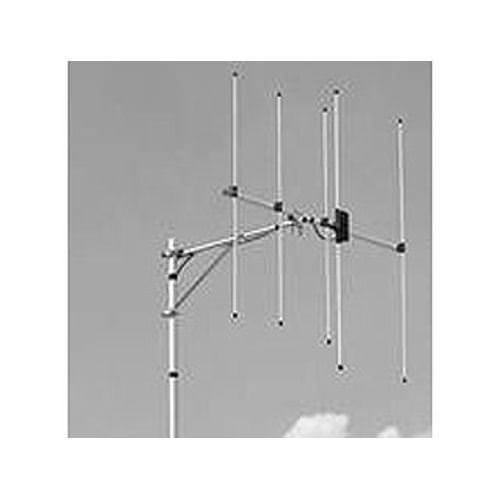
A compact 5-element Yagi rated 9.1 dBi gain on a 0.95-meter boom, factory-adjusted so it needs no tuning on arrival. 50W power rating, N-female connector, front-to-back ratio over 14 dB, and a modular lightweight boom aimed at an easy roof or mast install rather than a competition-grade DX array.
- 5 elements, 9.1 dBi gain
- 0.95m boom, factory pre-tuned
- 50W rating, N-female connector
- Front-to-back ratio greater than 14 dB
- No tuning required out of the box
- Compact and easy to mount
- Lightweight modular boom
- 50W rating limits it to typical mobile or base radios, not a full amplifier
- Modest gain versus the longer-boom options on this list
- Single fixed polarization
Elk Antennas 2M/440L5
A dual-band log-periodic covering both 2m and 70cm on one 24-inch boom without a duplexer — 6.8 dBd (8.9 dBi) gain on 2m and 7 dBd (9 dBi) on 70cm, with over 20 dB front-to-back ratio on both bands. Color-coded threaded elements screw onto the boom for fast field assembly, and twisting the mount changes polarization by hand — a common choice for satellite work where the satellite’s polarization shifts through a pass.
- Dual-band 2m/70cm log-periodic, no duplexer needed
- 6.8 dBd (2m) / 7 dBd (70cm) gain
- 24-inch boom, over 20 dB front-to-back
- Hand-twist polarization change
- One antenna covers both 2m and 70cm satellite uplink and downlink
- Fast, tool-free assembly
- Polarization adjustable by hand mid-pass
- Handheld-scale gain, not a base-station DX antenna
- Log-periodic design trades some peak gain for bandwidth
- Best suited to portable and satellite use, not fixed weak-signal DX
HYS TC-YG08UV Dual-Band Yagi
A budget dual-band 2m/70cm Yagi advertising 9.5 dBi (2m) and 11.5 dBi (70cm) gain, rated to 100W, with a U-bolt mount and cable included. An accessible import option for a repeater or base antenna on a tight budget, though published gain figures on budget imports are manufacturer claims rather than the independently documented numbers Cushcraft, M2, and Diamond publish.
- Dual-band 2m/70cm coverage
- 9.5 dBi / 11.5 dBi claimed gain
- 100W power rating
- U-bolt mount and cable included
- Low price for dual-band coverage
- Cable and mounting hardware included
- Easy U-bolt mast mount
- Claimed gain is not independently verified like the name-brand beams here
- Build quality does not match Cushcraft, M2, or Diamond
- No published front-to-back ratio to judge pattern quality
Buying tips
- Decide FM/repeater (vertical) versus SSB/weak-signal (horizontal) before you buy — mounting a beam sideways from its designed polarization throws away a large share of your signal.
- Compare gain figures in the same units — a spec sheet quoting dBi reads about 2.15 dB higher than the same antenna quoted in dBd, so line up units before comparing brands.
- Longer boom, not more elements, is what buys forward gain — a design with extra elements crammed onto a short boom rarely out-guns a well-spaced antenna with fewer elements on a longer one.
- For satellite and portable work, a short handheld Yagi you rotate by hand is often more useful than a fixed base antenna, since you can correct polarization mismatch as the pass moves overhead.
- Check the connector before ordering coax — some beams ship with BNC for portable use, others with SO-239 or N-type for base stations, and adapters add loss.
- If you want both FM and SSB from one mast, consider a cross or twist Yagi with separate feedlines rather than trying to make a single polarization do both jobs.
- Match the power rating to your radio — several budget import beams are rated well under 100W, which is fine for a handheld or mobile but not for a full legal-limit base amplifier.
- Mount height and clearance above nearby rooflines matters more than an extra dB of gain — sort the site before spending more money chasing elements.
As an Amazon Associate and eBay Partner, toptenpick.com earns from qualifying purchases. Prices and availability are subject to change.