

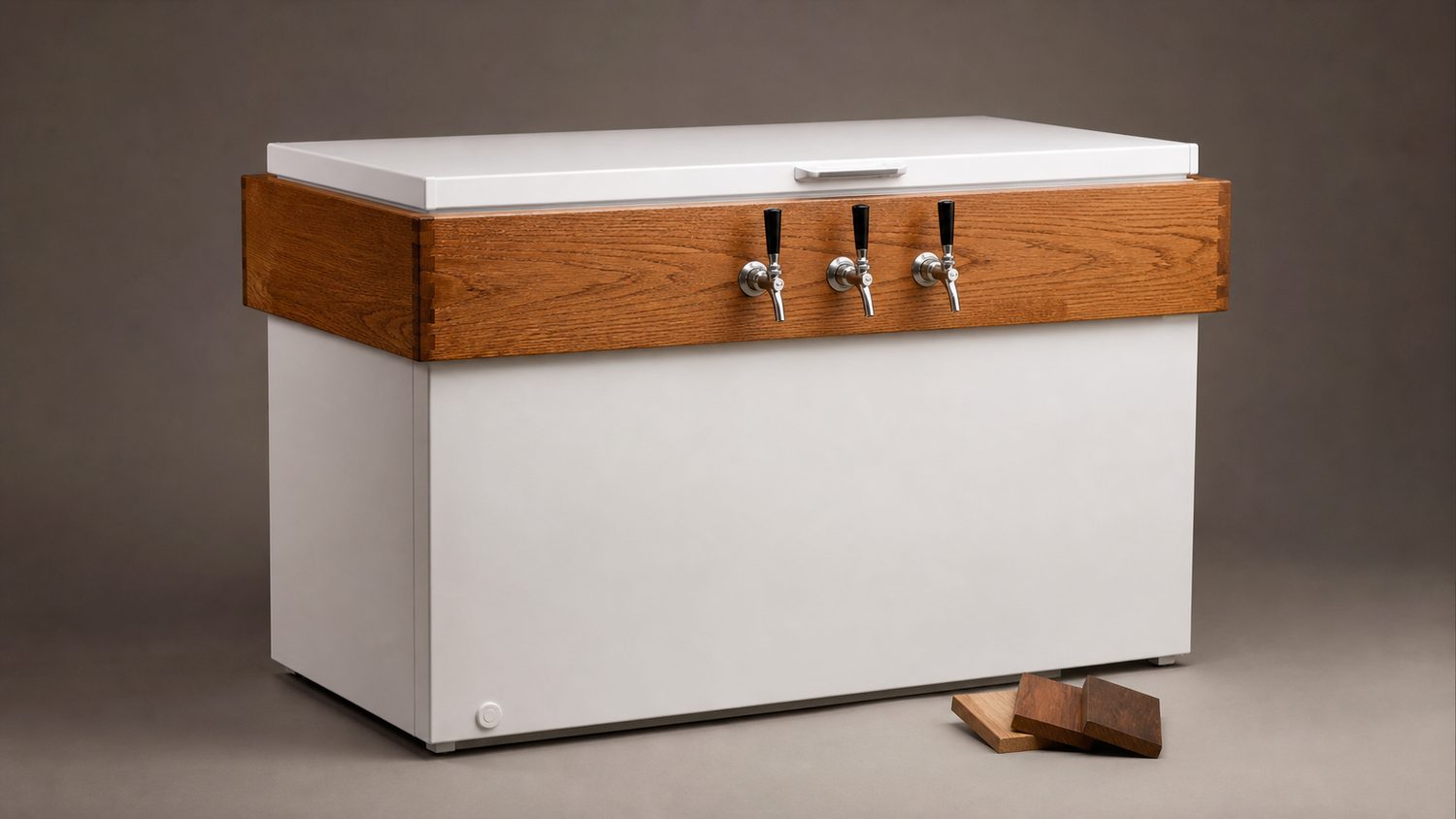
The best wood for a keezer collar is usually a straight, dry solid-wood board or plywood assembly chosen for the collar design, then thoroughly sealed on every face and edge. A keezer collar sits at the boundary between a warm room and a cold freezer, so the real challenge is moisture movement and a reliable air seal. Species matters, but wood choice cannot compensate for exposed end grain, unsealed joints, a loose lid gasket, or a collar that is too heavy for the freezer lid hardware.
For most practical builds, kiln-dried pine or a hardwood-faced exterior plywood box is the sensible starting point. Use a decorative hardwood only if the appearance justifies the cost. Do not select a board because a build thread calls it “waterproof.” Wood is not waterproof, and plywood bond labels describe adhesive durability rather than resistance to mold or decay.
Best all-around choice: straight kiln-dried pine
Pine is easy to source, cut, drill, sand, paint, and stain. A straight kiln-dried pine board is a practical collar frame when it is wide enough for the intended shanks, gas line, and lid attachment. Select boards that are dry, flat, and free of severe knots or twist. A warped board creates gaps that make it harder to seal the freezer and can put uneven stress on the lid.
Pine is not the answer because it ignores condensation. Seal all six faces before installation, including the end grain, drilled holes, shank openings, and cut edges. The interior face deserves the same attention as the visible exterior. A beautiful stained face with raw interior edges is a moisture trap. Use a finish compatible with the intended indoor environment and allow it to cure fully before the collar is exposed to cold service.
Best for a painted collar: exterior-rated plywood
An exterior-rated plywood box can make a stable, paint-friendly collar, especially when the design benefits from a wide flat panel or an insulated cavity. APA explains that Exterior plywood is designed for repeated wetting and drying or long-term weather exposure. It also warns that the common term CDX normally means Exposure 1, which resists temporary construction moisture but is not intended for long-term weather exposure.
A keezer is indoors, not outdoors, but its collar may experience recurring condensation. That makes exterior-rated plywood a more defensible choice than assuming any construction plywood is suitable. It does not make the panel decay proof. APA explicitly distinguishes glue-bond classification from fungal-decay resistance. Seal the faces and particularly the plywood edges, which expose multiple veneers and can absorb moisture if left raw.
Best for a furniture finish: hardwood face over a stable structure
Hardwood can give a keezer a furniture-like exterior, but it is not a requirement for strength or moisture control. Use a stable pine or plywood structure, then add hardwood as a face, trim, or exterior skin if the keezer will be visible in a finished room. This keeps the expensive wood where it is seen and makes repair simpler if a shank location or gas opening changes.
Do not assume every hardwood is inherently suitable for the cold interior. The seal design still matters more. Apply finish to both the front and back of any decorative board so the two faces take up moisture more evenly. Leave enough structural material around tap holes and do not rely on a thin decorative face to carry the weight of faucets and shanks.
Cedar: a specialty option, not a default liner
Cedar heartwood can be naturally decay resistant. The USDA Wood Handbook lists eastern redcedar heartwood as very resistant to decay. That property can make cedar appealing in a damp project, but it does not eliminate the need to seal the collar or manage condensation. It also has a distinct odor and cost, which may be unwanted around beverage lines and a finished interior.
Use cedar only when you want its appearance or documented natural durability and have considered the odor and construction details. It is not necessary for a successful keezer. A well-sealed pine or plywood collar with a sound gasket is usually easier to build and maintain.
Avoid these shortcuts
- Raw MDF or particleboard: they are poor choices where recurring moisture may reach cut edges.
- Unsealed end grain: every cut, screw hole, shank hole, and plywood edge needs finish.
- Assuming CDX means waterproof: Exposure 1 describes limited moisture exposure, not permanent weather service or decay resistance.
- Drilling blindly into the freezer: consult the freezer documentation and avoid refrigeration components, wiring, and unknown lid construction.
- Finishing only the visible face: the interior and joint faces are the ones most likely to see condensation.
Design and finishing matter more than the species
Build the collar so it sits flat and supports the original lid without forcing the hinges. Decide whether it rests on the freezer rim, attaches to the lid, or uses a separate hinge arrangement before cutting material. Use a closed-cell gasket or another appropriate seal between the freezer and collar, then check for air leaks after assembly. A collar that leaks warm humid air will create more condensation regardless of whether it is pine, cedar, or plywood.
Finish the pieces before final assembly when possible. Coat all faces, allow the finish to cure, assemble with suitable fasteners and adhesive, then touch up every joint and hole. Inspect the interior periodically for dampness, staining, loose sealant, or mold. If condensation appears, correct the leak or humidity problem rather than merely adding another coat of finish.
Choose pine for a simple stained or painted build, exterior-rated plywood for a painted box or insulated construction, and hardwood only for visible trim or a furniture finish. The best keezer collar is flat, fully sealed, mechanically sound, and easy to inspect. That matters more than calling any one wood species the universal winner.