

Choose capacity from the work you actually do
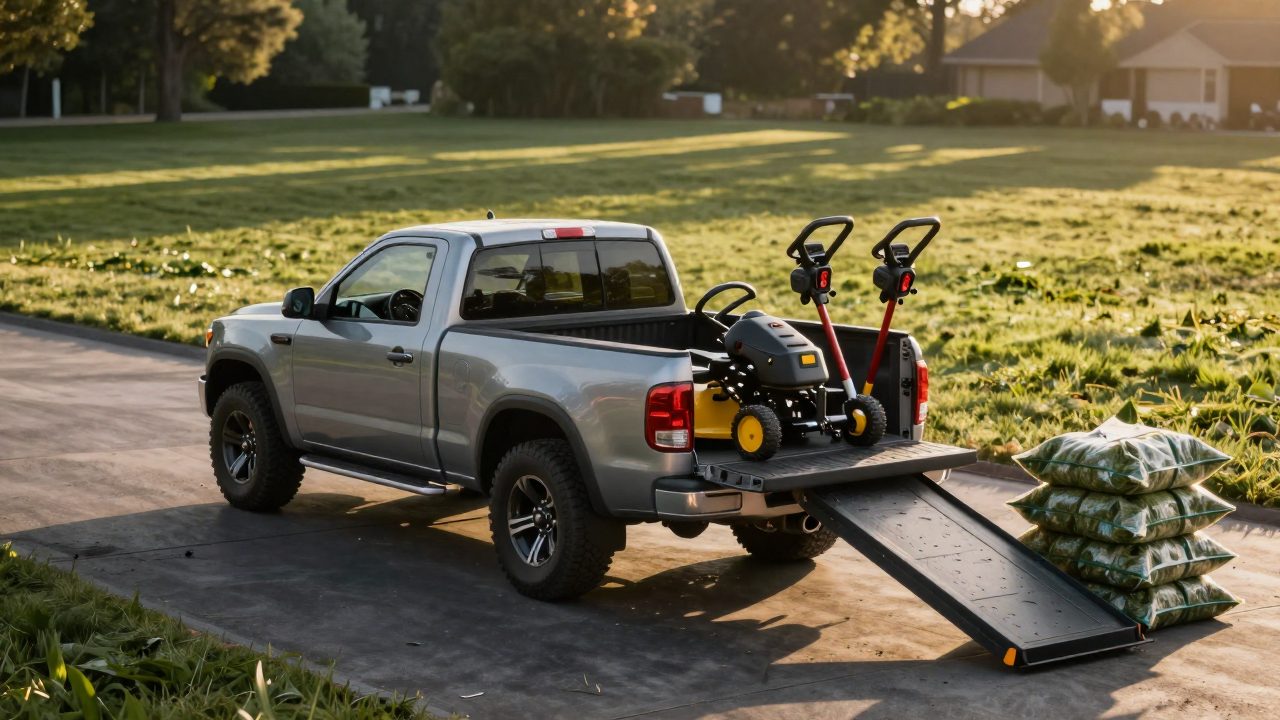
A lawn-care truck is selected from a job list, not from a badge or a social-media build. Start with the heaviest realistic day: crew members, enclosed or open trailer, mower or mowers, fuel, trimmers, blowers, racks, water, hand tools, mulch, debris, and any bed system. Then compare that load with the exact truck’s door-jamb payload label, trailer rating, hitch rating, tyre ratings, and gross-combined limits. Published maximum figures can depend on cab, bed, drivetrain, engine, axle, wheels, and options, so they are not a substitute for the label on the vehicle being considered.
Payload and towing solve different problems
Payload is weight carried by the truck itself: people, cargo, accessories, and trailer tongue weight all count. Towing capacity is the rated ability to pull a trailer under specified conditions. A truck can have an impressive tow number and still run out of payload after a crew, a heavy rack, tools, and the loaded trailer’s tongue weight are added. This is why a scale ticket from a typical workday is more useful than an estimate based on an empty trailer.
Measure trailer tongue weight rather than assuming a percentage. It changes with mower placement, fuel, ramps, debris, and whether equipment is loaded forward or rearward. Too little tongue weight can make a trailer unstable; too much can overload the truck’s rear axle or suspension. Use the trailer manufacturer’s loading guidance, safety chains, correctly rated coupler equipment, working lights, and brakes where required. A trailer brake controller and properly adjusted trailer brakes are safety equipment, not optional decoration.
Bed length, cab size, and parking reality
A longer bed makes room for tools, bagged material, and a rack, while a larger cab carries more people and paperwork. The trade-off is wheelbase, turning circle, purchase cost, and manoeuvrability in tight suburbs. Think through gate access, driveways, cul-de-sacs, storage yard layout, and the places where the truck will sit all day. A crew cab with a short bed can be excellent for people transport but may require a trailer or rack for items a long-bed regular cab could carry internally.
Flatbeds, service bodies, drawers, and rack systems can improve organisation, but every upfit has weight. Calculate it before treating the remaining payload as free capacity. The same applies to tonneau covers, toolboxes, bed liners, auxiliary fuel, spare equipment, and oversized tyres. A clean layout that allows quick daily inspection is generally more valuable than a visually impressive build that hides damaged cords, loose fuel containers, or unsecured tools.
Fuel, maintenance, and downtime
Operating cost is more than the purchase price. Record fuel use, tyre wear, brake service, oil changes, insurance, registration, finance cost, and unplanned repair days. A truck that is oversized for the daily route can consume more fuel and be harder to park; a truck that is undersized may operate at its limit and wear more quickly. Used vehicles can be sensible if their service history, rust condition, towing equipment, brakes, tyres, and fleet records are clear. An inspection by an independent technician is cheaper than discovering a work-stopping fault during peak season.
Match the powertrain to the route. Short, stop-start urban routes, highway travel between properties, steep terrain, and frequent heavy towing create different demands. Do not buy on a claimed fuel-economy figure alone. Keep records from comparable local routes and allow for idling, air-conditioning, seasonal loads, and trailers. The truck that performs best on a brochure test is not automatically the one that costs least per completed property.
Safety and compliance
Secure every mower, trimmer, blower, and container before moving. Use rated tie-down points and straps in good condition; replace damaged webbing rather than knotting it. Separate fuel from ignition sources, follow local transport rules, and keep an appropriate extinguisher and first-aid kit accessible. Check lights, tyres, wheel fasteners, hitch pins, safety chains, breakaway equipment, and ramps at the start of the day. A short walk-around catches many failures before they become a roadside incident.
Commercial use may change insurance, registration, inspection, driver licensing, and tax treatment. Trailer rules can change at municipal, state, provincial, or national boundaries. Keep load, maintenance, and incident records in a form the business can actually use. A proper insurer and a local transport authority are better sources than a generic truck forum for compliance questions.
A sensible purchase process
List the route, crew size, equipment weights, trailer weight, required bed length, storage constraints, and annual budget. Test-drive candidates with visibility, turning, seat comfort, and loading in mind. Compare the exact payload label and towing documentation for each configuration, then price the upfit and insurance before committing. The best lawn-care truck is the one that safely carries the real workload, can be serviced locally, and leaves enough operating margin for a busy day rather than merely looking capable when empty.