

As an Amazon Associate and eBay Partner, toptenpick.com earns from qualifying purchases. Prices and availability are subject to change.
Solar is a charging method, not a movement, and confusing the two is how people end up disappointed. Every watch on this list is a quartz watch: a crystal oscillator, a stepper motor, the same accuracy and the same tick as any other quartz watch. What the solar cell replaces is the coin cell and the trip to a shop every two years. It does not make the watch more accurate, it does not make it mechanical, and it does not make it last forever — it moves the maintenance from a battery you replace to a component you mostly forget about.
That component is the thing worth understanding before you spend. Under the dial is a rechargeable secondary cell — a lithium-ion cell or a capacitor depending on the maker — and it is the actual wear item. It is generally rated for something like ten to twenty years of charge cycles, after which capacity falls and the watch stops holding its reserve overnight. It is replaceable, but it is a service job rather than a battery swap, and on a watch that cost under $100 the service can cost a meaningful fraction of a new one. That is the honest lifetime maths: a decade or two of no maintenance, then a decision.
The power reserve figures need reading carefully too. A quoted six-month or twelve-month reserve is from a full charge, sitting in the dark, usually with the hands still running. Watches that have been in a drawer for a year arrive dead and need real light — not indoor lamplight — to recover, and several hours of it. Indoor light charges these very slowly; a windowsill on a bright day does more in an afternoon than a week at a desk.
Under $100 the field is narrower than it looks. Casio’s Tough Solar line dominates the price bracket and genuinely goes down to well under fifty dollars. Citizen’s Eco-Drive is the other major technology and mostly starts above this budget, though older or simpler models and sale prices bring some of it in range. Seiko’s solar range generally sits above $100. Anything else advertising solar at this price deserves a careful look at whether the movement is from a maker with a service network at all.
One feature genuinely worth paying for in this bracket: radio time sync, sold as Waveceptor or Multiband 6. A watch that sets itself from a time signal and never needs adjusting for daylight saving is the closest thing to a watch you genuinely never touch.
The list runs from the tough everyday options through to dress watches.
| # | Product | Price | Where to buy |
|---|---|---|---|
| 1 | Casio G-Shock GW-M5610 (Tough Solar, Multiband 6) | $90–$130 | Amazon · eBay |
| 2 | Casio Tough Solar Digital (W-S200H / similar) | $35–$60 | Amazon · eBay |
| 3 | Casio Wave Ceptor Analogue Solar | $60–$110 | Amazon · eBay |
| 4 | Casio G-Shock GA-B2100 / GA-2100 Solar Variants | $90–$140 | Amazon · eBay |
| 5 | Citizen Eco-Drive Entry Models | $90–$150 | Amazon · eBay |
| 6 | Casio Pro Trek Solar (PRG series, entry models) | $90–$150 | Amazon · eBay |
| 7 | Casio Tough Solar Analogue Field Watch (MTP-S / AQ-S series) | $35–$70 | Amazon · eBay |
| 8 | Seiko Solar (entry and clearance models) | $90–$160 | Amazon · eBay |
| 9 | Replacement Resin or NATO Strap | $8–$20 | Amazon · eBay |
| 10 | Watch Winder or Charging Stand (skip it) | $30–$120 | Amazon · eBay |
The picks, in detail
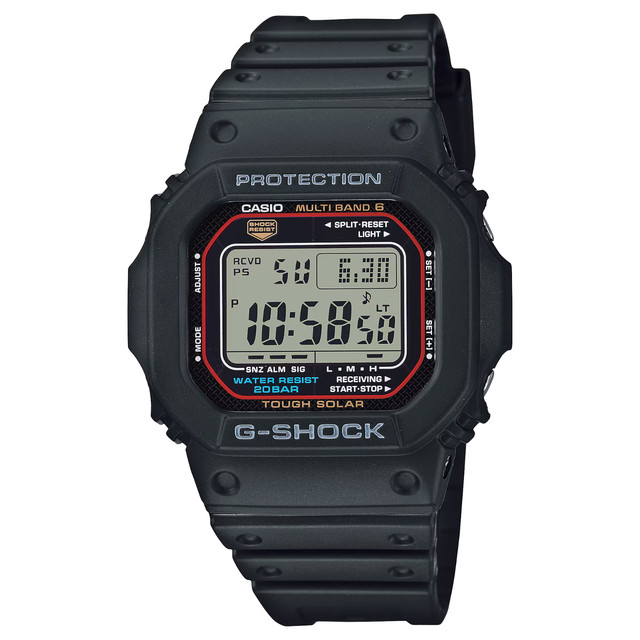
Casio G-Shock GW-M5610 (Tough Solar, Multiband 6)
The square G-Shock in its solar and radio-controlled form, and arguably the most complete watch under a hundred dollars regardless of category. Tough Solar handles the power, Multiband 6 sets the time from a radio signal so it is accurate to the second and handles daylight saving itself, and the case is the original G-Shock shape that has been in production for four decades. Street prices vary — it sometimes sits just above the budget.
- Tough Solar charging
- Multiband 6 radio time sync
- 200 m water resistance
- Resin case, around 47 mm
- Sets itself and charges itself — genuinely maintenance-free
- Legendary durability
- Compact by modern G-Shock standards
- Price drifts above $100 depending on colourway and retailer
- Display is small and unlit without pressing a button
- Resin strap eventually perishes
Casio Tough Solar Digital (W-S200H / similar)
The plainest expression of the technology and the cheapest way into it: a light resin digital watch with a solar cell under the display and a claimed multi-month reserve in the dark. It costs less than most people spend on a phone case, weighs almost nothing, and will run for a decade with no attention at all. Nobody will admire it, and that is not what it is for.
- Tough Solar charging
- 100 m water resistance
- Very light resin case
- Multi-month power reserve in darkness
- Cheapest genuine solar watch from a major maker
- Almost weightless on the wrist
- Utterly reliable
- No radio sync — you set it yourself
- Plain, unmistakably budget appearance
- Small display and fiddly buttons

Casio Wave Ceptor Analogue Solar
The analogue route to the same combination: solar charging plus radio time sync in a conventional dress-ish case with hands rather than a display. This is the watch for someone who wants the never-touch-it convenience without wearing a digital. The hands move themselves to the correct position after a sync, which is quietly impressive the first time you see it happen.
- Solar charging with radio time sync
- Analogue hands with date
- Stainless or resin cases
- 100 m water resistance on most models
- Never needs setting, including for daylight saving
- Conventional analogue appearance
- Wide model range within budget
- Radio sync needs a signal — coverage varies by region
- Hand-setting after a flat battery takes patience
- Model naming is confusing across regions

Casio G-Shock GA-B2100 / GA-2100 Solar Variants
The so-called CasiOak, the shape that made G-Shock fashionable again, in the variants that add solar charging and Bluetooth phone sync. It is thin for a G-Shock, the octagonal bezel works with more outfits than the traditional shape, and the analogue-digital display is clearer than the spec sheet suggests. Solar versions carry a price premium over the plain GA-2100.
- Tough Solar on B-series variants
- Bluetooth time sync via phone
- 200 m water resistance
- Slim octagonal case
- The most wearable G-Shock shape
- Phone sync is easier than radio in poor-coverage regions
- Thin enough for a shirt cuff
- Solar variants sit at the top of this budget or above
- Bluetooth sync needs the app installed
- Hugely counterfeited — buy from a known seller

Citizen Eco-Drive Entry Models
Citizen’s Eco-Drive is the other serious solar technology and it is generally a nicer-looking watch than the Casio equivalent — proper dials, metal cases, dress and field styles. Most of the range starts above this budget, but entry models and sale prices bring some into it. Worth watching for, because an Eco-Drive is the one solar watch in this bracket that looks like a grown-up watch rather than a tool.
- Eco-Drive light-powered movement
- Stainless cases and bracelets on most models
- Typically 50–100 m water resistance
- Long reserve in darkness
- Looks like a conventional quality watch
- Very long service intervals
- Strong dealer and service network
- Most of the range sits above $100
- No radio sync at this price
- Bracelets on entry models are hollow-link

Casio Pro Trek Solar (PRG series, entry models)
For anyone who actually goes outdoors: solar charging plus the sensor set — altimeter, barometer, compass — in a light resin case. The sensors are the point, and the reason solar matters more here than on a dress watch is that sensor use drains a battery fast, which is exactly the situation where a coin cell would leave you stuck. Entry models dip under a hundred on sale.
- Tough Solar charging
- Altimeter, barometer, compass sensors
- 100 m water resistance
- Low-temperature rated on most models
- Sensors are genuinely useful outdoors
- Solar covers the drain that sensors cause
- Light for the amount of function
- Base models only occasionally fall under $100
- Sensors need periodic calibration
- Bulky case on a small wrist
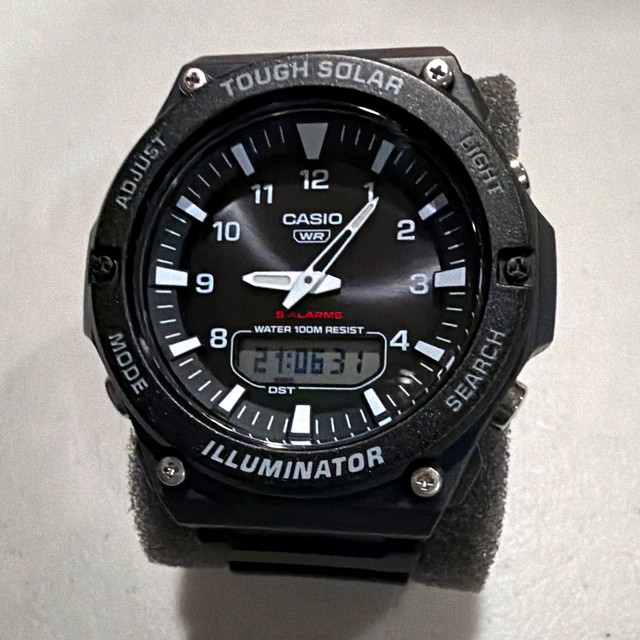
Casio Tough Solar Analogue Field Watch (MTP-S / AQ-S series)
The unglamorous, extremely sensible choice: a simple analogue field-style watch, solar powered, for around thirty to fifty dollars. No radio, no sensors, no app — hands, a date, and a cell that keeps it running indefinitely. This is the watch to buy someone who keeps forgetting to get a battery changed, and it is the best value on the list by a wide margin.
- Tough Solar charging
- Analogue display with date
- 100 m water resistance on most
- Resin or stainless case options
- Remarkably cheap for genuine solar
- Simple enough that nothing goes wrong
- Readable at a glance
- No time sync — set it yourself twice a year
- Budget bracelet and clasp quality
- Lume is weak or absent

Seiko Solar (entry and clearance models)
Seiko’s solar movements sit mostly above this budget, and they are listed here honestly as the thing to watch for on clearance rather than a reliable under-$100 buy. When an entry Seiko Solar does fall into range it is a notably better-finished watch than anything else here — proper dial work, a decent bracelet — and worth jumping on. Check it is the solar model and not the identical-looking quartz.
- Seiko solar movement
- Stainless case and bracelet
- Typically 100 m water resistance
- Conventional dress or diver styling
- Best finishing in this price bracket when discounted
- Looks and feels like a more expensive watch
- Good resale value
- Rarely under $100 outside clearance
- Solar and standard-quartz models look identical — check the reference
- No radio or phone sync

Replacement Resin or NATO Strap
The part of a budget solar watch that fails first is almost never the movement — it is the strap. Resin perishes and cracks at the lugs after a few years of sun and sweat, and a twelve-dollar strap turns a dead-looking watch back into a usable one. A NATO strap is the cheapest fix and fits almost anything with standard spring bars; check the lug width before ordering.
- NATO, resin or silicone options
- Sized by lug width in millimetres
- Spring bars usually included
- Wide colour range
- Revives a watch that only looks worn out
- Costs a fraction of a new watch
- NATO fits almost any standard lug
- Lug width must be measured — guessing wastes the purchase
- Some G-Shock cases need model-specific straps, not NATO
- Cheap spring bars fail and drop the watch

Watch Winder or Charging Stand (skip it)
Named so the money does not go here. Winders exist for automatic mechanical watches and do nothing whatsoever for a solar quartz — there is no rotor to turn. What a solar watch wants when not worn is light, which is free: leave it face-up near a window rather than face-down in a drawer, and it will never go flat. A sunny windowsill is the entire accessory this technology needs.
- Marketed alongside watches generally
- Rotates a watch to wind an automatic movement
- Mains or battery powered
- No function for quartz or solar
- Genuinely useful — for automatic mechanical watches only
- Keeps a collection dust-free
- Some models have decent storage
- Does absolutely nothing for a solar watch
- A windowsill achieves the actual goal for free
- Frequently sold to people who do not need one
Buying tips
- Understand that solar is a charging method, not a movement. These are all quartz watches — the cell replaces the battery, it does not change accuracy or make the watch mechanical.
- Know the real wear item: the rechargeable secondary cell under the dial, usually rated ten to twenty years. It is replaceable, but as a service rather than a battery swap, and on a sub-$100 watch that cost is a real consideration.
- Read power reserve figures as from a full charge in complete darkness. A watch stored in a drawer arrives flat and needs hours of genuine daylight, not lamplight, to recover.
- Pay for radio or phone time sync if you can stretch to it. Never adjusting for daylight saving is what makes these watches genuinely maintenance-free rather than just battery-free.
- Keep it face-up near a window when you are not wearing it. Indoor lighting charges these very slowly and a windowsill does more in an afternoon than a desk does in a week.
- Check whether a Seiko or Citizen model is actually the solar version. The solar and standard-quartz variants frequently share a case and dial, and only the reference number tells you apart.
- Budget for a strap, not a service. The resin or bracelet fails years before the movement does, and a cheap replacement makes a tired watch usable again.
- Do not buy a winder. They are for automatic mechanical watches and do nothing at all for a solar quartz.
As an Amazon Associate and eBay Partner, toptenpick.com earns from qualifying purchases. Prices and availability are subject to change.