

As an Amazon Associate and eBay Partner, toptenpick.com earns from qualifying purchases. Prices and availability are subject to change.
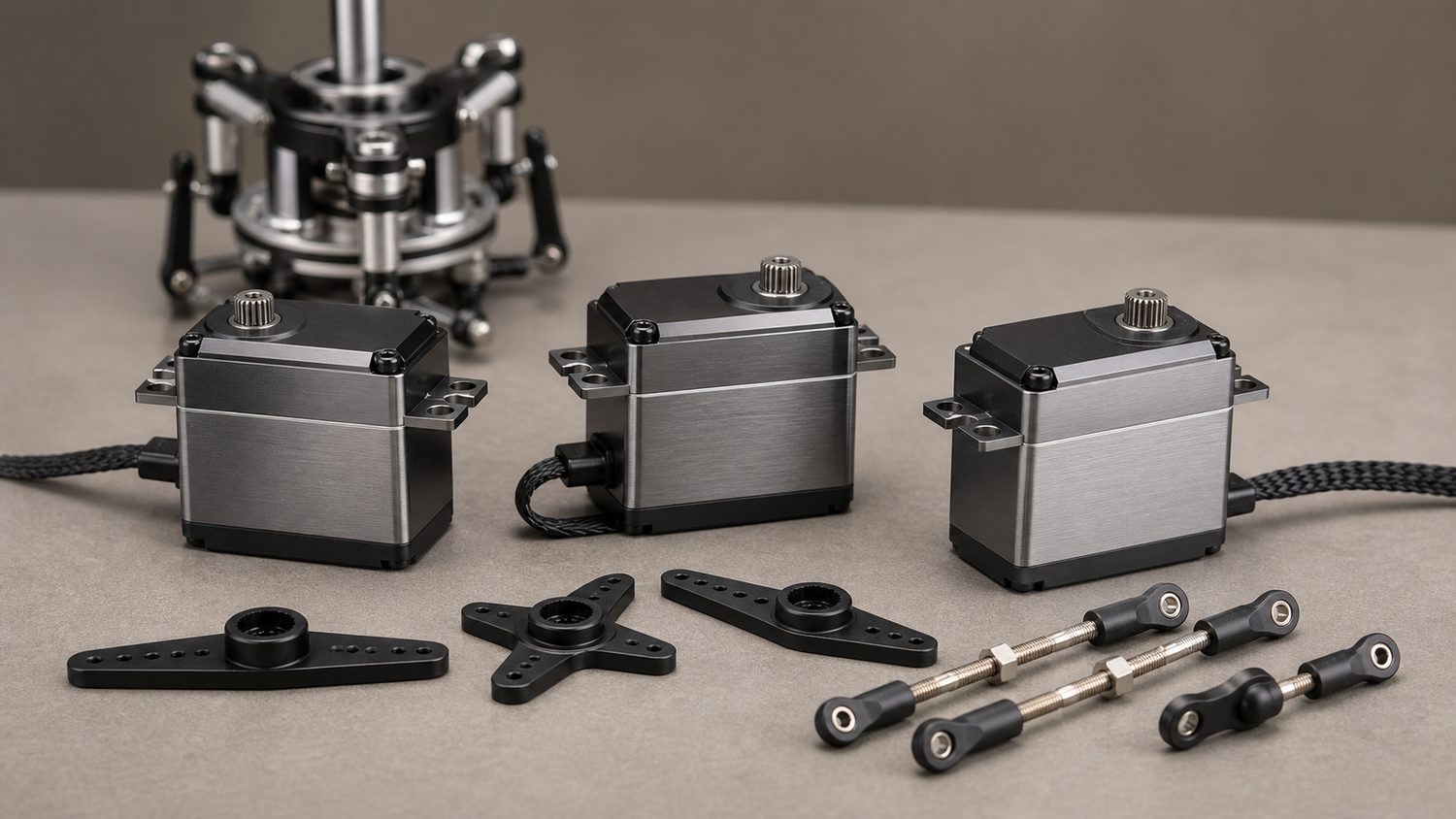
The T-Rex 500’s swashplate is tilted by three separate cyclic servos working together, not one servo per axis — and if those three aren’t matched to each other in speed and centering, the swashplate doesn’t hold still. It dances: a small, constant wobble as the servos fight tiny differences in how fast each one moves and where each one calls center. Pilots who see this on a freshly built or rebuilt heli usually blame a worn bearing, a bent link, or the gyro — when the actual cause is three different servos, or three of the same model from different production runs, responding at slightly different speeds.
That’s the mistake this list is built around avoiding: buying three cyclic servos as three separate decisions, whichever is cheapest each time, rather than as one matched set. The fix isn’t exotic. It’s buying identical servos from the same order — ideally the same batch — and treating the three as a single purchase rather than three unrelated ones.
The tail (rudder) servo is a different animal entirely, and buying a fourth of your cyclic servo for the tail is usually the wrong move. Tail duty is about speed, not torque — the servo has to correct yaw fast enough to counter the tail rotor’s own torque changes as collective pitch shifts, working with your gyro rather than lagging behind it. Treat it as its own spec, not a spare cyclic servo.
Size class matters too. The T-Rex 500’s swash geometry and frame rails are built around mini servos — roughly a 35 × 15 × 29 mm case — not the larger bodies built for 600/700-size helis, and not the true micro servos scaled for 450-class machines, which don’t have the torque for 500-size blades. Check the case dimensions against your specific frame before ordering three of anything.
One more honest note: the original T-Rex 500 is a legacy airframe now. Align’s current 500-class kit is the 500X/500XT, and the plain 500 (500E, 500ESP, 500L) is sold mainly through specialty RC retailers and parts shops rather than mainstream electronics stores. A servo listed as 500-class is usually fine across sub-variants, but it’s worth confirming against your specific swash and frame version before you commit to three of them.
| # | Product | Price | Where to buy |
|---|---|---|---|
| 1 | Align DS530M | $40–$55 | Amazon |
| 2 | Align DS535M | $35–$50 | Amazon · eBay |
| 3 | Align DS520 | $18–$28 | Amazon · eBay |
| 4 | KST DS589MG | $32–$45 | Amazon · eBay |
| 5 | Hitec HS-5245MG | $40–$55 | Amazon · eBay |
| 6 | Futaba S9257 | $35–$50 | Amazon · eBay |
The picks, in detail
Align DS530M
Align’s official high-voltage digital cyclic servo for the T-Rex 500 platform, and the one that ships in current factory combos. Buying three from the same batch is what actually fixes swashplate wobble — matched speed and centering across all three servos, not a heavier gyro or a stiffer linkage.
- Stall torque 6.5 kg·cm at 6.0V, 9.0 kg·cm at 8.4V
- Motion speed 0.085 sec/60° at 6.0V, 0.065 sec/60° at 8.4V
- 35.1 × 15.1 × 29 mm case, 36 g
- Metal gear train, rated 6.0–8.4V (HV)
- Factory-matched feel when three are bought together from one order
- Metal gear train built for repeated collective-pitch loading
- HV voltage headroom for faster response than standard-voltage servos
- Costs more than generic cyclic servos in the same size class
- HV performance only shows up if your receiver or BEC actually supplies 7.4–8.4V
- Buying just one or two rather than a matched trio defeats the point

Align DS535M
Align’s factory-paired tail/rudder partner to the DS530M cyclic servo, spec’d for yaw speed rather than raw torque — the tail rotor has to correct fast as collective pitch changes, working with your gyro instead of lagging behind it. It’s the servo Align ships in 500X combos alongside the DS530M cyclics, not a spare cyclic pressed into tail duty.
- Stall torque 5.0 kg·cm at 6.0V, 6.5 kg·cm at 8.4V
- Same 35.1 × 15.1 × 29 mm case as the DS530M cyclic
- Digital, metal case, rated 6.0–8.4V (HV)
- Factory tail partner in Align’s current 500X combo kits
- Matched pairing with the DS530M cyclic set used in factory combos
- Metal case durability for tail-rotor duty
- Speed-oriented spec suited to yaw correction rather than heavy lifting
- A separate purchase from your three cyclic servos, not a fourth of the same part
- HV rating needs a receiver or regulator that actually supplies the voltage
- Pricier than a basic standard-voltage tail servo

Align DS520
Align’s budget digital servo for 500-class cyclic and tail duty, and still the mini case size the T-Rex 500 needs — the standard-voltage option when you don’t want to pay the DS530M’s HV premium. Three of these bought together make a genuinely matched cyclic set at a fraction of the cost, provided you’re not flying aggressive 3D.
- Stall torque 1.9 kg·cm at 4.8V, 2.5 kg·cm at 6.0V
- 35 × 15 × 29.2 mm case
- Digital, rated for 500-class cyclic or tail use
- Standard voltage, no HV option
- Lowest-cost way to get a genuinely matched trio of cyclic servos
- Correct mini case size for the T-Rex 500 swash and frame
- Doubles as a budget tail servo if you don’t need the DS535M’s speed
- Noticeably less torque than the HV DS530M, more prone to flexing under hard collective inputs
- No HV headroom even if your electronics support it
- Not the choice for aggressive 3D flying

KST DS589MG
A third-party mini digital servo built specifically for 430–570 mm rotor helicopters — the T-Rex 500’s exact size class — with coreless-motor smoothness and HV torque/speed figures that match Align’s own DS530M. It’s the alternative if you’d rather not lock your cyclic set to Align parts, provided you check the slightly deeper case against your frame first.
- Stall torque 6.5 kg·cm at 6.0V, 9.2 kg·cm at 8.4V
- Speed 0.10 sec/60° at 6.0V, 0.08 sec/60° at 8.4V
- 35.5 × 15 × 32.7 mm case, 40 g, coreless motor
- Rated for 430–570 mm rotor helicopters, the T-Rex 500’s size class
- Comparable torque and speed to the official Align HV cyclic servo
- Coreless motor for smooth low-speed response near center
- Not locked to a single airframe brand
- Case is roughly 3.7 mm deeper than the Align DS530M — check clearance before buying three
- Buying loose singles from different sellers risks mismatched production batches
- Less established flight history on the T-Rex 500 specifically than the Align parts
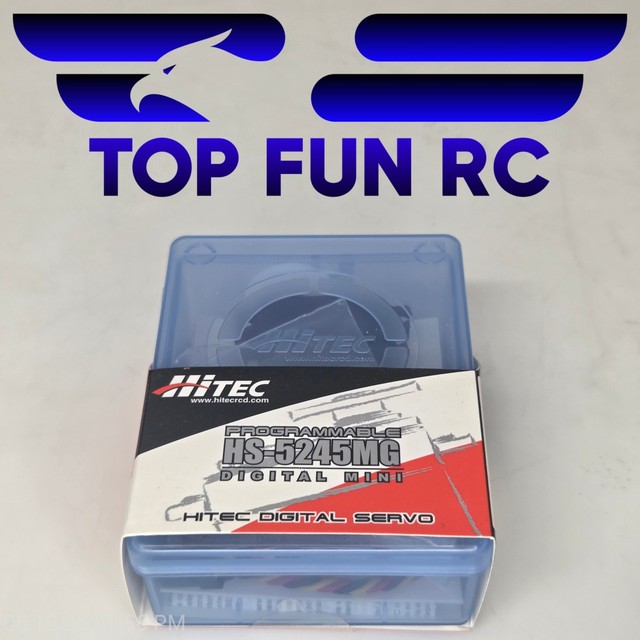
Hitec HS-5245MG
A long-running mini digital metal-gear servo with years of documented use as a 500-class cyclic servo, from a brand most flyers already trust for standard-voltage electronics. It’s slower than the newer HV digital options here, which shows up more in hard 3D flying than gentle sport patterns, but it needs no HV BEC or regulator to run.
- Stall torque 4.4 kg at 4.8V, 5.5 kg at 6.0V
- Speed 0.15 sec/60° at 4.8V, 0.12 sec/60° at 6.0V
- 32.4 × 16.8 × 30.8 mm case, 32 g
- Ball-bearing output, standard voltage (no HV)
- Long, well-documented history as a 500-class CCPM cyclic servo
- Standard voltage means no HV BEC or regulator required
- Ball-bearing output for smoother centering over time
- Noticeably slower than the HV digital servos above
- Torque is on the low side for aggressive collective pitch inputs
- Case dimensions differ slightly from the Align mini standard — double-check frame fit

Futaba S9257
A compact, dedicated tail-rotor servo with a long-standing reputation among T-Rex 500 owners specifically — RC forum consensus repeatedly names it a go-to tail servo for this platform. It’s light, fast for its size, and built with dual ball bearings for a clean output shaft, though it’s a standard-voltage part with no HV option.
- Stall torque 2.0 kgf·cm at 4.8V
- Speed 0.08 sec/60° at 4.8V
- 35.5 × 15 × 28.6 mm case, 26 g
- Dual ball bearings, not rated for 6.0V operation
- Specifically well-regarded among T-Rex 500 owners for tail response
- Light and compact at 26 g
- Dual ball-bearing output shaft
- 4.8V only — no HV option to push speed or torque further
- Modest torque figure, so pair it with a reasonably light tail-rotor grip
- Not a cyclic servo — this is a tail-only pick
Buying tips
- Buy your three cyclic servos as one order from a single batch, not three separate purchases over time — mismatched speed and centering between them is what causes swashplate wobble, not a bad gyro or worn linkage.
- Spec the tail servo separately from your cyclic set — it’s chosen for yaw speed, not torque, since it has to counter the tail rotor’s own torque changes as collective pitch shifts.
- Check a servo’s case dimensions (roughly 35 × 15 × 29 mm for the T-Rex 500’s mini class) against your swash arms and frame rails before ordering three of anything.
- Confirm your receiver or voltage regulator actually outputs 7.4–8.4V before paying extra for an HV-rated servo — without it, the servo just runs at its lower-voltage torque and speed figures.
- Buy through specialty RC retailers or parts shops rather than general electronics stores — the original T-Rex 500 is a legacy airframe now that Align’s current lineup has moved on to the 500X.
- Re-center every new servo with your transmitter’s sub-trim before bolting it to the swashplate linkage, not just by eye at the horn.
- Cycle the sticks through full deflection on the bench after any servo swap and watch for binding or grinding before you ever spin the head.
- Match your servo choice to how you actually fly: HV digital servos like the DS530M earn their price in aggressive 3D, but budget standard-voltage servos are genuinely enough for gentle sport flying.
As an Amazon Associate and eBay Partner, toptenpick.com earns from qualifying purchases. Prices and availability are subject to change.